



Silex is a free, open source website builders project written in TypeScript and released under AGPL-3.0. It has 2,973 GitHub stars, 678 forks and 70 open issues, and was last pushed 35 hours ago. On this registry it ranks #4 of 9 tracked projects in Website Builders, with 5 head-to-head comparisons available. It gained 9 stars over the last 6 tracked days.

What is Silex?

Silex is a free, open-source visual website builder that lets designers, agencies, and no-code developers build static sites by drag and drop and export clean HTML and CSS they can host anywhere.

What it is

Silex is a visual website builder written in TypeScript and released under the AGPL-3.0 licence. It runs as an online tool, as a self-hosted server, and as a desktop application in alpha, and it is maintained by Silex Labs, a non-profit recognised as being of general interest with no investors and transparent finances published on Open Collective. The editor is built on GrapesJS and pairs drag-and-drop page building with direct HTML, CSS, and JavaScript editors, an 11ty-compatible template pipeline, and a plugin system for extending both server and client behaviour in JavaScript or TypeScript. It sits in the JAMstack and no-code ecosystems, with a public repository at roughly 2,973 stars, 678 forks, and 70 open issues.

The concrete problem it solves is vendor lock-in in the no-code and visual builder market. Most competing tools store pages in proprietary formats, force hosting onto their own platform, and charge a subscription, so leaving means rebuilding. Silex produces standard static HTML and CSS as its output, which means every page it generates can be exported in full, hosted on any static host, and abandoned at any time without losing the work. The knowledge it teaches, HTML, CSS, and JAMstack practice, transfers directly to hand-written web development rather than to one vendor's interface.

Key capabilities

  • GrapesJS-based visual editor with drag-and-drop page building alongside HTML, CSS, and JavaScript editors.
  • Static HTML output, so generated sites are fast and can be hosted anywhere.
  • CMS integration that binds components to WordPress, Strapi, Squidex, or any GraphQL API.
  • 11ty compatibility, generating static sites from Silex templates for deployment through CI/CD.
  • Desktop app for Windows, macOS, and Linux, built with Tauri, working offline with no account and including a built-in MCP server for AI and vibe-coding workflows.
  • Plugin system that extends the application with server and client plugins written in JavaScript or TypeScript.
  • SEO tooling covering meta tags, Open Graph, and per-page settings.
  • Self-hosting through Docker, Node.js, or one-click deployment on CapRover.

Who uses it and how

  • Web agencies use the visual workflow and static output to take on more client work without scaling the team.
  • WordPress developers keep WordPress for content and replace the theme layer by pulling content through GraphQL into Silex-built frontends.
  • Freelance webdesigners build client sites without writing code, then export standard HTML and host it on any provider the client prefers.
  • No-code developers move past Wix and Squarespace limits by getting full CSS control with no vendor lock-in.
  • Designers who want to work offline, or who want AI-assisted page generation through the bundled MCP server, use the alpha desktop app instead of the hosted editor.

Getting started

The hosted editor is available at v3.silex.me and is free, though it requires a GitLab account for storage. The desktop app can be downloaded for Windows, macOS, or Linux, and self-hosting is done with Docker, Node.js, or one-click CapRover deployment, with local development running pnpm install && pnpm build && pnpm start and opening http://localhost:6805.

How it compares

Against Webflow, Wix, and Squarespace, Silex differs on licence, hosting, data ownership, and cost model. Those products are proprietary and include subscriptions with premium tiers, while Silex is AGPL-licensed, includes all features with no premium tier, and is described by its project as the only open source alternative to Webflow. Silex also allows self-hosting and full export of a site in standard HTML and CSS, so the user keeps the data and can leave at any time.

When to use it — and when not to

A self-hoster must run and maintain a Node.js or Docker deployment themselves, and anyone using the hosted editor must hold a GitLab account for storage because storage is tied to GitLab rather than handled internally. Teams that want a fully managed service with no server operations, or that depend on a mature desktop client, should not pick it yet, since the desktop app is explicitly labelled alpha. The README also defers production and Docker setup to the external self-hosting guide rather than documenting them inline, so expect to leave the repository for deployment detail.

project readme (upstream, from github) — read inline

Stars Issues License Good first issues

Silex — the visual builder for static sites

The web belongs to everyone. Silex is a free/libre visual website builder — no lock-in, no subscription, no tracking. Design visually, export clean HTML/CSS, host anywhere.

Try Silex online | Documentation | Download the desktop app | Manifesto
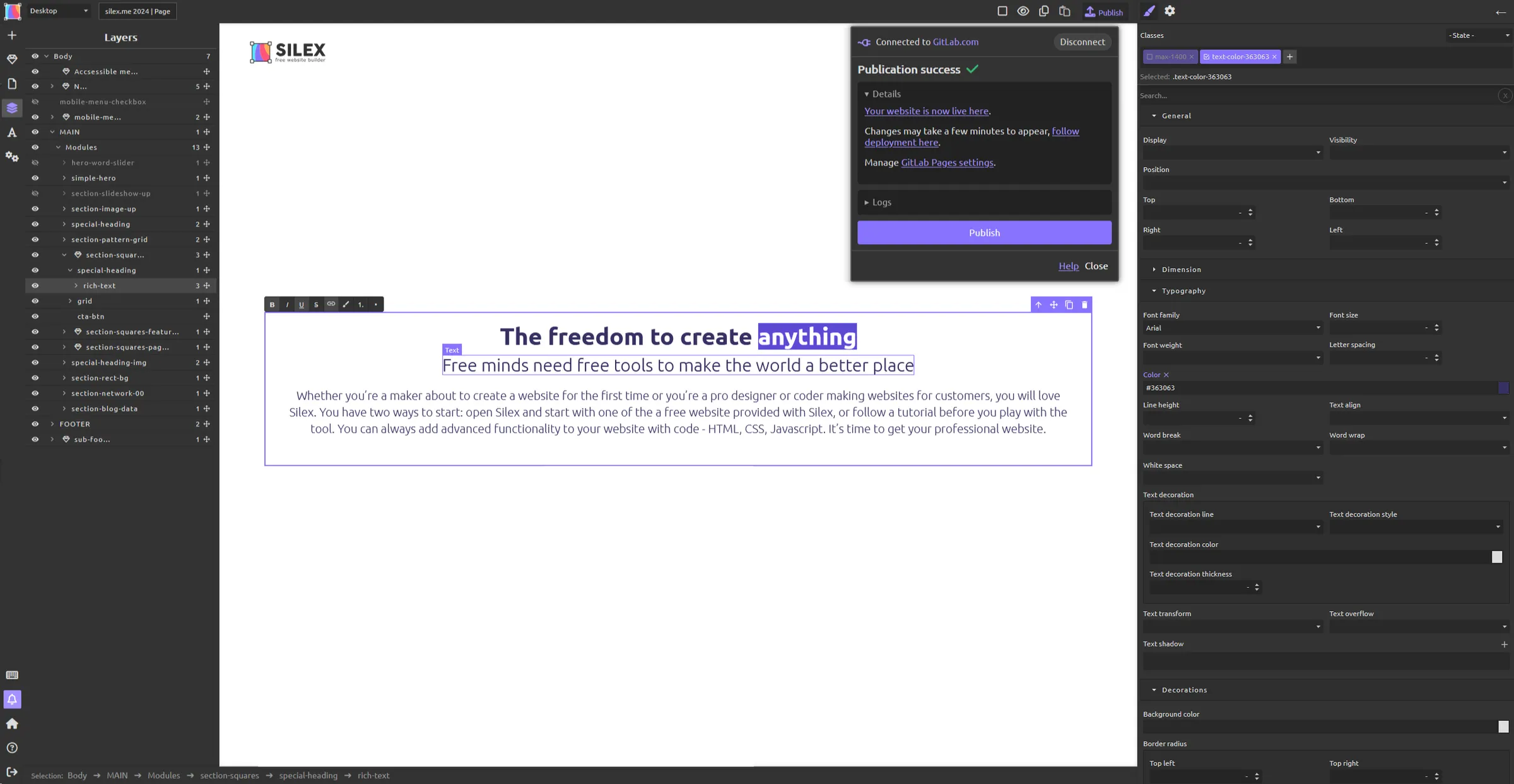
Silex UI

Why Silex?

Most no-code tools lock you in: proprietary formats, forced hosting, subscriptions. Silex is different.

  • Your data is yours — standard HTML/CSS output, export everything, host anywhere, leave anytime
  • Real web skills — everything you learn in Silex (HTML, CSS, JAMstack) is transferable knowledge
  • Community-owned — maintained by Silex Labs, a non-profit recognized as being of general interest. No investors, no exit strategy, transparent finances
  • Free forever — always free software (AGPL), all features included, no premium tier

"The only open source alternative to Webflow.""The most powerful and graphically precise website builder that I have experienced."

Who is Silex for?

  • Web agencies — visual workflow, static output, scale client work without scaling your team
  • WordPress developers — visual frontend, content from WP via GraphQL, ditch the theme layer
  • Freelance webdesigners — create client sites without code, export standard HTML, host anywhere
  • No-code developers — go beyond Wix/Squarespace with full CSS control and no vendor lock-in

Features

  • GrapesJS-based visual editor — drag-and-drop page building with HTML, CSS, and JS editors
  • Static HTML output — fast, secure, easy to host anywhere
  • CMS integration — bind components to WordPress, Strapi, Squidex, or any GraphQL API
  • 11ty compatible — generate static sites from Silex templates, deploy with CI/CD
  • Desktop app (alpha) — work offline, no account needed, AI-ready with built-in MCP server. Built with Tauri for Windows, macOS, Linux. Download it or follow progress.
  • Plugin system — extend with server and client plugins in JS/TS
  • SEO tools — meta tags, Open Graph, per-page settings
  • Self-hosting — Docker, Node.js, or one-click deploy on CapRover

Quick start

Use it onlinev3.silex.me (free, requires a GitLab account for storage)

Desktop app (alpha)download for Windows, macOS or Linux. Work offline, no account needed.

Contribute

git clone --recurse-submodules https://github.com/silexlabs/Silex.git
cd Silex
pnpm install && pnpm build && pnpm start

Then open http://localhost:6805. For Docker and production setups, see the self-hosting guide.

Useful links to get you contributing fast:

AI / Vibe coding

Design websites with AI — open, local, yours. Learn more

The upcoming Silex Desktop app will let you create and transform sites through prompts: describe what you want, see it built live, refine the design in real time, publish clean HTML/CSS anywhere.

Silex uses MCP (Model Context Protocol), an open standard — so you choose your AI. Run a local model with Ollama for full privacy, or use any MCP-compatible tool: OpenCode, Goose, Claude Code, etc. The MCP server is optimized for small local models (7B+).

See the vibe coding roadmap for what's coming (prompt library, examples cookbook, best practices guide — contributions welcome).

MCP setup (for developers)

Once Silex Desktop is running, connect your AI tool to:

http://localhost:6807/mcp

OpenCode — add an MCP server in your config file with URL http://localhost:6807/mcp.

Goose — add a remote server in your profile config with endpoint http://localhost:6807/mcp.

Claude Codeclaude mcp add --transport http silex http://localhost:6807/mcp

Any other MCP client — use a Streamable HTTP transport pointed at the same URL.

Contributors

Silex is the work of contributors from all over the world. This project is maintained by Alex Hoyau and owned by the non-profit Silex Labs

2026Alex Hoyau, Aysajan Eziz, JE4NVRG, KozakLordOfMatrix, pupuking723, Ola Mohamed, Syed Ishmum Ahnaf, Wassim Triki

2025Alex Hoyau, Mazen Kamal, Piotr Golebiewski, ioleo, oliviermgx

2024Alex Hoyau, oliviermgx, JeremyZXi, SuperDelphi

2023Alex Hoyau, Eskeminha, Ari Karageorgos

2022Alex Hoyau, Khaled Bentoumi

2021Alex Hoyau

2020Alex Hoyau

2019Alex Hoyau

2018Alex Hoyau, Jean-Baptiste Richardet, jotakar, swakarm

2017Alex Hoyau, Jean-Baptiste Richardet, Jenn Parker, Rapenne Solène, tariqbenezza, singchan

2016Alex Hoyau, singchan, Pierre Ozoux

2015Alex Hoyau, singchan, Christophe, Pierre Ozoux, René Föhring, christian-bromann

2014Alex Hoyau, Camille Gérard-Hirne, neocorp64, Michele Martone, peoslaap

2013Alex Hoyau, Yann Le Scouarnec, TheCause, yanhick, Alexandre Hoyau, Thomas Fetiveau

The list above is generated from the git history of this repository, so it only covers code. Silex owes just as much to people whose work lives elsewhere:

readme truncated — read the full docs on github

Frequently asked questions

Is Silex free to use?

Silex is open source under the AGPL-3.0 licence. There is no licence fee and no seat count — you can self-host it or, where the project offers one, pay a vendor for a managed version instead.

What does Silex do?

Free, open-source visual website builder for designers

What is Silex written in?

Silex is primarily written in TypeScript. Its source is publicly available at https://github.com/silexlabs/silex, and it has 2,973 GitHub stars.