SideX
VSCode's workbench, without Electron.




Why · What's Working · AI Agent · Getting Started · How It's Built · Contributing · Discord
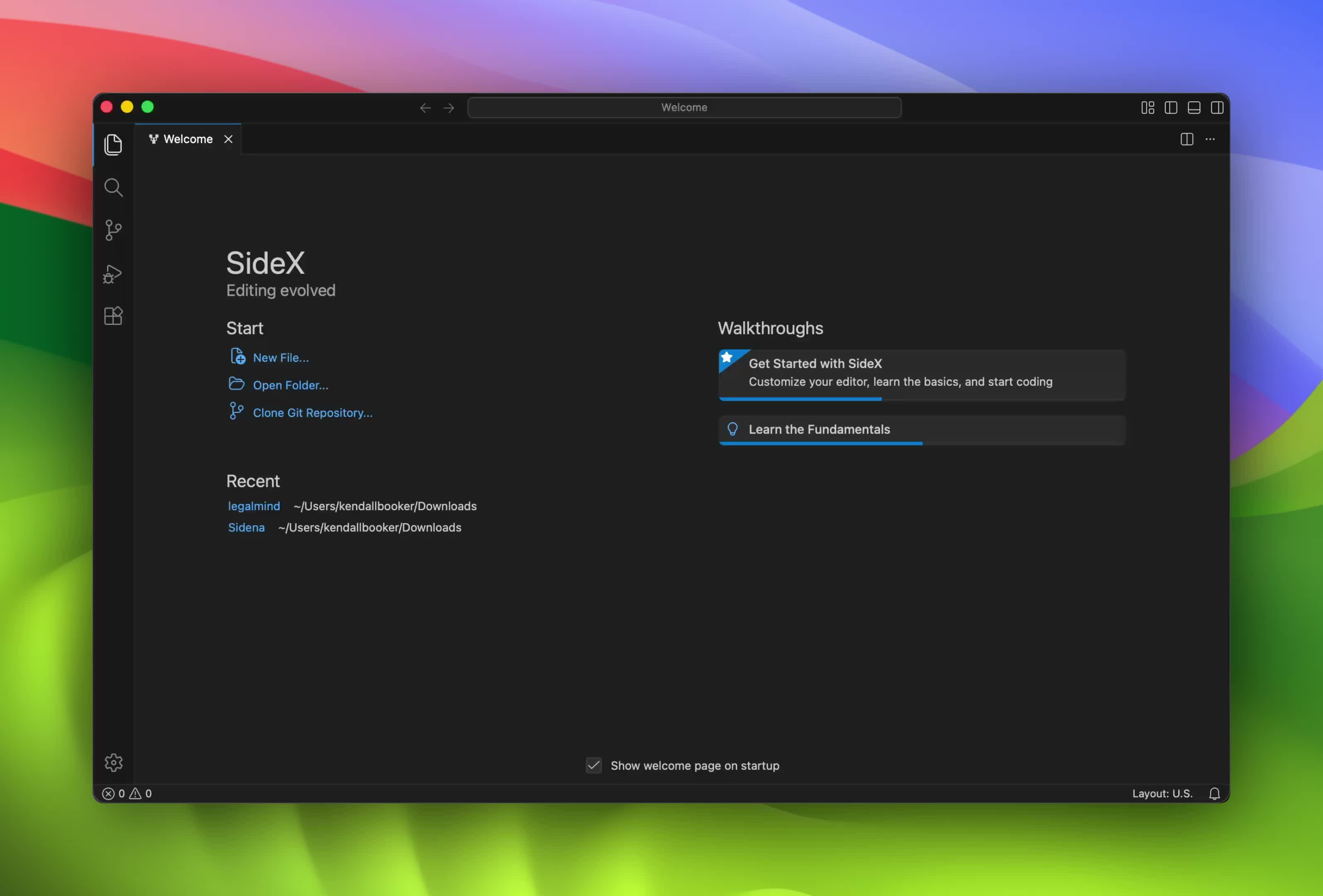
SideX is a port of Visual Studio Code that replaces Electron with Tauri — a Rust backend and OS's native webview. The same TypeScript workbench, the same editor, terminal, and Git integration, running without a bundled browser.
Early release. Core editing and the terminal are solid. The extension host and debugger are still in progress. See What's Working for the full picture.
Why
VSCode's memory useage is almost entirely from its bundled Chromium, not the editor itself. Tauri replaces that with the webview already on your system — WKWebView on macOS, WebView2 on Windows — shared across apps and costing almost nothing extra.
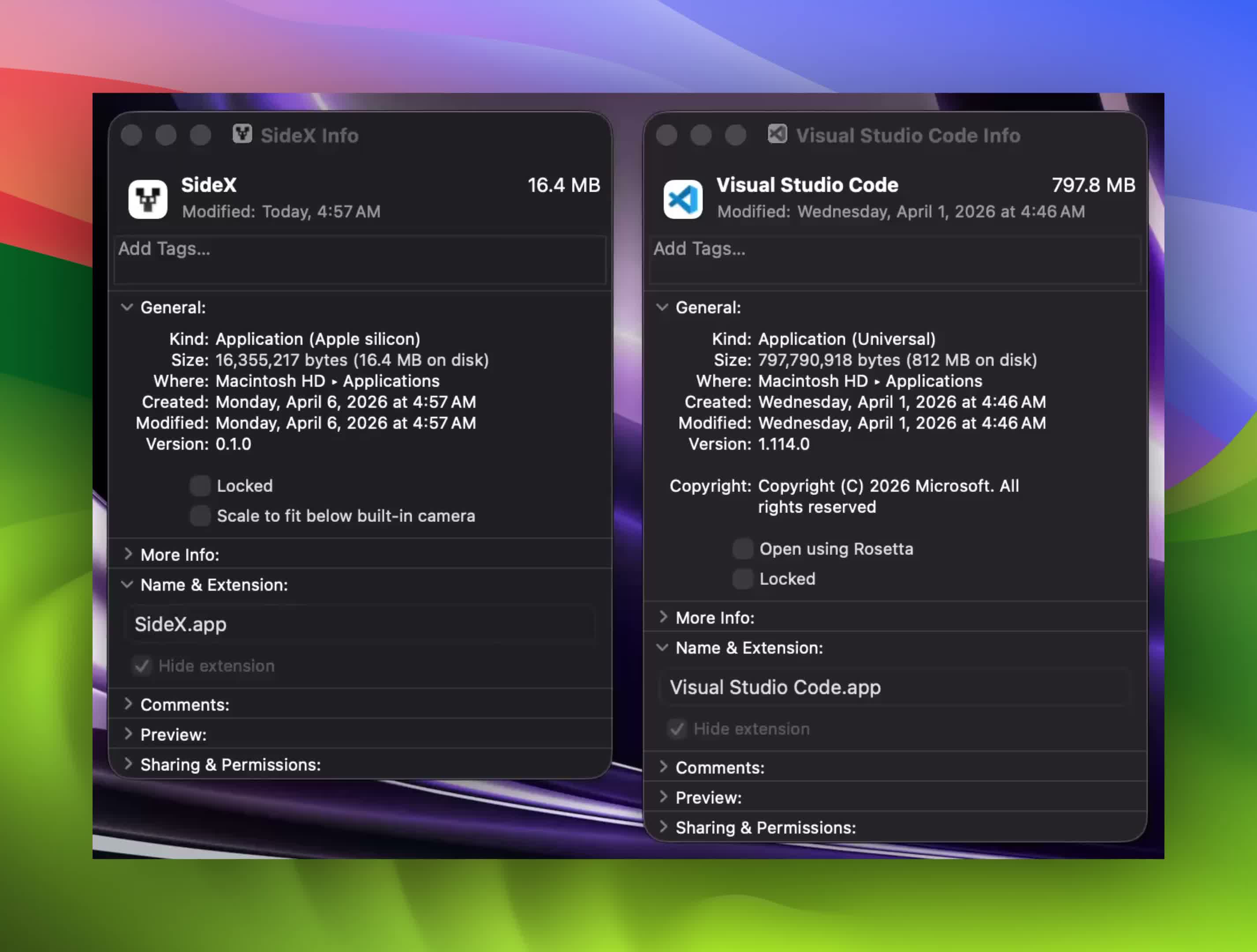
RAM savings are most tested on macOS, WKWebView is shared with Safari. On Windows the picture is more nuanced — WebView2 memory can look higher depending on how it's measured, and it's an active area in the Tauri ecosystem. The target is under 200 MB at idle on macOS. We'll publish real benchmarks once the app is stable enough for them to be meaningful.
What's Working
Solid:
- Monaco editor with syntax highlighting and basic IntelliSense
- File explorer — open folders, create, rename, delete
- Integrated terminal — full PTY via Rust, shell detection, resize, signals
- Git — status, diff, log, stage, commit, branch, push/pull/fetch, stash, reset
- Themes — multiple built-in themes from the VSCode catalogue
- Native OS menus (macOS, Windows, Linux)
- Extension installation from Open VSX
- File watching, file search, full-text search, Rust-backed search index
- SQLite storage, document management (autosave, undo/redo, encoding)
- Built-in AI agent — chat, inline diffs, shell commands, multi-file edits; bring your own model provider, no account needed (see AI Agent)
AI Agent
SideX has a built-in coding agent, and it needs no SideX account of any kind — no sign-in, no identity provider, no hosted service in the path. Every request goes from the editor to a server running on your own machine, and from there straight to whichever model provider you point it at.
How it starts
On launch, the app spawns its own agent server (sidexai/sidex-server, written in Go) as a child process bound to 127.0.0.1 on a random free port. It's supervised from src-tauri/src/server.rs and stopped when the app exits. If the server binary isn't built, the rest of the editor still works — the chat panel just reports itself as disconnected.
Bring your own model
There are no built-in model presets. You add a provider and a model ID yourself in Settings → Models. Credentials are resolved in this order, first match wins (see src-tauri/src/commands/providers.rs):
- a key entered in Settings → Models
- an environment variable already in your shell (
ANTHROPIC_API_KEY,OPENAI_API_KEY, and so on — see.env.examplefor the full list) - an existing Claude Code or Codex CLI login on your machine, opt-in per provider
- a keyless local model server on loopback — Ollama, LM Studio, llama.cpp, or vLLM — detected automatically
Anthropic is called through its native Messages API (/v1/messages); every other provider, including local servers, is treated as OpenAI-compatible (/chat/completions).
Credentials reach the agent server only through its process environment (SIDEX_PROVIDER__KEY / _BASE_URL / _AUTH), set fresh each time the app starts or restarts it. They're never written to a config file and never sent to the webview.
Claude Code / Codex CLI logins are optional, per provider, and off by default. SideX talks to Anthropic and ChatGPT with the same first-party client identity those CLIs use, so a connected login can run models. Usage still counts against that subscription. A billed API key in Settings → Models is the path that does not depend on a CLI login or the provider's consumer terms.
Security: this server runs commands on your machine
The agent server executes shell commands and edits files on your behalf — that's what lets it act as an agent. Binding it to 127.0.0.1 only is a deliberate security boundary, not an accident: nothing else on your network can reach it.
SIDEX_BIND_ADDR can widen that if you need to, but the server refuses to start on a non-loopback address unless you explicitly opt in with SIDEX_ALLOW_UNAUTHENTICATED=1. Don't set that unless you understand the exposure and have your own authentication sitting in front of it — an open port on this server means arbitrary code execution for whoever can reach it.
Building the agent server
The agent server needs Go 1.26 or later to build (see sidexai/sidex-server/go.mod):
cd sidexai/sidex-server
go build -tags fts5 -o sidex-server ./cmd/server
The app looks for a binary at that path automatically when running from a source checkout. Without it, everything except the chat panel works normally. See sidexai/sidex-server/.env.example if you'd rather run the server yourself instead of letting the app manage it.
Getting Started
Run in Development
git clone https://github.com/Sidenai/sidex.git
cd sidex
npm install
npm run tauri dev
Build from Source
npm install
npx tauri build
npx tauri build runs the frontend build for you (npm run build), which already raises Vite's Node heap limit to 12 GB internally — no NODE_OPTIONS needed on a normal machine. If you still hit an out-of-memory error, raise it further yourself with NODE_OPTI before the command.
First build takes 5–10 minutes (Rust compile time). Pre-built binaries are not distributed yet.
Everything above runs standalone, with no account and no setup. Want the chat panel connected too? See AI Agent above — building the agent server is a separate, optional step.
How It's Built
SideX maps VSCode's Electron architecture onto Tauri layer by layer:
| VSCode (Electron) | SideX (Tauri) |
|---|---|
| Electron main process | Tauri Rust backend |
BrowserWindow |
WebviewWindow |
ipcMain / ipcRenderer |
invoke() + Tauri events |
Node.js fs, pty, etc. |
Rust commands (std::fs, portable-pty) |
| Menu / Dialog / Clipboard | Tauri plugins |
| Renderer (DOM + TypeScript) | Same — runs in native webview |
| Extension host | Sidecar process (in progress) |
The TypeScript frontend is a direct port of VSCode's workbench. The Rust backend is in src-tauri/src/commands/ and handles everything that would have been a Node.js native module: file I/O, terminal PTY, Git, file watching, search indexing, SQLite, and process management.