「电商问数」智能数据分析 Agent
shopkeeper-agent
可能是全网最适合用于系统学习 LangGraph 的智能问数实战项目,配套系统性文字教程与对应章节分支,带你打通混合检索、多阶段推理、SQL 生成与执行全链路



快速开始 • 项目亮点 • 系统架构 • 配套教程 • 加入社群
📢 说明:本套实战项目已更新完成,配套教程、章节分支和前后端代码均可对照学习。
如果你正在找一个适合学习 LangGraph、Qdrant、MySQL、FastAPI 和 AI Agent 工程开发的实战项目,「电商问数」很可能是最适合你的项目。
它不是只调用一次大模型接口,也不是写几个 Prompt 演示 SQL 生成结果。这个项目围绕电商数仓问数场景,先构建元数据知识库,再做字段、指标、字段取值的混合检索,随后用 LangGraph 编排多阶段问数流程,完成 SQL 生成、校验、修正、执行和前端流式展示。换句话说,你学到的不是某一个框架 API,而是一条 AI 应用从数据准备、检索增强、智能体编排、接口交付到前端联调的完整项目主线。
本套仓库是 ai-agents-from-zero 教程体系中的 实战项目-电商问数 配套源码仓库,除了可直接运行和二次开发的项目代码之外,也提供了与教程章节对应的 Git 分支演进过程,以及完整的在线图文讲义入口。 如果你想系统学习「AI智能体 大模型应用开发」,也可直接从系统教程 AI 智能体实战速成指南-大模型入门 开始。
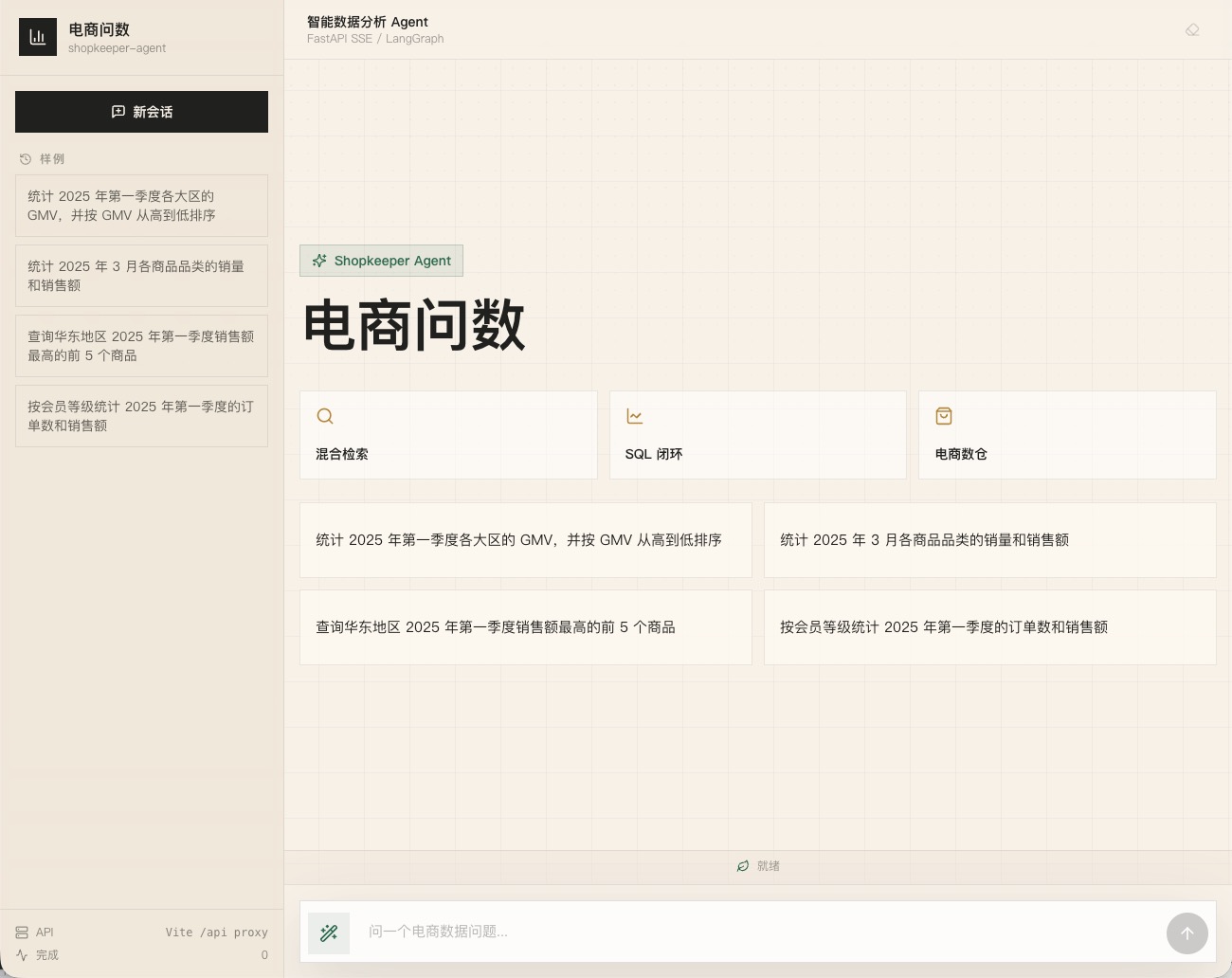
📖 项目介绍
在真实问数场景里,业务同学通常不会写 SQL,数据分析同学也很难随时记住所有表结构、字段含义、指标口径和字段取值。单纯把自然语言问题直接交给大模型,很容易出现表选错、字段选错、指标理解错和 SQL 幻觉等问题。
电商问数 要解决的就是这个问题:
- 用户用自然语言提问
- 系统自动召回相关字段、指标和字段取值
- 大模型基于上下文进行分步推理
- 生成 SQL 并查询数据仓库
- 以流式方式返回分析结果
✨ 项目亮点
- 检索 + 推理 + 生成,而不是模型直出 SQL
- 先围绕问题召回相关字段、指标和值域,再组织上下文生成 SQL,整体链路更稳、更可控。
- 面向企业问数场景的混合检索
Qdrant负责字段和指标的语义召回。Elasticsearch负责字段取值的全文检索。MySQL负责保存完整、权威的结构化元数据。
- 支持字段、指标、取值三类信息协同召回
- 比单纯做表级或字段级检索更贴近真实企业分析流程。
- 从检索到执行的完整可运行链路
- 不停留在 Prompt 设计,而是会真实生成 SQL、执行查询,并以流式方式返回结果。
- 工程化后端结构清晰
- 基于
FastAPI + LangGraph + Repository + Client Manager组织配置、客户端、仓储层、服务层与智能体流程,便于维护和扩展。
- 基于
- 不仅有实战代码,还有完整配套教程文档
- 项目配有一套系统化、持续更新、完全免费的教程讲义,适合按章节从数仓基础、元数据知识库到问数智能体流程逐步学习。
- 兼顾学习价值与可扩展性
- 既可以按教程章节逐步理解,也可以在此基础上继续扩展权限控制、SQL 审核、结果可视化等能力。
这套课程十分适合这些场景:
- 想系统学习
LangGraph,但不想只停留在几个玩具节点。 - 想把
MySQL、Qdrant、Elasticsearch和大模型放到同一个业务场景里理解。 - 想做一个比简单模型调用更接近实际开发的 AI Agent 项目。
- 想把项目写进简历,并且能说清楚数据层、检索层、智能体层、服务层和前端层分别做了什么。
🏗️ 系统架构
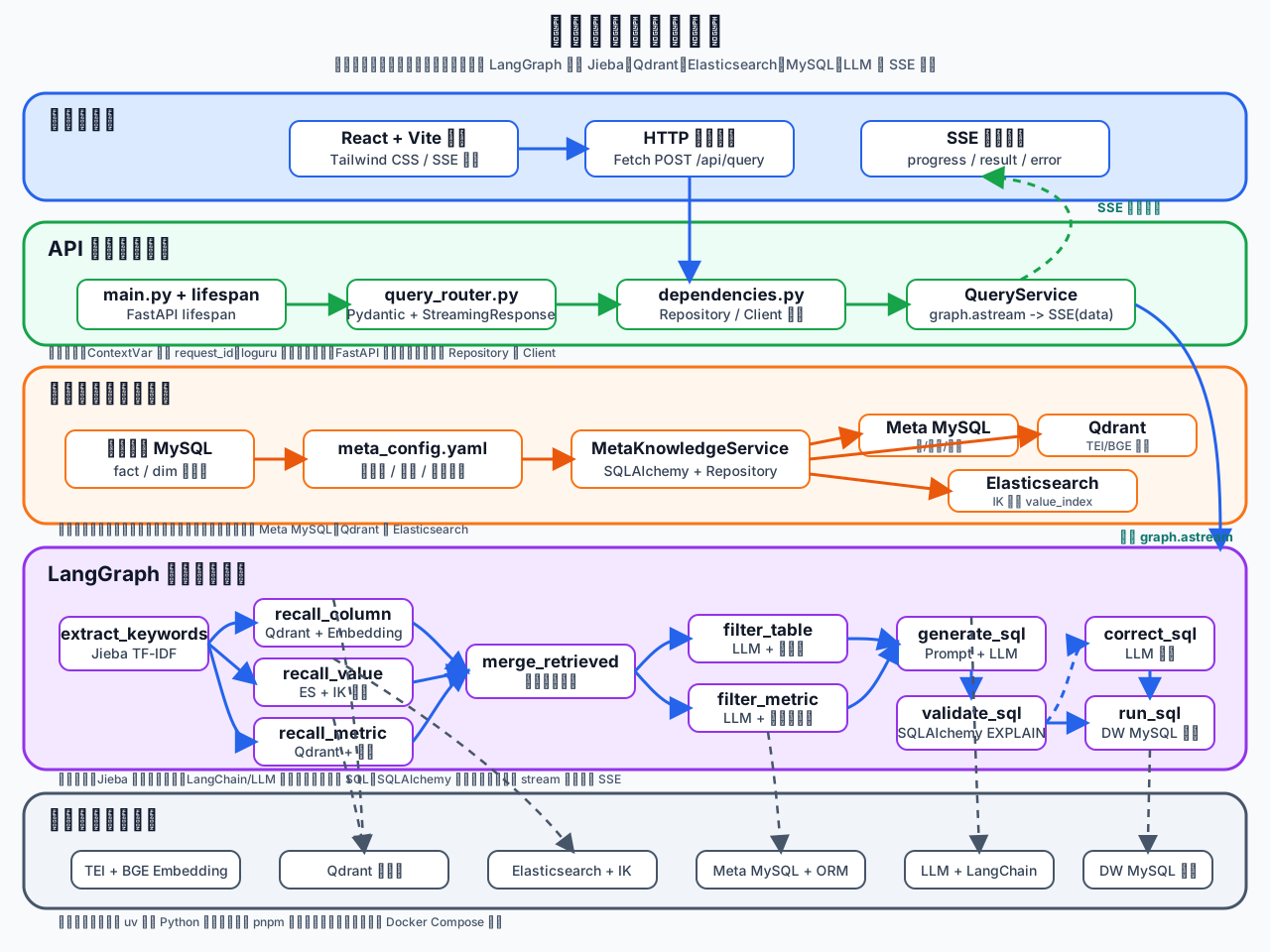
项目围绕两条主线展开:
| 主线 | 做什么 | 涉及模块 |
|---|---|---|
| 元数据知识库构建 | 抽取教学数仓中的表、字段、指标和字段取值,写入结构化库、向量库和全文索引 | MySQL / Qdrant / Elasticsearch / TEI |
| 自然语言问数 | 基于用户问题完成召回、上下文整理、SQL 生成校验执行,并把过程流式返回前端 | LangGraph / FastAPI / SSE / React |
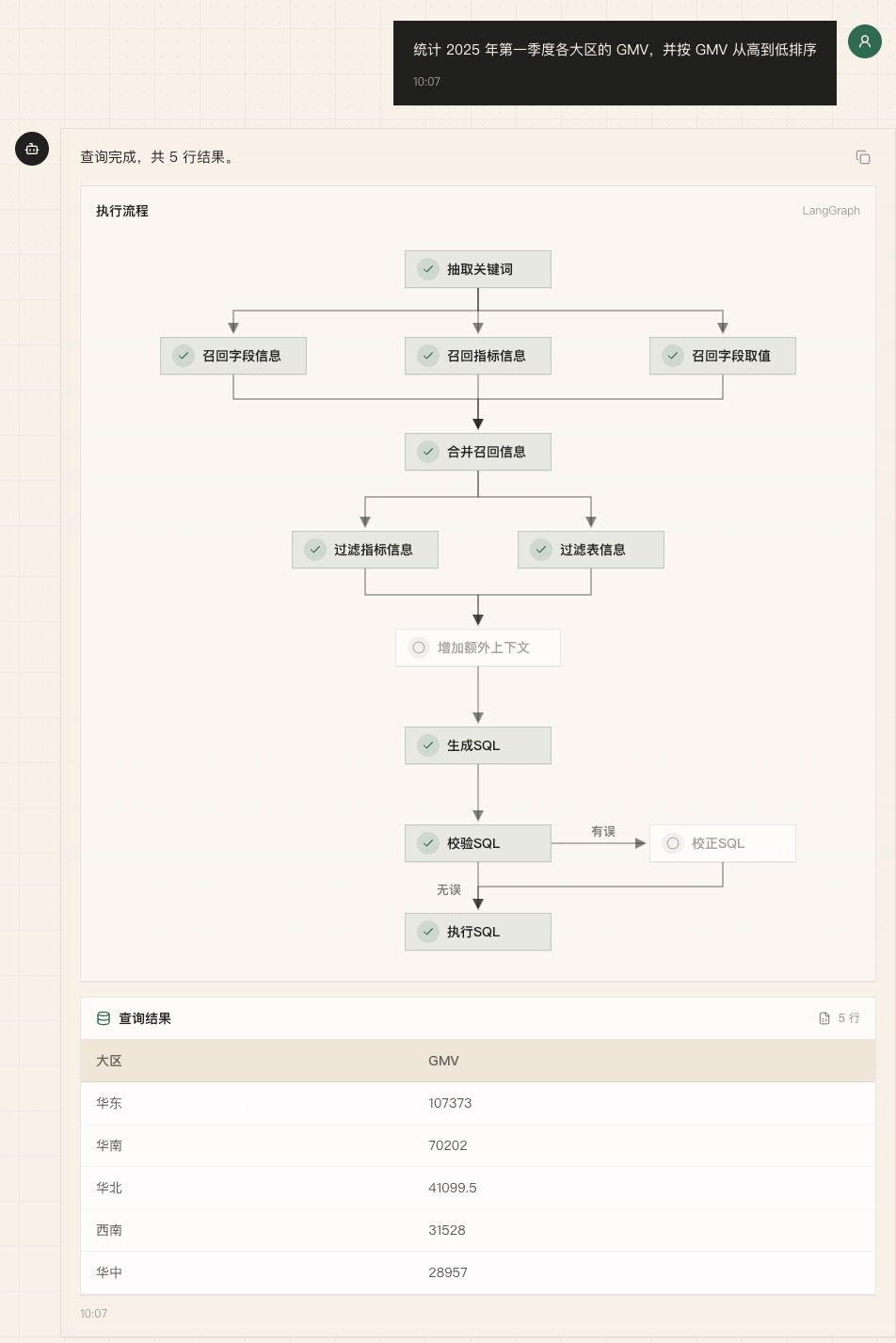
🛠️ 项目技术栈
| 模块 | 技术 | 作用 |
|---|---|---|
| 教学数仓 | MySQL |
模拟事实表、维度表和分析型查询环境 |
| 元数据库 | MySQL / SQLAlchemy |
保存表、字段、指标、字段指标关系等结构化元数据 |
| 向量检索 | Qdrant |
保存字段和指标向量,支持语义召回 |
| 全文检索 | Elasticsearch |
保存字段真实取值,支持关键词和值域检索 |
| Embedding | TEI / BAAI/bge-large-zh-v1.5 |
将字段、指标、问题等文本转成向量 |
| 智能体编排 | LangGraph |
组织多阶段问数工作流 |
| 模型接入 | LangChain |
封装 LLM 与 Embedding 调用 |
| 后端接口 | FastAPI |
提供问数 API、依赖注入和生命周期管理 |
| 流式协议 | SSE |
实时返回节点进度、查询结果和错误消息 |
| 前端 | React / Vite / Tailwind CSS |
提供聊天式问数界面和流程展示 |
| 日志追踪 | ContextVar / loguru |
为并发请求注入 request_id,便于排查链路 |
| 依赖管理 | uv / pnpm |
管理 Python 后端和前端依赖 |
📁 项目结构
shopkeeper-agent/
├── app/
│   ├── agent/            # LangGraph 图、状态、上下文和各类节点
│   ├── api/              # FastAPI 路由、依赖注入、生命周期和请求结构
│   ├── clients/          # MySQL、Qdrant、Elasticsearch、Embedding 客户端管理
│   ├── conf/             # 配置 dataclass 与配置加载工具
│   ├── core/             # 日志、request_id 上下文等通用能力
│   ├── entities/         # 更贴近业务语义的数据对象
│   ├── models/           # SQLAlchemy ORM 模型
│   ├── prompt/           # Prompt 加载工具
│   ├── repositories/     # MySQL、Qdrant、Elasticsearch 数据访问层
│   ├── scripts/          # 元数据知识库构建脚本
│   └── services/         # 元数据构建服务和问数查询服务
├── conf/                 # app_config.yaml、meta_config.yaml
├── docker/               # Docker Compose、MySQL 初始化 SQL、ES 插件、Embedding 挂载目录
├── frontend/             # React + Vite + Tailwind CSS 前端项目
├── prompts/              # SQL 生成、修正、过滤等 Prompt 模板
├── main.py               # FastAPI 应用入口
└── pyproject.toml        # Python 项目依赖与工具配置
🚀 快速开始
当前仓库已经包含一套可直接启动的本地开发环境,你可以按照以下顺序启动项目。
1. 准备环境
- Python
>= 3.14 uv- Docker 与 Docker Compose
- Node.js 与
pnpm
2. 克隆项目
git clone https://github.com/didilili/shopkeeper-agent.git
cd shopkeeper-agent
3. 安装后端依赖
uv sync
4. 配置大模型 API Key
cp .env.example .env
把 .env 中的 LLM_API_KEY 替换成真实密钥:
LLM_API_KEY=your_real_api_key
默认配置使用兼容 OpenAI 接口的硅基流动服务:
llm:
    model_name: Pro/zai-org/GLM-5.1
    api_key: ${oc.env:LLM_API_KEY}
    base_url: https://api.siliconflow.cn/v1
如需使用其他兼容 OpenAI API 的模型平台,修改 conf/app_config.yaml 中的 model_name 和 base_url。
5. 准备 Embedding 模型
项目通过 TEI 加载 BAAI/bge-large-zh-v1.5。模型文件体积较大,无法再仓库中进行提交,需要先下载到 Docker 挂载目录:
uv run hf download BAAI/bge-large-zh-v1.5 --local-dir docker/embedding/bge-large-zh-v1.5
如果手动下载,请解压到:docker/embedding/bge-large-zh-v1.5路径下。
6. 启动 Docker 基础服务
docker compose -f docker/docker-compose.yaml up -d
默认端口:
| 服务 | 端口 |
|---|---|
| MySQL | 3306 |
| Elasticsearch | 9200 |
| Kibana | 5601 |
| Qdrant | 6333 |
| Embedding | 8081 |
docker/mysql/meta.sql和docker/mysql/dw.sql会在 MySQL 容器首次启动时自动初始化元数据库和教学数仓。
7. 构建元数据知识库
uv run python -m app.scripts.build_meta_knowledge -c conf/meta_config.yaml
这一步会把表字段元数据写入 MySQL,把字段和指标向量写入 Qdrant,并把字段真实取值写入 Elasticsearch。
8. 启动后端
uv run fastapi dev main.py
后端接口:
POST http://127.0.0.1:8000/api/query
请求示例:
{
    "query": "统计华北地区的销售总额"
}
SSE 消息类型:
| 类型 | 含义 |
|---|---|
progress |
节点执行进度 |
result |
最终查询结果 |
error |
全局异常消息 |
9. 启动前端
cd frontend
pnpm install
pnpm dev
前端默认通过 Vite 代理把 /api 转发到 http://127.0.0.1:8000。如需修改:
cd frontend
cp .env.example .env
VITE_DEV_PROXY_TARGET=http://127.0.0.1:8000
💬 加入社群
想和更多朋友聊聊 AI 编程、Vibe Coding、面试经验,顺便 吹水唠嗑、吐槽老板?欢迎加入「全宇宙最有爱的 AI Agent 交流群 —— 胡思妙想研究所」!🎉
👉 猛击这里!申请入所:在申请帖留言,并按帖内说明添加微信。
愿我们在这里少一点焦虑,多一点灵感;少一点单打独斗,多一点一起胡思妙想~
📚 配套教程目录
教程总入口:电商问数完整教程
| 章节 | 标题 | 学习重点 | 对应分支 |
|---|---|---|---|
| 0 | 前言 | 项目定位、学习价值与能力边界 | - |
| 1 | 项目概述与数仓基础 | 业务库、数仓、事实表、维度表与教学数仓设计 | - |
| 2 | 项目整体架构与智能体流程 | MySQL、Qdrant、Elasticsearch、LLM 与 Agent 工作流如何协作 | - |
| 3 | 开发环境与基础服务准备 | uv、Docker Compose、MySQL、Qdrant、Elasticsearch、Kibana、Embedding 服务 | 03-env-services |
| 4 | 项目结构与基础服务配置管理 | 工程结构、YAML 配置、OmegaConf 与 dataclass 配置加载 | 04-structure-config |
| 5 | Qdrant 与 ES 快速入门与接入 | 向量检索、全文检索与客户端管理 | 05-qdrant-es |
| 6 | MySQL、Embedding 接入与日志管理 | 异步 MySQL、TEI Embedding、loguru 日志 | 06-mysql-embedding-log |
| 7 | 元数据知识库总览与构建入口 | 元数据知识库产物、存储分工和构建入口 | 07-metadata-base-overview |
| 8 | 表与字段信息同步到元数据库 | Service、Repository、Mapper、ORM 如何配合入库 | 08-metadata-table-column-sync |
| 9 | 字段与指标检索能力构建 | 字段向量索引、字段值全文索引和指标向量索引 | 09-metadata-retrieval-capability |
| 10 | 问数智能体总览与工作流骨架 | LangGraph 工作流骨架与节点设计 | 10-agent-workflow-skeleton |
| 11 | 关键词抽取与多路召回 | 关键词抽取,字段、指标和字段取值并行召回 | 11-agent-keyword-multi-recall |
| 12 | 召回信息合并与上下文构建 | 召回结果合并、依赖字段补齐和值域上下文构建 | 12-agent-merge-retrievals |
| 13 | SQL 生成前的信息过滤与补全 | 候选表字段过滤、指标过滤、日期和数据库上下文补齐 | 13-agent-filter-extra-context |
| 14 | SQL 生成与执行闭环 | SQL 生成、EXPLAIN 校验、错误修正和最终执行 | 14-agent-sql-loop |
| 15 | API 接口基础与 FastAPI 入门 | /api/query、StreamingResponse 和 SSE 基础 |
15-api-streaming-basics |
| 16 | 查询接口实现与依赖组装 | QueryService、依赖注入和应用生命周期资源管理 | 16-api-query-service |
| 17 | 前后端联调与日志追踪 | SSE 消息协议、前端展示、异常兜底和 request_id 日志追踪 | 17-api-integration-logging |
可以用分支切换对照每一阶段的代码演进:
git checkout 04-structure-config
git checkout main
main 分支保留当前完整闭环版本。
本项目基于尚硅谷「大模型智能体掌柜问数」项目,并在此基础上整理完善。
🚧 能力边界
这套项目主要关注智能问数的学习流程,不刻意覆盖生产治理能力,例如:
- 用户登录、角色权限和数据权限控制
- 多租户隔离
- SQL 安全审计和执行白名单
- 查询缓存、限流和性能治理
- 系统化评测集与自动化回归评测
- 监控告警、链路追踪平台和灰度发布
- 更复杂的多轮问数记忆、追问改写和会话管理
这些能力适合在基础流程跑通之后继续扩展。shopkeeper-agent 更适合承担一个清晰角色:先把智能问数最关键、最必要、最值得学习的工程链路讲清楚、跑起来,并为后续扩展企业级能力打基础。