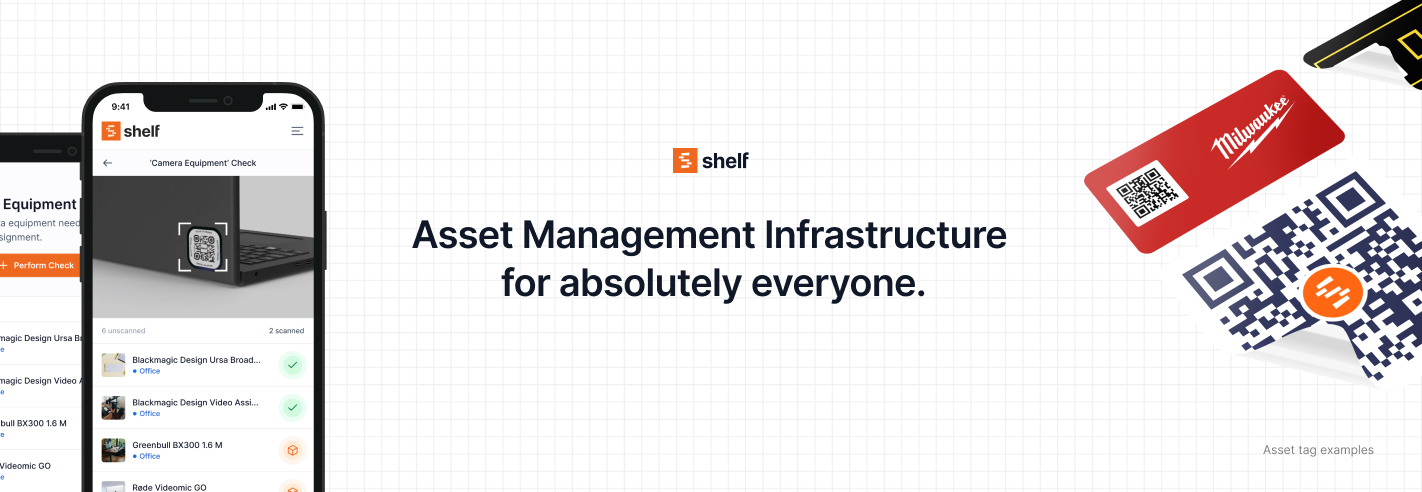
Open-source asset management infrastructure for everyone.




Website · Documentation · Discord · Twitter
Shelf is a platform for tracking physical assets — equipment, devices, tools, vehicles, props, inventory. It's built for teams that need to know what they have, where it is, and who's using it. Organizations use Shelf to manage thousands of assets across locations with role-based access for their teams.
Features
- QR asset tags — Generate and print QR codes. Scan with any phone to view, check out, or report an asset.
- Bookings and reservations — Schedule equipment, prevent double-bookings, set checkout/return dates with calendar integration.
- Custody tracking — Assign assets to team members. Know who has what at all times.
- Location management — Hierarchical locations (buildings, floors, rooms, shelves). GPS tagging support.
- Team roles — Owner, Admin, Base, and Self Service roles with granular permissions.
- Custom fields — Add any metadata to assets: purchase date, warranty info, serial numbers, condition.
- Categories and tags — Organize assets into categories. Tag for flexible cross-cutting grouping.
- Kits — Bundle assets into kits (e.g., laptop + charger + dock) and manage them as a unit.
- Search and filtering — Full-text search with advanced filters. Saved filter presets.
- CSV import/export — Bulk import assets from spreadsheets. Export for reporting.
- Asset reminders — Schedule alerts for maintenance, calibration, warranty expiry.
- Audit trail — Notes and activity logs on every asset.
- Multi-workspace — Manage separate inventories for different organizations or departments.
- Scanner — Built-in QR/barcode scanner with bulk actions: assign custody, update location, add to bookings.
Tech Stack
| Layer | Technology |
|---|---|
| Framework | React Router 7 (React 19) |
| Language | TypeScript 5 |
| Database | PostgreSQL via Supabase |
| ORM | Prisma 6 |
| Styling | Tailwind CSS 3 |
| Components | Radix UI primitives |
| Auth | Supabase Auth (email, SSO) |
| Job queue | pg-boss |
| Payments | Stripe |
| Nodemailer (SMTP) | |
| Build | Vite 7, Turborepo |
| Testing | Vitest, Playwright |
Getting Started
Prerequisites
Setup
# Clone the repository
git clone https://github.com/Shelf-nu/shelf.nu.git
cd shelf.nu

# Install dependencies
pnpm install

# Copy environment template
cp .env.example .env
Edit .env with your Supabase credentials and other configuration. See the Supabase setup guide for step-by-step instructions.
# Generate Prisma client and run migrations
pnpm webapp:setup

# Start development server
pnpm webapp:dev
The app runs at https://localhost:3000 (the dev server uses HTTPS with local certificates by default).
For detailed setup instructions including SSL certificates and troubleshooting, see the local development guide.
Project Structure
shelf.nu/
├── apps/
│   ├── webapp/          # Main application (React Router + Hono)
│   │   ├── app/
│   │   │   ├── routes/      # File-based routing
│   │   │   ├── modules/     # Business logic (booking, asset, kit, etc.)
│   │   │   ├── components/  # React components
│   │   │   └── utils/       # Shared utilities
│   │   └── public/          # Static assets
│   └── docs/            # Documentation site (VitePress)
├── packages/
│   └── database/        # Prisma schema, migrations, client
└── tooling/
    └── typescript/      # Shared TypeScript config
The monorepo is managed with pnpm workspaces and Turborepo. The @shelf/database package owns all database concerns — schema, migrations, and Prisma client generation.
Commands
| Command | Description |
|---|---|
pnpm webapp:dev |
Start development server |
pnpm webapp:build |
Production build |
pnpm webapp:test |
Run tests (Vitest) |
pnpm webapp:validate |
Lint + typecheck + test |
pnpm webapp:doctor |
React health scan (react-doctor) |
pnpm companion:doctor |
React Native health scan (react-doctor) |
pnpm webapp:setup |
Generate Prisma client + run migrations |
pnpm db:prepare-migration |
Create a new database migration |
pnpm db:deploy-migration |
Apply pending migrations |
pnpm db:reset |
Reset database (destructive) |
pnpm docs:dev |
Start documentation site |
pnpm typecheck |
TypeScript type checking |
pnpm lint |
ESLint |
Deployment
Fly.io
Shelf deploys to Fly.io with GitHub Actions for CI/CD. Pushes to dev trigger staging deploys and pushes to main trigger production deploys; in both cases we run lint, typecheck, test, Docker build, and deploy.
See the deployment guide for full setup instructions.
Docker
Community-maintained Docker support is available for self-hosting. Requires an external Supabase instance.
See the Docker guide.
Documentation
| Guide | Description |
|---|---|
| Local Development | Full local setup with SSL, monorepo overview |
| Supabase Setup | Database, auth, storage configuration |
| Deployment | Fly.io + GitHub Actions CI/CD |
| Docker | Self-hosted Docker setup |
| App Configuration | shelf.config.ts options |
| Error Handling | Error patterns and conventions |
| Accessibility | WCAG 2.1 AA compliance |
| Contributing | How to contribute |
For developer onboarding and codebase conventions, see CLAUDE.md.
Contributing
We welcome contributions. Check the contribution guidelines and look for issues labeled [**"O