
The open-source outreach platform that runs on your Claude or ChatGPT plan.
Sellbird finds companies that need what you sell, finds the person who decides, checks their email address, writes each one a personal cold email, sends it and handles the replies. It runs on your own machine, and by default nothing goes out until you approve it.






Harvey is now Sellbird. Same project, same history, new name. Already running Harvey? Your setup carries over: see Upgrading from Harvey.
Prefer not to run it yourself? sellbird.ai is the hosted version, with sending domains, inboxes and warmup set up for you. It's in early access.
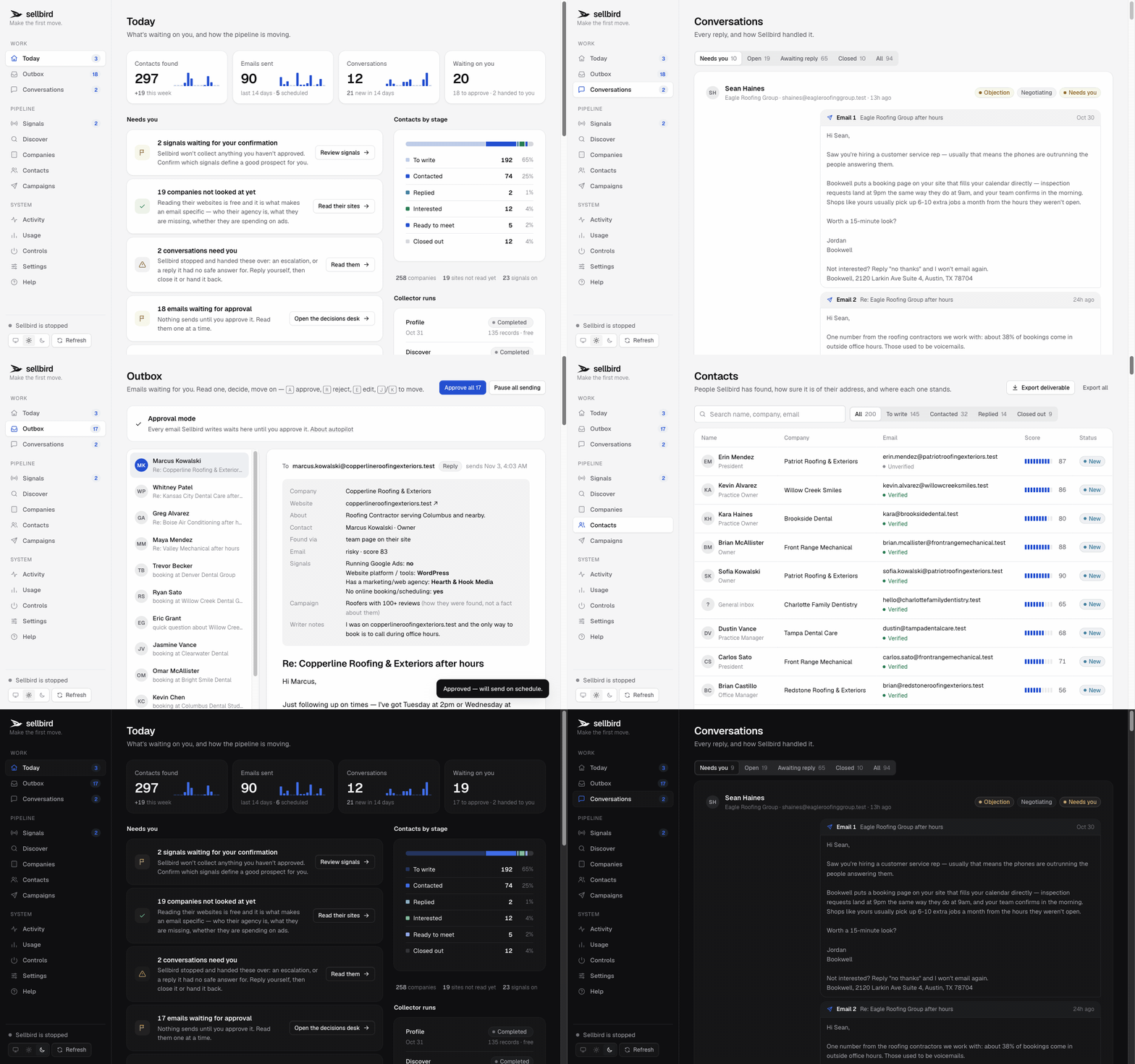
The demo data is invented: "Bookwell" selling online booking to roofers, dental practices and HVAC shops, on .test domains.
What it does
Sellbird is a pipeline you can run end to end, or stop at any step.
| What happens | More | |
|---|---|---|
| Find companies | Searches for businesses that match your customer: free on OpenStreetMap, or on a paid source you pick. Every paid search shows its cost before it runs. | Discovery |
| Learn why they'd buy | Reads each company's own website for the buying signals you confirmed, like no online booking, ads running or a role they're hiring for. No model calls, no cost. | Signals |
| Find who decides | Finds the owner or manager named on the company's own pages, two people per company at most. | Enrich |
| Check the address | Learns the company's email pattern and verifies one address. Every address is marked verified, risky, guess or invalid, and only deliverable ones are ever sent to. | Verify |
| Write and send | Writes a short sequence for each person from what it found, then sends from your Gmail, Microsoft 365 or SMTP mailbox inside your daily limit and their office hours. | Sending |
| Handle replies | Reads every reply, drafts an answer, sets auto-replies aside, honours opt-outs at once, and hands you anything it shouldn't answer alone. | Dashboard |
Only want the list? Stop after verifying and run sellbird export for a sequencer-ready CSV of everything it found.
$ sellbird run

============================================================
Sellbird is online.
============================================================
Checking pipeline state...
Decision: write_campaign (3 new prospects with no drafts)
  handler   → Elena Park, Harbor Dental Studio     interested, answer drafted
  handler   → Priya Nair, Highline Roofing         objection, answer drafted
  writer    → 2-email sequence: Phoenix HVAC hiring a dispatcher
  outbox    → 5 emails waiting for your approval
Cycle complete. Sleeping for 15 minutes.
No model API bill
Sellbird thinks through the Claude Code CLI on your Claude Pro or Max plan, or through Codex on a ChatGPT plan. There's no API key and no per-token billing, and Sellbird throttles itself to leave room for your own work.
| Claude Pro or Max, or a ChatGPT plan with Codex | the subscription you already have |
| Finding businesses | $0 on the default source, or about $0.37 per 1,000 on the cheapest paid one |
| Reading their websites | $0: three HTTP requests each, no model call |
| Writing and sending | your subscription and a mailbox (about $7 a month for Google Workspace) |
| Prospecting tools | None. No Apollo, ZoomInfo, Clearbit or Clay. |
How the loop, the budget and the isolation work: How Sellbird works.
Quick start
You need:
- Python 3.11 or newer. macOS ships 3.9, so run
brew install python@3.13first ifpython3 --versionsays so. - Claude Pro or Max with the CLI signed in (
claude login), or a ChatGPT plan with the Codex CLI (Codex setup). - A mailbox to send from, ideally Google Workspace on a separate sending domain. Microsoft 365 and SMTP work too.
- Warmup on that mailbox. We recommend TrulyInbox: it warms a new mailbox before cold email and keeps it out of spam after, and Sellbird reads its inbox rate to tell you when you're ready.
Let Claude set it up
git clone https://github.com/ethanplusai/sellbird.git
cd sellbird
claude
Then say "set up Sellbird for me". The repo's CLAUDE.md turns Claude Code into the setup guide: it checks where you are, installs what's missing, asks what it needs and trains Sellbird on your product.
Or do it yourself
# 1. Install. Use python3.13, not python3: on macOS bare python3 is 3.9.
python3.13 -m venv .venv && source .venv/bin/activate && pip install -e .

# 2. Add credentials. Every variable is documented inline.
cp .env.example .env && $EDITOR .env

# 3. Learn your product from your website (writes sellbird.local.yaml).
sellbird train https://your-company.com

# 4. Confirm what makes a good prospect.
sellbird signals --confirm free

# 5. Find businesses. The default source is free and needs no account.
sellbird discover

# 6. Open the dashboard and start the loop.
sellbird dashboard          # prints a private link to http://127.0.0.1:5555
sellbird run
On Linux you can also run it with Docker.
Nothing sends without you
Every outgoing email waits in the Outbox for your approval until you turn on autopilot yourself. Before anything leaves, a pre-send check with no model involved rejects unfilled merge tags, banned phrases, overlong emails, extra links and undeliverable addresses. Autopilot still holds back any email that links to a domain that isn't yours or quotes Sellbird's own instructions. sellbird sending pause stops everything at once.
Details: Approval and sending and Legal and deliverability.
Upgrading from Harvey
Harvey was renamed Sellbird in 0.4.0. Your configuration, data and dashboard sign-in carry over:
git pull
pip install -e .        # once, to get the new `sellbird` command
sellbird dashboard
- On first run Sellbird renames
harvey.local.yamltosellbird.local.yamlanddata/harvey.db(and its log) todata/sellbird.*. It never overwrites a file that already exists under the new name, and waits if a Harvey process is still running from the folder. Stop that first. HARVEY_*environment variables still work when theSELLBIRD_*one isn't set; rename them when convenient.- The
harveycommand andpython -m harveystill work for now and say they moved. They will be removed in a later release. - If you edited the tracked
harvey.yamldirectly,git pullstops with "your local changes would be overwritten". Rungit stash,git pull, thengit stash pop. Git carries your edits intosellbird.yaml. If it reports a conflict there, keep your lines, delete the conflict markers, and rungit stash drop. Better still, put your settings insellbird.local.yaml, which git never touches. - Docker: the service is now
sellbird. Rundocker compose down,git pull,docker compose build, thendocker compose up -d.HARVEY_UID/HARVEY_GIDare still read.
Links to github.com/ethanplusai/harvey keep working: GitHub redirects them here.
Where your files live
Your config, knowledge and data live in one home folder. Which one, first match wins:
SELLBIRD_HOME, if you set it (the Docker image sets it to/app).- A checkout: the checkout folder itself, as before.
- Otherwise, for an installed package (
piporpipx), your user data folder:
| Home folder | |
|---|---|
| macOS | ~/Library/Application Support/sellbird |
| Windows | %APPDATA%\sellbird |
| Linux | ~/.local/share/sellbird (or $XDG_DATA_HOME/sellbird) |
Inside it are sellbird.yaml (and sellbird.local.yaml once you train), .env,
prompts/ and skills/, all yours to edit. An installed package copies the defaults in on
first run and never overwrites them, so your edits survive upgrades. data/ holds the
database, the logs and the dashboard token.
Documentation
| Guide | What's in it |
|---|---|
| How Sellbird works | The heartbeat loop, the subscription budget, project structure and the ideas behind it |
| Signals and the prospecting pipeline | The 29 signals, cohorts, and the discover, profile, enrich and verify stages |
| Skills and sub-agents | The editable sales playbooks and which agent uses which |
| Approval and sending | The Outbox, autopilot, office hours and email signatures |
| The dashboard and the data | Every screen, how sign-in works, and how the data is stored |
| Configuration and commands | .env, sellbird.yaml and every command |
| Using a ChatGPT plan (Codex) | Running on Codex instead of Claude |
| Legal and deliverability | The rules you're sending under, and warmup |
| Microsoft 365 · Precleared | Provider setup guides |
| Docker · Troubleshooting · Roadmap | Running, fixing and what's next |
Contributing
Pull requests are welcome. Read CONTRIBUTING.md first: it covers keeping real contact data out of the repo, test email, and signing off your commits. Found a security problem? Follow SECURITY.md instead of opening an issue.
See CHANGELOG.md for what changed in each release.
License
Sellbird is licensed under the GNU Affero General Public License v3.0. Harvey releases up to 0.3.x were released under MIT, and that code keeps its MIT notice in NOTICE.
TrulyInbox links in this project are affiliate links: the maintainer may earn a commission, at no extra cost to you.