


seatunnel is a free, open source data engineering & integration project written in Java and released under Apache-2.0. It has 9,655 GitHub stars, 2,413 forks and 705 open issues, and was last pushed 16 hours ago. On this registry it ranks #6 of 39 tracked projects in Data Engineering & Integration, with 5 head-to-head comparisons available. It gained 2 stars over the last 3 tracked days.

What is seatunnel?

What it is

Apache SeaTunnel is a multimodal, high-performance, distributed data integration tool that is capable of synchronizing vast amounts of data daily. It is an Apache Software Foundation project written in Java and released under the Apache-2.0 license, with a home on the web at seatunnel.apache.org. The project has been in development for roughly nine years and has accumulated 9,652 stars and 2,407 forks on GitHub. It sits in the Data & Analytics ecosystem, specifically in data engineering and integration, and it is built around a connector-driven model: sources, sinks, and transforms are configured as jobs, and those jobs run on a selected execution engine.

The concrete problem it addresses is the fragmentation of data movement across an organization. Teams that need to copy data between heterogeneous systems usually face a long list of one-off scripts, each tied to a particular database or file format, each behaving differently under failure. SeaTunnel targets that situation directly by integrating with hundreds of evolving data sources through a single job configuration model, and by supporting the awkward cases rather than only the tidy ones: real-time synchronization, change data capture, full database synchronization, and integration of video, images, binary files, and structured and unstructured text alongside the ordinary tabular data that most integration tools stop at. For real-time synchronization it also aims to minimize the computing resources and JDBC connections consumed, which matters when many tables must be replicated at once.

Key capabilities

  • Over 160 connectors are provided, and the set is described as ongoing expansion.
  • Multimodal integration covers video, images, binary files, and both structured and unstructured text.
  • Batch and stream integration use connectors designed to be easily adaptable, simplifying management of both modes.
  • A distributed snapshot algorithm ensures data consistency across synchronized data.
  • A job runs on one of three engines: the SeaTunnel Zeta Engine, Flink, or Spark.
  • JDBC multiplexing and log parsing support efficient synchronization of multiple tables and databases.
  • Data quality and real-time monitoring features are intended to prevent data loss or duplication.

Who uses it and how

  • Companies and organizations worldwide use it for research, production, and commercial products.
  • Documented use cases include JP Morgan, S7, JDT, Bytedance, and Tencent Cloud.
  • Production deployments run daily synchronization of large data volumes, with the project citing efficiency and stability as the basis for that trust.
  • Real-time and CDC pipelines replicate many tables and databases at once, using JDBC multiplexing rather than one connection per table.
  • Multimedia pipelines move video, images, and binary files through the same job model used for text and tabular data.
  • Companion tooling such as the SeaTunnel MCP Server lives in the separate SeaTunnel Tools project.

Getting started

Download SeaTunnel from the official website at seatunnel.apache.org/download, then choose a runtime execution engine: SeaTunnel Zeta Engine, Spark, or Flink, each with its own locally hosted quick-start guide. Developers extending or compiling the project are pointed to the developer setup documentation.

When to use it — and when not to

SeaTunnel fits teams that need many connectors and several synchronization modes under one configuration model, and that are willing to pick and operate an execution engine. A self-hoster must choose

project readme (upstream, from github) — read inline

Apache SeaTunnel

SeaTunnel Logo

Build Workflow Join Slack Twitter Follow Ask DeepWiki

Overview

SeaTunnel is a multimodal, high-performance, distributed data integration tool, capable of synchronizing vast amounts of data daily. It's trusted by numerous companies for its efficiency and stability.

Why Choose SeaTunnel

SeaTunnel addresses common data integration challenges:

  • Diverse Data Sources: Seamlessly integrates with hundreds of evolving data sources.
  • Multimodal Data Integration: Supports the integration of video, images, binary files, structured and unstructured text data.
  • Complex Synchronization Scenarios: Supports various synchronization methods, including real-time, CDC, and full database synchronization.
  • Resource Efficiency: Minimizes computing resources and JDBC connections for real-time synchronization.
  • Quality and Monitoring: Provides data quality and monitoring to prevent data loss or duplication.

Key Features

  • Diverse Connectors: Offers support for over 160 connectors, with ongoing expansion.
  • Batch-Stream Integration: Easily adaptable connectors simplify data integration management.
  • Distributed Snapshot Algorithm: Ensures data consistency across synchronized data.
  • Multi-Engine Support: Works with SeaTunnel Zeta Engine, Flink, and Spark.
  • JDBC Multiplexing and Log Parsing: Efficiently synchronizes multi-tables and databases.
  • High Throughput and Low Latency: Provides high-throughput data synchronization with low latency.
  • Real-Time Monitoring: Offers detailed insights during synchronization.

SeaTunnel Workflow
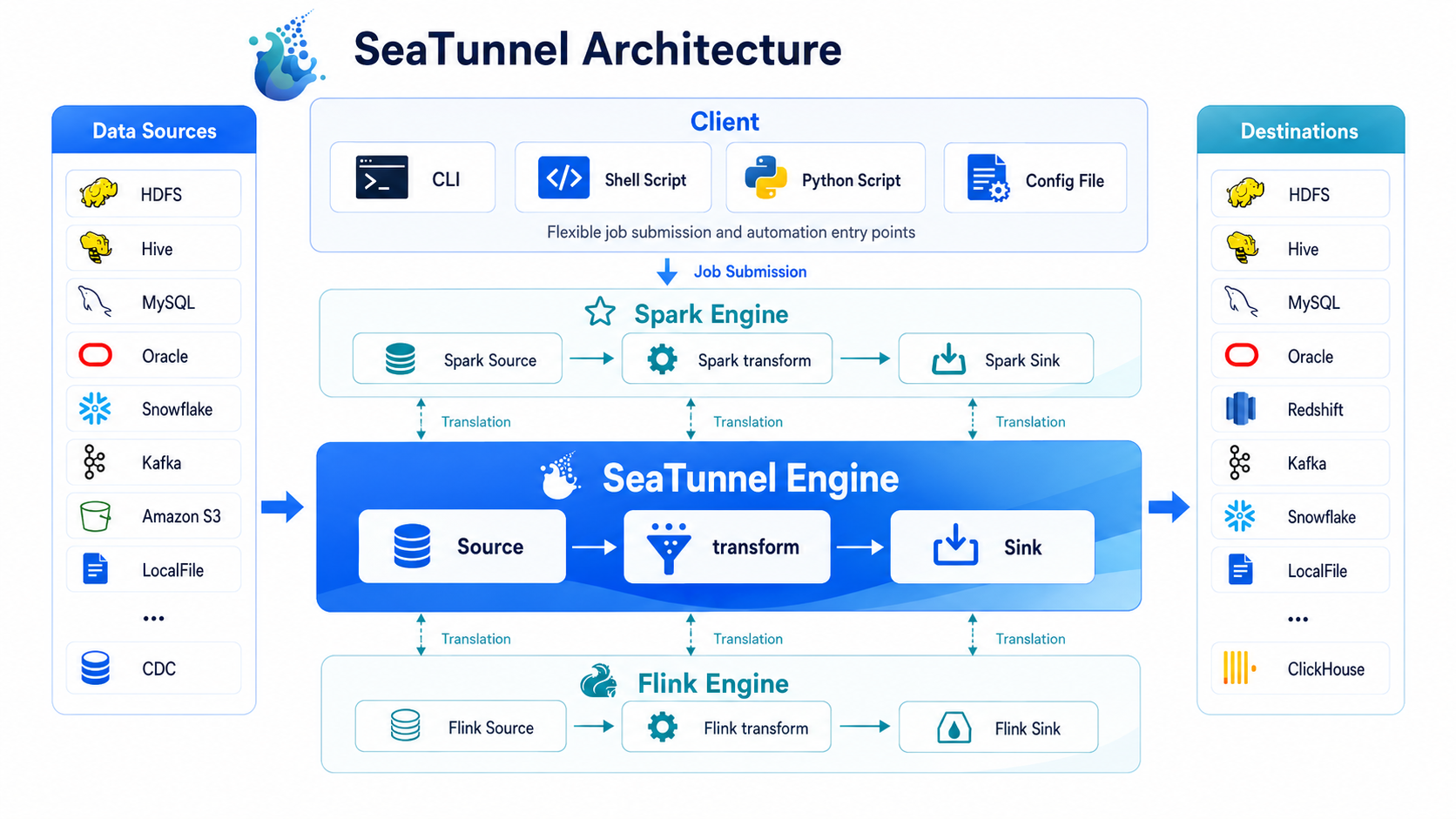
SeaTunnel Workflow

Configure jobs, select execution engines, and parallelize data using Source Connectors. Easily develop and extend connectors to meet your needs.

Supported Connectors

Getting Started

Download SeaTunnel from the Official Website. Choose your runtime execution engine:

Multimodal Data Integration

  • Most data integration tools support structured and unstructured text data, and SeaTunnel does as well. Simply refer to the desired Source/Sink to use.
  • For integrating video, images, and binary files with SeaTunnel, please refer to the documentation for detailed instructions.

Apache SeaTunnel Tools

SeaTunnel Tools provides a range of peripheral tools, including Apache SeaTunnel Mcp Server, etc, please refer to SeaTunnel Tools.

Users

Companies and organizations worldwide use SeaTunnel for research, production, and commercial products. Explore real-world use cases of SeaTunnel, such as JP morgan, S7, JDT, Bytedance, Tencent Cloud. More use cases can be found on the SeaTunnel Users.

Code of Conduct

Participate in this project in accordance with the Contributor Covenant Code of Conduct.

Contributors

We appreciate all developers for their contributions. See the List Of Contributors.

How to Compile

Refer to this Setup for compilation instructions.

Contact Us

Landscapes

SeaTunnel enriches the CNCF CLOUD NATIVE Landscape.

License

Apache 2.0 License

Frequently Asked Questions

1. How do I install SeaTunnel?

Follow the Local Deployment on SeaTunnel website to get started quickly. Please refer to the Cluster Deployment

2. Where can I find documentation and tutorials?

Official Documentation includes detailed guides and tutorials to help you get started.

3. Is there a community or support channel?

You can submit an issue on GitHub Issues. Join our Slack community SeaTunnel Slack. More information, please refer to FAQ.

4. How can I contribute to SeaTunnel?

We welcome contributions! Please refer to our Contribution Guidelines for details.

Frequently asked questions

Is seatunnel free to use?

seatunnel is open source under the Apache-2.0 licence. There is no licence fee and no seat count — you can self-host it or, where the project offers one, pay a vendor for a managed version instead.

What does seatunnel do?

SeaTunnel is a multimodal, high-performance, distributed, massive data integration tool.

What is seatunnel written in?

seatunnel is primarily written in Java. Its source is publicly available at https://github.com/apache/seatunnel, and it has 9,655 GitHub stars.