Scira
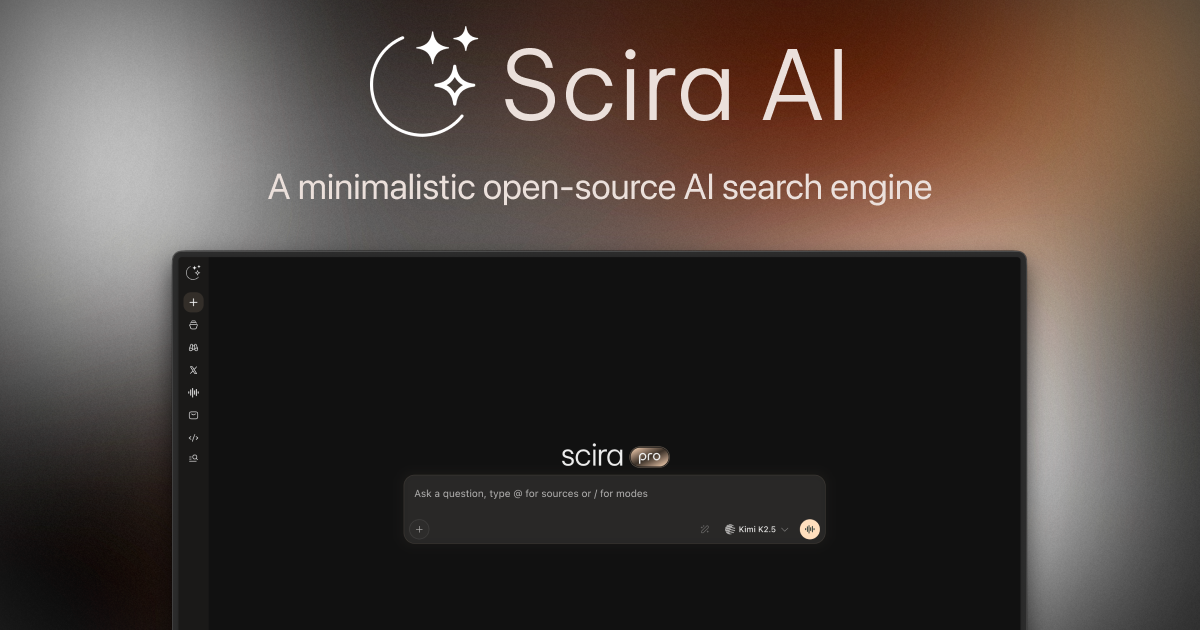
Research at the speed of thought. The agentic research platform that plans, retrieves, and cites — so you can think faster.


Context.dev, One API to fetch the internet
Sign up for 500 credits free, no card required.

Powered By
| Vercel AI SDK | Exa AI | Upstash |
|---|---|---|
 |
 |
 |
| For AI model integration and streaming | For web search and content retrieval | For serverless Redis and rate limiting |
How It Works
- Ask anything — Type a question, upload a PDF, or paste a URL. Pick a mode or let Scira decide for you.
- Scira plans & retrieves — The agent breaks your question into sub-tasks, searches live sources, and cross-checks the evidence.
- Get cited answers — Receive a grounded answer with inline citations. Click any source to verify it yourself.
Features
Core Capabilities
- Agentic Planning — Breaks complex questions into steps, selects the right models and tools, then executes multi-step workflows end to end
- Grounded Retrieval — Every answer comes with inline citations you can click to audit the evidence yourself
- Extensible & Open — AGPL-3.0 licensed. Self-host, bring your own models, connect custom tools, and tailor everything to your workflow
- Lookouts — Schedule recurring research agents that monitor topics, track changes, and email you updates
Search Modes (17 modes)
| Mode | Description |
|---|---|
| Web | Search the entire web with AI-powered analysis |
| Chat | Talk to the model directly, no search |
| X | Real-time posts, trends, and conversations |
| Stocks | Market data, charts, and financial analysis |
| Code | Get context about languages and frameworks |
| Academic | Research papers, citations, and scholarly sources |
| Extreme | Deep research with multiple sources and analysis |
| Discussions, opinions, and community insights | |
| GitHub | Repositories, code, and developer discussions |
| Crypto | Cryptocurrency research powered by CoinGecko |
| Prediction | Prediction markets from Polymarket and Kalshi |
| YouTube | Video summaries, transcripts, and analysis |
| Spotify | Search songs, artists, and albums |
| Connectors | Search Google Drive, Notion & OneDrive (Pro) |
| Memory | Your personal memory companion (Pro) |
| Voice | Conversational AI with real-time voice (Pro) |
| XQL | Advanced X query language for tweet analysis (Pro) |
Tools (28 tools)
Search & Retrieval
- Web search — Multi-query parallel web search with deduplication using Exa, Firecrawl, Parallel, and Tavily
- Extreme search — LLM-driven deep research agent with multi-step planning, code execution, and R2 artifact storage
- Academic search — Search academic papers and research using Exa and Firecrawl
- Reddit search — Search Reddit with configurable time ranges using Parallel
- X search — Search X posts with date range filtering and handle inclusion/exclusion using xAI Grok
- YouTube search — Search videos, channels, playlists with transcript extraction using Supadata
- GitHub search — Search repositories with structured metadata extraction using Firecrawl
- Spotify search — Search tracks, artists, albums, and playlists via Spotify Web API
- URL content retrieval — Extract content from any URL including tweets, YouTube, TikTok, and Instagram
Financial & Market Data
- Stock charts — Interactive stock charts with OHLC data, earnings, and news using Valyu, Tavily, and Exa
- Currency converter — Forex and crypto conversion with real-time rates using Valyu
- Crypto tools — Cryptocurrency data, contract lookups, and OHLC charts using CoinGecko
- Prediction markets — Query Polymarket and Kalshi data with Cohere reranking using Valyu
Location & Travel
- Weather — Current weather, 5-day forecast, air quality, and 16-day extended forecast using OpenWeatherMap and Open-Meteo
- Maps & geocoding — Forward/reverse geocoding and nearby place discovery using Google Maps API
- Flight tracking — Real-time flight status with departure/arrival details
Media & Entertainment
- Movie/TV search — Search movies and TV shows with detailed cast, ratings, and metadata using TMDB
- Trending movies — Today's trending movies from TMDB
- Trending TV shows — Today's trending TV shows from TMDB
Productivity & Utilities
- Code interpreter — Write and execute Python code in a sandboxed Daytona environment with chart generation
- Code context — Get contextual information about programming topics using Exa Context API
- Text translation — Translate text (and text within images) between languages using AI models
- File query search — Semantic search over uploaded files (PDF, CSV, DOCX, Excel) with Cohere embeddings and reranking
- Connectors search — Search connected Google Drive, Notion, and OneDrive using Supermemory
- Memory tools — Save and search personal memories using Supermemory
- Date & time — Current date/time in multiple formats with timezone support
- Greeting — Personalized time-of-day-aware greetings
LLM Models Supported
- xAI: Grok 3, Grok 3 Mini, Grok 4, Grok 4 Fast, Grok 4.1 Fast, Grok Code
- OpenAI: GPT 4.1 (Nano/Mini/Standard), GPT 5 (Nano/Mini/Medium/Standard), GPT 5.1 (Instant/Thinking/Codex), GPT 5.2 (Instant/Thinking/Codex), o3, o4 mini, GPT OSS 20B/120B
- Anthropic: Claude Haiku 4.5, Claude Sonnet 4.5, Claude 4.5 Opus, Claude 4.6 Opus
- Google: Gemini 2.5 Flash (Lite/Standard), Gemini 2.5 Pro, Gemini 3 Flash, Gemini 3 Pro
- Alibaba (Qwen): Qwen 3 (4B/32B/235B), Qwen 3 VL, Qwen 3 Max, Qwen 3 Coder (Small/Standard/Plus/Next), Qwen 3 Next 80B
- Mistral: Ministral 3 (3B/8B/14B), Mistral Large 3, Mistral Medium, Magistral (Small/Medium), Devstral 2 (Small/Standard)
- DeepSeek: DeepSeek v3, v3.1 Terminus, v3.2, R1, R1 0528
- Zhipu (GLM): GLM 4.5, GLM 4.5 Air, GLM 4.6, GLM 4.6V, GLM 4.7, GLM 4.7 Flash
- Cohere: Command A, Command A Thinking
- MoonShot: Kimi K2, Kimi K2.5
- Minimax: M1 80K, M2, M2.1, M2.1 Lightning
- ByteDance: Seed 1.6, Seed 1.6 Flash, Seed 1.8
- Arcee: Trinity Mini, Trinity Large
- Others: Vercel v0 (1.0/1.5), Amazon Nova 2 Lite, Xiaomi Mimo V2 Flash, StepFun Step 3.5 Flash, Kwaipilot KAT-Coder-Pro V1
Built with
- Next.js - React framework
- Tailwind CSS - Styling
- Vercel AI SDK - AI model integration and streaming
- Shadcn/UI - UI components
- Exa.AI - Web search, academic search, and content retrieval
- Firecrawl - Web scraping with structured extraction
- Parallel - Web and Reddit search
- Tavily - Web search and financial news
- Valyu - Financial data, forex, and prediction markets
- Supadata - YouTube search, transcripts, and social media
- CoinGecko - Cryptocurrency market data
- Spotify - Music search
- OpenWeatherMap - Weather data
- Open-Meteo - Extended forecasts and geocoding
- Daytona - Code execution sandbox
- Google Maps - Geocoding and places
- TMDB - Movie and TV data
- Cohere - Embeddings and reranking
- Supermemory - Memory management and connector search
- Upstash - Serverless Redis and rate limiting
- Cloudflare R2 - Object storage for artifacts
- ElevenLabs - Voice synthesis
- [Better Auth]