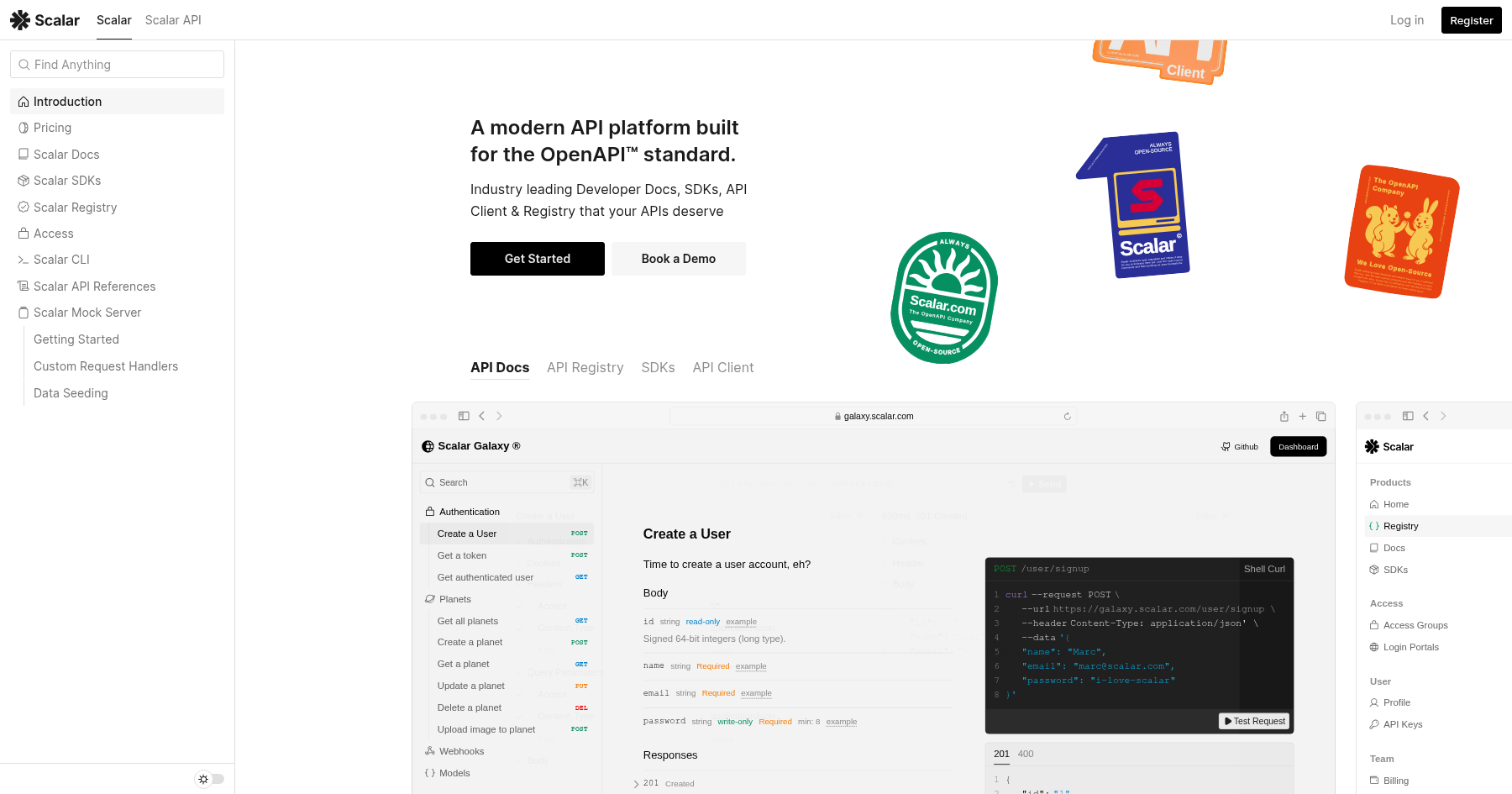


Scalar is a free, open source api development & testing project written in TypeScript and released under MIT. It has 16,136 GitHub stars, 937 forks and 68 open issues, and was last pushed 8 hours ago. On this registry it ranks #15 of 103 tracked projects in API Development & Testing, with 5 head-to-head comparisons available. It gained 45 stars over the last 6 tracked days.

Scalar — Open-source API documentation and testing platform

What is Scalar?

What it is

Scalar is open-source API documentation and testing platform. It lives in TypeScript ecosystem, with Vue in topics, and targets REST API, OpenAPI, Swagger, API client, docs, http-client, reference work. License is MIT. It gives interactive API reference from OpenAPI/Swagger documents, plus built-in API testing tool. It also gives offline-first API client built for OpenAPI.

Problem it solves is scattered API surface. Teams often have OpenAPI or Swagger files, but need readable reference, test requests, and code examples without separate tools. Scalar combines docs, client, framework integration, and example generation around OpenAPI/Swagger. It can run from single HTML file or through many framework integrations.

Key capabilities

  • Renders OpenAPI and Swagger documents as interactive API reference.
  • Includes API testing tool inside reference.
  • Generates code examples for many languages and frameworks.
  • Supports offline-first API client for OpenAPI.
  • Integrates with server frameworks and API frameworks listed in README, including Elysia, Hono, FastAPI, Express, NestJS, Next.js, Vue.js, Laravel, Django, Flask, Spring Boot, Go, Rust, Ruby on Rails, .NET ASP.NET Core, Aspire, AdonisJS, Astro, Docker, Docusaurus, Elixir, Fastify, Hapi, Java, Laravel Scribe, Micronaut, Nuxt, Python, React, SvelteKit, Ts.ED.
  • Syncs with server framework through Watch Mode.
  • Supports environment variables and dynamic parameters.

Who uses it and how

  • Developers publish API reference by adding HTML page with Scalar.createApiReference('#app', {url: 'https://registry.scalar.com/@scalar/apis/galaxy?format=json', proxyUrl: 'https://proxy.scalar.com'}).
  • Teams test endpoints inside generated reference, using OpenAPI/Swagger document.
  • Framework users embed reference through listed integrations, so docs appear near API server or app.
  • Client users run offline-first API client and use environment variables, dynamic parameters, and Watch Mode sync.
  • Demo and download paths let users try browser or desktop downloads for Windows, MacOS, Linux.

Getting started

Use single HTML file and call Scalar.createApiReference('#app', {url: 'https://registry.scalar.com/@scalar/apis/galaxy?format=json', proxyUrl: 'https://proxy.scalar.com'}). Use listed framework integrations, Docker integration, or browser/desktop download paths mentioned in README.

When to use it — and when not to

Use Scalar when OpenAPI/Swagger document should become both reference and testing surface, and when many framework integrations matter. Avoid Scalar when project needs only static docs, no interactive client, or no OpenAPI/Swagger source. Weakness in facts: README example needs proxyUrl to avoid CORS issues; metadata shows 0 contributors, 68 open issues, and repo age 0 years, so public maturity signal is thin. Provided facts do not list database, storage, SMTP, or self-hosting operations.

project readme (upstream, from github) — read inline

CI Contributors GitHub License Twitter Discord

Scalar

Scalar API Reference

 	</a>
Scalar API client
	</a>
</p>

Interactive API Reference from OpenAPI/Swagger

└ Renders OpenAPI/Swagger documents
└ Comes with an API testing tool
└ Doesn't look like 2011
└ Generates code examples for many languages & frameworks
└ Integrates with your favorite framework
Try Demo

An offline-first API Client built for OpenAPI

└ Free and open-source
└ First-class OpenAPI/Swagger support
└ Integrates with dozens of API Frameworks (Elysia, Hono, FastAPI, etc)
└ Syncs with your favorite server framework (Watch Mode)
└ Has environment variables, dynamic parameters and everything
Try It in the BrowserDownload (Windows, MacOS, Linux)

Trusted by:


Scalar API clientScalar API client

Quickstart

All you need is a single HTML file to create an amazing API reference:

<!doctype html>
<html>
  <head>
    <title>Scalar API Reference</title>
    <meta charset="utf-8" />
    <meta
      name="viewport"
      content="width=device-width, initial-scale=1" />
  </head>

  <body>
    <div id="app"></div>

    <!-- Load the Script -->
    <script src="https://cdn.jsdelivr.net/npm/@scalar/api-reference"></script>

    <!-- Initialize the Scalar API Reference -->
    <script>
      Scalar.createApiReference('#app', {
        // The URL of the OpenAPI/Swagger document
        url: 'https://registry.scalar.com/@scalar/apis/galaxy?format=json',
        // Avoid CORS issues
        proxyUrl: 'https://proxy.scalar.com',
      })
    </script>
  </body>
</html>

Need a Custom Header? Check out this example: https://codepen.io/scalarorg/pen/VwOXqam

And there's an ever-growing list of plugins and integrations:

Integrations

Built-in Support

The following frameworks have chosen Scalar API Reference as their default OpenAPI documentation UI, recognizing its developer-friendly features and modern design:

readme truncated — read the full docs on github

Frequently asked questions

Is Scalar free to use?

Scalar is open source under the MIT licence. There is no licence fee and no seat count — you can self-host it or, where the project offers one, pay a vendor for a managed version instead.

What does Scalar do?

Open-source API documentation and testing platform

What is Scalar written in?

Scalar is primarily written in TypeScript. Its source is publicly available at https://github.com/scalar/scalar, and it has 16,136 GitHub stars.