Commerce that works with your language and stack
GraphQL native, API-only platform for scalable composable commerce.
Get to know Saleor:
Talk to a human
|
Talk to the API
Join our community:
Website
|
Twitter
|
Discord
Blog | Subscribe to newsletter




Table of Contents
- What makes Saleor special?
- Why API-only Architecture?
- Features
- Installation
- Documentation
- Saleor Platform
- Storefront
- Dashboard
- Contributing
- License
What makes Saleor special?
Technology-agnostic - no monolithic plugin architecture or technology lock-in.
GraphQL only - Not afterthought API design or fragmentation across different styles of API.
Headless and API only - APIs are the only way to interact, configure, or extend the backend.
Open source - a single version of Saleor without feature fragmentation or commercial limitations.
Cloud native - battle tested on global brands.
Native-multichannel - Per channel control of pricing, currencies, stock, product, and more.
Why API-only Architecture?
Saleor's API-first extensibility provides powerful tools for developers to extend backend using webhooks, attributes, metadata, apps, subscription queries, API extensions, dashboard iframes.
Compared to traditional plugin architectures (monoliths) it provides the following benefits:
- There is less downtime as apps are deployed independently.
- Reliability and performance - custom logic is separated from the core.
- Simplified upgrade paths - eliminates incompatibility conflicts between extensions.
- Technology-agnostic - works with any technology, stack, or language.
- Parallel development - easier to collaborate than with a monolithic core.
- Simplified debugging - easier to narrow down bugs in independent services.
- Scalability - extensions and apps can be scaled independently.
What are the tradeoffs?
If you are a single developer working with a small business that doesn't have high traffic or a critical need for 24/7 availability, using a service-oriented approach might feel more complex compared to the traditional WordPress or Magento approach that provides a language-specific framework, runtime, database schema, aspect-oriented programming, and other tools to a quick start.
However, if you deploy on a daily basis, reliability and uptime is critical, you need to collaborate with other developers, or you have non-trivial requirements you might be in the right place.
Features
- Enterprise ready: Secure, scalable, and stable. Battle-tested by big brands
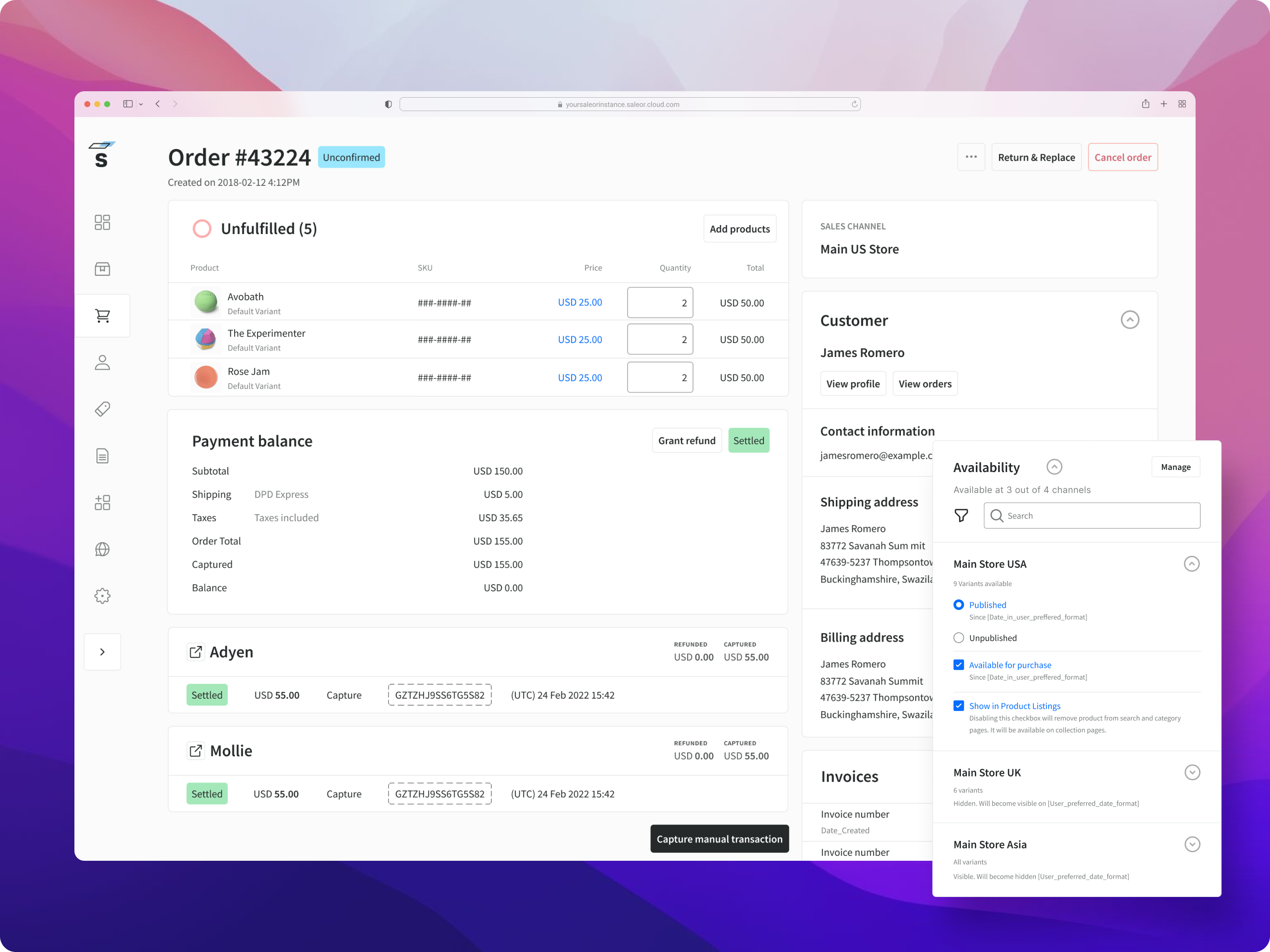
- Dashboard: User-friendly, fast, and productive. (Decoupled project repo )
- Global by design Multi-currency, multi-language, multi-warehouse, tutti multi!
- CMS: Manage product or marketing content.
- Product management: A rich content model for large and complex catalogs.
- Orders: Flexible order model, split payments, multi-warehouse, returns, and more.
- Customers: Order history and preferences.
- Promotion engine: Sales, vouchers, cart rules, giftcards.
- Payment orchestration: multi-gateway, extensible payment API, flexible flows.
- Cart: Advanced payment and tax options, with full control over discounts and promotions.
- Payments: Flexible API architecture allows integration of any payment method.
- Translations: Fully translatable catalog.
- SEO: Unlimited SEO freedom with headless architecture.
- Apps: Extend dashboard via iframe with any web stack.
Installation
See the Saleor docs for step-by-step installation and deployment instructions. For local development without Docker, follow our Contributing Guide.
Note:
The main branch is the development version of Saleor and it may be unstable. To use the latest stable version, download it from the Releases page or switch to a release tag.
The current production-ready version is 3.x and you should use this version for all three components:
- Saleor:
- Dashboard:
- Storefront:
Saleor Cloud
The fastest way to develop with Saleor is by using developer accounts in Saleor Cloud.
Register here or install our CLI tool:
npm i -g @saleor/cli
and run the following command:
saleor register
Bootstrap your first storefront with:
saleor storefront create --url {your-saleor-graphql-endpoint}
Documentation
Saleor documentation is available here: docs.saleor.io
To contribute, please see the saleor/saleor-docs repository.
Saleor Platform
The easiest way to run all components of Saleor (API, storefront, and dashboard) together on your local machine is to use the saleor-platform project. Go to that repository for instructions on how to use it.
Storefront
An open-source storefront example built with Next.js App Router, React.js, TypeScript, GraphQL, and Tailwind CSS.
Dashboard
For the dashboard, go to the saleor-dashboard repository.
Contributing
We love your contributions and do our best to provide you with mentorship and support. If you are looking for an issue to tackle, take a look at issues labeled Good first issue and Help wanted.
If nothing grabs your attention, check our roadmap or start a Discord discussion about a feature you'd like to see. Make sure to read our [Contribution Guidelines](http://docs.saleor.io/developer/c