SAG
English · 简体中文



From now on, this is the only knowledge base app you need.
Built on the state-of-the-art SAG architecture, it turns scattered documents and data into knowledge that is searchable, connected, and traceable.
https://github.com/user-attachments/assets/ac805e3c-ab52-4857-bef6-2865f3831b2f
Contents
Community · Project · Technology · User Guide · Developer Guide
Project
Changelog
August 30, 2026
SAG now supports @zleap-ai/dsh-sag. The built-in local DeepSeek Harness connector makes SAG knowledge available to DSH Agents for search, source reading, and source and document management.
August 13, 2026
Added OCTX source import and export with integrity validation, conflict handling, failure recovery, and compatible vector reuse for cross-instance knowledge base migration and backup. This release also improves continuous Chinese-term retrieval and document lifecycle controls for more reliable fast search and background processing.
July 31, 2026
Published the official command-line client @zleap-ai/sag-cli. One command (sag agent connect codex | claude-code) mounts the SAG Knowledge MCP into Codex or Claude Code — no JWT copy-paste, no hand-edited config files. The MCP guide below now leads with the CLI.
July 14, 2026
Released a completely new version built on the zleap-sag package, featuring an entirely redesigned UI. The previous version has been archived in the v1 branch and is no longer maintained.
SAG in one minute
SAG is not a fusion of traditional RAG and GraphRAG. It is an original retrieval architecture that replaces both.
Through event-entity indexing and query-time dynamic hyperedges, SAG delivers semantic retrieval and relational reasoning in one system, without maintaining two RAG systems or merging two retrieval paths.
Experiments on HotpotQA, 2WikiMultiHopQA, and MuSiQue show that SAG achieves the best retrieval and end-to-end QA performance on every benchmark, establishing a new state of the art for RAG.
This project is a complete knowledge base application for individuals and Agents built on SAG:
sources and documents → structured knowledge → search and source tracing → cited Agent answers → reuse through API or MCP
Upload a document once. SAG parses it, splits it into chunks, embeds it, extracts events and entities, and keeps every retrieval result connected to the original text. You can then search across sources, inspect the event-entity graph, ask questions with citations, or expose the same knowledge to another application.
| Capability | What it gives you |
|---|---|
| Knowledge ingestion | File and web sources, document parsing, chunking, embedding, event/entity extraction, background processing |
| Search | Global or source-scoped retrieval with Fast (vector) and Precise (multi) modes |
| Source tracing | Open any result or citation back to the exact original chunk |
| Knowledge graph | Inspect events, entities, and their queryable associations |
| Agent chat | Multi-turn answers grounded in selected sources, with clickable citations |
| Integration | Self-hosted REST/OpenAPI, OpenAI-compatible chat, MCP, and the zleap-sag Python package |
The product is deliberately local-first and single-user. It starts with SQLite and LanceDB, requires no external database, and keeps a clear path to PostgreSQL/pgvector and other production backends.
Technology
Paper
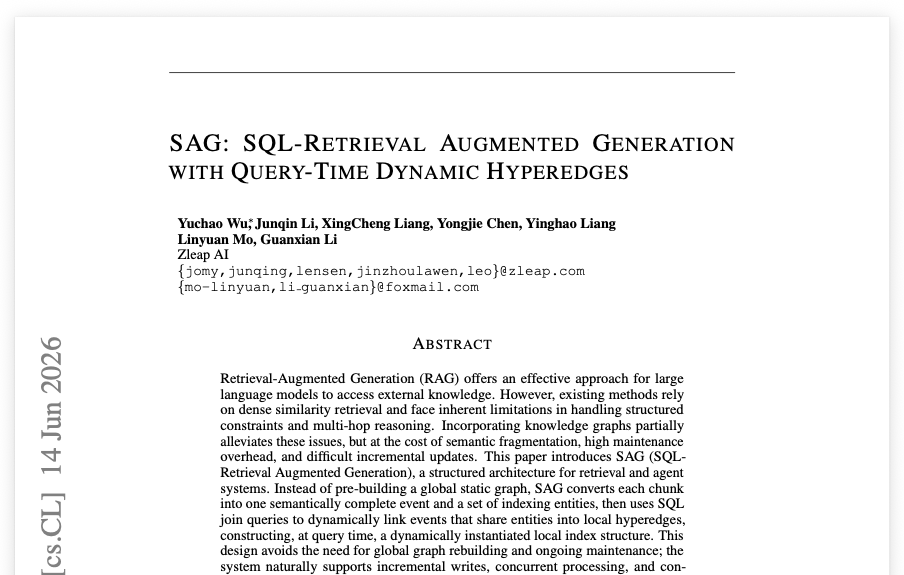
SAG: SQL-Retrieval Augmented Generation with Query-Time Dynamic Hyperedges
Yuchao Wu*, Junqin Li, XingCheng Liang, Yongjie Chen, Yinghao Liang, Linyuan Mo, and Guanxian Li
Read the paper · Reproduce the benchmark
An original third architecture
Traditional dense RAG retrieves chunks mainly by semantic similarity. GraphRAG adds offline graph construction, but pays for triple extraction, entity merging, relation normalization, global maintenance, and difficult incremental updates.
SAG does not wrap those two systems. It replaces that choice with its own data model and execution path:
chunk → one semantically complete event
chunk → multiple indexing entities
event ↔ entities → one latent hyperedge
- Event carries the complete meaning of a chunk. It is not fragmented into independent triples.
- Entity is a lightweight index and expansion point, not a replacement for the event's meaning.
- Query-time dynamic hyperedge is created locally when SQL joins events that share entities around the current query. SAG does not pre-build or globally maintain those hyperedges.
- Original evidence remains the output boundary. Selected events always map back to source chunks for generation and citation.
The semantic and structural paths inside SAG are native parts of the SAG pipeline. They are not a traditional RAG service and a GraphRAG service running side by side.
How retrieval works
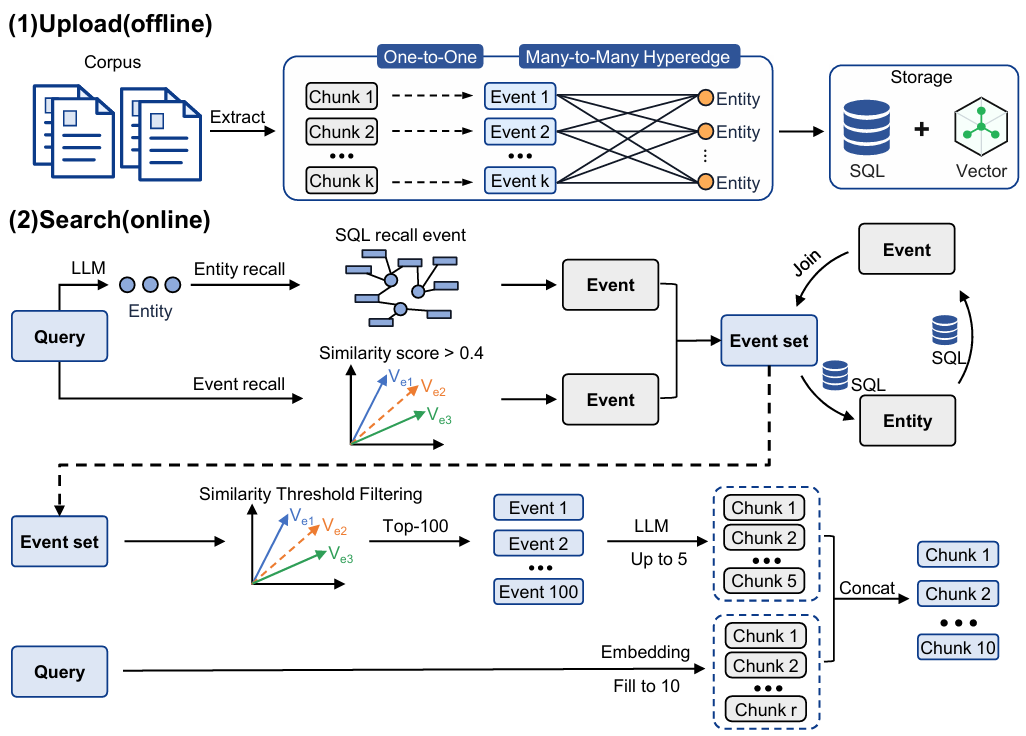
Offline indexing
- Parse a document into semantically coherent chunks.
- Extract one event and multiple entities from each chunk in parallel.
- Persist chunks, events, entities, and event-entity associations to relational storage.
- Persist chunk, event, and entity representations to vector/full-text indexes.
Online retrieval
- Find seed entities and events using semantic and lexical signals.
- Use SQL joins over shared entities to expand from seed events into a local candidate space.
- Instantiate only the hyperedges relevant to this query; no global graph traversal or rebuild is required.
- Select the strongest event and direct-chunk candidates, deduplicate them, and return the original evidence chunks.
This makes incremental writes natural: a new chunk adds its own event, entities, and associations without recomputing a global graph.
A new SOTA for RAG
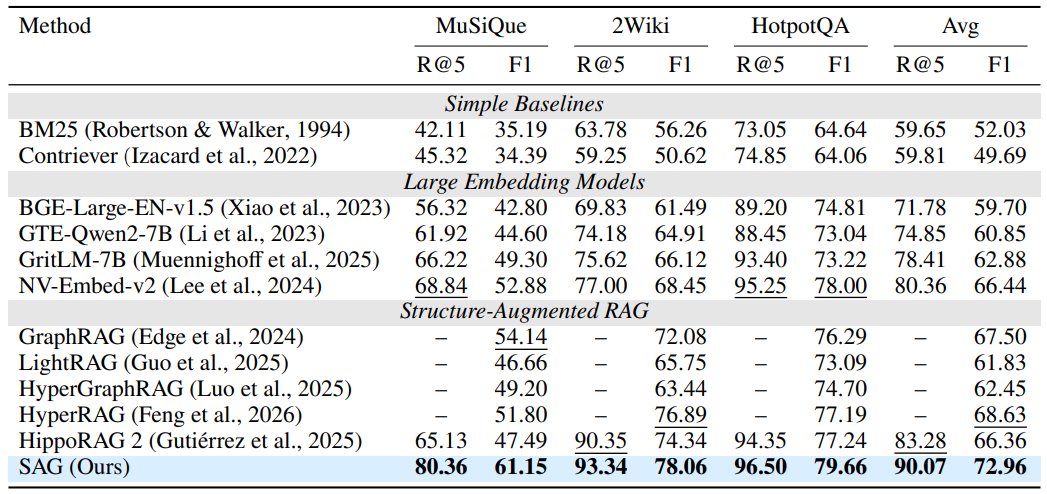
Under the same BGE-Large-EN-v1.5 embedding and Qwen3.6-Flash LLM configuration, SAG achieves the best retrieval and end-to-end QA performance on every benchmark across HotpotQA, 2WikiMultiHopQA, and MuSiQue.
- Across the three datasets, SAG averages 90.07%/72.96% in Recall@5 and F1, outperforming the strongest baseline for each metric by 6.79/4.33 percentage points, respectively.
- On the most challenging MuSiQue dataset, SAG outperforms the strongest baseline for each metric by 11.52/7.01 percentage points in Recall@5 and F1, respectively.
Full results:
See the paper and SAG-Benchmark for the full method and reproduction scripts.
User Guide
Desktop app (easiest)
Download the latest desktop installer from GitHub Releases:
| Platform | Download | Update behavior |
|---|---|---|
| macOS 15+, Apple Silicon | SAG-*-mac-arm64.dmg |
Signed, notarized, and updated through the stable channel |
| Windows 10/11, x64 | SAG-Setup-*-win-x64.exe |
Unsigned for now; Windows may show an unknown-publisher warning; stable automatic updates remain supported |
The desktop app bundles the Web workspace and local knowledge backend