ROAPI


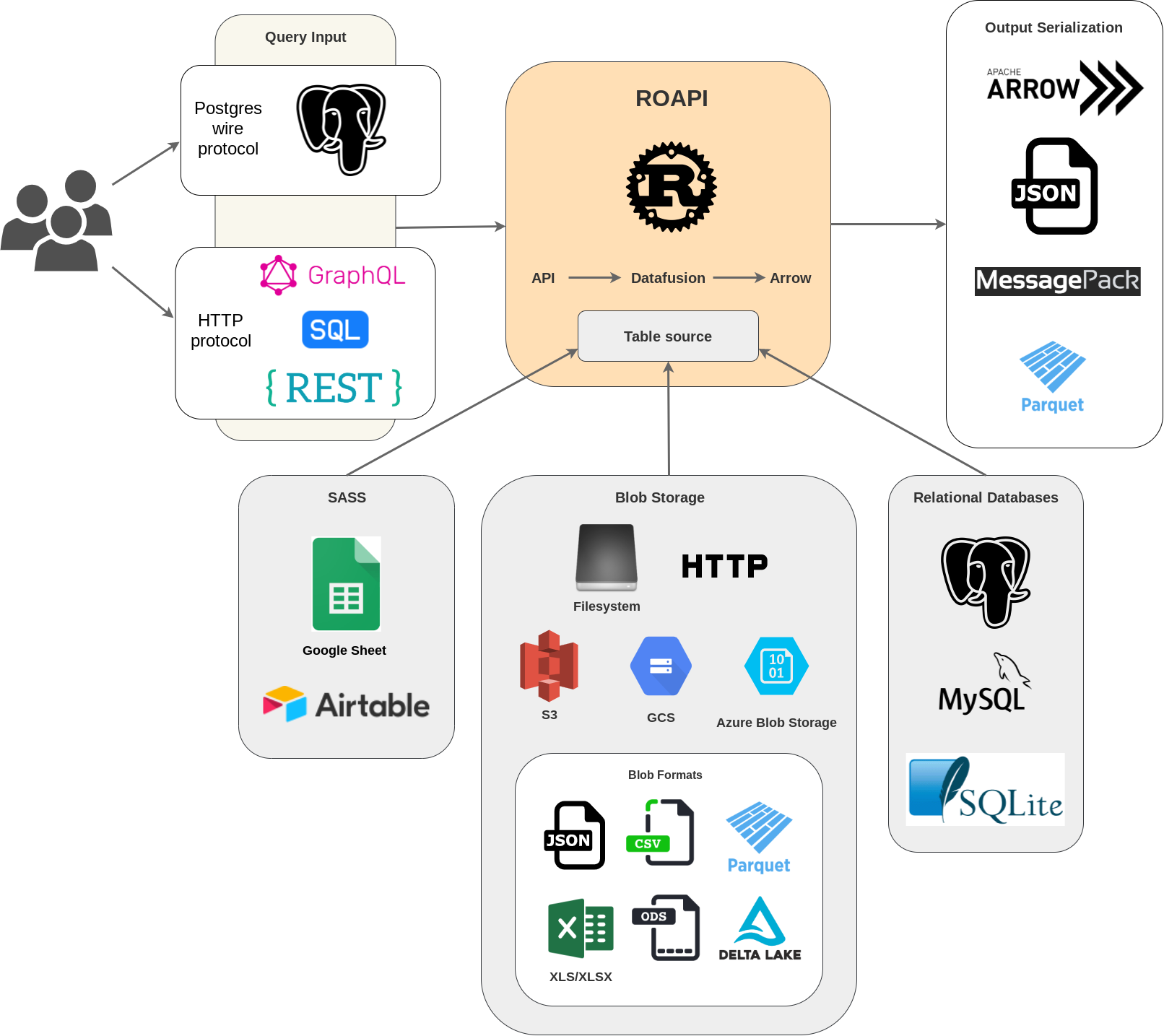
ROAPI automatically spins up read-only APIs for static datasets without requiring you to write a single line of code. It builds on top of Apache Arrow and Datafusion. The core of its design can be boiled down to the following:
- Query frontends to translate SQL, FlightSQL, GraphQL and REST API queries into Datafusion plans.
- Datafusion for query plan execution.
- Data layer to load datasets from a variety of sources and formats with automatic schema inference.
- Response encoding layer to serialize intermediate Arrow record batch into various formats requested by client.
See below for a high level diagram:
Installation
Install pre-built binary
# if you are using homebrew
brew install roapi
# or if you prefer pip
pip install roapi
Check out Github release page for pre-built binaries for each platform. Pre-built docker images are also available at ghcr.io/roapi/roapi.
Install from source
cargo install --locked --git https://github.com/roapi/roapi --branch main --bins roapi
Usage
Quick start
Spin up APIs for test_data/uk_cities_with_headers.csv and
test_data/spacex_launches.json:
roapi \
    --table "uk_cities=test_data/uk_cities_with_headers.csv" \
    --table "test_data/spacex_launches.json"
Or using docker:
docker run -t --rm -p 8080:8080 ghcr.io/roapi/roapi:latest --addr-http 0.0.0.0:8080 \
    --table "uk_cities=test_data/uk_cities_with_headers.csv" \
    --table "test_data/spacex_launches.json"
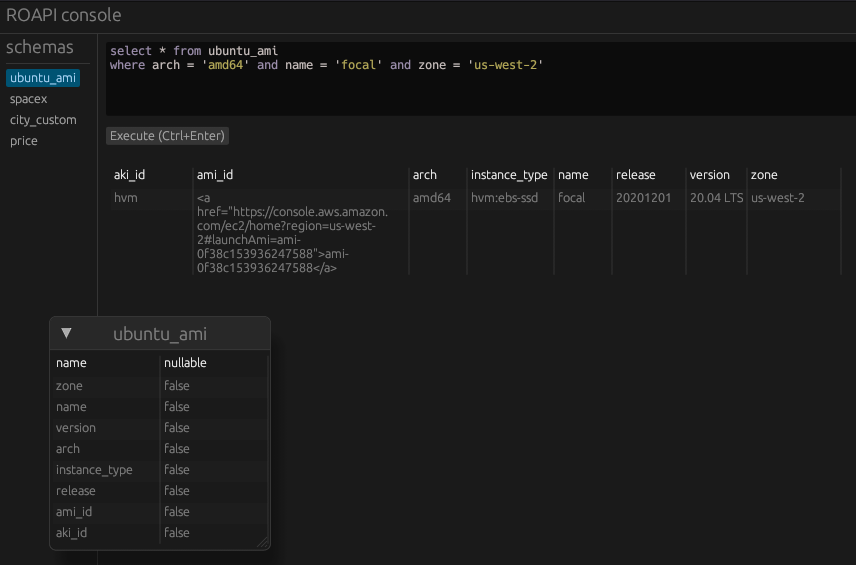
Query data using the builtin web UI at http://localhost:8080/ui:
Query data using SQL, GraphQL or REST via curl:
curl -X POST -d "SELECT city, lat, lng FROM uk_cities LIMIT 2" localhost:8080/api/sql
curl -X POST -d "query { uk_cities(limit: 2) {city, lat, lng} }" localhost:8080/api/graphql
curl "localhost:8080/api/tables/uk_cities?columns=city,lat,lng&limit=2"
Get inferred schema for all tables:
curl 'localhost:8080/api/schema'
For MySQL and SQLite, specify the table argument like below:
--table "table_name=mysql://username:password@localhost:3306/database"
--table "table_name=sqlite://path/to/database"
Want dynamic register data? Add parameter -d to command. --table parameter cannot be ignored for now.
roapi \
    --table "uk_cities=test_data/uk_cities_with_headers.csv" \
    -d
Then post config to /api/table register data.
curl -X POST http://172.24.16.1:8080/api/table \
     -H 'Content-Type: application/json' \
     -d '[
       {
         "tableName": "uk_cities2",
         "uri": "./test_data/uk_cities_with_headers.csv"
       },
       {
         "tableName": "table_name",
         "uri": "sqlite://path/to/database"
       }
     ]'
For windows, full scheme(file:// or filesystem://) must filled, and use double quote(") instead of single quote(') to escape windows cmdline limit:
roapi \
    --table "uk_cities=file://d:/path/to/uk_cities_with_headers.csv" \
    --table "file://d:/path/to/test_data/spacex_launches.json"
Config file
You can also configure multiple table sources using YAML or Toml config, which supports more advanced format specific table options:
addr:
  http: 0.0.0.0:8080
  postgres: 0.0.0.0:5433
tables:
  - name: "blogs"
    uri: "test_data/blogs.parquet"

  - name: "ubuntu_ami"
    uri: "test_data/ubuntu-ami.json"
    option:
      format: "json"
      pointer: "/aaData"
      array_encoded: true
    schema:
      columns:
        - name: "zone"
          data_type: "Utf8"
        - name: "name"
          data_type: "Utf8"
        - name: "version"
          data_type: "Utf8"
        - name: "arch"
          data_type: "Utf8"
        - name: "instance_type"
          data_type: "Utf8"
        - name: "release"
          data_type: "Utf8"
        - name: "ami_id"
          data_type: "Utf8"
        - name: "aki_id"
          data_type: "Utf8"

  - name: "spacex_launches"
    uri: "https://api.spacexdata.com/v4/launches"
    option:
      format: "json"

  - name: "github_jobs"
    uri: "https://web.archive.org/web/20210507025928if_/https://jobs.github.com/positions.json"
To run serve tables using config file:
roapi -c ./roapi.yml # or .toml
See config documentation for more options including using Google spreadsheet as a table source.
Response serialization
By default, ROAPI encodes responses in JSON format, but you can request
different encodings by specifying the ACCEPT header:
curl -X POST \
    -H 'ACCEPT: application/vnd.apache.arrow.stream' \
    -d "SELECT launch_library_id FROM spacex_launches WHERE launch_library_id IS NOT NULL" \
    localhost:8080/api/sql
REST API query interface
You can query tables through REST API by sending GET requests to
/api/tables/{table_name}. Query operators are specified as query params.
REST query frontend currently supports the following query operators:
- columns
- sort
- limit
- filter
To sort column col1 in ascending order and col2 in descending order, set
query param to: sort=col1,-col2.
To find all rows with col1 equal to string 'foo', set query param to:
filter[col1]='foo'. You can also do basic comparisons with filters, for
example predicate 0 <= col2 < 5 can be expressed as
filter[col2]gte=0&filter[col2]lt=5.
GraphQL query interface
To query tables using GraphQL, send the query through POST request to
/api/graphql endpoint.
GraphQL query frontend supports the same set of operators supported by REST query frontend. Here how is you can apply various operators in a query:
{
  table_name(
    filter: { col1: false, col2: { gteq: 4, lt: 1000 } }
    sort: [{ field: "col2", order: "desc" }, { field: "col3" }]
    limit: 100
  ) {
    col1
    col2
    col3
  }
}
SQL query interface
To query tables using a subset of standard SQL, send the query through POST
request to /api/sql endpoint. This is the only query interface that supports
table joins.
Key value lookup
You can pick two columns from a table to use a key and value to create a quick keyvalue store API by adding the following lines to the config:
kvstores:
  - name: "launch_name"
    uri: "test_data/spacex_launches.json"
    key: id
    value: name
Key value lookup can be done through simple HTTP GET requests:
curl -v localhost:8080/api/kv/launch_name/600f9a8d8f798e2a4d5f979e
Starlink-21 (v1.0)%
Query through Postgres wire protocol
ROAPI can present itself as a Postgres server so users can use Postgres clients to issue SQL queries.
$ psql -h 127.0.0.1
psql (12.10 (Ubuntu 12.10-0ubuntu0.20.04.1), server 13)
WARNING: psql major version 12, server major version 13.
         Some psql features might not work.
Type "help" for help.

houqp=> select count(*) from uk_cities;
 COUNT(UInt8(1))
-----------------
              37
(1 row)
Features
Query layer:
- REST API GET
- GraphQL
- SQL
- join between tables
- access to array elements by index
- access to nested struct fields by key
- column index
- protocol
- Postgres
- FlightSQL
- Key value lookup
Response serialization:
- JSON
application/json - Arrow
application/vnd.apache.arrow.stream - Parquet
application/vnd.apache.parquet - msgpack
Data layer:
- filesystem
- HTTP/HTTPS
- S3
- GCS
- Azure Storage
- Google spreadsheet
- MySQL
- SQLite
- Postgres
- Airtable
- Data format
- CSV
- JSON
- NDJSON
- parquet
- xls, xlsx, xlsb, ods: https://github.com/tafia/calamine
- DeltaLake
Misc:
- auto gen OpenAPI doc for rest layer
- query input type conversion based on table schema
- stream arrow encoding response
- authentication layer
Development
The core of ROAPI, including query front-ends and data layer, lives in the self-contained [columnq](https:/