
Rivet Actors are the primitive for stateful workloads.
Built for AI agents, collaborative apps, and durable execution.
Quickstart • Documentation • Changelog • Discord • X
What is Rivet?
Rivet Actors are long-running, lightweight processes designed for stateful workloads. State lives in-memory with automatic persistence. Create one per agent, per session, or per user — with built-in workflows, queues, and scheduling.
Backend
const agent = actor({
  // In-memory, persisted state for the actor
  state: { messages: [] as Message[] },

  // Long-running actor process
  run: async (c) => {
    // Process incoming messages from the queue
    for await (const msg of c.queue.iter()) {
      c.state.messages.push({ role: "user", content: msg.body.text });
      const response = streamText({ model: openai("gpt-5"), messages: c.state.messages });

      // Stream realtime events to all connected clients
      for await (const delta of response.textStream) {
        c.broadcast("token", delta);
      }

      c.state.messages.push({ role: "assistant", content: await response.text });
    }
  },
});
Client (frontend or backend)
// Connect to an actor
const agent = client.agent.getOrCreate("agent-123").connect();

// Listen for realtime events
agent.on("token", delta => process.stdout.write(delta));

// Send message to actor
await agent.queue.send("how many r's in strawberry?");
Features
One Actor per agent, per session, per user — state, storage, and networking included.
Rivet provides:
- In-memory state — Co-located with compute for instant reads and writes. Persist with SQLite or BYO database.
- Runs indefinitely, sleeps when idle — Long-lived when active, hibernates when idle.
- Scales infinitely, scales to zero — Supports bursty workloads and is cost-efficient.
- Global edge network — Deploy close to your users or in specific legal jurisdictions without complexity.
Actors support:
- WebSockets — Real-time bidirectional streaming built in.
- Workflows — Multi-step operations with automatic retries.
- Queues — Durable message queues for reliable async processing.
- Scheduling — Timers and cron jobs within your actor.
Use Cases
One primitive that adapts to agents, workflows, collaboration, and more.
- AI Agent — Each agent runs as its own actor with persistent context, memory, and the ability to schedule tool calls.
- Sandbox Orchestration — Coordinate sandbox sessions, queue work, and schedule cleanup in one long-lived actor per workspace.
- Workflows — Multi-step operations with automatic retries, scheduling, and durable state across steps.
- Collaborative Documents — Real-time collaborative editing where each document is an actor broadcasting changes to all connected users.
- Per-Tenant Database — One actor per tenant with low-latency in-memory reads and durable tenant data persistence.
- Chat — One actor per room or conversation with in-memory state, persistent history, and realtime delivery.
How Actors Compare
Rivet Actors vs. Traditional Infrastructure
| Metric | Rivet Actor | Kubernetes Pod | Virtual Machine |
|---|---|---|---|
| Cold start | ~20ms | ~6s | ~30s |
| Memory per instance | ~0.6KB | ~50MB | ~512MB |
| Idle cost | $0 | ~$85/mo (cluster) | ~$5/mo |
| Horizontal scale | Infinite | ~5k nodes | Manual |
| Multi-region | Global edge | 1 region | 1 region |
State
| Metric | Rivet Actor | Redis | Postgres |
|---|---|---|---|
| Read latency | 0ms | ~1ms | ~5ms |
Benchmark details & methodology
Cold Start
- Rivet Actor (~20ms): Includes durable state init, not just a process spawn. No actor key, so no cross-region locking. Measured with Node.js and FoundationDB.
- Kubernetes Pod (~6s): Node.js 24 Alpine image (56MB compressed) on AWS EKS with a pre-provisioned m5.large node. Breakdown: ~1s image pull and extraction, ~3-4s scheduling and container runtime setup, ~1s container start.
- Virtual Machine (~30s): AWS EC2 t3.nano from launch to SSH-ready, using an Amazon Linux 2 AMI. t3.nano is the smallest available EC2 instance (512MB RAM).
Memory Per Instance
- Rivet Actor (~0.6KB): RSS delta divided by actor count, measured by spawning 10,000 actors in Node.js v24 on Linux x86.
- Kubernetes Pod (~50MB): Minimum idle Node.js container on Linux x86: Node.js v24 runtime (~43MB RSS), containerd-shim (~3MB), pause container (~1MB), and kubelet per-pod tracking (~2MB).
- Virtual Machine (~512MB): AWS EC2 t3.nano, the smallest available EC2 instance with 512MB allocated memory.
Read Latency
- Rivet Actor (0ms): State is read from co-located SQLite/KV storage on the same machine as the actor, with no network round-trip.
- Redis (~1ms): AWS ElastiCache Redis (cache.t3.micro) in the same availability zone as the application.
- Postgres (~5ms): AWS RDS PostgreSQL (db.t3.micro) in the same availability zone as the application.
Idle Cost
- Rivet Actor ($0): Assumes Rivet Actors running on a serverless platform. Actors scale to zero with no idle infrastructure costs. Traditional container deployments may incur idle costs.
- Virtual Machine (~$5/mo): AWS EC2 t3.nano ($0.0052/hr compute + $1.60/mo for 20GB gp3 storage) running 24/7. t3.nano is the smallest available EC2 instance (512MB RAM).
- Kubernetes Cluster (~$85/mo): AWS EKS control plane ($73/mo) plus a single t3.nano worker node with 20GB gp3 storage, running 24/7.
Horizontal Scale
- Rivet Actors (Infinite): Scale linearly by adding nodes with no single cluster size limit.
- Kubernetes (~5k nodes): Officially supports clusters of up to 5,000 nodes per the Kubernetes scalability documentation.
Multi-Region
- Rivet (Global edge network): Automatically spawns actors near your users and handles routing across regions.
Built-In Observability
Powerful debugging and monitoring tools from local development to production at scale.
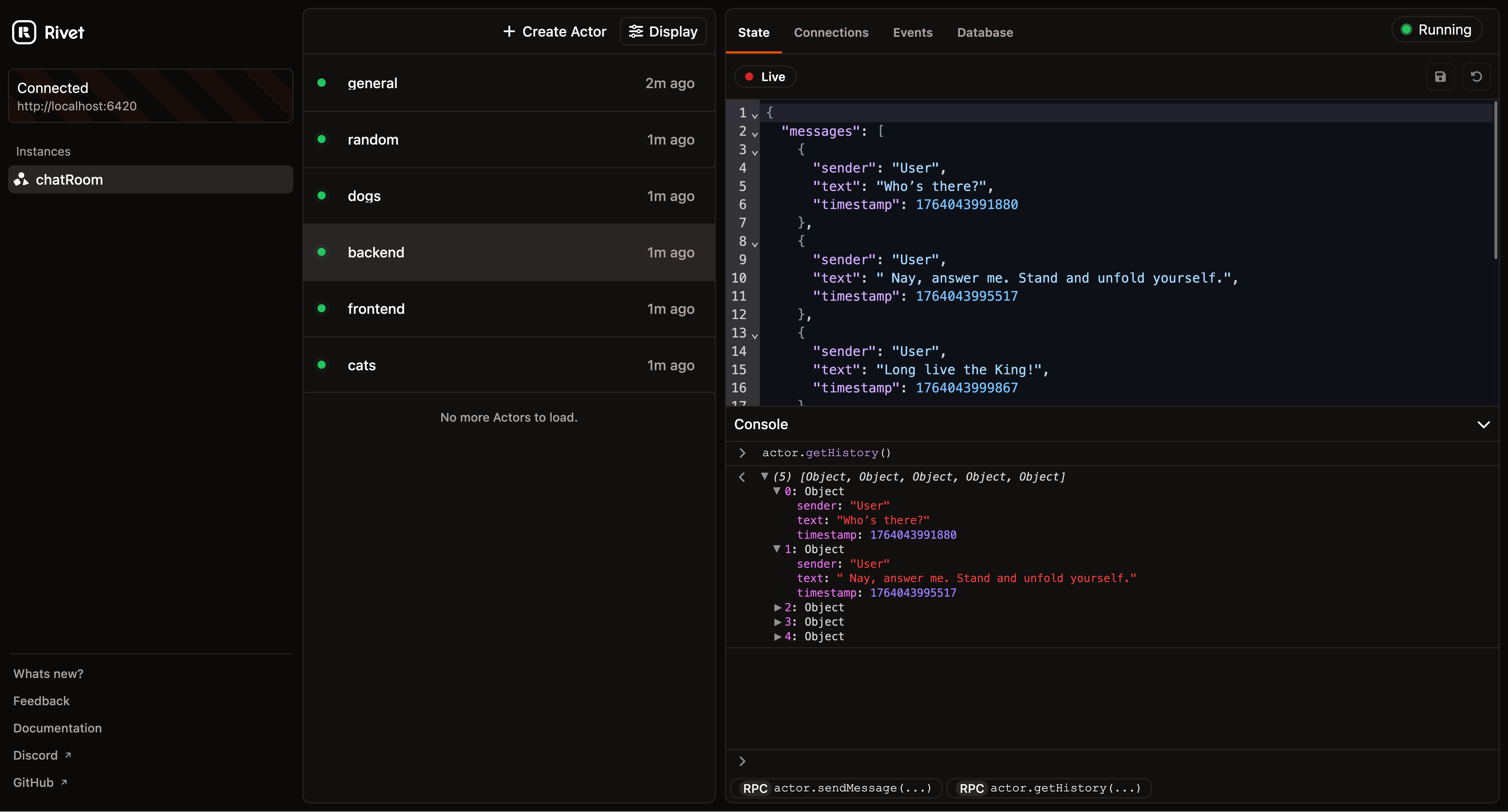
- SQLite Viewer — Browse and query your actor's SQLite database in real-time
- Workflow State — Inspect workflow progress, steps, and retries as they execute
- Event Monitoring — Track every state change and action as it happens
- REPL — Call actions, subscribe to events, and interact directly with your code
Deployment Options
RivetKit is a library. Connect it to Rivet Cloud or self-host when you need scaling, fault tolerance, and observability.
Just a LibraryInstall a package and run locally. No servers, no infrastructure. Actors run in your process during development. |
Self-HostSingle Rust binary or Docker container. Works with Postgres, file system, or FoundationDB. |
Rivet CloudFully managed. Global edge network. Connects to your existing cloud — Vercel, Railway, AWS, wherever you already deploy. |
Open source, permissively licensed — Self-hosting matters for enterprise deployments, cloud portability, and avoiding vendor lock-in. Apache 2.0 means you own your infrastructure. View on GitHub →
Getting Started
Use with Your Coding AgentGive your coding agent the Rivet skills to create examples or integrate into existing projects: Works with Claude Code, Cursor, Windsurf, and other AI coding tools. |
Start From Scratch[View documentation →](https://www.rivet.d readme truncated — read the full docs on github Frequently asked questionsIs Rivet free to use?Rivet is open source under the Apache-2.0 licence. There is no licence fee and no seat count — you can self-host it or, where the project offers one, pay a vendor for a managed version instead. What does Rivet do?Build stateful backends with in-memory actors What is Rivet written in?Rivet is primarily written in Rust. Its source is publicly available at https://github.com/rivet-dev/rivet, and it has 6,144 GitHub stars. |