repowise is a free, open source documentation & knowledge base project written in Python and released under AGPL-3.0. It has 6,695 GitHub stars, 703 forks and 223 open issues, and was last pushed 76 minutes ago. On this registry it ranks #23 of 91 tracked projects in Documentation & Knowledge Base, with 5 head-to-head comparisons available.
What is repowise?
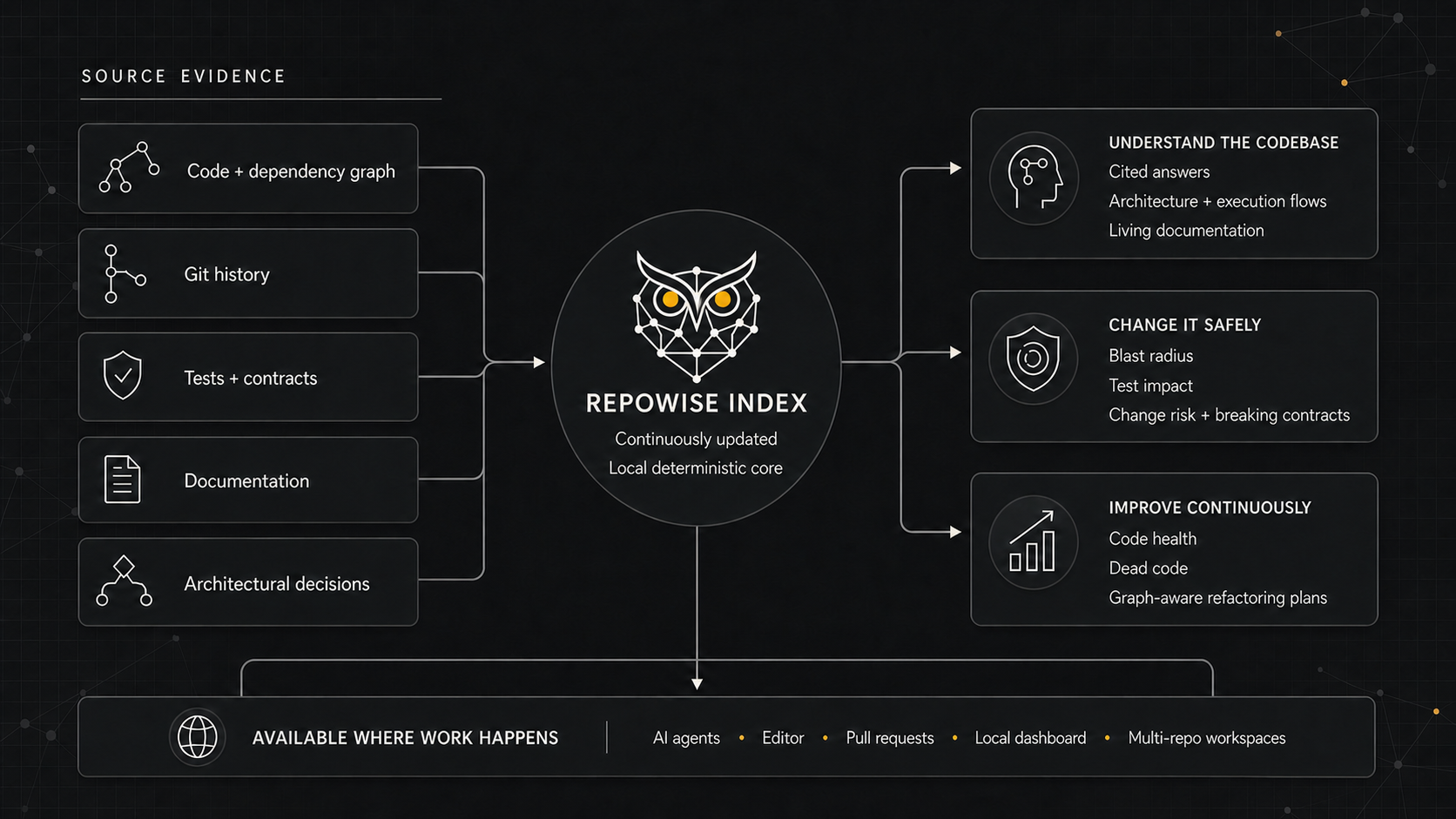
Repowise is a self-hosted, AGPL-3.0 codebase intelligence tool that indexes a repository once — code, dependency graph, git history, tests, documentation and decisions — and then serves cited answers, change-impact analysis and code-health findings to coding agents and developers through MCP.
What it is
Repowise is a Python developer tool that builds a local index of a repository and exposes that index through several surfaces: a dashboard, MCP tools for coding agents and editors, pull-request analysis, and a cross-repository system map. It is written in Python, licensed under AGPL-3.0 with a commercial option, and lives in the MCP ecosystem, where it presents itself as an MCP host-compatible server alongside agents such as Claude Code, Codex and Cursor. The index covers code, the dependency graph, git history, tests, documentation and architectural decisions, and the README stresses that graph, risk, health, test-selection, dead-code and PR-review analysis involve zero LLM calls, with generated prose remaining optional. Analysis stays on the operator's own infrastructure, and no API key is required.
The concrete problem it targets is agent rediscovery. Each question an agent asks about a repository — who calls this function, what breaks if this file changes, why the code is written this way, which files are actually dangerous — has an answer that could have been computed ahead of time, yet without an index the agent rediscovers it on every task by grepping, reading and re-reading. Repowise builds that answer set once and returns task-shaped, cited context instead, so the same evidence reaches the agent, the editor, the pull request, the local dashboard and the cross-repository map.
Key capabilities
Builds a local index through pip install repowise, repowise init --no-prose -y and repowise serve, covering graph, git, decisions, health, dead-code and structural-wiki layers.
Exposes MCP tools such as get_overview, and answers natural questions like "What breaks if I change src/auth.py?" with symbol-level blast radius.
Produces a defect-validated 1–10 code health score across defect risk, maintainability and performance, separating maintainability risk from performance risk.
Detects dead code, defect-prone files and missing companion files, and hands concrete graph-aware refactoring plans to an agent.
Returns change intelligence before merge: symbol-level callers, co-change partners, breaking contracts, and a measured or graph-inferred test run list for a diff.
Supports workspaces that match backend and frontend contracts, catch breaking providers, map downstream services and enforce architecture rules across repositories through one MCP endpoint.
Provides always-current generated documentation and recovers the decisions behind the code.
Who uses it and how
Developers running a coding agent over a repository who want fewer tool calls and a smaller context payload per task.
Reviewers who need change risk, callers, co-change partners and a test run list before a pull request merges.
Teams operating more than one repository that need contract matching and architecture rules across an estate.
Engineering organizations rolling the tool out broadly, keeping analysis on their own infrastructure so agents and reviewers see the same evidence.
Install with pip install repowise, then run cd /path/to/your/repo, repowise init --no-prose -y and repowise serve; init wires Claude Code automatically, and the dashboard or any MCP host can be connected instead.
How it compares
No competing or paid products are named in the facts for this entry, so no licence, hosting or cost contrast can be drawn honestly. Repowise stands alone in this registry on the evidence available.
When to use it — and when not to
Choose it when local, no-API-key indexing of a Python or mixed repository with MCP delivery to agents is the goal, and when AGPL-3.0 or a commercial licence is acceptable. The project carries 223 open issues, so operators should expect active bug traffic. Teams that cannot accept AGPL-3.0, do not want to buy commercial licensing, or want a fully hosted service with no local indexing should look elsewhere; the facts do not state which database, storage or mail services a self-hoster must operate.
project readme (upstream, from github) — read inline
Understand your codebase without paying your agent to rediscover it.
Repowise indexes your code, dependency graph, git history, tests,
documentation, and decisions once, then gives agents and developers cited answers,
change impact, and concrete code-health fixes.
−31.6%
97.2%
2.3×
less agent output 3.8 vs 7.2 tool calls n=43 · p<0.0001
smaller context payload 393 vs 13,984 tokens 30 Flask commits
more defects surfaced same 20%-of-lines budget 2,770 files · p=0.003
Graph accuracy leader at matched coverage.
No tool finding as much was more precise in all 7 compiler-graded cells. 5 tools · 37,853 oracle edges
Zero LLM calls for graph, risk, health, tests,
dead code, and PR review. Generated prose is optional. Every benchmark publishes its
sample, method, limitations, and losing rows.
Free and self-hosted · core analysis stays on your infrastructure · no API key needed ·
AGPL-3.0 or commercial
Ask cited questions · explore architecture and execution flows · read always-current docs · recover the decisions behind the code
See symbol-level blast radius · run only the tests a diff exercises · catch missing companion files · detect breaking contracts before merge
Find defect-prone files · separate maintainability from performance risk · remove dead code · hand concrete, graph-aware refactoring plans to an agent
These are not disconnected scanners. The graph locates what git history flags; code
health measures it; tests show what guards it; decisions explain why it exists; and
the same evidence reaches your agent, editor, pull request, local dashboard, and
cross-repository system map.
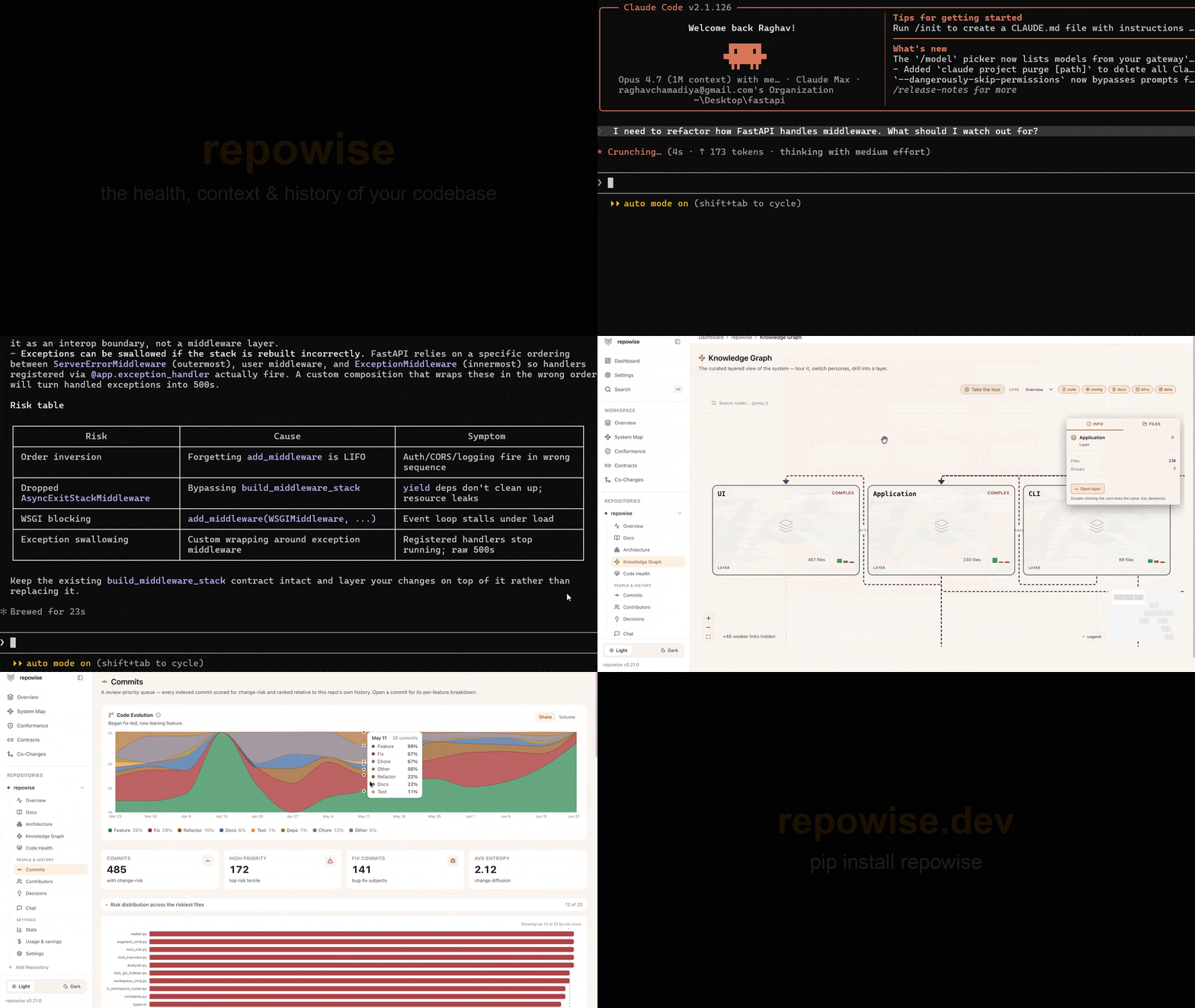
A dashboard tour recorded on this repository. The same local index powers the UI,
MCP tools, editor views, and PR analysis. No API key and nothing uploaded.
Pick your front door
If you care about…
Start here
A coding agent that understands the repository
Repowise finds the right files, returns task-shaped context in fewer calls, and proactively supplies decisions and risk. For agents ↓
Safer pull requests and faster test feedback
Get change risk, symbol-level callers, co-change partners, and a measured or graph-inferred test run list before merge. Change intelligence ↓
Finding and fixing the code most likely to hurt you
A defect-validated 1–10 health score across defect risk, maintainability, and performance, followed by the concrete refactoring plan. Code health ↓
Understanding an estate, not one repository
Match backend and frontend contracts, catch breaking providers, map downstream services, enforce architecture rules, and query every repo through one MCP endpoint. Workspaces ↓
Rolling this out across an engineering organization
Keep analysis on your infrastructure, give agents and reviewers the same evidence, and add commercial licensing, security controls, custom extensions, and SLA-backed support. Teams and enterprise ↓
That builds the graph, git, decisions, health, dead-code and structural-wiki layers
locally. Connect Claude Code, Codex, Cursor or any MCP host, or open the dashboard.
init wires Claude Code automatically. Then ask your agent: "Use Repowise
get_overview to summarize this repository" or "What breaks if I change
src/auth.py?"
Every question your agent asks about a repository has an answer that could have been
computed ahead of time. Who calls this function? What breaks if I change it? Why is
it written this way? Which files are actually dangerous? Without an index, the agent
rediscovers that answer on every task: grep, read, re-read, forget.
Repowise exposes ten task-shaped MCP tools to Claude Code, Codex, Cursor, VS Code
and anything else that speaks MCP: graph, git, docs, decisions, and ten MCP tools
behind one index. See the canonical surface. Most tools are built around data entities (one
file, one symbol), which forces agents into long chains of sequential calls. These are
built around tasks: pass several targets in one call, get complete context back.
Because the exploration work is already done, that phase mostly disappears. In a
measured agent loop across 43 questions on django/django, Repowise cut the agent's
own output by 31.6% (p<0.0001) and reached the answer in 3.8 tool calls
instead of 7.2. That is the end-to-end result.
One mechanism is much larger but narrower: loading a commit's context through
get_context costs 393 tokens instead of 13,984, or 97.2% less. That is one
retrieval payload, not a claim of 97.2% total agent savings. Both measurements and
every competitor row are published in the benchmark report.
And it arrives without being asked. Optional hooks push
context into the session at the moment it matters: the governing architectural
decision when your agent edits a file that decision covers, a warning when it touches
a file with a run of recent bug fixes, a compact briefing at session start. Repowise
also generates your CLAUDE.md and AGENTS.md from the real index, so even an agent
with no MCP support starts informed.
It learns from how you actually work. Switch on transcript capture
(repowise decision source set session --on) and Repowise reads your own agent
transcripts for the corrections you keep making ("use the shared
repowise is open source under the AGPL-3.0 licence. There is no licence fee and no seat count — you can self-host it or, where the project offers one, pay a vendor for a managed version instead.
What does repowise do?
Codebase intelligence for AI and humans: code health scores, auto-generated docs, git analytics, dead code detection, and architectural decisions via MCP.
What is repowise written in?
repowise is primarily written in Python. Its source is publicly available at https://github.com/repowise-dev/repowise, and it has 6,695 GitHub stars.