🧠 ReMemory
A digital safe with multiple keys, held by people you trust.
ReMemory protects your files and divides the key among people you choose. You decide how many must come together to open it. Each person gets a self-contained recovery tool that works offline, in any browser.*
* Time-locked archives need a brief internet connection at recovery time.
Recovery works without this project
Each person receives a bundle containing recover.html — a browser-based recovery tool. No servers. No dependencies. No need for this project to exist when recovery happens.
Download demo bundles to try the recovery process yourself.
graph TB
    subgraph seal["① SEAL (you do this once)"]
        A[Your Files] --> B[Encrypt with age]
        B --> C[Split key into 5 pieces]
        C --> D1[Alice's bundle]
        C --> D2[Bob's bundle]
        C --> D3[Camila's bundle]
        C --> D4[Dominique's bundle]
        C --> D5[Elias's bundle]
    end

    subgraph recover["② RECOVER (friends do this together)"]
        R1[Alice opens recover.html] --> R2[Her piece is pre-loaded]
        R2 --> R3[Drags Bob's file]
        R3 --> R4[Drags Camila's file]
        R4 --> R5{3 of 5 pieces}
        R5 -->|Threshold met| R6[Files unlocked]
        R6 --> R7[Download files]
    end

    D1 -.-> R1
    D2 -.-> R3
    D3 -.-> R4
Any 3 pieces can reconstruct the key, but a single piece reveals nothing — not "very little," mathematically zero information.
The number of people and the threshold are up to you: 2-of-3 for a small circle, 3-of-5 for a wider group, or 2-of-2 for a couple.
Two Ways to Use ReMemory
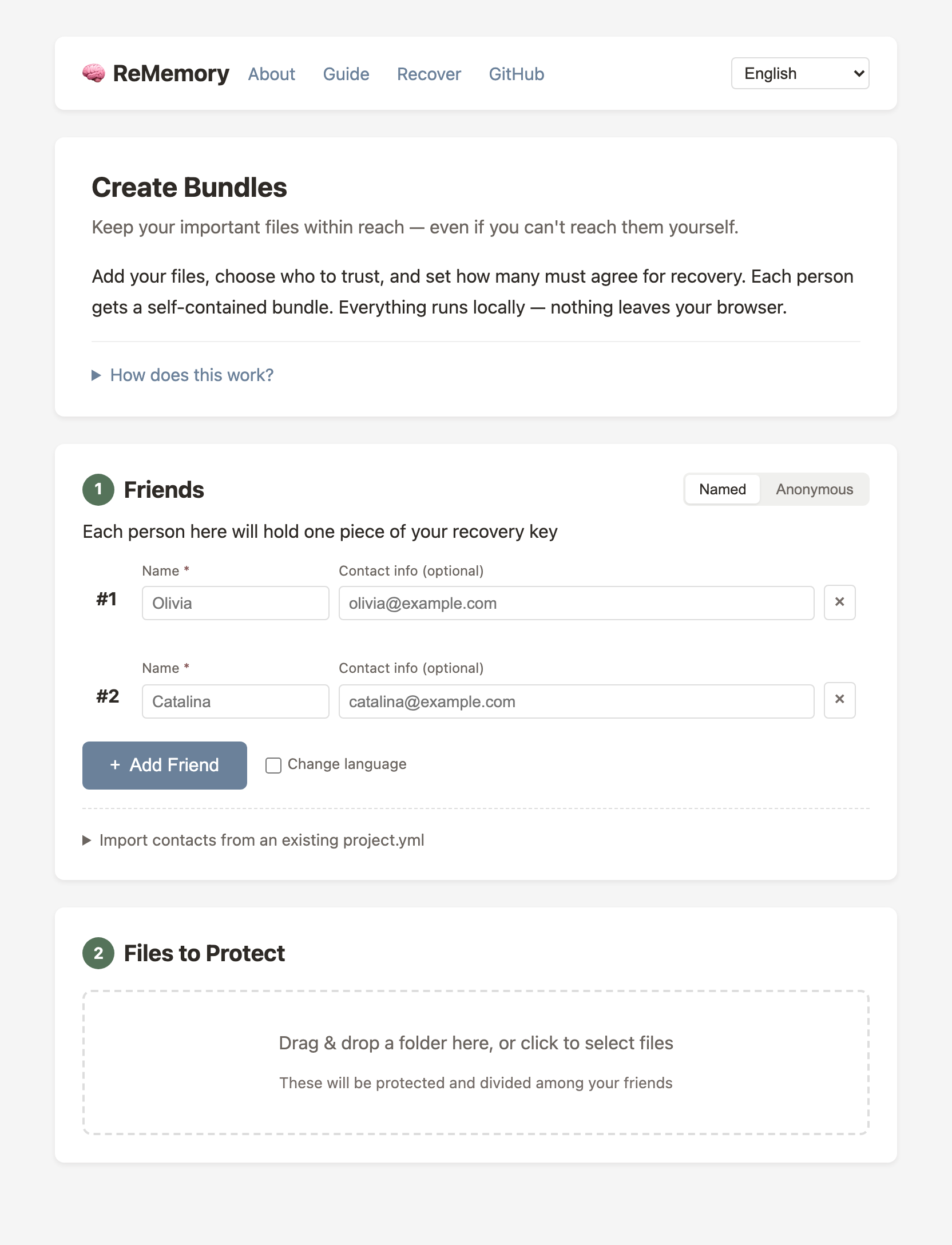
🌐 Web UI (recommended)
Create bundles in your browser — no installation required.
| Create Bundles | eljojo.github.io/rememory/maker.html |
| Documentation | eljojo.github.io/rememory/docs.html |
Everything runs locally. Your files never leave your device.
💻 CLI and Docker
For automation, scripting, or if you prefer the terminal.
# macOS (Homebrew)
brew install eljojo/rememory/rememory

# Linux (x86_64)
curl -Lo rememory https://github.com/eljojo/rememory/releases/latest/download/rememory-linux-amd64
chmod +x rememory
sudo mv rememory /usr/local/bin/

# Docker (self-hosted)
docker run -d \
  --name rememory \
  -p 8080:8080 \
  -v rememory-data:/data \
  ghcr.io/eljojo/rememory:latest

# Nix
nix run github:eljojo/rememory
See the CLI User Guide or the Self-Hosted Guide for complete documentation.
Try It First
Before protecting real secrets, try the recovery process:
- Download demo bundles (5 friends, any 3 can recover)
- Open
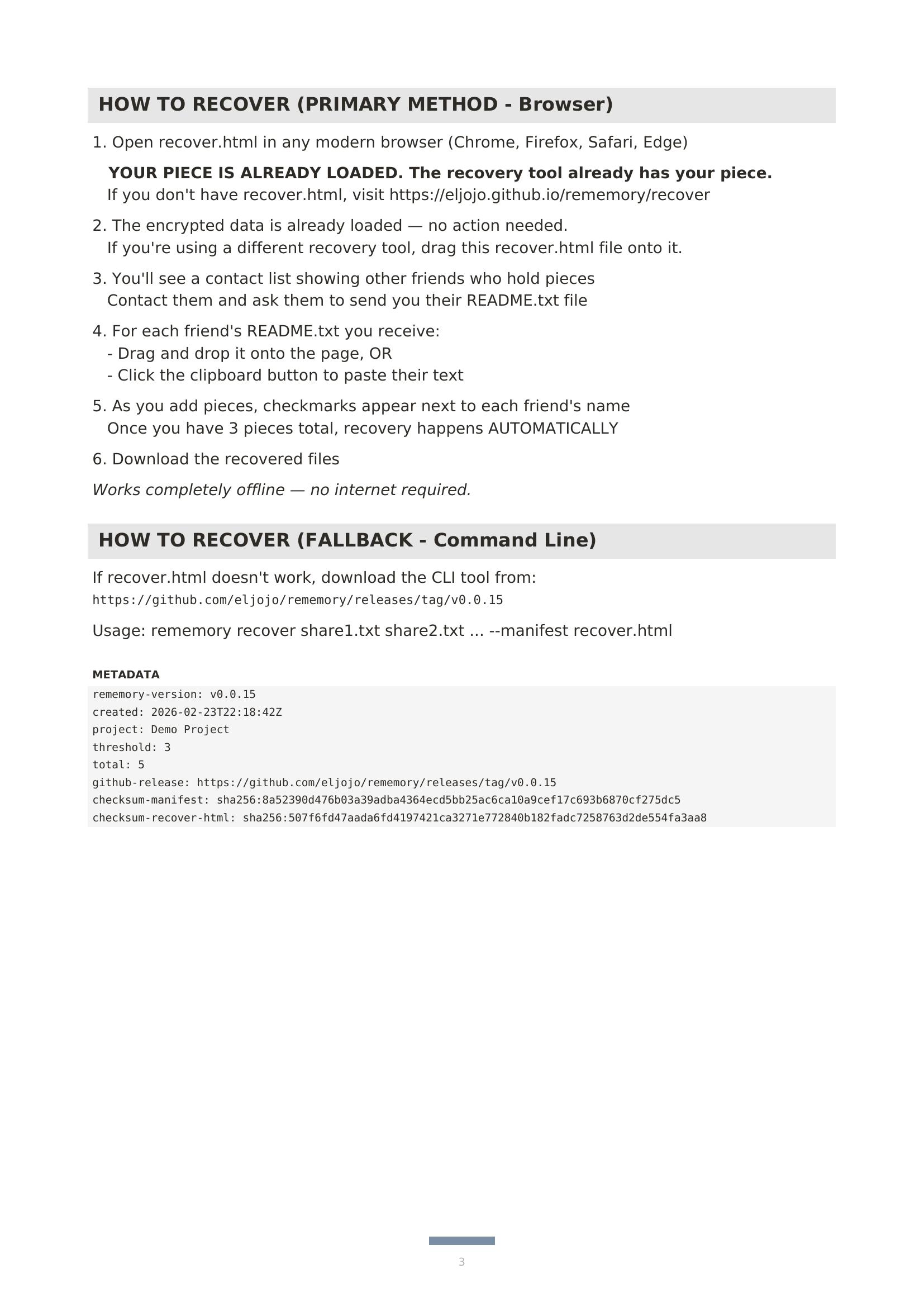
bundle-alice/recover.htmlin your browser - Alice's piece is pre-loaded — drag two more README files onto the page. Dragging an entire bundle works too.
- When enough pieces are combined, the files unlock
This is the closest thing to what a real recovery feels like.
What Friends Receive
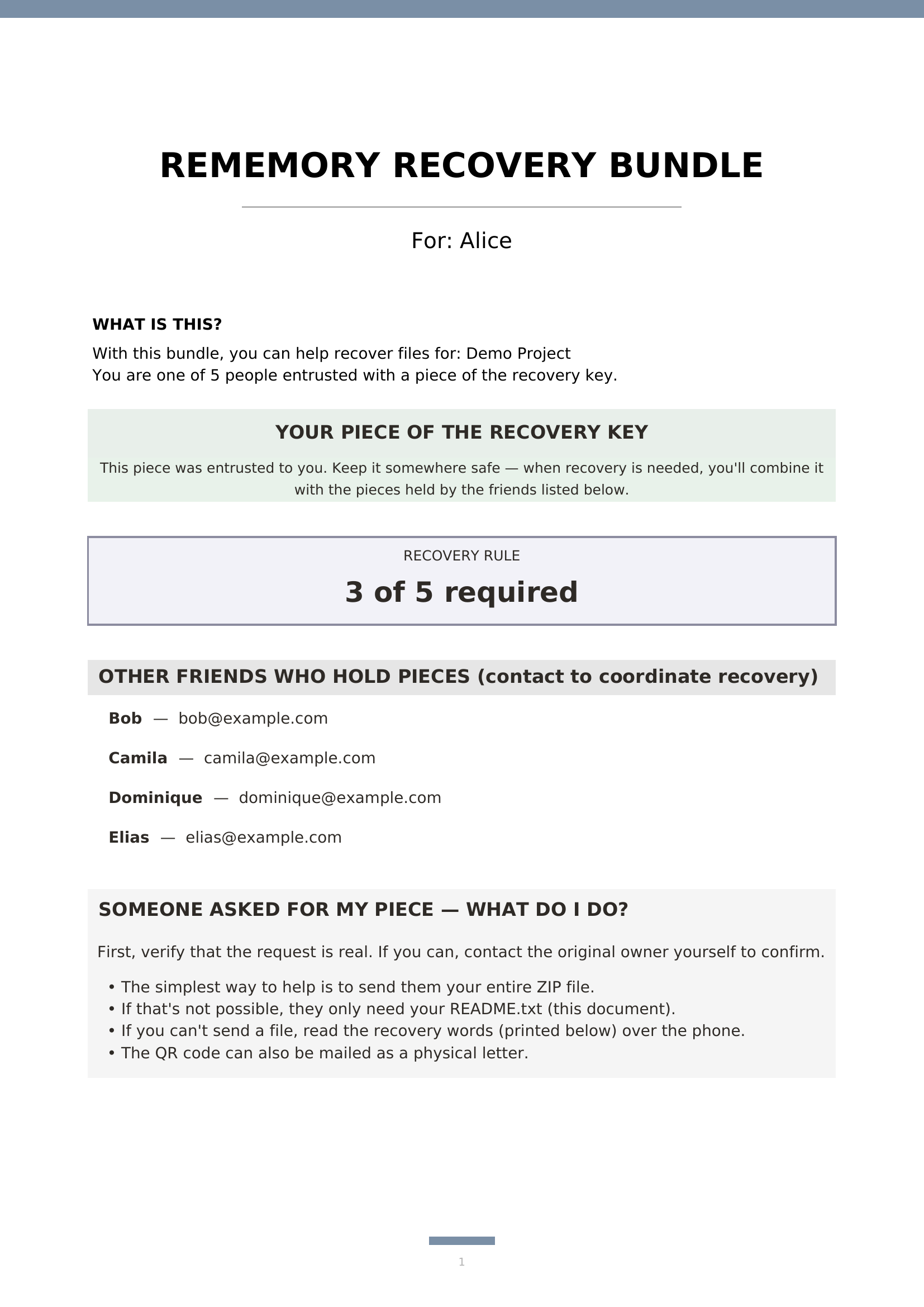
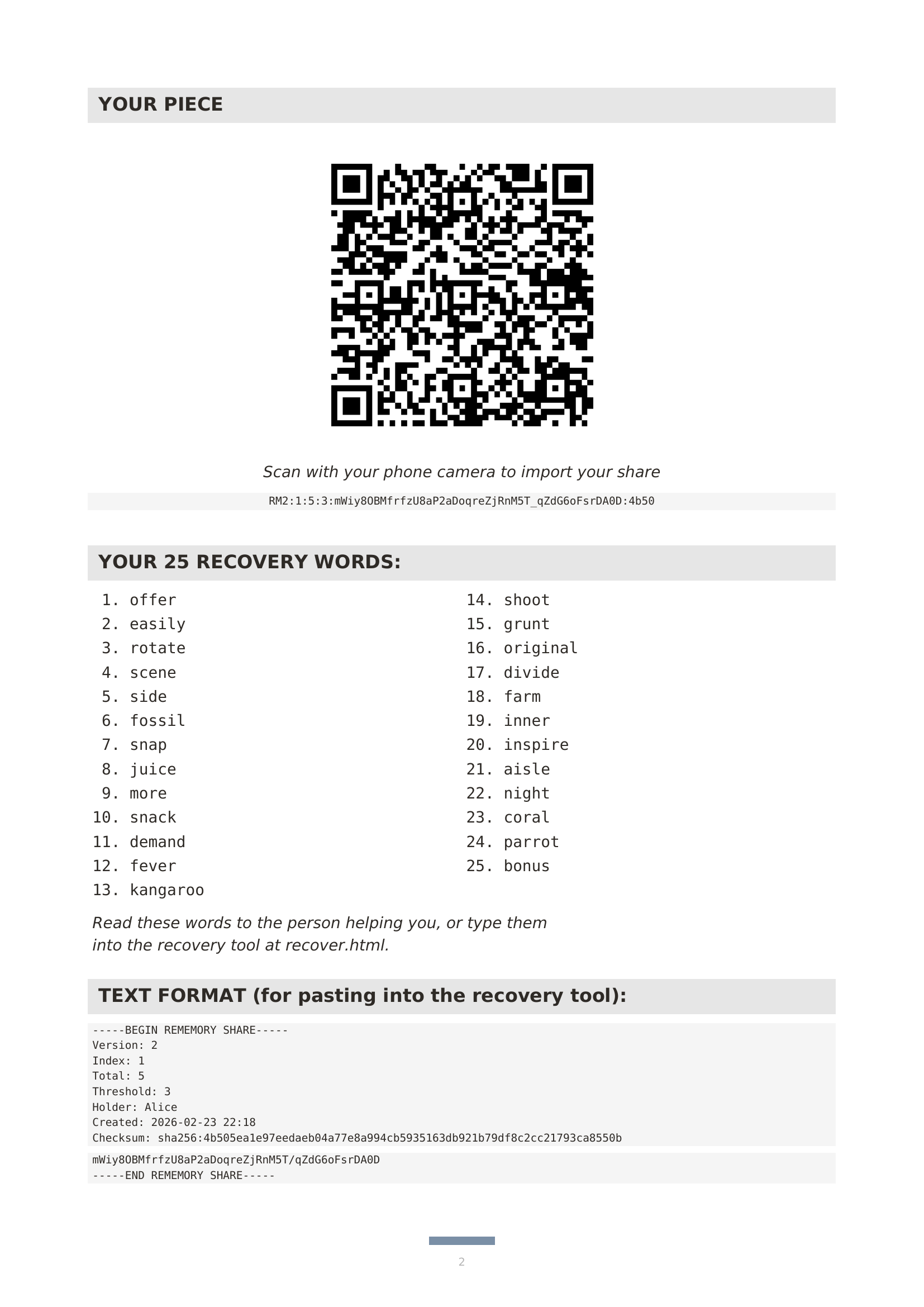
Each friend gets a ZIP bundle containing:
| File | Purpose |
|---|---|
README.txt |
Instructions, their unique piece, contact list |
README.pdf |
Same content, formatted for printing |
MANIFEST.age |
Your encrypted files (only included separately when over 10 MB) |
recover.html |
Recovery tool (~300 KB), runs in any browser. For smaller archives, everything is embedded — just open this file |
A single piece reveals nothing. But tell your friends to keep their bundle somewhere safe — it's their responsibility to you.
More pages
FAQ
Why ReMemory?
We all have digital secrets that matter: password manager recovery codes, cryptocurrency seeds, important documents, instructions for loved ones. What happens to these if you're suddenly unavailable?
Traditional approaches fail:
- Give one person everything → Single point of failure and trust
- Split files manually → Confusing, error-prone, no encryption
- Use a password manager's emergency access → Relies on company existing
- Write it in a will → Becomes public record, slow legal process
ReMemory takes a different approach:
- No single point of failure — requires multiple people to cooperate
- No trust in any one person — even your most trusted friend can't access secrets alone
- Offline and self-contained — recovery works without internet or servers*
- Designed for non-technical people — clear instructions, not cryptographic puzzles
Why I Built This
Two things drove me to create ReMemory.
First, I watched a documentary about Clive Wearing, a man who has lived with a 7-second memory since 1985. Seeing how fragile memory can be made me think about what would happen to my digital life if something similar happened to me.
Second, I've had several concussions from cycling accidents. Each time, I've been lucky to recover fully. But each time, I've been reminded that our brains are more fragile than we like to think.
ReMemory is my answer: a way to ensure the people I trust can access what matters, even if I can't help them.
Threat Model
ReMemory assumes:
- Your friends will only cooperate when needed
- At least threshold friends will keep their bundle safe
- Your device is trusted when you create bundles
- The browser used for recovery is not compromised
ReMemory does NOT rely on:
- Any server or cloud service
- Any ReMemory website or infrastructure
- Any long-term availability of this project
- The internet during recovery
See the Security Review for details.
Cryptographic Guarantees
| Component | Algorithm |
|---|---|
| Encryption | age (scrypt passphrase mode) |
| Key derivation | scrypt (N=2²⁰, r=8, p=1) |
| Secret sharing | Shamir's Secret Sharing over GF(2⁸) |
| Integrity | SHA-256 checksums |
| Passphrase | 256 bits from crypto/rand |
| Time lock (optional) | drand tlock (BLS12-381 IBE, inner layer) |
A single piece reveals nothing about your secret. This is a mathematical guarantee of Shamir's Secret Sharing — any fewer than threshold pieces contain zero information about the original secret.
Time-Delayed Recovery (Experimental)
You can set a waiting period when creating bundles. Even with enough pieces, the files stay locked until the date you chose — for example, 30 days, 6 months, or a specific date.
This uses the League of Entropy (drand), a distributed randomness beacon run by organizations around the world. At recovery time, a brief internet connection is needed — not to send data, but to verify that enough time has passed.
CLI: rememory seal --timelock 30d (or 6m, 1y, 2027-06-15T00:00:00Z)
Web: Enable under "Advanced options" in the bundle creator.
Important caveats:
- Recovery requires internet access (to check the drand beacon)
- If the League of Entropy stops operating before your time lock expires, recovery won't work
- Without the time lock, recovery works fully offline — the time lock adds this one dependency
Failure Scenarios
| What if... | Result |
|---|---|
| A friend loses their bundle? | Fine, as long as threshold friends remain |
| A friend leaks their piece publicly? | Harmless without threshold-1 other pieces |
| ReMemory disappears in 10 years? | recover.html still works — it's self-contained |
| Browsers change dramatically? | Pure JavaScript with no external dependencies |
| You forget how this works? | Each bundle's README.txt explains everything |
| Some friends can't be reached? | That's why you set threshold below total friends |
| Time lock used, but no internet at recovery? | Wait and try again — data is safe, just needs the beacon check |
| League of Entropy shuts down? | Time-locked archives become unrecoverable — only a risk if you use the time lock feature |