RedisShake is an MIT-licensed, Go-based data processing and migration tool that moves data between Valkey and Redis deployments, built for operators and platform teams relocating standalone instances, clusters, or cloud-hosted Redis-compatible services without taking the source offline.
What it is
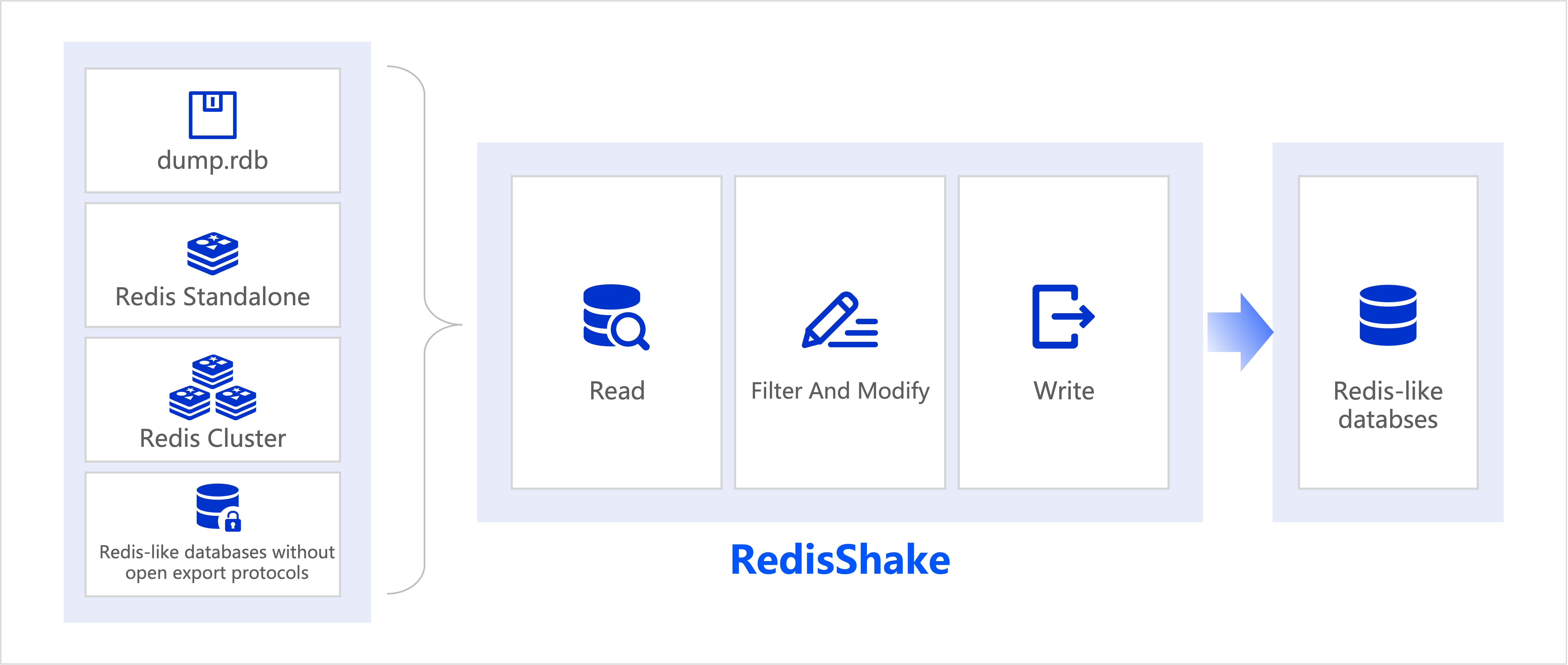
RedisShake is a command-line tool distributed by the tair-opensource project that reads data out of one Valkey or Redis deployment and writes it into another, optionally transforming and filtering keys along the way. It is written in Go, licensed under MIT, and lives in the Infrastructure and Operations / Databases space alongside the Redis ecosystem itself. It operates on live servers rather than on files, connecting to a source over PSync, loading an RDB dump, or walking the keyspace with Scan, then feeding the results to a destination writer.
The concrete problem it solves is moving Redis data between environments that do not share a native replication link. Redis replication is topology-bound: it works within a master–slave chain or a cluster, but not from an on-premise instance to a managed cloud service, not from standalone to sentinel, and not across cloud providers. RedisShake replaces ad-hoc scripting around DUMP/RESTORE, manual RDB file shuffling, and hand-rolled key scans with a single configuration file and one invocation, while keeping the source serving traffic.
Key capabilities
- Performs zero-downtime migration without data loss or service interruption, so the source keeps serving reads and writes during the transfer.
- Reads from three source modes: a PSync reader, an RDB reader, and a Scan reader.
- Supports Redis versions 2.8 through 8.4.x and Valkey 8.x through 9.x across standalone, master–slave, sentinel, and cluster deployments.
- Integrates with cloud Redis-compatible services, including Alibaba Cloud Tair (Redis OSS-Compatible), AWS ElastiCache, and AWS MemoryDB.
- Understands Tair module data types: TairString, TairZSet, and TairHash.
- Applies filter rules declared in
shake.toml, such as block_key_prefix = ["temp:", "cache:"], to skip keys by prefix.
- Supports script-based data transformation through the function filter, allowing values to be rewritten in flight.
Who uses it and how
- Operators running a local cutover, invoking
./redis-shake shake.toml with a [sync_reader] source and a [redis_writer] destination to copy one instance into another.
- Teams lifting data out of a self-managed cluster and into a managed service such as ElastiCache or MemoryDB, where no native replication path exists between the two.
- Container-based deployments that pull
ghcr.io/tair-opensource/redisshake and drive a run through environment variables such as SYNC=true, SHAKE_SRC_ADDRESS, and SHAKE_DST_ADDRESS instead of a config file.
- Users holding Tair module data who need TairString, TairZSet, or TairHash values preserved rather than dropped during a move.
- Automation and agent-driven workflows, using the project's
README_FOR_AGENTS.md guide as a machine-readable usage reference.
Getting started
Download a binary from the project Releases page, run the published container image ghcr.io/tair-opensource/redisshake:latest, or clone the repository and run sh build.sh with Go installed. A run then takes a single shake.toml configuration file, for example: ./redis-shake shake.toml.
How it compares
The facts do not present a list of paid products that RedisShake is positioned to replace; instead they name commercial alternatives in the same problem space. Alibaba Cloud DTS and Tair Global Active-Active are cited as commercial solutions that can resume from the last checkpoint after an interruption, a capability RedisShake 4.x does not offer. RedisShake's distinction is that it is MIT-licensed, self-hosted, and runs against any Redis or Valkey endpoint without a vendor account.
When to use it — and when not to
Resumable transfer and checkpointing are not supported in version 4.x: an interrupted run does a full resync from the beginning, which makes long migrations over unstable links or very large keyspaces risky. A self-hoster operates the tool itself plus both Redis endpoints; no database, object storage, or SMTP service is required beyond those endpoints. Choose it when the source can stay live and the migration can complete in one pass, and look to a checkpointing commercial service when the dataset is large enough that restarting from zero is unacceptable.
project readme (upstream, from github) — read inline
RedisShake: Redis Data Transformation and Migration Tool




Overview
RedisShake is a powerful tool for Redis data transformation and migration, offering:
Zero Downtime Migration: Enables seamless data migration without data loss or service interruption, ensuring continuous operation during the transfer process.
Valkey/Redis Compatibility: Supports Redis (2.8 to 8.4.x) and Valkey (8.x to 9.x) across standalone, master–slave, sentinel, and cluster deployments. See Version Compatibility for detailed feature support.
Cloud Service Integration: Seamlessly works with Redis-like databases from major cloud providers:
Module Support: Compatible with TairString, TairZSet, and TairHash.
Flexible Data Source: Supports PSync, RDB, and Scan data fetch methods.
Advanced Data Processing: Enables custom script-based data transformation and easy-to-use data filter rules.
How to Get RedisShake
For Humans
Download from Releases.
Use Docker:
docker run --network host \
    -e SYNC=true \
    -e SHAKE_SRC_ADDRESS=127.0.0.1:6379 \
    -e SHAKE_DST_ADDRESS=127.0.0.1:6380 \
    ghcr.io/tair-opensource/redisshake:latest
- Build it yourself:
Prerequisite: Go must be installed and available in your system before running the build script.
git clone https://github.com/tair-opensource/RedisShake
cd RedisShake
sh build.sh
For LLM Agents
Copy and paste this prompt to your LLM agent (Claude Code, Cursor, etc.):
Read the RedisShake usage guide and help me with my task:
https://raw.githubusercontent.com/tair-opensource/RedisShake/v4/README_FOR_AGENTS.md
How to Use RedisShake
To move data between two Redis instances and skip some keys:
- Make a file called
shake.toml with these settings:
[sync_reader]
address = "127.0.0.1:6379"

[redis_writer]
address = "127.0.0.1:6380"

[filter]
# skip keys with "temp:" or "cache:" prefix
block_key_prefix = ["temp:", "cache:"]
- Run RedisShake:
./redis-shake shake.toml
For more help, check the docs.
Limitations
Resumable Transfer (Checkpoint) is NOT Supported: RedisShake 4.x does not support resumable transfer. Unlike commercial solutions such as Alibaba Cloud DTS or Tair Global Active-Active which can resume from the last checkpoint after interruption, RedisShake will perform a full resync from the beginning when restarted.
Cluster Topology Change Awareness is NOT Supported: RedisShake assumes a static cluster topology. Any topology changes (such as scaling, failover, or slot migration) will cause the process to panic. Combined with the lack of checkpoint support, RedisShake is best suited for one-time data migration scenarios, not for long-term continuous synchronization.
Cross-Version Migration
Before migrating data between different major versions of Redis, we recommend using the resp-compatibility tool for a compatibility check and consulting the compatibility report to avoid known breaking changes and bugs.
History
RedisShake, actively maintained by the Tair team at Alibaba Cloud, evolved from redis-port. Key milestones:
License
RedisShake is open-sourced under the MIT license.