RedELK is a free, open source monitoring & observability project written in Python and released under BSD-3-Clause. It has 2,670 GitHub stars, 391 forks and 13 open issues, and was last pushed 3 hours ago. On this registry it ranks #143 of 271 tracked projects in Monitoring & Observability, with 5 head-to-head comparisons available.

What is RedELK?

RedELK is a red team's SIEM — an Elasticsearch, Logstash and Kibana based system that collects operational logs from red team teamservers and traffic logs from redirectors into one enriched central location, built for red team operators and for the white teams that need oversight of long-running engagements.

What it is

RedELK is a Python tool that lives in the Elastic/Elasticsearch, Logstash and Kibana ecosystem and turns that stack into a monitoring and observability platform aimed at offensive operators rather than defenders. It ingests two kinds of data: operational logs from multiple teamservers, and traffic logs from redirectors. Both are enriched at collection time, so a single central location holds the full operational picture instead of scattered per-server logs.

The concrete problem it solves is the loss of visibility that comes with scaled-up adversary simulation. Once an engagement spans several scenarios, several teamservers, several operators and several months, no individual operator can hold the history, and no white team member can audit it. RedELK replaces ad hoc log grepping and manual teamserver inspection with enriched, queryable history, and it additionally gives red teams a way to notice that the blue team has started investigating their infrastructure by querying collected redirector traffic.

Key capabilities

  • Central collection and enrichment of operational logs from multiple teamservers, supporting historic searching across multi-scenario, multi-teamserver, multi-member and multi-month operations.
  • Traffic log collection and enrichment from redirectors, with specific queries intended to detect blue team investigation of red infrastructure.
  • Fast viewing of screenshots, IOCs and keystrokes output gathered from the operation.
  • A read-only view of the operation suitable for a white team.
  • Docker images built for the base system plus Elasticsearch, Kibana, Logstash and Jupyter, each with its own GitHub Actions build workflow.
  • Kibana-based search and dashboards over the enriched indices, consistent with the project's kibana and elasticsearch topics.
  • Deployment automation provided through Ansible playbooks for both server and client roles.

Who uses it and how

  • Red team operators running campaigns that involve more than one teamserver, so that logs from all of them land in one searchable place.
  • White teams that need a read-only view of ongoing operations without direct access to teamserver consoles.
  • Long engagements measured in months, where historic searching matters more than real-time alerting.
  • Infrastructure teams deploying the server and client roles through Ansible playbooks: redelk-server and redelk-client, maintained by one of RedELK's developers, or ansible-redelk, maintained by curi0usJack/TrustedSec.
  • Teams that need to review all captured screenshots, IOCs and keystroke output in bulk rather than one host at a time.

Getting started

The README points to the project wiki for manual installation, and notes Ansible playbooks maintained by others for the server and client roles. Docker images for the base system, Elasticsearch, Kibana, Logstash and Jupyter are built by the project's own GitHub Actions workflows.

How it compares

No list of paid products that RedELK replaces is provided in the available facts, and no directly comparable red-team SIEM is named. It stands alone in this registry, since the Elasticsearch, Kibana and Logstash components it is built on are dependencies rather than substitutes.

When to use it — and when not to

A self-hoster must operate the full Elasticsearch, Logstash and Kibana stack, plus the Jupyter image, and must arrange log shipping from every teamserver and redirector that matters. Teams with a single teamserver, no redirectors, or no need for historic operational search get little from it, and blue-team-only organisations have no reason to run it. The main weakness visible in the facts is documentation shape: the README defers installation entirely to the wiki and to third-party Ansible playbooks, so the initial setup is not self-contained in the repository.

project readme (upstream, from github) — read inline

Build docker base image (dev) Build docker elasticsearch image (dev) Build docker jupyter image (dev) Build docker kibana image (dev) Build docker logstash image (dev)

RedELK

The Red Team's SIEM - a tool for Red Teams for tracking and alarming about Blue Team activities as well as enhanced usability in long term operations.

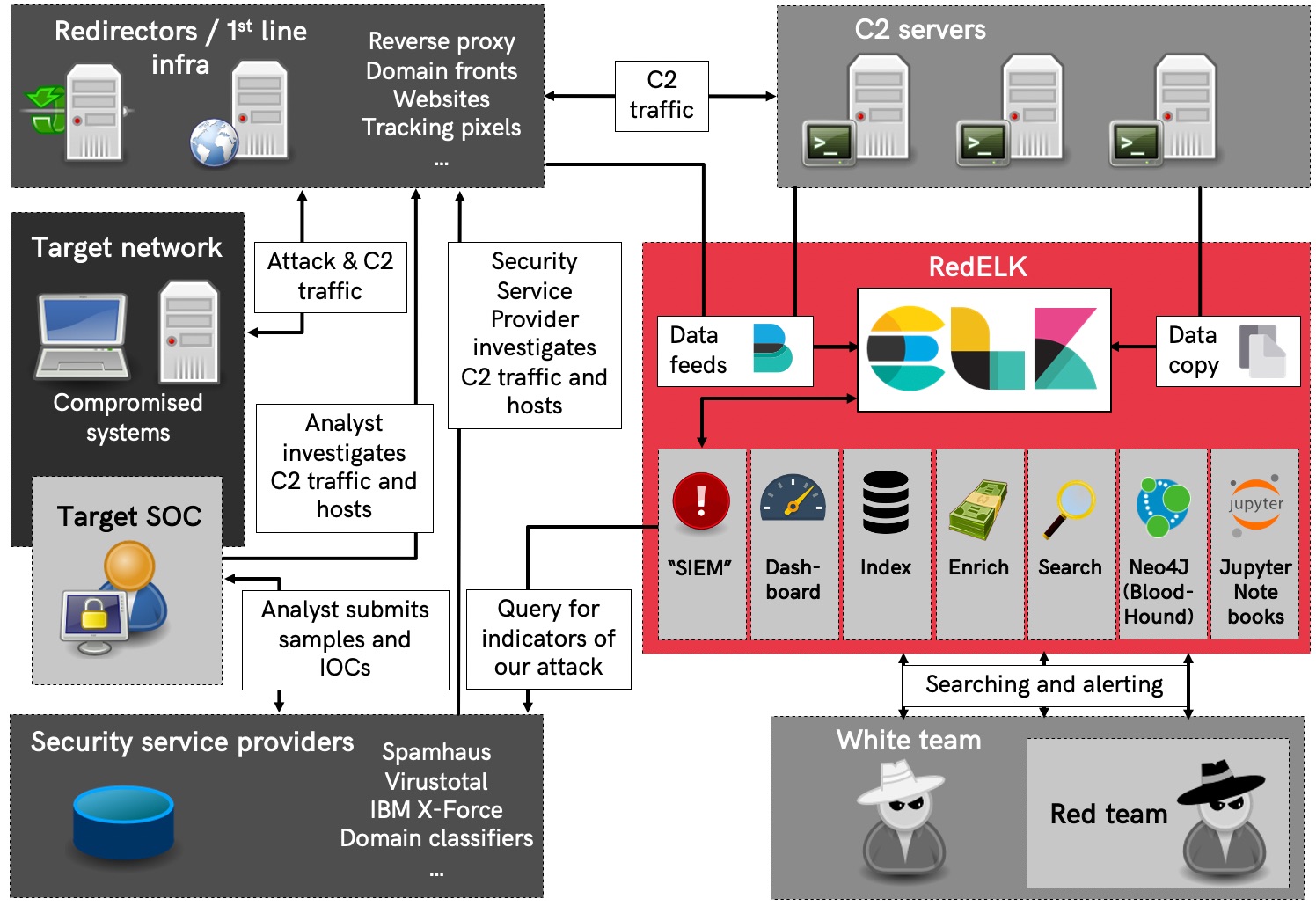
  1. Enhanced usability and overview for the red team operators by creating a central location where all relevant operational logs from multiple teamservers are collected and enriched. This is great for historic searching within the operation as well as giving a read-only view on the operation (e.g. for the White Team). Especially useful for multi-scenario, multi-teamserver, multi-member and multi-month operations. Also, super easy ways for viewing all screenshots, IOCs, keystrokes output, etc. \o/
  2. Spot the Blue Team by having a central location where all traffic logs from redirectors are collected and enriched. Using specific queries its now possible to detect that the Blue Team is investigating your infrastructure.

Background info

Check the wiki for info on usage or one the blog posts or presentations listed below:

Installation

Check the wiki for manual installation manual. There are also Ansible playbooks maintained by others:

Conceptual overview

Here's a conceptual overview of how RedELK works.
Authors and contribution

This project is developed and maintained by:

We welcome contributions! Contributions can be both in code, as well as in ideas you might have for further development, alarms, usability improvements, etc.

Frequently asked questions

Is RedELK free to use?

RedELK is open source under the BSD-3-Clause licence. There is no licence fee and no seat count — you can self-host it or, where the project offers one, pay a vendor for a managed version instead.

What does RedELK do?

Red Team's SIEM - tool for Red Teams used for tracking and alarming about Blue Team activities as well as better usability in long term operations.

What is RedELK written in?

RedELK is primarily written in Python. Its source is publicly available at https://github.com/outflanknl/RedELK, and it has 2,670 GitHub stars.