



Redash is a free, open source business intelligence & reporting project written in Python and released under BSD-2-Clause. It has 28,800 GitHub stars, 4,624 forks and 805 open issues, and was last pushed 14 days ago. On this registry it ranks #7 of 34 tracked projects in Business Intelligence & Reporting, with 5 head-to-head comparisons available. It gained 7 stars over the last 6 tracked days.

Redash — Connect, query, visualize, and share your data

What is Redash?

What it is

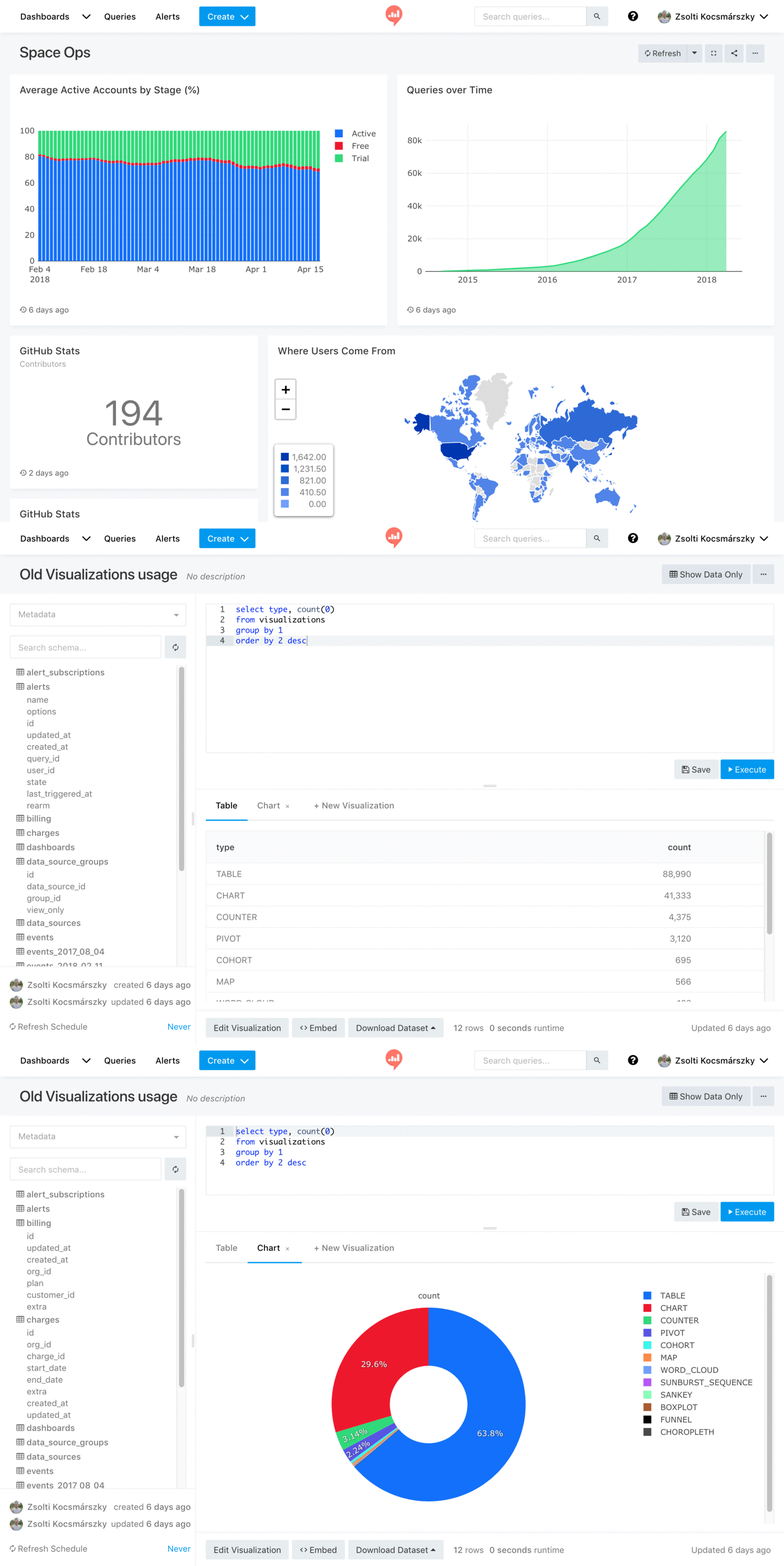
Redash is an open-source business intelligence and data analytics platform built with Python and JavaScript. It enables users to connect to diverse data sources, write and execute SQL/NoSQL queries, build visualizations, and share interactive dashboards—all through a browser-based interface.

It solves the problem of fragmented, inaccessible data by providing a unified workspace where teams can explore data without needing deep technical expertise or installing complex software. Organizations use it to replace or supplement expensive proprietary BI tools, enabling broader data literacy and self-service reporting across engineering, product, and business roles.

Key capabilities

  • Connect to over 35 SQL and NoSQL data sources including PostgreSQL, MySQL, BigQuery, Snowflake, MongoDB, Elasticsearch, and Athena
  • Compose and execute queries via a browser-based editor with schema browser and auto-complete
  • Create and combine visualizations (charts, tables, gauges, maps) into customizable dashboards using drag-and-drop
  • Schedule automatic query and dashboard refreshes at defined intervals
  • Set up alerts to notify users when query results meet specific conditions
  • Share visualizations and queries via shareable URLs with embedded permissions and comments
  • Access all UI functionality programmatically via a REST API

Who uses it and how

Engineering teams run ad-hoc data explorations and monitor system metrics using integrations with databases and observability tools like Prometheus or ClickHouse.
Product and marketing analysts build recurring reports from sources like Google Analytics, Salesforce, and Snowflake to track KPIs and campaign performance.
Data teams deploy Redash internally to enable non-technical stakeholders to self-serve reports and dashboards, reducing reliance on centralized reporting teams.

Getting started

Deploy using Docker (redash/redash:latest) or pre-built images for AWS/GCE; install via package managers or from source with PostgreSQL as the backend database. Documentation and setup guides are at https://redash.io/help/.

When to use it — and when not to

Redash replaces paid BI tools for teams needing flexible, self-hosted analytics with broad data source support, but requires manual setup and maintenance of PostgreSQL, Redis, and optionally SMTP for alerts. It lacks native row-level security and advanced governance features found in commercial suites, making it less suitable for highly regulated environments requiring strict audit trails or multi-tenancy.

project readme (upstream, from github) — read inline

Documentation GitHub Build

Redash is designed to enable anyone, regardless of the level of technical sophistication, to harness the power of data big and small. SQL users leverage Redash to explore, query, visualize, and share data from any data source. Their work, in turn, enables anybody in their organization to use the data. Every day, millions of users at thousands of organizations around the world use Redash to develop insights and make data-driven decisions.

Redash features:

  1. Browser-based: Everything in your browser, with a shareable URL.
  2. Ease-of-use: Become immediately productive with data without the need to master complex software.
  3. Query editor: Quickly compose SQL and NoSQL queries with a schema browser and auto-complete.
  4. Visualization and dashboards: Create beautiful visualizations with drag and drop, and combine them into a single dashboard.
  5. Sharing: Collaborate easily by sharing visualizations and their associated queries, enabling peer review of reports and queries.
  6. Schedule refreshes: Automatically update your charts and dashboards at regular intervals you define.
  7. Alerts: Define conditions and be alerted instantly when your data changes.
  8. REST API: Everything that can be done in the UI is also available through the REST API.
  9. Broad support for data sources: An extensible data source API with native support for a long list of common databases and platforms.
Getting Started

Supported Data Sources

Redash supports more than 35 SQL and NoSQL data sources. It can also be extended to support more. Below is a list of built-in sources:

  • Amazon Athena
  • Amazon CloudWatch / Insights
  • Amazon DynamoDB
  • Amazon Redshift
  • ArangoDB
  • Axibase Time Series Database
  • Apache Cassandra
  • ClickHouse
  • CockroachDB
  • Couchbase
  • CSV
  • Databricks
  • DB2 by IBM
  • Dgraph
  • Apache Drill
  • Apache Druid
  • e6data
  • Eccenca Corporate Memory
  • Elasticsearch
  • Exasol
  • Microsoft Excel
  • Firebolt
  • Databend
  • Google Analytics
  • Google BigQuery
  • Google Spreadsheets
  • Graphite
  • Greenplum
  • Apache Hive
  • Apache Impala
  • InfluxDB
  • InfluxDBv2
  • IBM Netezza Performance Server
  • JIRA (JQL)
  • JSON
  • Apache Kylin
  • OmniSciDB (Formerly MapD)
  • MariaDB
  • MemSQL
  • Microsoft Azure Data Warehouse / Synapse
  • Microsoft Azure SQL Database
  • Microsoft Azure Data Explorer / Kusto
  • Microsoft SQL Server
  • MongoDB
  • MySQL
  • Oracle
  • Apache Phoenix
  • Apache Pinot
  • PostgreSQL
  • Presto
  • Prometheus
  • Python
  • Qubole
  • Rockset
  • RisingWave
  • Salesforce
  • ScyllaDB
  • Shell Scripts
  • Snowflake
  • SPARQL
  • SQLite
  • TiDB
  • Tinybird
  • TreasureData
  • Trino
  • Uptycs
  • Vertica
  • Yandex AppMetrica
  • Yandex Metrica

Getting Help

Reporting Bugs and Contributing Code

  • Want to report a bug or request a feature? Please open an issue.
  • Want to help us build Redash? Fork the project, edit in a dev environment and make a pull request. We need all the help we can get!

Security

Please email [email protected] to report any security vulnerabilities. We will acknowledge receipt of your vulnerability and strive to send you regular updates about our progress. If you're curious about the status of your disclosure please feel free to email us again. If you want to encrypt your disclosure email, you can use this PGP key.

License

BSD-2-Clause.

Frequently asked questions

Is Redash free to use?

Redash is open source under the BSD-2-Clause licence. There is no licence fee and no seat count — you can self-host it or, where the project offers one, pay a vendor for a managed version instead.

What does Redash do?

Connect, query, visualize, and share your data

What is Redash written in?

Redash is primarily written in Python. Its source is publicly available at https://github.com/getredash/redash, and it has 28,800 GitHub stars.