

qwen-code is a free, open source ai development platforms project written in TypeScript and released under Apache-2.0. It has 27,927 GitHub stars, 3,055 forks and 1,422 open issues, and was last pushed 3 hours ago. On this registry it ranks #29 of 61 tracked projects in AI Development Platforms, with 5 head-to-head comparisons available. It gained 45 stars over the last 3 tracked days.

What is qwen-code?

What it is

Qwen Code is an open-source AI coding agent that runs in the terminal, with additional interfaces for editors, desktop, browser, and chat. It is written in TypeScript and released under the Apache-2.0 license, and it lives in the AI and machine learning ecosystem as a development platform for agentic coding. The project is maintained by QwenLM and published on npm as @qwen-code/qwen-code, with a documentation site hosted at qwenlm.github.io. It ships as a command-line tool named qwen that opens an interactive session inside a project directory.

The concrete problem it solves is the gap between a general-purpose language model and the working context of a real codebase. Instead of copying files into a chat window, a developer starts the agent in the repository and asks it to explain the project, locate entry points, or act on the code directly. It also removes provider lock-in: the agent supports OpenAI, Anthropic, Gemini, and Qwen APIs, and can point at a third-party provider or a local model served by Ollama or vLLM, with the ability to switch at runtime. Because both the framework and the Qwen models are open-source, the tooling and the models can evolve together without a vendor controlling either side.

Key capabilities

  • Agentic behavior available out of the box, including Auto-Memory, Auto-Skills, SubAgents, Agent Teams, and MCP support, with dynamic workflows and no setup step.
  • Multi-protocol model support across OpenAI, Anthropic, Gemini, and Qwen APIs, plus any third-party provider or local model through Ollama or vLLM.
  • Runtime switching between providers, so a session is not bound to a single API key or endpoint.
  • Interfaces beyond the terminal: IDE plugins for VS Code, Zed, and JetBrains, a desktop application, a Web UI, SDKs, and chat integrations.
  • Chat channel integrations for Telegram, DingTalk, WeChat, and Feishu.
  • A Web UI launched through qwen serve --open, marked experimental in the documentation.
  • Self-hosting of the project's own development loop, where the agent files issues, submits pull requests, reviews code, and runs tests.

Who uses it and how

  • Developers working in a terminal who run qwen inside a project directory and ask the agent to explain the repository and identify where to start.
  • Teams that need to route requests to a specific model provider, configuring the provider and API key inside the session with the /auth command.
  • Users who prefer an editor workflow, installing the VS Code, Zed, or JetBrains integration rather than working from the command line.
  • Users who want a graphical or remote surface, downloading the desktop build for macOS, Windows, or Linux, or opening the Web UI in a browser.
  • Groups that coordinate work through chat platforms, connecting the agent to Telegram, DingTalk, WeChat, or Feishu.

Getting started

Installation is available through a standalone shell script for Linux and macOS, a PowerShell script for Windows, the npm package @qwen-code/qwen-code with Node.js 22 or later, or Homebrew on macOS and Linux. After installation, a developer opens a terminal in the project, runs qwen, and configures a provider and API key with /auth.

When to use it — and when not to

Choose Qwen Code when an open-source agent that can target multiple model providers, including local models, matters more than a single hosted service. A self-hoster must supply their own provider credentials, and the project carries a substantial open issue count of 1422 alongside a repository history of roughly one year, so stability expectations should match an actively iterating tool. The Web UI is documented as experimental, which makes the terminal and editor integrations the safer surfaces for daily work.

project readme (upstream, from github) — read inline

npm version License Node.js Version Downloads

QwenLM%2Fqwen-code | Trendshift

The open-source AI coding agent for your terminal, editor, desktop, browser, and chat.

中文 | Deutsch | français | 日本語 | Русский | Português (Brasil) | 한국어
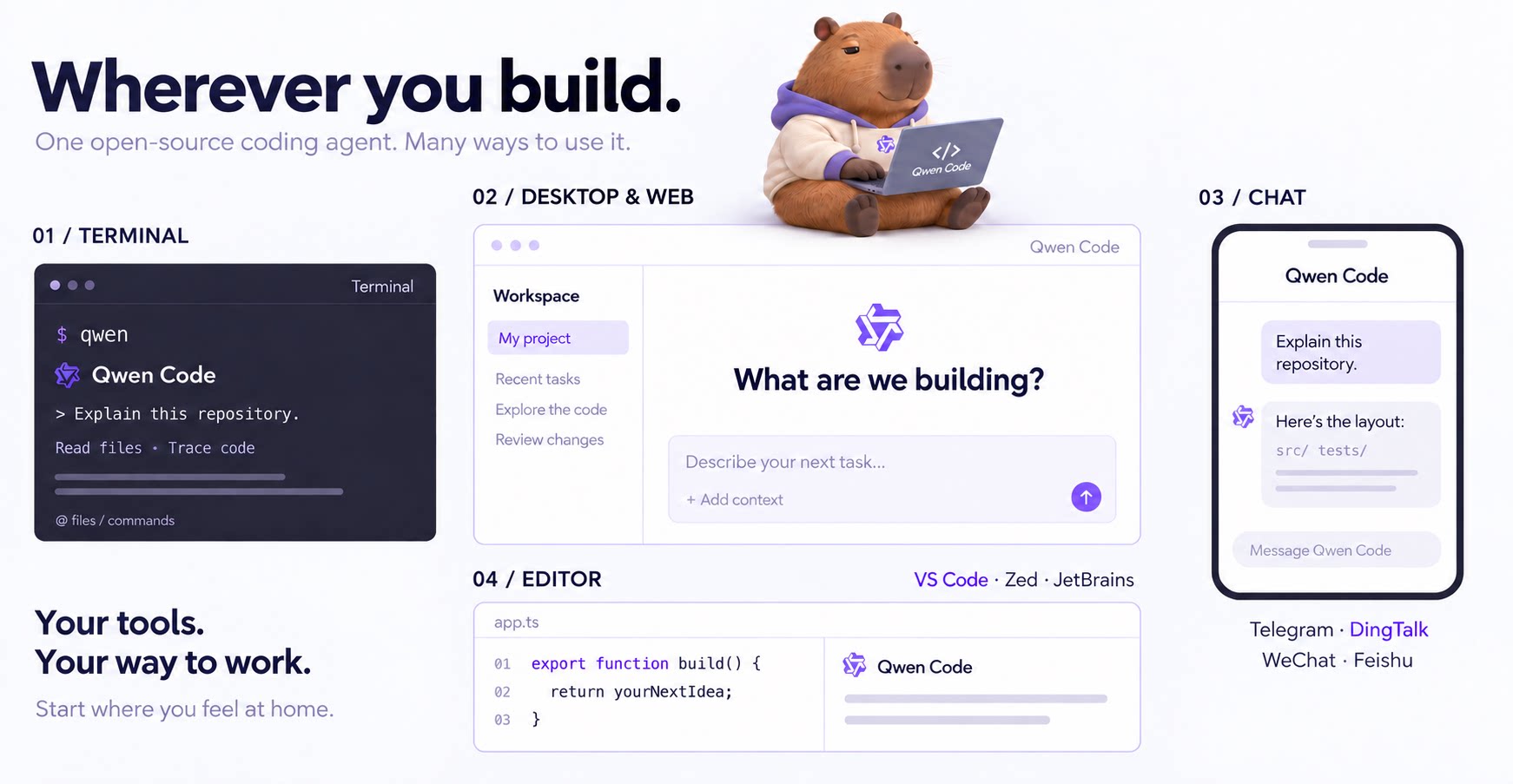
Qwen Code in the terminal, desktop app, browser, editor, and chat, with VS Code, Zed, JetBrains, Telegram, DingTalk, WeChat, and Feishu integrations

Why Qwen Code?

  • Agentic out of the box — Auto-Memory, Auto-Skills, SubAgents, Agent Teams, and MCP. Dynamic workflows, zero setup.
  • Open-source, inside and out — The framework and the Qwen models are open-source. They evolve together. No vendor lock-in.
  • Multi-protocol — Supports OpenAI, Anthropic, Gemini, and Qwen APIs. Any third-party provider or local model (Ollama / vLLM). Switch at runtime.
  • Beyond the terminal — IDE plugins, Desktop app, Web UI, SDKs, and chat integrations (Telegram / DingTalk / WeChat / Feishu).

[!TIP] Qwen Code is actively iterating on itself — using its own agent and models to file issues, submit PRs, review code, and run tests. Powered by the community, driven by AI.

Installation

Linux / macOS:

curl -fsSL https://qwen-code-assets.oss-cn-hangzhou.aliyuncs.com/installation/install-qwen-standalone.sh | bash

Windows:

irm https://qwen-code-assets.oss-cn-hangzhou.aliyuncs.com/installation/install-qwen-standalone.ps1 | iex

Restart your terminal after installation to ensure environment variables take effect.

NPM / Homebrew

NPM (requires Node.js 22+):

npm install -g @qwen-code/qwen-code@latest

Homebrew (macOS / Linux):

brew install qwen-code

Quick Start

Open a terminal in your project and start Qwen Code:

cd /path/to/your-project
qwen

Inside the session, run /auth to configure your provider and API key. Then try:

Explain this repository and show me where to start.

See the Authentication Guide and Settings Reference for detailed setup.

See the terminal interface
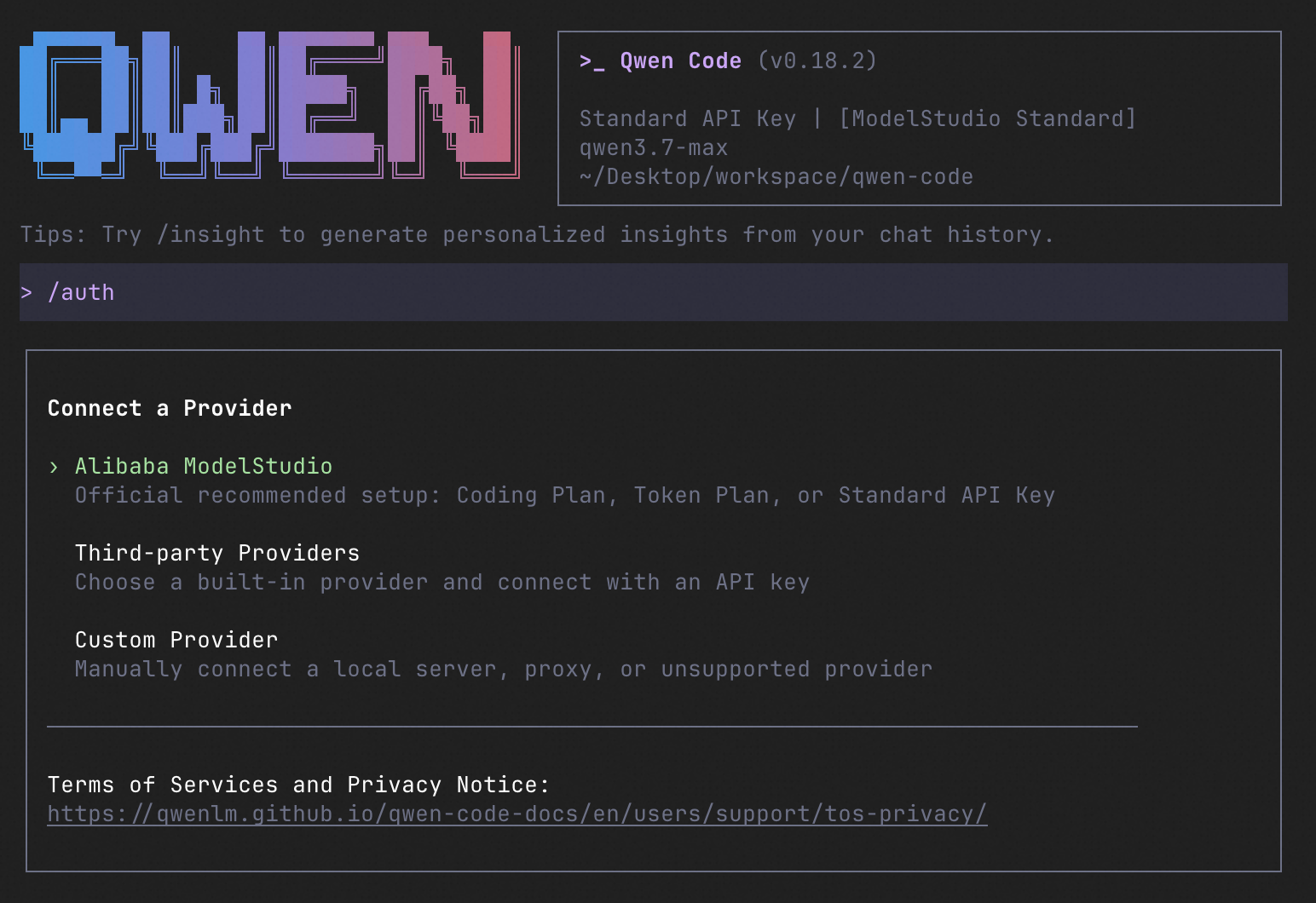
Qwen Code terminal interface

How to Use Qwen Code

Choose the interface that fits your workflow:

Interface Get started
Terminal Run qwen in your project — see Quick Start.
Desktop Download Qwen Code Desktop for macOS, Windows, and Linux.
Web Run qwen serve --open to open the Web UI in your browser. (experimental)
Editor Set up VS Code, Zed, or JetBrains.
Chat Connect Telegram, DingTalk, WeChat, or Feishu, then run qwen channel start.

For automation and custom integrations:

  • Headless — Run qwen -p "..." in scripts, CI/CD, or batch jobs.
  • SDKs — Build with TypeScript, Python, or Java.
  • Daemon — Run qwen serve to connect clients over HTTP + SSE (ACP). (experimental) Daemon guide.
SDK example (Python)
import asyncio

from qwen_code_sdk import is_sdk_result_message, query


async def main() -> None:
    result = query(
        "Summarize the repository layout.",
        {
            "cwd": "/path/to/project",
            "path_to_qwen_executable": "qwen",
        },
    )

    async for message in result:
        if is_sdk_result_message(message):
            print(message["result"])


asyncio.run(main())

Capabilities

If you know Claude Code, you already know Qwen Code — and then some. We've put significant effort into bringing Qwen Code to feature parity with Claude Code, improving both breadth and reliability across the board.

Feature Qwen Code Claude Code
SubAgents, Agent Teams, Dynamic Workflows
Auto-Memory, Auto-Skills, Hooks
Built-in Skills (/review, /batch, /loop, /bugfix…)
MCP, Plan Mode, LSP Integration
Auto Mode, Sandbox, Git Worktrees
Computer Use (desktop automation)
IDE Plugins (VS Code / JetBrains / Zed)
SDK
Headless Mode, Session Management
Open-source — model and framework

readme truncated — read the full docs on github

Frequently asked questions

Is qwen-code free to use?

qwen-code is open source under the Apache-2.0 licence. There is no licence fee and no seat count — you can self-host it or, where the project offers one, pay a vendor for a managed version instead.

What does qwen-code do?

An open-source AI coding agent that lives in your terminal.

What is qwen-code written in?

qwen-code is primarily written in TypeScript. Its source is publicly available at https://github.com/QwenLM/qwen-code, and it has 27,927 GitHub stars.