





English | 简体中文
QuestDB is the open-source, low-latency time-series database on open formats. It ingests millions of events per second, computes on live data in milliseconds, and keeps years of history queryable. One SQL engine spans ingestion, stream processing, and tiered storage.
The engine is zero-GC Java with C++ and Rust on the hot paths. Data lives in memory-mapped, time-partitioned columns. Queries run across all cores with SIMD and JIT-compiled filters. There are no third-party dependencies on the data path.
Storage is tiered: a parallel write-ahead log, native columnar partitions,
and Apache Parquet. In open source you convert partitions to Parquet with
ALTER TABLE, or create a table in Parquet directly. QuestDB Enterprise
converts cold partitions automatically and tiers them to object storage.
Parquet, Apache Iceberg, and Apache Arrow keep the data open to any tool.
Measured on QuestDB 10.0 over QWP:
| Source | ||
|---|---|---|
| Peak ingestion per instance | 19M rows/sec | QWP vs ILP ingestion benchmark |
| Query results streamed to Arrow | 220M rows/sec | Streaming 500 million rows into Arrow |
| 500M rows streamed | 2.3 s | same post |
| First Arrow batch | 32 ms | same post |
Get started
Use Docker to start quickly:
docker run -p 9000:9000 -p 8812:8812 questdb/questdb
Or macOS users on Apple Silicon can use Homebrew:
brew install questdb
brew services start questdb
questdb start
questdb stop
QuestDB bundles native libraries for Apple Silicon only. On an Intel Mac, use the Docker image above.
For the full walkthrough, start with the quick start guide.
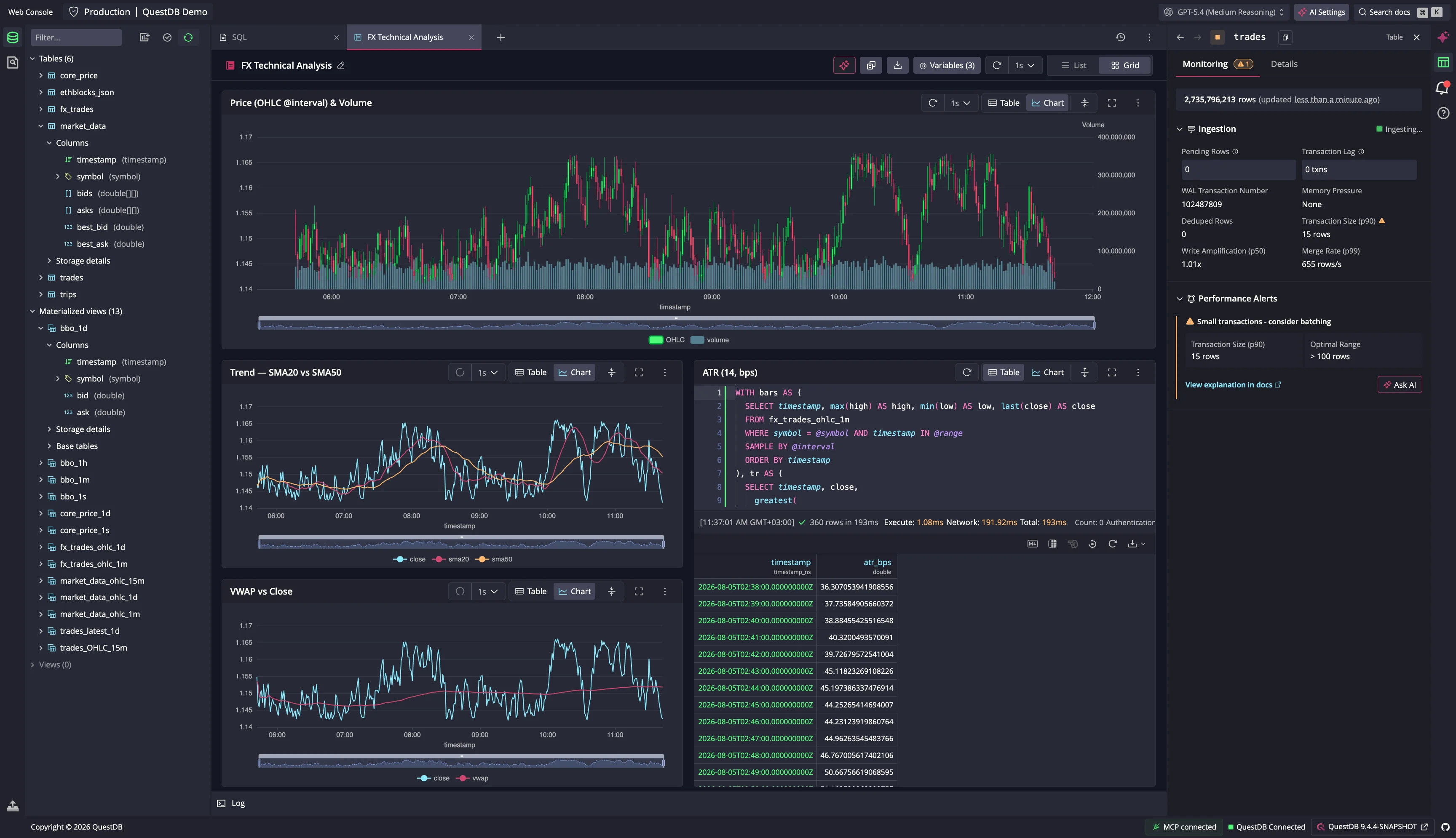
QuestDB Web Console - click to launch demo
New in QuestDB 10.0: the QuestDB Wire Protocol (QWP), one binary columnar protocol for writes and for Arrow reads, plus native arrays and live views in beta. Release notes.
Ingress and egress over QWP
QWP is a binary columnar protocol over WebSocket. The same connection writes rows in and streams query results back out as columns. The Python client returns those columns as Apache Arrow by default, and Rust and C/C++ can enable it with a flag.
On the way in, the QWP vs ILP ingestion benchmark measures 19M rows/sec over the network, and that peak holds from one thousand to one million series. On the way out, Streaming 500 million rows into Arrow measures 220M rows/sec with eight readers, with the first batch after 32 ms and client memory flat however large the result. The QWP overview covers the protocol design.
What QuestDB does
One engine covers the full lifecycle of the data:
- Capture. Ingest millions of ordered and out-of-order events per second without pre-aggregation. Deduplication and out-of-order correction are built in.
- Compute. Transform, enrich, and aggregate events as they arrive. Materialized views aggregate by time slice, many rows in and one row out. Live views run window functions such as indicators, one row in and one row out, on an in-memory tier.
- Query. Run time-series SQL across live and historical data with predictable low latency.
- Retain. Keep the complete record online in native storage and Parquet, queried through the same SQL. Enterprise tiers cold partitions to object storage automatically.
The SQL is standard, extended where time series needs it: SAMPLE BY,
LATEST ON, ASOF JOIN, WINDOW JOIN, HORIZON JOIN, materialized views,
live views, and n-dimensional arrays.
Both queries run on the live demo:
-- 15-minute OHLCV bars for EURUSD, today
SELECT timestamp, symbol,
  first(price) AS open,
  max(price) AS high,
  min(price) AS low,
  last(price) AS close,
  sum(quantity) AS total_volume
FROM fx_trades
WHERE symbol = 'EURUSD'
  AND timestamp IN '$today'
SAMPLE BY 15m;

-- Match each trade to the most recent quote by timestamp
SELECT t.timestamp, t.symbol, t.price, q.bid_price, q.ask_price
FROM fx_trades t
ASOF JOIN core_price q ON (symbol)
WHERE t.timestamp IN '$today';
Where it runs:
- capital markets: tick data, order books, trades, pre-trade analysis and post-trade analytics, with the finance SQL cookbook, finance functions and order book analytics
- aerospace and robotics: flight-test telemetry, fleet data, mission replay
- energy and infrastructure: reactor, turbine, and grid telemetry at full resolution
- AI coding agents, through the agent skills and the MCP server
A time-series engine takes care of what a general database leaves to you: out-of-order data, deduplication and exactly-once semantics, continuous ingest under concurrent queries, bursty load, and schema changes while streaming.
Try QuestDB, demo and dashboards
The live, public demo runs the latest QuestDB release on sample datasets. Scan more than 2 billion rows in milliseconds:
- Trades: live crypto trades with 30M+ rows per month (OKX exchange)
- FX order book: live charts with orderbook FX pairs.
- Trips: 10 years of NYC taxi trips with 1.6 billion rows
We also have some public, real-time demo dashboards using our Grafana-native plugin:
- Real-time crypto trades: executed trades on OKX from more than 20 assets in real time
- FX order book: live depth/imbalance charts for major FX pairs
QuestDB performance vs. other databases
TSBS ingestion at 100,000 hosts with 32 workers on one AWS r8a.8xlarge (32 vCPU, 256 GB RAM). Competitors benchmarked August 2026, QuestDB 9.3.3 on the same instance.
| Engine | Version | Ingestion rate |
|---|---|---|
| QuestDB | 9.3.3 | 8.59M rows/sec |
| ClickHouse | 26.7.5.10 | 1.75M rows/sec |
| TimescaleDB | 2.29.1 | 1.08M rows/sec |
| InfluxDB | 1.12.4 | 541K rows/sec |
The full comparisons, ingestion and queries:
- QuestDB vs InfluxDB
- QuestDB vs InfluxDB 3
- QuestDB vs ClickHouse
- QuestDB vs TimescaleDB
- QuestDB vs kdb+
As always, we encourage you to run your own benchmarks.
AI coding agents
QuestDB works with Claude Code, Codex, Cursor, and any MCP client. There are two ways in.
Run SQL against the database from your agent. Install the QuestDB skill. It teaches the agent QuestDB's SQL dialect and how to inspect a schema. The agent then executes SQL through the [REST API](https://questdb.com/docs/conne