QOwnNotes is a free, open source note taking & knowledge management project written in C++ and released under GPL-2.0. It has 5,882 GitHub stars, 500 forks and 63 open issues, and was last pushed 14 hours ago. On this registry it ranks #23 of 37 tracked projects in Note Taking & Knowledge Management, with 5 head-to-head comparisons available.

What is QOwnNotes?

QOwnNotes is a GPL-2.0 licensed, C++ plain-text notepad and todo-list manager with Markdown support for GNU/Linux, macOS and Windows that stores every note as a Markdown file and pairs with Nextcloud or ownCloud so the same notes stay readable on mobile and in the web service.

What it is

QOwnNotes is an open-source desktop notepad and todo-list manager written in C++, released under GPL-2.0, and built for GNU/Linux, macOS and Windows. It lives in the Nextcloud and ownCloud note ecosystem: its notes are plain-text Markdown files, and it works together with the Nextcloud Notes and ownCloud Notes apps. The notes are synced through Nextcloud's or ownCloud's file sync functionality, and other sync software such as Syncthing or Dropbox can be used instead. The project also includes a Markdown cheatsheet, a web companion browser extension, a web app, and a separate Android client.

The concrete problem it solves is where note writing happens. QOwnNotes replaces the Nextcloud or ownCloud web-service note editor as the primary place to write and search notes, while leaving the same plain Markdown files readable in that web service, in the Nextcloud Notes and ownCloud Notes apps, and on mobile through QOwnNotes Android, MyOwnNotes or the Notes app. Because notes remain plain-text files on disk, the user keeps direct access to them. Todo lists are handled through the Nextcloud Tasks or ownCloud Tasks backend, and optional server-side features such as note versioning and trash access come from the QOwnNotesAPI app.

Key capabilities

  • Writes, edits and searches notes stored as plain-text Markdown files on local disk.
  • Syncs through Nextcloud or ownCloud file sync, with Syncthing and Dropbox supported as alternatives.
  • Works with the same note store as the Nextcloud Notes and ownCloud Notes apps.
  • Manages todo lists through the Nextcloud Tasks or ownCloud Tasks backend, matching the CalDAV topic.
  • Adds note versioning and trash access when the QOwnNotesAPI server app is installed.
  • Installs browser integration through the QOwnNotes Web Companion extensions for Firefox and Chrome.
  • Offers the QOwnNotes Web App at app.qownnotes.org and a Tor hidden service at qownnotn3bknenanjs5u4nf3f2law2tzmqklux3c5e2xbvzcksmxm6yd.onion.

Who uses it and how

  • Desktop users on GNU/Linux, macOS and Windows who want notes kept as local plain-text files rather than inside an application database.
  • Existing Nextcloud or ownCloud operators, whose notes stay visible in the server web service and mobile clients after being written in QOwnNotes.
  • Mobile users, through QOwnNotes Android releases, MyOwnNotes for ownCloud, or the Nextcloud Notes app.
  • People who sync without Nextcloud or ownCloud at all, using Syncthing or Dropbox to carry the same Markdown files between machines.

Getting started

Install from the official installation page at https://www.qownnotes.org/installation, which covers the desktop builds and the Snap package. On the server side, install the Tasks backend and, for versioning and trash access, the QOwnNotesAPI app.

How it compares

No paid product list is supplied here, so the useful comparison is with the tools the README names. Nextcloud Notes and ownCloud Notes are the web and mobile clients over the same plain Markdown files, which makes QOwnNotes the desktop writing surface for that shared store rather than a separate silo. The sync layer is interchangeable as well, since Syncthing or Dropbox can carry the files instead of Nextcloud or ownCloud file sync, and MyOwnNotes or the Notes app can serve as the Android client.

When to use it — and when not to

A self-hoster must run a Nextcloud or ownCloud server, add the Tasks backend for todo lists, and add the QOwnNotesAPI app for versioning and trash, or else arrange Syncthing or Dropbox sync and accept fewer server-side features. It is a poor fit for anyone who wants a single hosted application with no server to operate, or who does not want notes as individual files. The main weakness visible in the facts is fragmentation: the README is dense with links, and the desktop client, mobile clients, browser extensions and server apps are separate projects that must be assembled to get the full workflow.

project readme (upstream, from github) — read inline

QOwnNotes

Installation | Changelog | Issues | Shortcuts | Documentation | Privacy Policy | Screenshots | Nextcloud API App | ownCloud API App | Matrix room | Telegram Group | IRC Chat | Mastodon | QOwnNotes Web Companion Firefox extension | QOwnNotes Web Companion Chrome extension | QOwnNotes Web App | QOwnNotes Tor Hidden Service


Build Status GitHub Actions Build Status Windows Snap Status Coverage Status Percentage of issues still open Crowdin Gitter chat

QOwnNotes is the open source notepad with Markdown support and todo list manager for GNU/Linux, macOS and Windows, that works together with Nextcloud Notes and ownCloud Notes.

You are able to write down your thoughts with QOwnNotes and edit or search for them later from your mobile device, like with QOwnNotes Android, the default Android app, or the Nextcloud / ownCloud web-service.

The notes are stored as plain text markdown files and are synced with Nextcloud's/ownCloud's file sync functionality. Of course other software, like Syncthing or Dropbox can be used too.

If you like the concept of having notes accessible in plain text files, like it is done in the Nextcloud / ownCloud notes apps to gain a maximum of freedom then QOwnNotes is for you.

Visit the project page here: QOwnNotes project page

To manage your todo lists in the web and on your mobile devices, you need to install the Tasks backend on Nextcloud or ownCloud.

To get more on-line features for your notes, like versioning and trash access, you might also want to install the QOwnNotesAPI app on your server.

To access your ownCloud notes from your mobile device you may want to get one of these:

On Android you could also use any sync-tool like Synchronize Ultimate or FolderSync to sync your note files and use software like neutriNotes or Markor to edit your notes.

On iOS Notebooks may also work well (syncing notes via WebDAV).

Screenshot
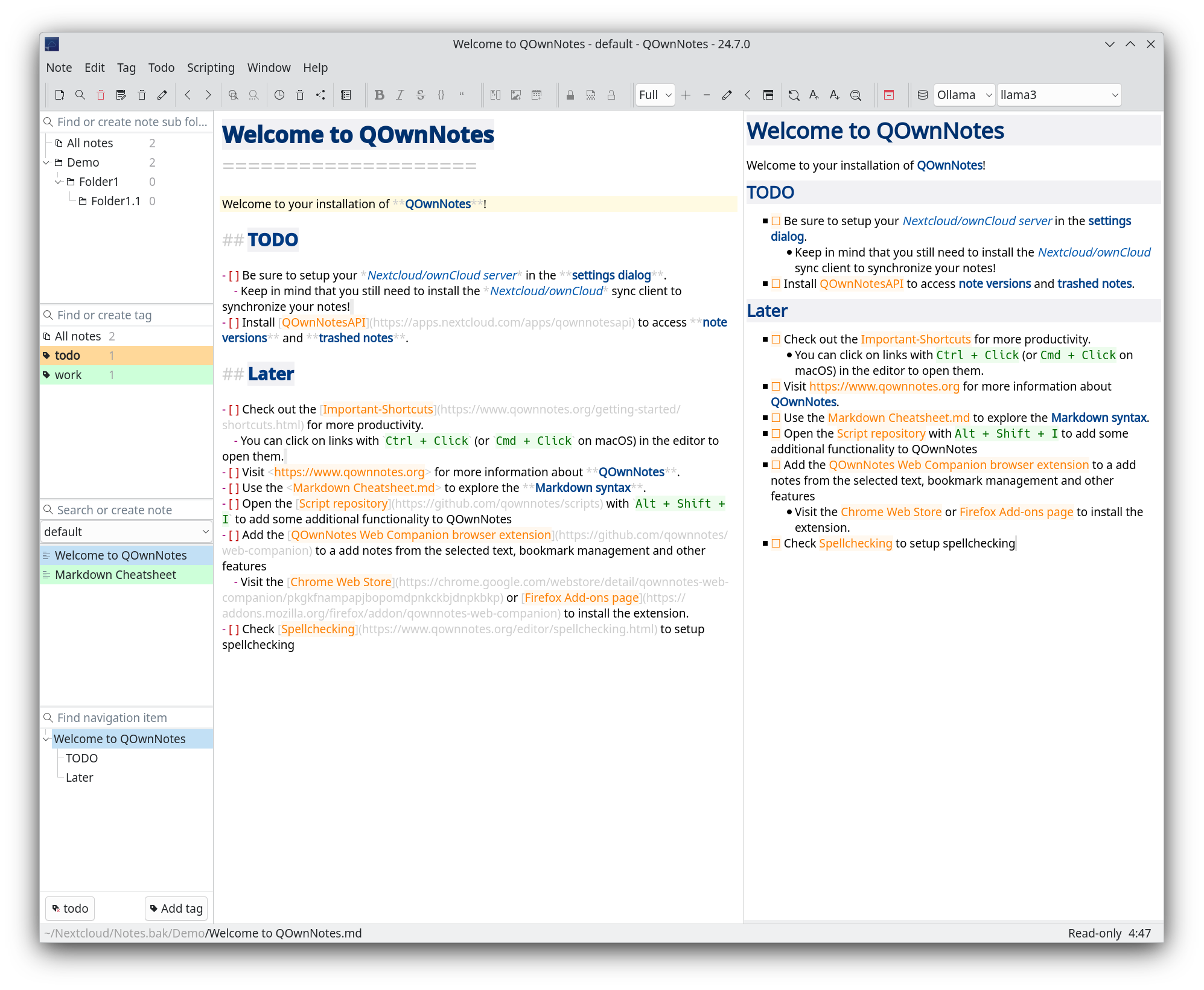
Screenhot

You can visit the QOwnNotes project page for more screenshots.

Features

  • written in C++ and optimized for low resource consumption (no CPU and memory-hungry Electron app)
  • multiple note folders can be used
  • you can use your existing text or markdown files, no need for an import most of the time
  • older versions of your notes can be restored from your Nextcloud / ownCloud server (install QOwnNotesAPI on your server)
  • trashed notes can be restored from your Nextcloud / ownCloud server (install QOwnNotesAPI on your server)
    • there also are local trash and system trash modes
  • sub-string searching of notes is possible and search results are highlighted in the notes
  • application can be operated with customizable keyboard shortcuts
    • supports global keyboard shortcuts on Wayland
  • external changes of note files are watched (notes or note list are reloaded)
  • differences between current note and externally changed note are shown in a dialog
  • markdown highlighting of notes and a markdown preview
    • includes inline image previews, heading folding, and optional hiding of Markdown formatting syntax
  • optional wiki-style note links like [[Note]] with auto-completion, heading anchors, aliases, backlinks, and refactoring support
  • spellchecking and optional LanguageTool grammar and style checking, Harper grammar and style checking, and Markdown LSP support (e.g. Marksman for completions and diagnostics, or Rumdl for linting)
  • tabbing support for editing notes
  • scripting support and an online script repository where you can install scripts inside the application
  • built-in AI support with script integration for providers like OpenAI and Groq
    • includes a built-in MCP server so external AI agents can search and fetch notes securely
  • QOwnNotes Web Companion browser extension to add notes from the selected text and other features
  • notes are getting their name from the first line of the note text (just like in the Nextcloud / ownCloud notes web-application) and the note text files are automatically renamed, if the first line changes
    • this feature can also be turned off, and you can use any filename you like
  • manage your Nextcloud / ownCloud todo lists (ownCloud tasks or Tasks Plus / Calendar Plus), or use another CalDAV server
  • create Nextcloud Deck cards and link to them in your notes
  • encryption of notes (AES-256 is built in, or you can use custom encryption methods like Keybase.io (encryption-keybase.qml) or PGP (encryption-pgp.qml))
  • dark mode theme support, live theme switching, and custom color modes
  • all panels can be placed wherever you want, they can even float or stack (fully dockable)
  • toolbars are fully customizable
  • support for freedesktop theme icons, so you can use QOwnNotes with your native desktop icons and with your favorite dark desktop theme QOwnNotes supports Freedesktop icon themes
  • support for hierarchical note tagging and note subfolders
    • linked files and attachments can be managed from the Navigation panel
  • support for sharing notes on your Nextcloud / ownCloud server

readme truncated — read the full docs on github

Frequently asked questions

Is QOwnNotes free to use?

QOwnNotes is open source under the GPL-2.0 licence. There is no licence fee and no seat count — you can self-host it or, where the project offers one, pay a vendor for a managed version instead.

What does QOwnNotes do?

QOwnNotes is a plain-text file notepad and todo-list manager with Markdown support and Nextcloud / ownCloud integration.

What is QOwnNotes written in?

QOwnNotes is primarily written in C++. Its source is publicly available at https://github.com/pbek/QOwnNotes, and it has 5,882 GitHub stars.

