Puppetboard


/badge.svg)


Puppetboard is a web interface to PuppetDB aiming to replace the reporting functionality of Puppet Enterprise console (previously: Puppet Dashboard) for the open source Puppet.
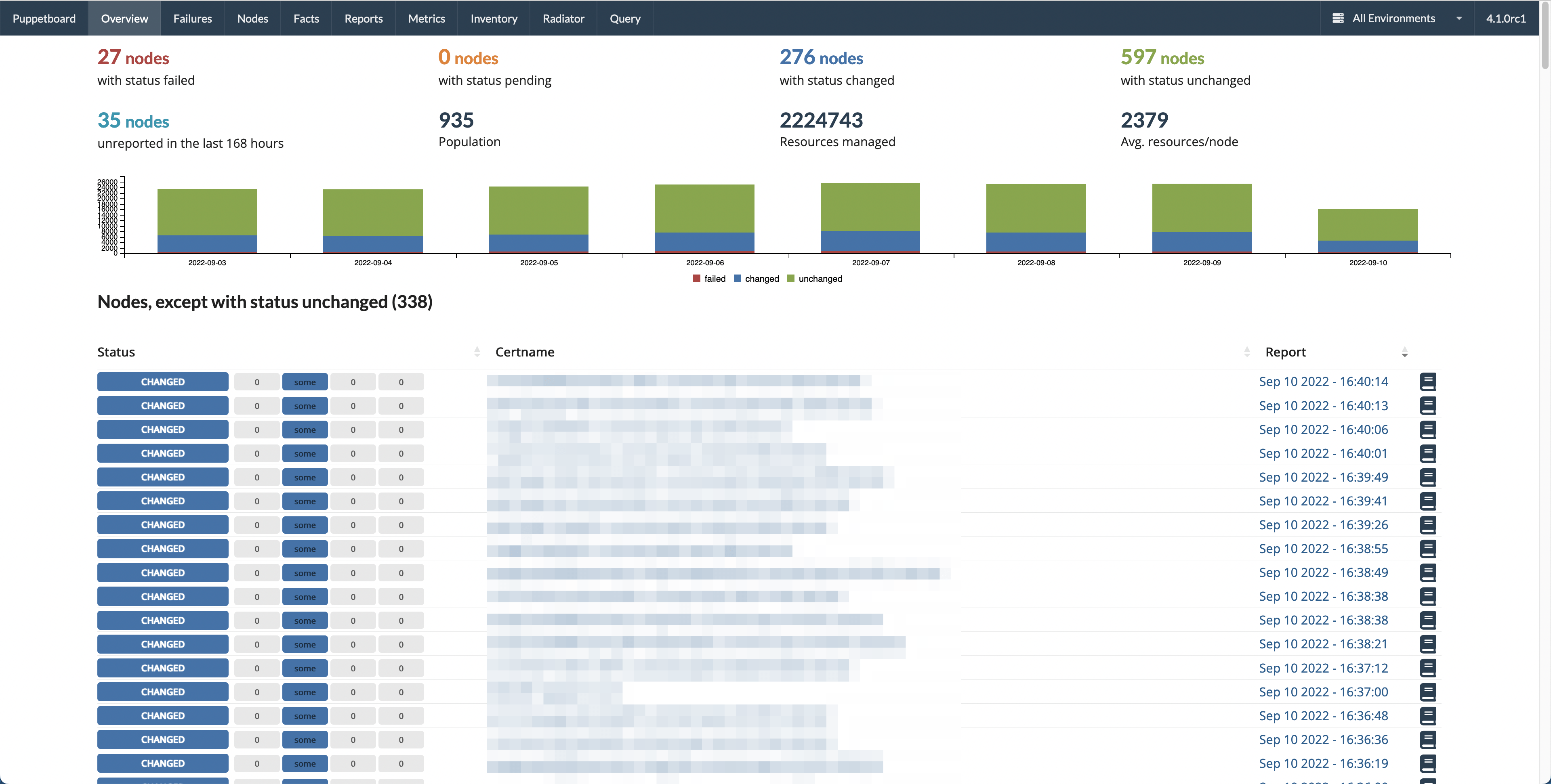
Table of Contents
Requirements
- PuppetDB v. 5.2-8.*
- (Note: PuppetDB 8.1.0 is not supported because of this bug. Please update to 8.1.1+.)
- Python 3.9-3.13 or Docker
Installation
Puppetboard is packaged and available on PyPI.
With Puppet module
There is a Puppet module originally written by Spencer Krum and currently maintained by Voxpupuli that takes care of installing the Puppetboard for you.
To see how to get it working with RedHat/Centos 7 check out these docs.
Using Docker
We provide an official Docker image in:
You can run the app on your PuppetDB host with this command:
docker run -it \
  -e PUPPETDB_HOST=localhost \
  -e PUPPETDB_PORT=8080 \
  -e SECRET_KEY=XXXXXXXX \
  --net=host \
  ghcr.io/voxpupuli/puppetboard
Note: you must provide a secret key! Generate one for example by running ruby -e "require 'securerandom'; puts SecureRandom.hex(32)".
Optionally you can set PUPPETBOARD_URL_PREFIX env variable to a value like /puppetboard to run the app under a URL prefix.
You can use the following Puppet Code to have Puppetboard managed by Puppet:
include docker

docker::image { 'ghcr.io/voxpupuli/puppetboard': }

docker::run { 'puppetboard':
  image => 'ghcr.io/voxpupuli/puppetboard',
  env   => [
    'PUPPETDB_HOST=127.0.0.1',
    'PUPPETDB_PORT=8080',
    'PUPPETBOARD_PORT=8088',
    'SECRET_KEY=XXXXXXXX',
  ],
  net   => 'host',
}
If you want to have all features enabled, you must use SSL talking to PuppetDB:
file { '/etc/puppetboard':
  ensure => directory,
}
file { '/etc/puppetboard/key.pem':
  ensure => file,
  mode   => '0644',
  source => "/etc/puppetlabs/puppet/ssl/private_keys/${facts['networking']['fqdn']}.pem",
}
file { '/etc/puppetboard/cert.pem':
  ensure => file,
  mode   => '0644',
  source => "/etc/puppetlabs/puppet/ssl/certs/${facts['networking']['fqdn']}.pem",
}

include docker

docker::image { 'ghcr.io/voxpupuli/puppetboard': }

docker::run { 'puppetboard':
  image   => 'ghcr.io/voxpupuli/puppetboard',
  volumes => ['/etc/puppetboard:/etc/puppetboard:ro'],
  env     => [
    'PUPPETDB_HOST=puppet', # this must be the certname or DNS_ALT_NAME of the PuppetDB host
    'PUPPETDB_PORT=8081',
    'PUPPETBOARD_PORT=8080',
    'ENABLE_CATALOG=true',
    'PUPPETDB_SSL_VERIFY=false',
    'PUPPETDB_KEY=/etc/puppetboard/key.pem',
    'PUPPETDB_CERT=/etc/puppetboard/cert.pem',
    'SECRET_KEY=XXXXXXXX',
    'DEFAULT_ENVIRONMENT=*',
  ],
  net     => 'host',
}
Within an air gapped environment you want to load all content from your local puppetboard web service.
Add: 'OFFLINE_MODE=true', to the env parameter list of the docker::run Puppet type.
We also provide the Dockerfile, so you can build the image yourself:
docker build -t puppetboard .
Using Red Hat OpenShift
The included OpenShift template file helps in the creation of the Puppetboard web interface by adopting a source-to-image methodology.
You can run the app on your OpenShift environment with these commands:
# Import the template into OpenShift
oc create -f puppetboard-s2i-template.yaml

# Create the Puppetboard application and supporting Pods.
oc new-app -p PUPPETDB_HOST=puppetdb.fqdn.com \
           --template=puppetboard-template
This will build a puppetboard application that queries a PuppetDB database at puppetdb.fqdn.com.
Optionally you can set other environment variables to fit your needs:
oc new-app -p PUPPETDB_HOST=puppetdb.fqdn.com \
           -p PUPPETDB_PORT=3456 \
           -p PUPPETBOARD_SOURCE_REPOSITORY_REF="v5.4.0" \
           -p PUPPETBOARD_SERVICE_NAME=prod_puppetboard \
           --template=puppetboard-template
This will build Puppetboard version v5.4.0 that queries the PuppetDB server on TCP/3456.
The following is a list of OpenShift parameters that you can pass to the oc command to customize the application:
PUPPETBOARD_SERVICE_NAME: This is the name that will be used for application. Deployment Configs, Build Configs Services, Routes and Pods will use this value for their names as well. You can instantiate multiple applications by using different names inoc new-app. Defaults to 'puppetboard'.PUPPETDB_HOST: This is the name of the PuppetDB host that Puppetboard will query for its reports. Defaults to 'puppetdb'.PUPPETDB_PORT: This is tcp port on thePUPPETDB_HOSTfor queries. Defaults to '8080'.PUPPETBOARD_SECRET_KEY: Identical toSECRET_KEY(below). Defaults to 'Secr3t_K3y'.PUPPETBOARD_PORT: The TCP port on which the Puppetboard docker image presents the web interface. This is not the user-facing web interface. Rather, it's the port that the OpenShift route forwards to.SERVICE_PORT: The TCP port on which the Puppetboard service offers its user-facing web interface on OpenShift. Defaults to '80'.PUPPETBOARD_SOURCE_REPOSITORY_URL: The URL to the Puppetboard repository. Defaults to 'https://github.com/voxpupuli/puppetboard.git'.PUPPETBOARD_SOURCE_REPOSITORY_REF: The branch/tag/ref for Puppetboard. Defaults to 'master'.
From a package
Actively maintained packages:
- FreeBSD maintained by Romain Tartière
- OpenBSD maintained by Sebastian Reitenbach
Manually
You can also install the package from PyPI and configure a WSGI-capable application server to serve it.
We recommend using virtualenv to provide a separate environment for the app.
virtualenv -p python3 venv
. venv/bin/activate
pip install puppetboard
Please see an article about more deployment setups here.
Configuration
Puppet agents
The default value of usecacheonfailure = true configuration setting for Puppet agents causes Puppet runs to always succeed,
event if there are catalog compilation failures f.e. because of a syntax error in your code. This is because in such
cases with this setting Puppet will just use a cached working catalog and report the run to PuppetDB as successful.
(Although with an error visible in the Puppet run log.)
Therefore, to show the nodes with a catalog compilation as failed in Puppetboard you need to set
usecacheonfailure = false in your nodes' puppet.conf.
PuppetDB
Of course you need to configure your Puppet Server to store the Puppet run reports in PuppetDB. If you haven't done that already please follow the PuppetDB documentation about this.
If you run Puppetboard on a different host than PuppetDB then you may want to configure the certificate allow-list for which certificates are allowed to access data from PuppetDB. Please read more about this feature in the PuppetDB documentation here.
App settings
Puppetboard will look for a file pointed at by the PUPPETBOARD_SETTINGS environment variable.
The file has to be identical to
[default_settings.py](https://github.com/voxpupuli/puppetboard/blob/master/puppetboard/default_s