Radix Primitives is an MIT-licensed, TypeScript UI component library for React, maintained by WorkOS, that gives teams building design systems and web apps low-level components focused on accessibility, customization and developer experience.
What it is
Radix Primitives is an open-source UI component library for building high-quality, accessible design systems and web apps. It is a low-level library, which means it supplies the base layer rather than a finished visual theme, and it is maintained by WorkOS under the MIT License, Copyright © 2022-present WorkOS. The source language is TypeScript, the registry places it in Miscellaneous / Design & Prototyping, and its topic list ties it to accessibility, colors, component-library, design-systems, radix-ui, react, ui, ui-components and ui-kit. Documentation, changelogs and releases live at radix-ui.com/primitives, with the repository itself carrying the logo, contributing guidelines and community links.
The problem it solves is the base layer of a design system. Teams that ship React interfaces otherwise write their own accessibility plumbing and component internals before any product code is written, then maintain that code indefinitely. Radix Primitives replaces that project-specific base layer with a shared one that can be consumed either as the foundation of an entire design system or adopted incrementally, component by component. The registry entry reflects a mature project: 19,309 stars, 1,247 forks and 356 open issues, with repository activity as recent as 2026-08-08.
Key capabilities
- Low-level components built with a stated focus on accessibility, customization and developer experience, intended as design system base layer or incremental adoption.
- React and TypeScript as the primary stack, with react and ui-components among the repository topics.
- Repository workflow driven by pnpm:
npm install -g pnpm installs the package manager, then pnpm install installs dependencies.
- External documentation and changelog at radix-ui.com/primitives/docs and radix-ui.com/primitives/docs/overview/releases.
- Contribution path documented in
.github/CONTRIBUTING.md, with community support through Discord and Twitter.
- Visual testing platform Chromatic used to review UI changes and catch visual regressions.
- Topic coverage spanning accessibility, colors, component-library, design-systems, ui and ui-kit.
Who uses it and how
- Design system teams use it as the base layer of an in-house component library, then layer their own styling and tokens on top.
- Product teams adopt it incrementally, pulling in individual components instead of replacing an existing component set at once.
- Accessibility-focused teams select it because accessibility is a stated focus of the library rather than an add-on.
- Contributors work against the repository directly, following
.github/CONTRIBUTING.md and coordinating through Discord and Twitter.
- Maintainers and reviewers use Chromatic to inspect UI changes and catch visual regressions before merge.
Getting started
The README documents a pnpm-based setup: install pnpm with npm install -g pnpm, then run pnpm install to install dependencies. Full usage documentation sits at radix-ui.com/primitives/docs, with releases at radix-ui.com/primitives/docs/overview/releases.
How it compares
No paid products this project replaces are listed in the facts, and no comparable tools are named either, so on the evidence provided it stands alone in this registry. Comparisons against other component libraries are not supported by the supplied material and are not made here.
When to use it — and when not to
Choose it when the goal is a shared, accessible base layer for a React design system, and when the team is willing to read documentation hosted outside the repository. The README is sparse on its own: it covers the pnpm bootstrap and then defers to radix-ui.com for documentation and releases, so it does not list per-component install packages, usage APIs or upgrade notes in the repository. Because the library is deliberately low-level, teams that want a finished styled component set out of the box, or that work outside React, should look elsewhere; the 356 open issues also indicate an active maintenance queue rather than a frozen codebase.
project readme (upstream, from github) — read inline
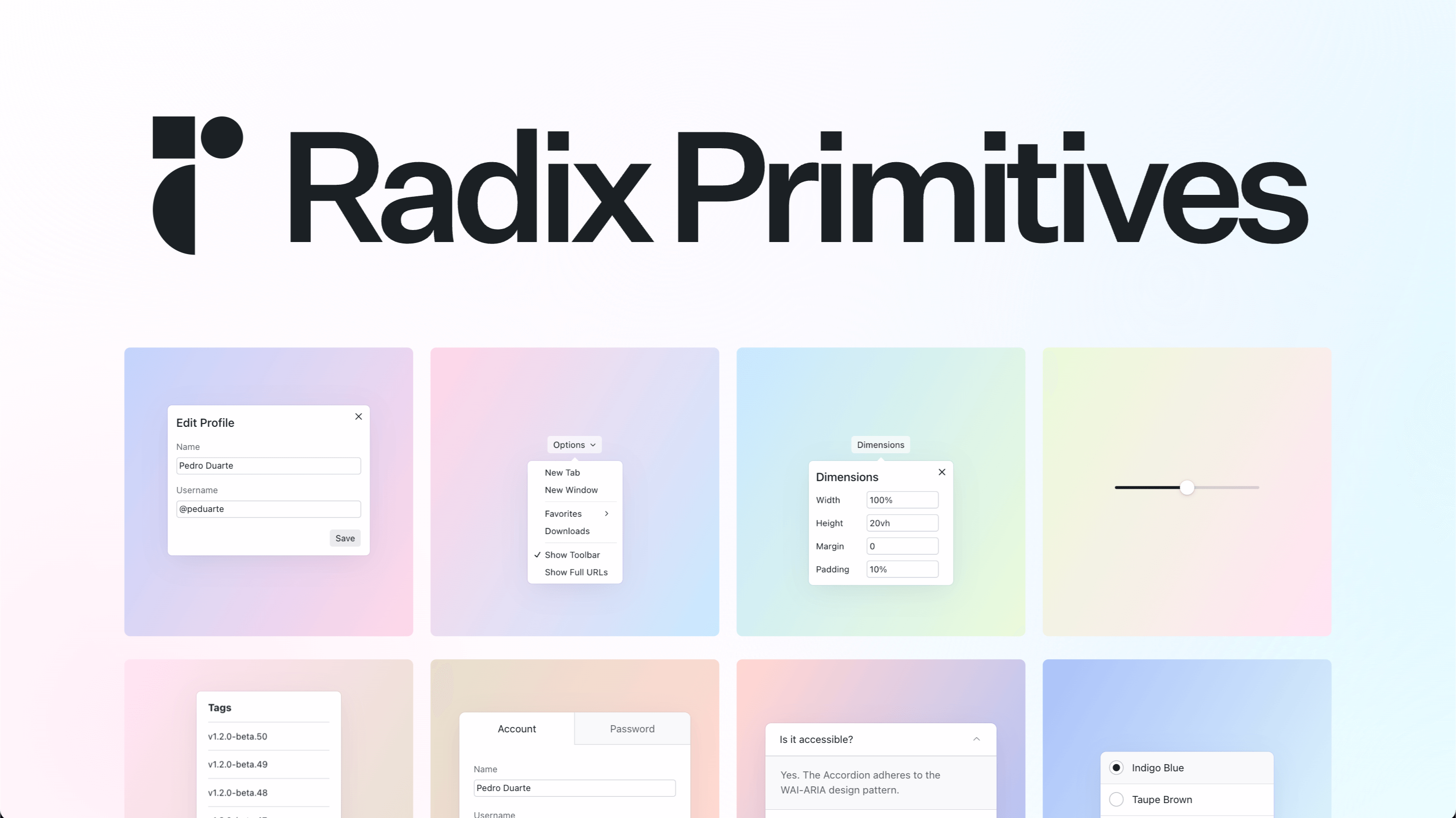
Radix Primitives
An open-source UI component library for building high-quality, accessible design systems and web apps.
Radix Primitives is a low-level UI component library with a focus on accessibility, customization and developer experience. You can use these components either as the base layer of your design system, or adopt them incrementally.
Installation
First, install pnpm if you haven't already. Open your terminal and run:
npm install -g pnpm
Then, install the dependencies:
pnpm install
Documentation
For full documentation, visit radix-ui.com/primitives/docs.
Releases
For changelog, visit radix-ui.com/primitives/docs/overview/releases.
Contributing
Please follow our contributing guidelines.
Community
- Discord - To get involved with the Radix community, ask questions and share tips.
- Twitter - To receive updates, announcements, blog posts, and general Radix tips.
Thanks

Thanks to Chromatic for providing the visual testing platform that helps us review UI changes and catch visual regressions.
License
Licensed under the MIT License, Copyright © 2022-present WorkOS.