English · Français · Deutsch · Español · Português · Русский · 简体中文

Powerful note-taking without the hassle.
A free, self-hosted, open-source alternative to Notion, Obsidian, Evernote, or OneNote.




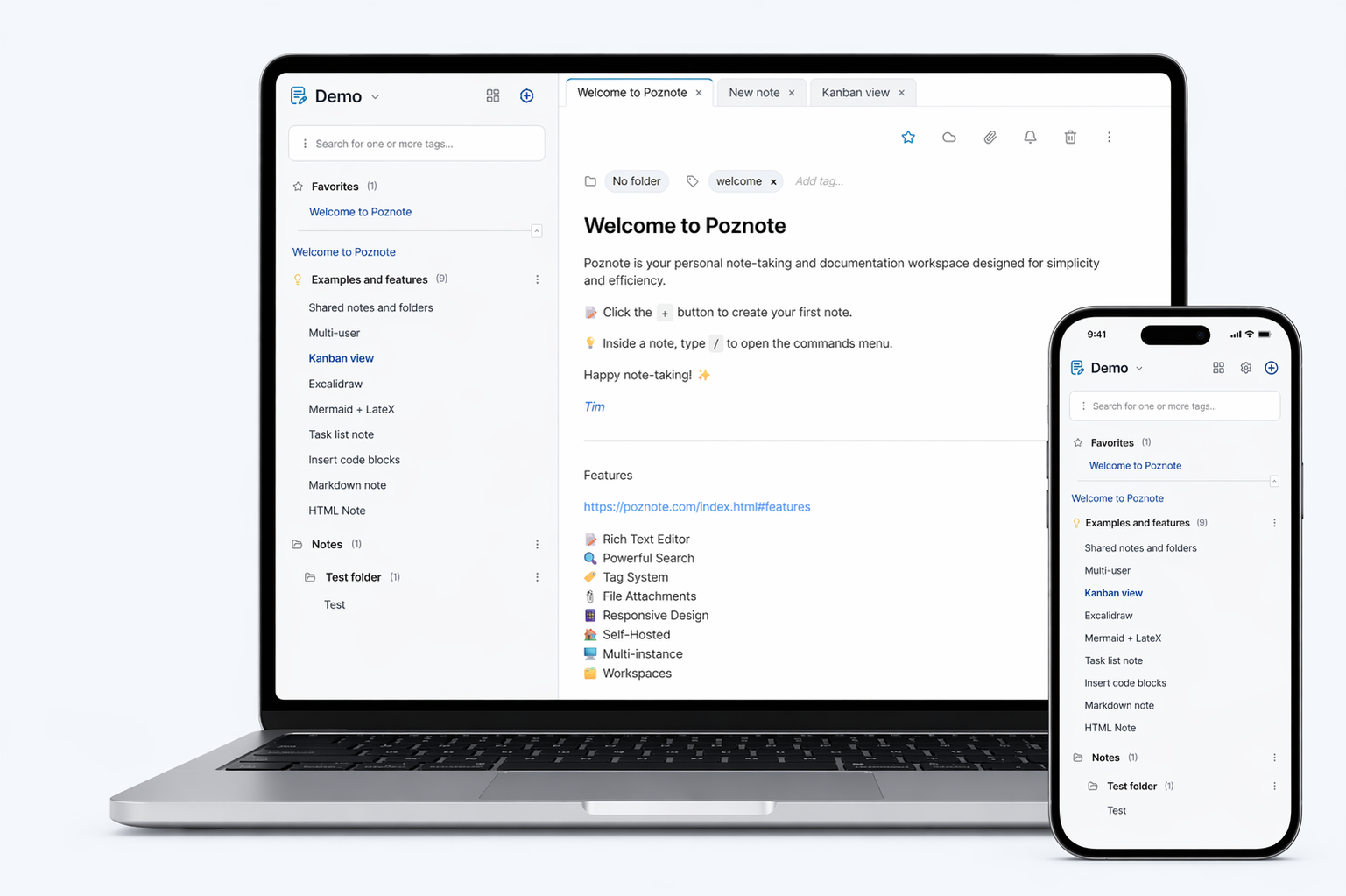
Features
Discover all the features here.
Screenshots
See all the screenshots here.
Demo
Login: poznote
Password: poznote
They talk about Poznote
https://poznote.com/press.html
Discord
Join the community to ask questions, share feedback or follow the development:
Table of content
- Install
- Access
- Change Settings
- Update application
- Authentication
- App Passwords
- Note types
- Snapshots
- Personalization
- Multi-users
- Activity Log
- Webhooks
- Git Synchronization
- S3 Attachment Storage
- S3 Backups
- Backup / Export
- Restore / Import
- Offline View
- Multiple Instances
- AI Assistant
- Transcription (speech to text)
- MCP Server
- Chrome Extension
- Share to Poznote on Android
- API Documentation
- Tech Stack
Install
The official image is multi-arch (linux/amd64, linux/arm64) and supports Windows/macOS via Docker Desktop, as well as ARM64 devices like Raspberry Pi, NAS systems etc.
Choose your preferred installation method below:
🖥️ Windows
Step 1: Prerequisite
Install and start Docker Desktop
Step 2: Deploy Poznote
Create a new directory:
mkdir poznote
Navigate to the Poznote directory:
cd poznote
Create the environment file:
curl -o .env https://raw.githubusercontent.com/timothepoznanski/poznote/main/.env.template
Edit the .env file:
notepad .env
Download the Docker Compose configuration file:
curl -o docker-compose.yml https://raw.githubusercontent.com/timothepoznanski/poznote/main/docker-compose.yml
Download the latest Poznote Webserver and Poznote MCP images :
docker compose pull
Start Poznote containers:
docker compose up -d
🐧 Linux
Step 1: Prerequisite
- Install Docker engine
- Install Docker Compose
Step 2: Install Poznote
Create a new directory:
mkdir poznote
Navigate to the Poznote directory:
cd poznote
Create the environment file:
curl -o .env https://raw.githubusercontent.com/timothepoznanski/poznote/main/.env.template
Edit the .env file:
vi .env
Download the Docker Compose configuration file:
curl -o docker-compose.yml https://raw.githubusercontent.com/timothepoznanski/poznote/main/docker-compose.yml
Download the latest Poznote Webserver and Poznote MCP images:
docker compose pull
Start Poznote containers:
docker compose up -d
🍎 macOS
Step 1: Prerequisite
Install and start Docker Desktop
Step 2: Deploy Poznote
Create a new directory:
mkdir poznote
Navigate to the Poznote directory:
cd poznote
Download the environment file:
curl -o .env https://raw.githubusercontent.com/timothepoznanski/poznote/main/.env.template
Edit the .env file:
vi .env
Download the Docker Compose configuration file:
curl -o docker-compose.yml https://raw.githubusercontent.com/timothepoznanski/poznote/main/docker-compose.yml
Download the latest Poznote Webserver and Poznote MCP images:
docker compose pull
Start Poznote containers:
docker compose up -d
☁️ Cloud
Don't want to manage a server? Two hosts run Poznote for you. With either one, you first need to create an account with the host, then you deploy Poznote from their catalog in a few clicks. Both give you free credit when you sign up, so you can try without paying anything.
- Caliber Node, from $2.50 a month: updates arrive as soon as they are released, fixed plans (you move up to the next tier if you need more), SSH console and automatic snapshots included. A good fit if you want as little to manage as possible and don't have that many notes.
- PikaPods, from $2 a month: updates are tested before rollout so they arrive a little later, RAM, CPU and disk can be adjusted independently, backups run automatically but you set up where they are stored (S3). A good fit if you want room to grow as your notes pile up.
🗄️ Proxmox VE
On a Proxmox VE host, the Proxmox VE Community Scripts project installs Poznote in its own container with a single command, no Docker involved: it creates an unprivileged Debian 13 LXC (1 vCPU, 512 MB of RAM and a 4 GB disk by default) and serves Poznote from nginx and PHP inside it.
Run this from the Proxmox host shell:
bash -c "$(curl -fsSL https://raw.githubusercontent.com/community-scripts/ProxmoxVE/main/ct/poznote.sh)"
Poznote then answers at http://:8040, with the same default credentials as any other install. To update it later, run update in the container console.
This script is written and maintained by the community, not by Poznote. See the Poznote script page for its options and notes.
☸️ Kubernetes with Helm
Step 1: Prerequisite
Install Helm and make sure your Kubernetes context points to the cluster where you want to deploy Poznote.
Step 2: Deploy Poznote
Add the HelmForge chart repository:
helm repo add helmforge https://repo.helmforge.dev
Update your local chart index:
helm repo update
Install Poznote:
helm install poznote helmforge/poznote --namespace poznote --create-namespace
The Poznote Helm chart is maintained by the HelmForge community as a Kubernetes-native installation option. See the [HelmForge Poznote chart documentation](https