power-bi-agentic-development
The best source for Power BI AI skills and agentic development resources in one marketplace
Teach AI agents like Claude Code or GitHub Copilot Power BI and Microsoft Fabric




[!WARNING] These skills are under active development with a weekly release cadence, so expect regular renaming and restructuring.
Versions 26.26 through 26.38 are a deliberate breaking transition. Skills may be consolidated, renamed, removed, or made less automatic between weekly releases in this range. Pin 26.25 or earlier if you need the pre-transition skill structure and behavior; do not assume compatibility from one transition release to the next.
What is agentic development?
- Agentic development is when you use agents to help you build, manage, and optimize artifacts and software. This includes semantic models, reports, and the things around them, like workspaces, deployment pipelines, and also processes.
- A marketplace hosts plugins that you can install. Plugins are a collection of resources that help coding agents perform better. They are typically special instruction files and scripts. Plugins can contain skills, subagents, hooks, and MCP servers focused on special topics or tasks.
- This marketplace is focused on everything to help your agent work well with Power BI and Fabric: Power BI skills, Fabric skills, subagents, and hooks for coding agents. Read further for more information.
Installation
Here's how you get started in Claude Code; run this in the terminal to get the marketplace:
claude plugin marketplace add data-goblin/power-bi-agentic-development
Example: Using the pbir-cli with the skills
Click here for a YouTube walkthrough
Claude Code
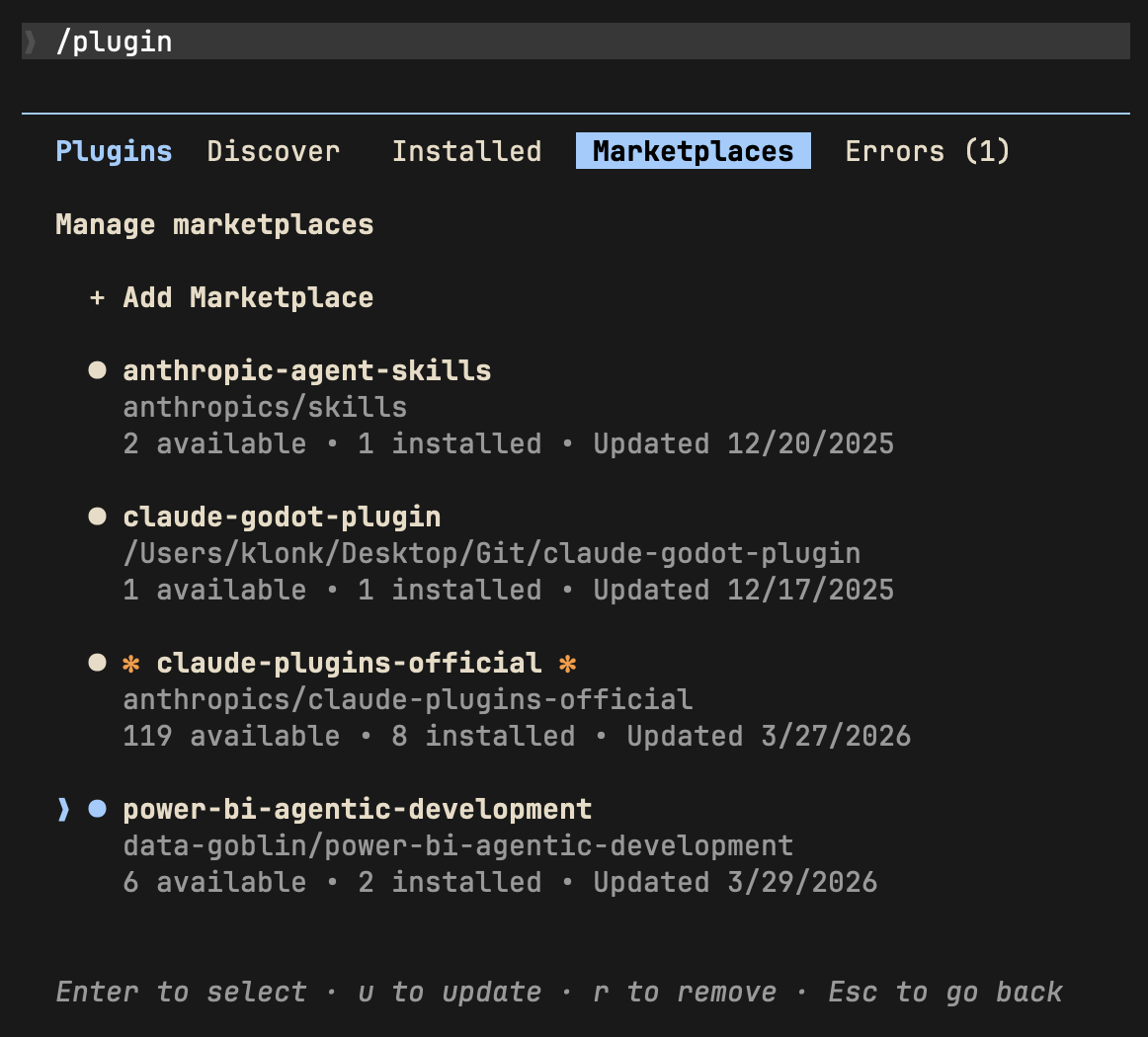
Add the marketplace, then install plugins via /plugin and navigating to the installed marketplace.
 |
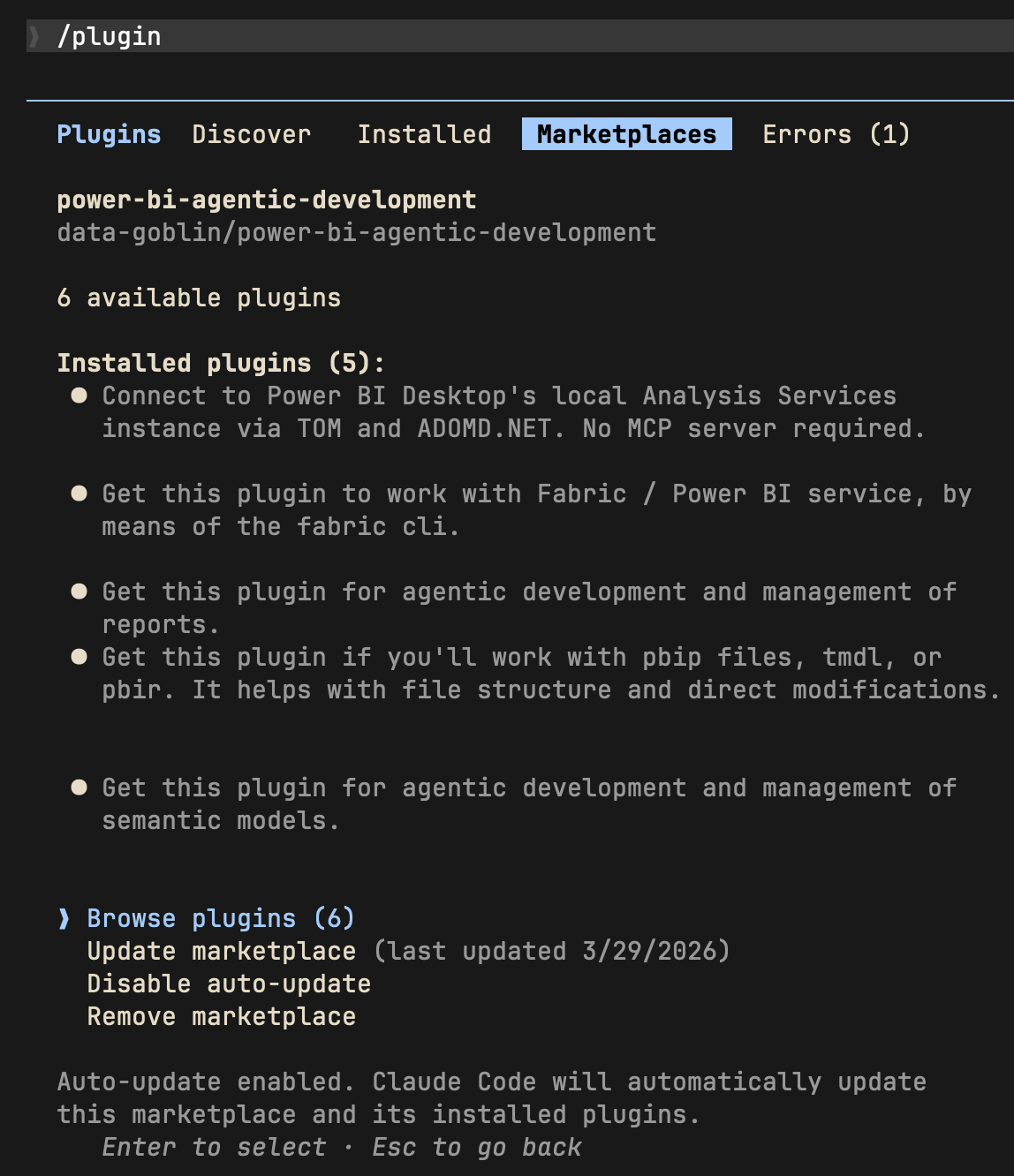 |
| Install plugins from the marketplace | Enable marketplace auto-update |
Alternative; add plugins via command line:
claude plugin install goblin-mode@power-bi-agentic-development
claude plugin install tabular-editor@power-bi-agentic-development
claude plugin install pbi-desktop@power-bi-agentic-development
claude plugin install pbip@power-bi-agentic-development
claude plugin install semantic-models@power-bi-agentic-development
claude plugin install reports@power-bi-agentic-development
claude plugin install paginated-reports@power-bi-agentic-development
claude plugin install custom-visuals@power-bi-agentic-development
claude plugin install fabric-cli@power-bi-agentic-development
claude plugin install fabric-admin@power-bi-agentic-development
claude plugin install etl@power-bi-agentic-development
Copilot CLI
The standalone Copilot CLI supports plugin installation from GitHub repos. Copilot CLI reads the same .claude-plugin/marketplace.json manifest this repo uses, so the marketplace and child-plugin layout works without modification.
Windows long paths
TMDL files have a problem with repository-relative paths over 260 characters. Windows' legacy MAX_PATH blocks git clone from writing them unless long path support is enabled at both the OS and git level. Without this, copilot plugin install aborts with Filename too long.
Check useful-stuff/agent-scripts/enable-windows-longpaths.ps1 as an example of a script you can run from an elevated ps environment to enable long paths; there are other routes to do this that you can find online, too... just ask Copilot. A reboot is recommended after the registry change. This is a Windows OS limitation, documented at Maximum Path Length Limitation.
See also the below git config command:
git config --system core.longpaths true
Additional installation instructions
This repository is an Anthropic-format plugin marketplace (a set of plugins), not a single distributable plugin, so the root .claude-plugin/ contains only marketplace.json. Two documented install paths work:
1. Register the marketplace once, then install named child plugins. Example:
copilot plugin marketplace add data-goblin/power-bi-agentic-development
copilot plugin install tabular-editor@power-bi-agentic-development
2. Or install a single plugin directly from its subdirectory, no marketplace registration needed. Example:
copilot plugin install data-goblin/power-bi-agentic-development:plugins/pbip
Both forms are documented in the Copilot CLI plugin reference and the plugins how-to. Inside an interactive Copilot session, /plugin install PLUGIN-NAME@MARKETPLACE-NAME is the equivalent of (1). The bare copilot plugin install data-goblin/power-bi-agentic-development (no qualifier) will not install anything useful, because the root is a marketplace catalog, not a plugin.
Verify installation in Copilot CLI
Inside Copilot CLI:
/env                    # Loaded instructions, MCP servers, skills, agents, plugins, LSPs, extensions
/plugin list            # Installed plugins
/skills list            # Available skills
/skills info pbip       # Details for a specific skill
/agent                  # Browse installed agents
Compatibility notes
- Skills load identically; Copilot CLI reads
skills//SKILL.md. - Agents use the
*.agent.mdextension required by Copilot CLI's documented convention. Claude Code matches any*.mdfile inagents/, so the dual extension works in both tools. - MCP servers load from
.mcp.json(plugin root) or.github/mcp.json. The plugins in this repo do not currently ship MCP servers. - Hooks are registered via
hooks.jsonand reference scripts using${CLAUDE_PLUGIN_ROOT}. Copilot CLI ≥ 1.0.26 (2026-04-14) setsCLAUDE_PLUGIN_ROOTfor plugin hooks (changelog); older builds do not, which causes hook commands to resolve to broken paths. Runcopilot updateif hooks fail to fire. Native Windows bash users may also hit a separate path-format bug tracked upstream at claude-code#11984.
Overview
The repo contains skills, agents, and hooks.
- Skills teach agents domain knowledge and workflows. They activate automatically based on task context, or can be invoked manually with
/skill-name. In Claude Code, skills and commands have coalesced; commands are simply more prescriptive skill workflows. - Agents are autonomous subprocesses that handle complex, multi-step tasks independently; typically used for review and validation.
- Hooks run automatically after tool use to validate files and catch errors early. They are deterministic; they fire when a specific pattern is matched, not by LLM judgment.
Hook checks can be individually toggled via config files. Set any check to false to disable it:
plugins/pbip/hooks/config.yaml-- PBIR, TMDL, and report binding validationplugins/pbi-desktop/hooks/config.yaml-- DAX references, measure metadata, referential integrity, metadata cache
Power BI and Fabric skills, agents, and hooks: available plugins
[!WARNING] Don't install every plugin. Each skill competes for the agent's attention and context window, so install a plugin only when y