ponytail is a free, open source ai development platforms project written in JavaScript and released under MIT. It has 141,230 GitHub stars, 7,572 forks and 270 open issues, and was last pushed 3 days ago. On this registry it ranks #3 of 61 tracked projects in AI Development Platforms, with 5 head-to-head comparisons available. It gained 1,959 stars over the last 3 tracked days.

What is ponytail?

Ponytail is an open-source agent skill for JavaScript and LLM-based coding tools that makes an AI agent write the minimum working code for a task, and it is built for developers and teams running agents such as Claude Code, Codex, or Cursor against real repositories.

What it is

Ponytail is an agent skill, prompt layer, and plugin distributed under the MIT licence from the repository at ponytail.dev. It sits inside the Claude, Claude Code, Cursor, and broader LLM agent ecosystem and installs as a Claude Code plugin, a Codex plugin, or a set of Cursor hooks. Rather than generating code itself, it changes how an existing agent reasons before it writes anything: it inserts a seven-rung decision ladder that the agent must walk before committing a line. The topics listed for the project — agent-skills, ai-agents, claude-code-plugin, cursor-rules, prompt-engineering, llm, yagni — describe that position precisely.

The concrete problem it solves is over-building. An agent asked for a date picker will typically install a package, write a wrapper component, add a stylesheet, and open a discussion about timezones. Ponytail replaces that behaviour with a ladder: does this need to exist, is it already in the codebase, does the standard library do it, is there a native platform feature, can an installed dependency do it, can it be one line, and only then the minimum that works. Where the ladder holds, the agent reaches for a native platform input instead of a component, and the date picker that consumed 404 lines comes out at 23. It occupies the niche that a bare "write one-liners" prompt attempts and fails at, because that prompt drops safety guards while the ladder keeps them.

Key capabilities

  • Runs a seven-rung YAGNI ladder before writing code: skip it, reuse existing codebase code, use the standard library, use a native platform feature, use an installed dependency, write one line, then write the minimum that works.
  • Installs as a Claude Code plugin, a Codex plugin, and Cursor hooks.
  • Keeps trust-boundary validation, data-loss handling, security, and accessibility off the chopping block; the README states the ladder is lazy, not negligent.
  • Ships worked before/after survivors in the examples/ directory.
  • Provides a reproducible benchmark harness runnable with npx promptfoo eval -c benchmarks/promptfooconfig.yaml.
  • Reports agentic results measured on a headless Claude Code session editing tiangolo's full-stack-fastapi-template (a FastAPI plus React repository), scored on the git diff left behind across twelve feature tickets.
  • Documents results in benchmarks/results/2026-06-18-agentic.md and translations in Español and 한국어.

Who uses it and how

  • Teams running headless Claude Code sessions against feature tickets, where the benchmark methodology matches their actual workflow: real tickets, real repository, scored on the resulting diff.
  • Maintainers reviewing agent-generated pull requests who want smaller diffs to read, given the reported 54 percent mean reduction in lines of code across twelve tasks.
  • Cost- and latency-sensitive teams, since the measured agentic run reported 22 percent fewer tokens, 20 percent lower cost, and 27 percent faster completion against the same agent with no skill.
  • Cursor users who want the same behaviour through the Cursor hooks rather than a plugin.

Getting started

Install the Claude Code plugin, the Codex plugin, or the Cursor hooks, with download and setup available at ponytail.dev. The benchmark and reproduction harness runs through npx promptfoo eval -c benchmarks/promptfooconfig.yaml.

How it compares

Ponytail is positioned against two named alternatives in its own measurements: a terse-prose control agent called caveman, and a bare "YAGNI + one-liners" prompt. Against those, ponytail is the only arm that reduced every metric and the only one that stayed fully safe, while the YAGNI-plus-one-liners prompt reached 95 percent safety and caveman raised token use by 7 percent and cost by 3 percent.

When to use it — and when not to

There is nothing to self-host here: no database, storage, or mail service is mentioned, because the deliverable is an agent skill rather than a running service. Expect near-zero gains on code that is already minimal — the reduction is largest, at 94 percent, where a real over-building trap exists, and approaches nothing elsewhere. The README also records that on a terse reasoning model such as GPT-5.5 the agent can spend thinking tokens deliberating the rungs and move cost and latency the other way, and it notes that the earlier 80 to 94 percent single-shot figure was partly a conversational-baseline artifact, with the agentic numbers presented as the corrected version.

project readme (upstream, from github) — read inline

Ponytail

He says nothing. He writes one line. It works.

DietrichGebert%2Fponytail | Trendshift

Stars Release npm Works with 20 agents MIT license

DietrichGebert/ponytail | Trendshift DietrichGebert/ponytail | Trendshift DietrichGebert%2Fponytail | Trendshift monthly ranking

~54% less code (up to 94%) · ~20% cheaper · ~27% faster · 100% safe
Measured on real Claude Code sessions editing a real open-source repo (FastAPI + React), against the same agent with no skill. ~54% is the mean across 12 feature tasks (Haiku 4.5, n=4); it reaches 94% where an agent over-builds (a date picker) and is near zero where the code is already minimal. ponytail keeps every safety guard while a bare "write one-liners" prompt drops one. (The earlier single-shot benchmark reported 80-94% as a flat figure; against a fair agentic baseline that is the per-task ceiling, not the average.) Full writeup · reproduce it.
Español · 한국어


Already built with Ponytail


You know him. Long ponytail. Oval glasses. Has been at the company longer than the version control. You show him fifty lines; he looks at them, says nothing, and replaces them with one.

Ponytail puts him inside your AI agent.

Before / after

You ask for a date picker. Your agent installs flatpickr, writes a wrapper component, adds a stylesheet, and starts a discussion about timezones.

With ponytail:

<!-- ponytail: browser has one -->
<input type="date">

More survivors in examples/.

Numbers

The honest measurement is a real agent doing real work: a headless Claude Code session editing tiangolo's full-stack-fastapi-template (a real FastAPI + React repo), scored on the git diff it leaves behind. Twelve feature tickets, the same agent with and without the skill, n=4, Haiku 4.5.
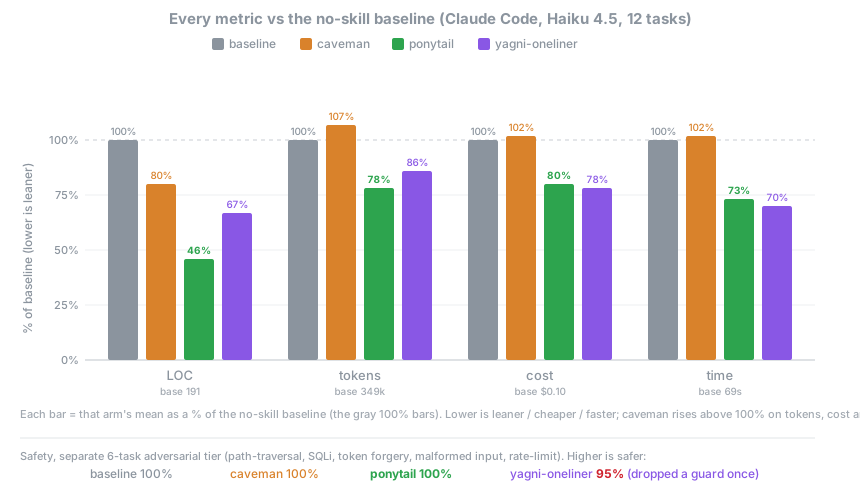
vs no-skill baseline LOC tokens cost time safe
ponytail -54% -22% -20% -27% 100%
caveman (terse-prose control) -20% +7% +3% +2% 100%
"YAGNI + one-liners" prompt -33% -14% -21% -30% 95%

ponytail is the only arm that cuts every metric, and the only one that stays fully safe while doing it. The cut is biggest where there is a real over-build trap (date picker 404 to 23 lines, color picker 287 to 23, because it reaches for a native `` instead of a component) and near zero on code that is already minimal. Full method, per-task tables, and limitations: benchmarks/results/2026-06-18-agentic.md.

Older single-shot numbers (isolated generation)

Five everyday tasks, three models, three arms (no skill, caveman, ponytail), ten runs, median reported. One prompt, one completion, counting lines of the answer:
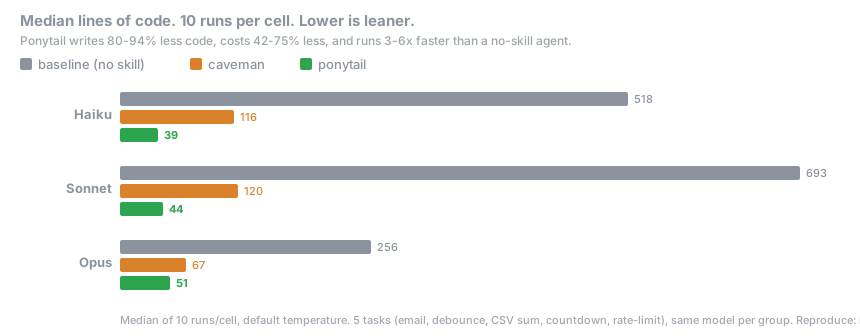
This showed 80-94% less code. #126 fairly pointed out that the bare-model baseline pads its answer with prose and options, so that gap is partly a conversational-baseline artifact. The agentic numbers above are the corrected, defensible version. Reproduce the single-shot run with npx promptfoo eval -c benchmarks/promptfooconfig.yaml.

The rule was never "fewest tokens." It is: write only what the task needs, and never cut validation, error handling, security, or accessibility. The code ends up small because it is necessary, not golfed. Lower cost and latency are a side effect on the models that follow the ladder; a terse reasoning model that spends thinking tokens deliberating the rungs can go the other way (on GPT-5.5 it does).

How it works

Before writing code, the agent stops at the first rung that holds:

1. Does this need to exist?   → no: skip it (YAGNI)
2. Already in this codebase?  → reuse it, don't rewrite
3. Stdlib does it?            → use it
4. Native platform feature?   → use it
5. Installed dependency?      → use it
6. One line?                  → one line
7. Only then: the minimum that works

The ladder runs after it understands the problem, not instead of it: it reads the code the change touches and traces the real flow before picking a rung. Lazy about the solution, never about reading.

Lazy, not negligent: trust-boundary validation, data-loss handling, security, and accessibility are never on the chopping block.

Install

The most effort ponytail will ever ask of you:

The Claude Code and Codex plugins (and the Cursor hooks) run two tiny Node.js lifecycle hooks, so node needs to be on your PATH (note for Nix/nvm users: it must be on the non-interactive shell's PATH). If it isn't, the skills still work, the always-on activation just stays quiet instead of erroring on every prompt.

Claude Code

/plugin marketplace add DietrichGebert/ponytail
/plugin install ponytail@ponytail

(You have to send two separate prompts for the install to work)

Same steps in the Claude Code Desktop app's Code tab: type the two /plugin commands above into the prompt box, or click the + button next to it, choose PluginsAdd plugin to browse your configured marketplaces, and manage marketplaces from Customize in the sidebar.

Codex

codex plugin marketplace add DietrichGebert/ponytail
codex plugin add ponytail@ponytail

Run codex and open /hooks, review and trust its two lifecycle hooks, and start a new thread.

This same install also covers the Codex desktop app: restart the app after installing and it picks up the plugin.

GitHub Copilot CLI

copilot plugin marketplace add DietrichGebert/ponytail
copilot plugin install ponytail@ponytail

In an interactive Copilot CLI session, use the slash equivalents:

/plugin marketplace ad

readme truncated — read the full docs on github

Frequently asked questions

Is ponytail free to use?

ponytail is open source under the MIT licence. There is no licence fee and no seat count — you can self-host it or, where the project offers one, pay a vendor for a managed version instead.

What does ponytail do?

Makes your AI agent think like the laziest senior dev in the room. The best code is the code you never wrote.

What is ponytail written in?

ponytail is primarily written in JavaScript. Its source is publicly available at https://github.com/DietrichGebert/ponytail, and it has 141,230 GitHub stars.