plannotator is a free, open source version control & collaboration project written in TypeScript and released under Apache-2.0. It has 8,748 GitHub stars, 658 forks and 155 open issues, and was last pushed 6 hours ago. On this registry it ranks #14 of 30 tracked projects in Version Control & Collaboration, with 5 head-to-head comparisons available. It gained 48 stars over the last 3 tracked days.

What is plannotator?

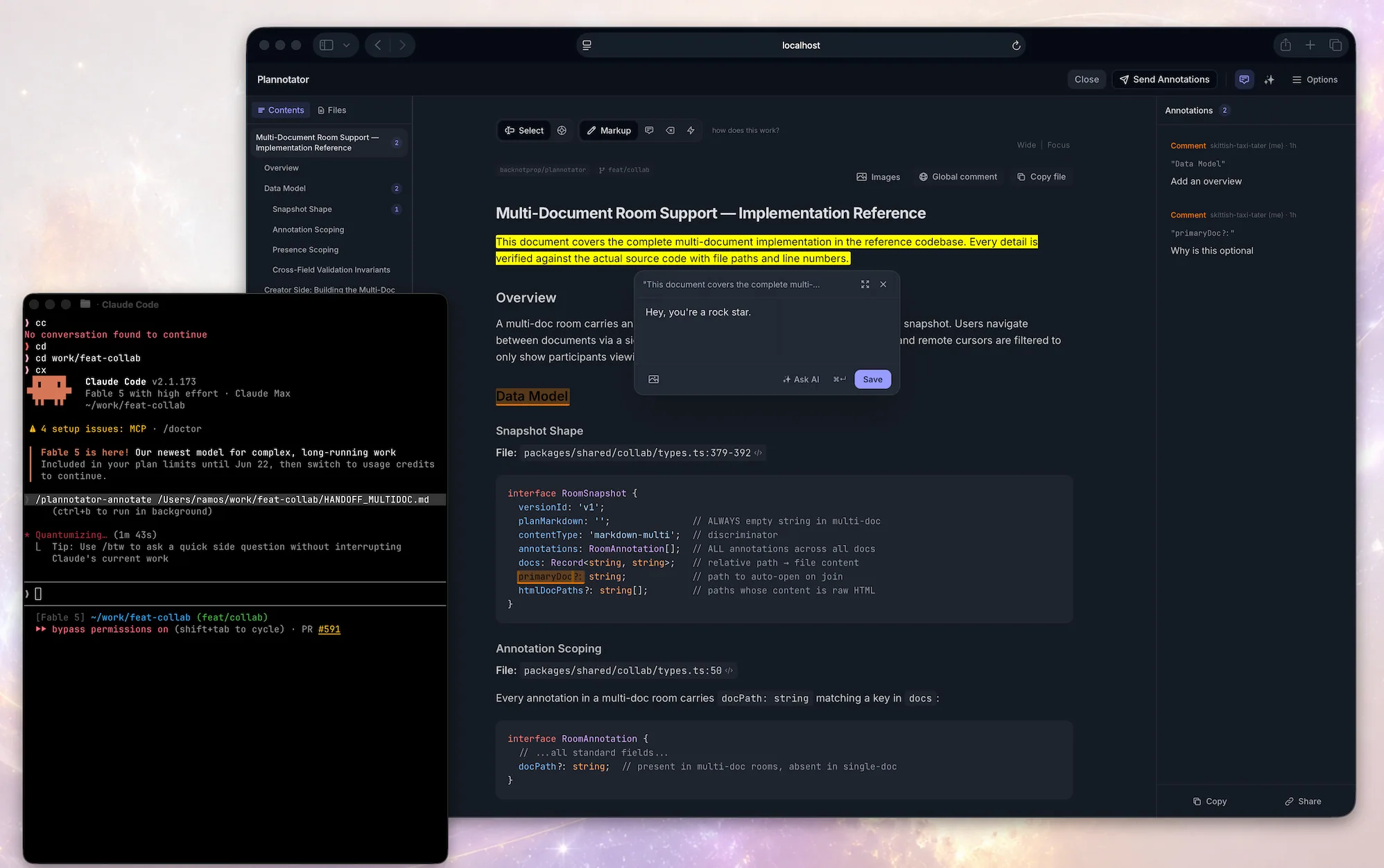
Plannotator is a local, browser-based review surface for AI coding agents that lets a developer annotate plans, documents, HTML artifacts, and code diffs, share them with a team, and send feedback back to the agent in one action.

What it is

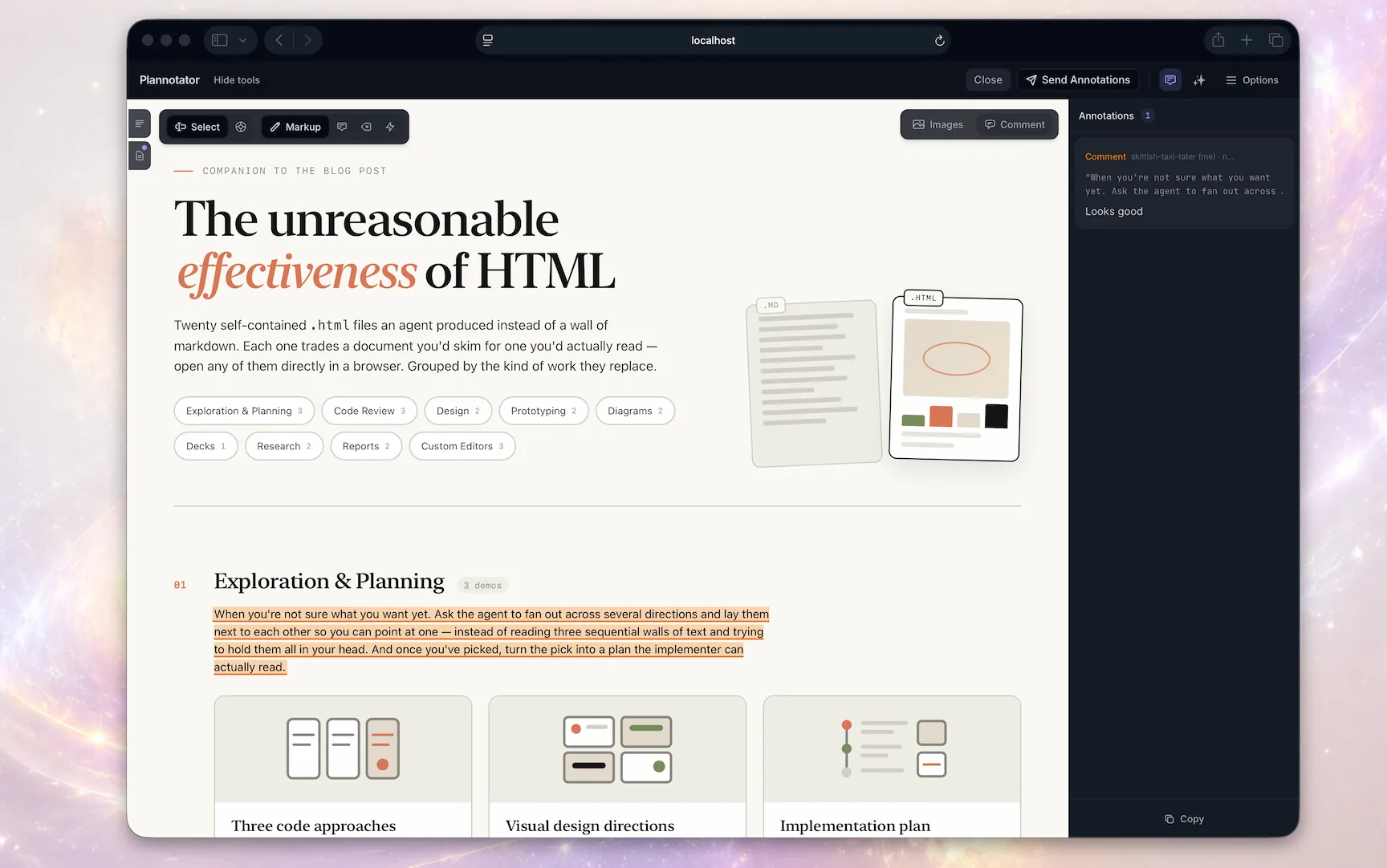
Plannotator is an open-source TypeScript project, licensed under Apache-2.0, that plugs directly into AI coding agents through their hooks and commands. The README names Claude Code, Codex, Copilot CLI, Gemini CLI, OpenCode, Kiro, Droid, Amp, and Pi as supported agents. When the agent proposes a plan, produces an HTML artifact, or finishes writing code, that work opens in the browser, where the reviewer marks it up, leaves comments, and sends the feedback to the agent for it to act on.

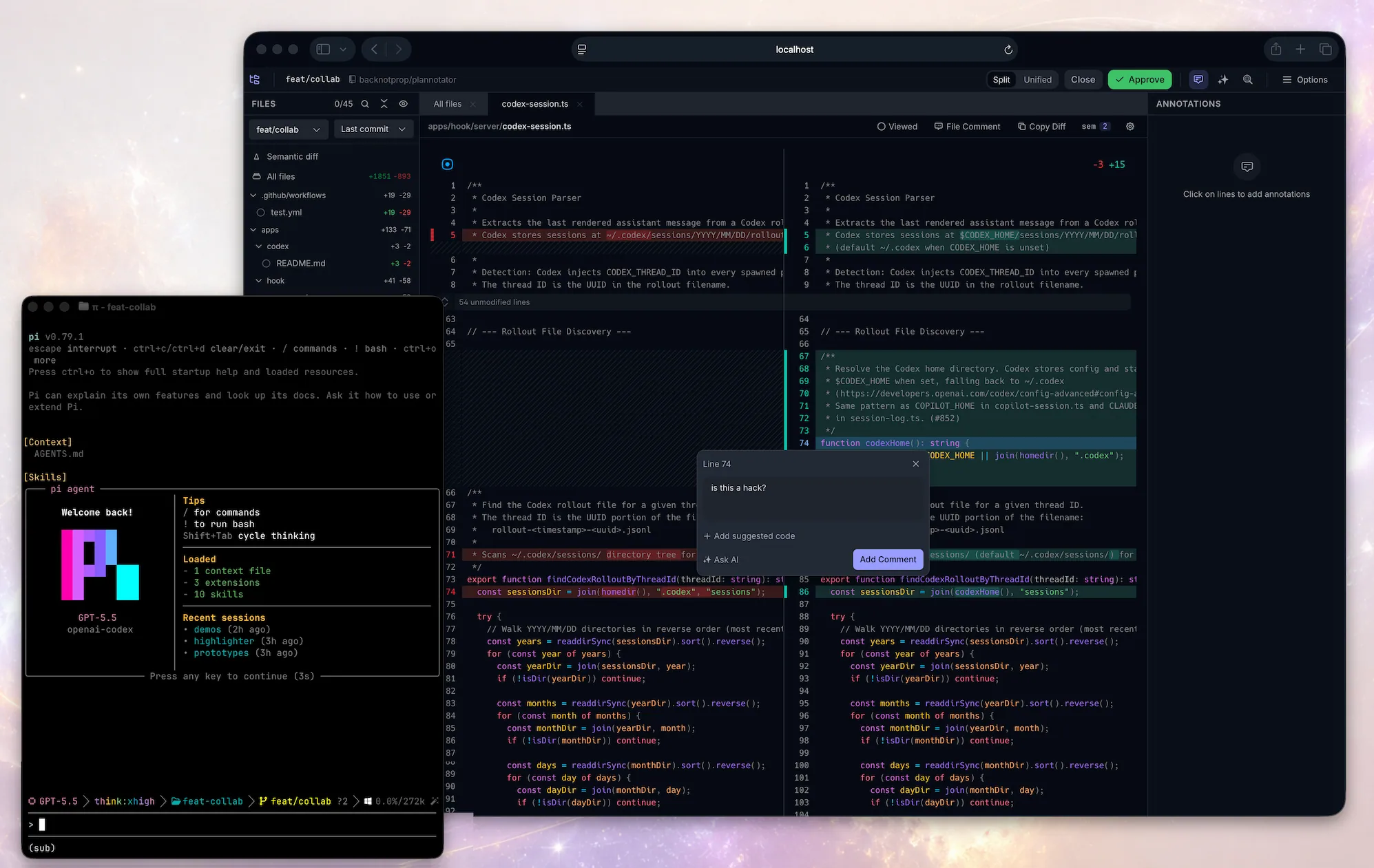
The concrete problem it solves is the review loop around agent output. Instead of reading a plan as raw terminal text and replying with a freeform message, the plan, spec, message, or HTML opens as an annotatable document through commands such as /plannotator-annotate and /plannotator-last. The same surface extends to code: local uncommitted changes, remote pull requests, and merge requests can be reviewed diff by diff, with comments routed back to the agent. Version control coverage includes Git, GitButler, Jujutsu (jj), Perforce (p4), GitHub, and GitLab.

Key capabilities

  • Annotate review targets from several sources: a local markdown file (/plannotator-annotate README.md), a folder (src/), any URL, or an HTML report with --render-html to render it as-is rather than converting it.
  • Plan mode runs with no command at all: it is wired in through each harness's hooks, so the markdown review surface opens whenever the agent creates a plan.
  • Code review through /plannotator-review for uncommitted changes, GitHub pull requests, and GitLab merge requests, plus plannotator review --gitbutler for an active GitButler workspace, reviewable as a whole workspace, a single stack, or one branch layer.
  • AI built into the review surface: ask AI about anything under review, or launch AI reviews that post comments directly to the diff.
  • CLI session and archive handling: plannotator sessions, plannotator sessions --open 1 to reopen a session in the browser, and plannotator archive to browse saved plan decisions read-only.
  • Herdr Annotate brings the same review style to the terminal, annotating terminal text and agent replies inside Herdr and sending feedback back as the agent's next message.
  • Codex support is expressed differently: !plannotator … in place of slash commands, or the $plannotator-* skills.

Who uses it and how

  • Developers running plan mode in Claude Code, Codex, Copilot CLI, Gemini CLI, OpenCode, Kiro, Droid, Amp, or Pi, who get a review surface automatically when a plan is created.
  • Reviewers working on GitHub pull requests and GitLab merge requests, who comment on diffs and route those comments back to the agent.
  • GitButler users reviewing an entire workspace, one stack, or a single branch layer rather than a flat diff.
  • Terminal-centric users who install Herdr Annotate and keep working inside Herdr; annotations are saved in the Plannotator data directory, so terminal reviews and app reviews compound.
  • The repository also carries an obsidian topic alongside agents, claude-code, code-review, codex, opencode, pi-mono, plan-mode, and skills.

Getting started

Installation follows the agent's hooks and commands as described in the installation guide on the official site, after which the review commands such as /plannotator-annotate and /plannotator-review become available. For terminal use, herdr plugin install plannotator/herdr-annotate adds the Herdr plugin, and brew install plannotator/tap/plannotator-tui installs the standalone TUI for document review without Herdr.

How it compares

This registry does not list paid products that Plannotator replaces, and no directly comparable third-party tools are named in the material provided, so on the evidence here it stands alone. The nearest neighbours are its own siblings: Herdr Annotate, which brings the same review model into the terminal, and Plannotator TUI, which powers document review standalone and shares the same data directory.

When to use it — and when not to

A self-hoster runs a local browser-based review surface for each agent harness; no database, object storage, or SMTP service is mentioned as a requirement. Plannotator does not collect usage telemetry or analytics, and plans, diffs, annotations, drafts, history, and configuration stay local by default, but each review, annotate, archive, share-portal, and code-review surface checks GitHub for the latest release on load, and there is currently no opt-out setting; local Git code review may also query the configured origin with git ls-remote. Teams that require zero outbound requests, or that want a hosted multi-tenant service rather than a local tool, should look elsewhere, and the excerpt's thin coverage of standalone installation plus 155 open issues are worth weighing before a wide rollout.

project readme (upstream, from github) — read inline

Everything you need to annotate and stay in the loop with your agents
Markdown Review • Code Review • HTML Artifacts
Annotate plans, specs, markdown, and HTML before implementation. Review diffs and PRs. Send feedback to your agent.


Watch the og demo · Installation guide · Official site · Visual HTML Skills · Herdr Annotate

Plannotator

Plannotator is a local, browser-based review surface for AI coding agents: Claude Code, Codex, Copilot CLI, Gemini CLI, OpenCode, Kiro, Droid, Amp, and Pi.

It plugs directly into your agent through its hooks and commands. When the agent proposes a plan, html, or finishes writing code, the work opens in your browser and you mark it up, comment, and send feedback directly to the agent for it to act on it.

Review documents, plans, and agent messages

Annotate plans, specs, messages, html, then send the feedback to your agent.

Demo: Plan review with Pi

Code Review

Review local changes or remote PRs. Comment on diffs, suggest code. Your comments go back to the agent. Works with Git, GitButler, Jujutsu (jj), Perforce (p4), GitHub, and GitLab.

AI built in: ask AI about anything you're reviewing,
or launch AI reviews that post comments to the diff.

Annotate HTML Artifacts
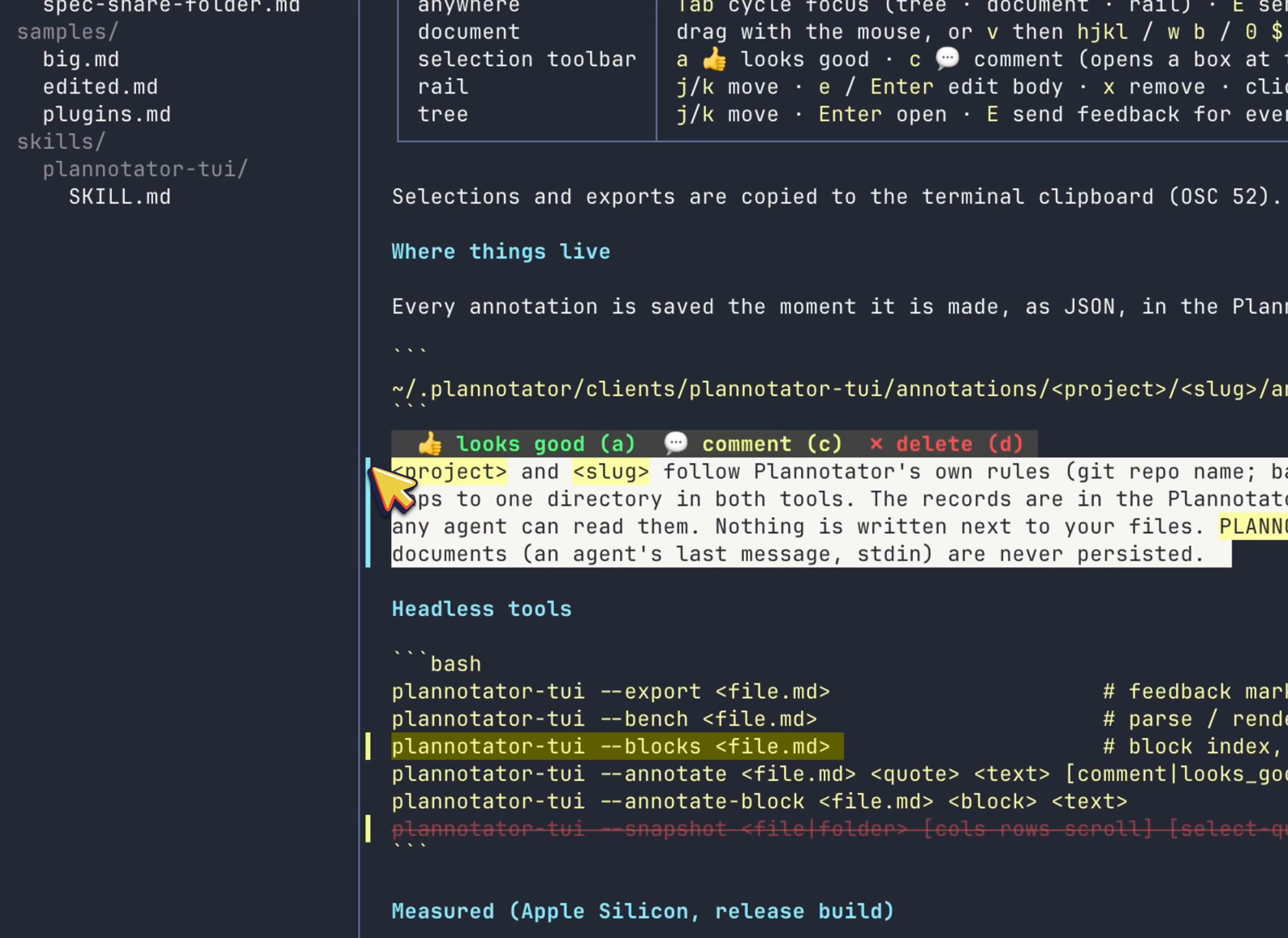
Herdr Annotate: Plannotator in the Terminal

  

Herdr Annotate brings Plannotator-style review to the terminal: annotate terminal text, review whole Markdown documents and your coding agent's replies inside Herdr, and send the feedback straight back to the agent as its next message. Works with Claude Code, Codex, Pi, Copilot CLI, and Droid replies. Annotations are saved in the Plannotator data directory, so terminal reviews and app reviews compound.

herdr plugin install plannotator/herdr-annotate

Prefer it standalone? Plannotator TUI powers the document review and runs without Herdr: brew install plannotator/tap/plannotator-tui.


Commands

On Codex, swap the slash commands for !plannotator … (e.g. !plannotator review) or the $plannotator-* skills.

Annotate

/plannotator-annotate README.md                  # Local markdown file
/plannotator-annotate src/                       # Browse and annotate files in a folder
/plannotator-annotate https://docs.rs/…          # Fetch and annotate any URL
/plannotator-annotate report.html --render-html  # Render HTML as-is instead of converting
/plannotator-last                                # Annotate the agent's last message

Need a realistic document to try? Copy the product requirements document template and filled example as Markdown.

Code review

/plannotator-review                    # Review uncommitted changes
/plannotator-review <github-pr-url>    # Review a GitHub pull request
/plannotator-review <gitlab-mr-url>    # Review a GitLab merge request
plannotator review --gitbutler         # Review an active GitButler workspace

GitButler users can review the whole workspace, one stack, or one branch layer. See the GitButler workflow guide.

Plan mode

No command needed. Plan mode is wired in through each harness's hooks. Any time your agent creates a plan, the markdown review surface opens for you.

CLI

plannotator sessions                   # List active Plannotator sessions
plannotator sessions --open 1          # Reopen a session in the browser
plannotator archive                    # Browse saved plan decisions read-only

Privacy and network behavior

Plannotator does not collect usage telemetry or analytics. Plans, diffs, annotations, drafts, history, and configuration stay local by default.

Each plan review, annotate, archive, share-portal, and code-review app surface checks GitHub for the latest Plannotator release when it loads. This sends no plan or review content and gives the Plannotator project owner no usage analytics, although GitHub receives an ordinary request. There is currently no opt-out setting. Local Git code review can also query the configured origin with git ls-remote to detect the default branch and a stale baseline; it does not send the local diff.

Content leaves the local workflow only when a network feature needs it:

  • URL annotation fetches the requested site, through Jina Reader by default for public pages or directly when Jina is disabled or unavailable.
  • GitHub and GitLab review uses your authenticated CLI and Git remote to retrieve PR or MR data.
  • Ask AI and review agents send the selected question and relevant plan, document, repository, or diff context to your configured provider.
  • Sharing sends the complete link to whoever or whatever service you use to deliver it. Encrypted short links upload ciphertext to the paste service.
  • Workspaces is a separate hosted product, so the open source app's local-storage model does not apply to content placed there.

The privacy policy documents these boundaries and the hosted website and waitlist data.


Link sharing

Open source asynchronous link sharing remains available for compatibility but is moving to deprecated support. Workspaces is the primary direction for team sharing. No removal date has been announced.
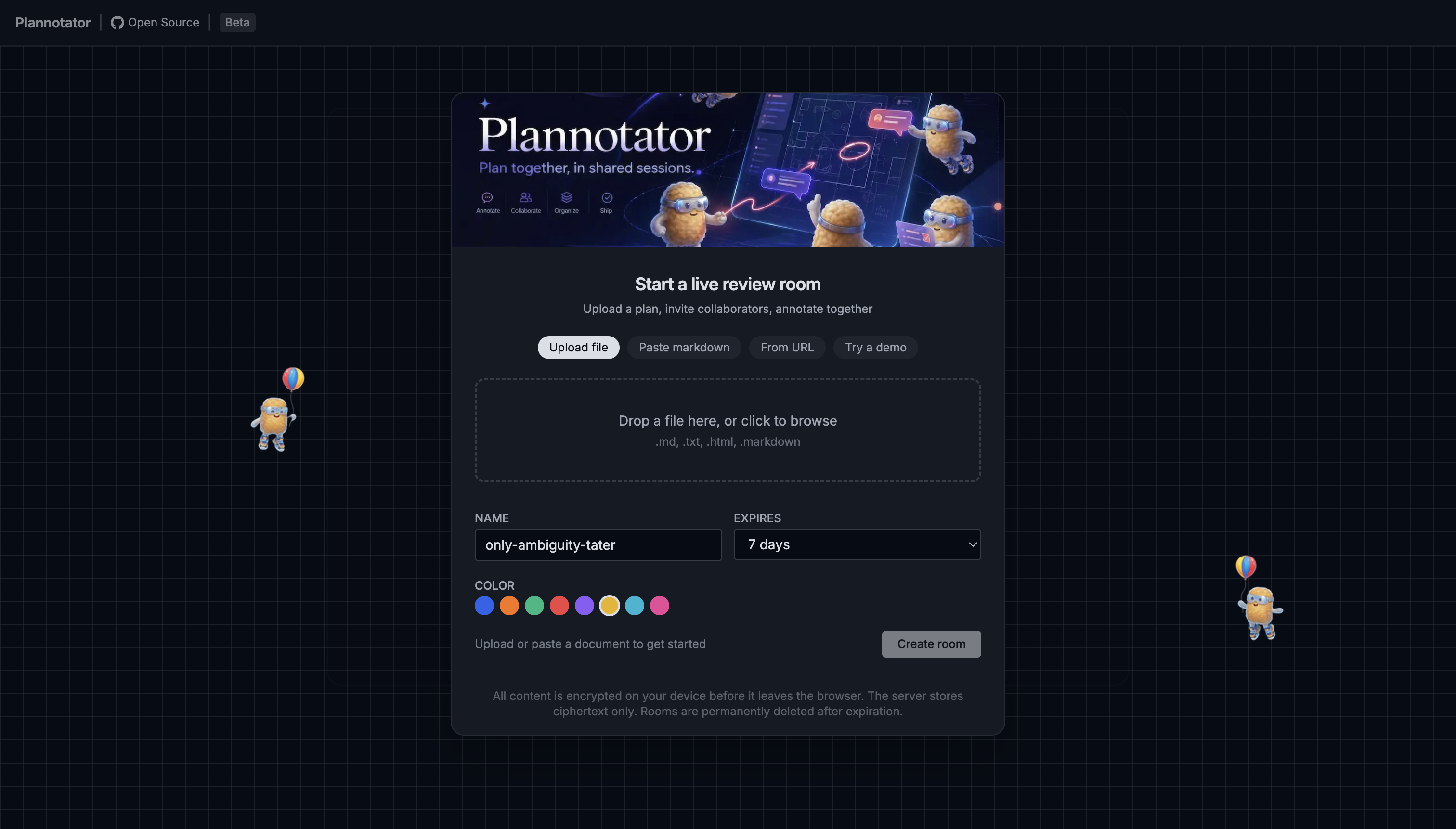
Legacy link-sharing demo: room.plannotator.ai

Share a plan with a teammate and they can annotate it themselves. Import their feedback and send it straight back to your agent.

Small markdown shares are compressed into the URL fragment. The fragment is not included in the browser's request to the share por

readme truncated — read the full docs on github

Frequently asked questions

Is plannotator free to use?

plannotator is open source under the Apache-2.0 licence. There is no licence fee and no seat count — you can self-host it or, where the project offers one, pay a vendor for a managed version instead.

What does plannotator do?

Annotate and review coding agent plans and code diffs visually, share with your team, send feedback to agents with one click.

What is plannotator written in?

plannotator is primarily written in TypeScript. Its source is publicly available at https://github.com/backnotprop/plannotator, and it has 8,748 GitHub stars.