Piik is a free, open source collaboration & communication project written in TypeScript and released under MIT. It has 533 GitHub stars, 42 forks and 7 open issues, and was last pushed 9 hours ago. On this registry it ranks #56 of 59 tracked projects in Collaboration & Communication, with 5 head-to-head comparisons available.

What is Piik?

Piik is a free, MIT-licensed screen sharing tool for games, movie nights, drawings and photos, built so that one host can share with up to 20 friends who watch in a desktop or mobile browser without installing anything.

What it is

Piik is an open-source, TypeScript screen sharing project in the WebRTC and peer-to-peer space. It takes two forms: Piik App, a desktop application that can host a local room, produce a temporary public link, or connect to a site you run yourself, and a browser-based online version at demo.piik.tv. Viewers need neither, because they simply open the invitation link a friend sends and select Play if the picture does not start automatically. A self-hosted deployment, Piik Server, adds the web interface, room management and optional media forwarding.

The problem it solves is twofold. For viewers, it removes the usual requirement to install a desktop client before watching: friends join by invitation in a desktop or mobile browser, and only the host needs software. For anyone who wants to run the service themselves, it removes the need to stitch together separate web, room-management and media-forwarding components, because Piik Server is a standalone binary with the web interface built in — one program to host a site, with room data stored in SQLite.

Key capabilities

  • Watch without installing: friends join a room by invitation in a desktop or mobile browser.
  • Direct connections first: media travels between participants where possible (P2P), with automatic media forwarding (SFU) available on a self-hosted server as a fallback.
  • Rooms the host controls, with invitation links, room codes and optional room passwords, sized for one host and up to 20 viewers.
  • Sharing sources chosen from Piik App or an existing Piik site: a screen, a window, a browser tab or a camera, plus a microphone channel for commentary with input device selection and voice volume adjustment.
  • Viewer-side controls including light and dark themes, playback controls, picture-in-picture and a connection topology view, with a header control labelled 中 / EN / ✦ for language and visual mode.
  • Packaged delivery: Piik Server as piik-*-runtime.tar.gz for Linux x64 and via Docker Compose, and piik-app ZIP files whose names identify windows-amd64, darwin-arm64 (native capture requires macOS 13+) and linux-amd64.

Who uses it and how

  • Small groups of friends sharing games, movie nights, drawings or photos, with one host and up to 20 viewers in a room.
  • Hosts who cannot or will not install software, sharing from a desktop browser or, on a phone with browser camera support, from the camera through the online version at demo.piik.tv.
  • Self-hosters deploying Piik Server on a Linux x64 server with their own domain, an HTTPS reverse proxy and a configured STUN address, then connecting through Piik App or a browser.
  • Operators who want invitations and optional room passwords under their own control and room data kept in their own SQLite database, including container deployments.

Getting started

To watch, open the invitation link and select Play if the picture does not start automatically; to share, download Piik App (a ZIP beginning with piik-app) and choose Public invite, or create a room in the online version. Self-hosters download the Linux x64 Server package, extract it, run ./piik-server and open http://localhost:8787, or use the Docker Compose setup.

How it compares

The facts provided do not name any paid products or similar screen sharing tools, so Piik cannot be contrasted against specific alternatives here. On the evidence given, it stands alone in this registry.

When to use it — and when not to

A self-hoster takes on real operational work: a Linux x64 server, a domain, an HTTPS reverse proxy, a STUN address and the SQLite room database behind invitations and room state. It is a poor fit for anyone who needs screen sharing that always connects on restrictive networks without a self-hosted SFU, since the P2P-only modes — the App's temporary public link and the online version — may fail there. Two further limits are documented in the README: the macOS and Linux apps have not yet been tested on physical devices, and browser capture requires HTTPS or localhost.

project readme (upstream, from github) — read inline

Piik

Share the good stuff.
Private screen sharing for you and up to 20 friends.

Website · Download · Gitee mirror · Use online · Documentation

License: MIT Up to 20 viewers P2P-first media

English · 简体中文

Piik is a free, open-source screen sharing tool for games, movie nights, drawings and photos. Choose what to share and send an invitation. Your friends watch in their browsers.

A little room · Show / hide animation

Features · Get started · Self-hosting · Contributing

Features

  • Watch without installing. Friends join by invitation in a desktop or mobile browser.
  • Share from Piik App or an existing Piik site. Choose a screen, window, browser tab or camera; available sources and audio depend on the platform.
  • Direct connections first. Media travels between participants where possible (P2P). A self-hosted server can provide automatic media forwarding (SFU) as a fallback.
  • Rooms you control. Invitations, room codes and optional room passwords, for one host and up to 20 viewers.
  • Flexible viewing. Light and dark themes, playback controls, picture-in-picture and a connection topology view.
  • One program to host a site. Web UI, room management and optional media forwarding are packaged together.
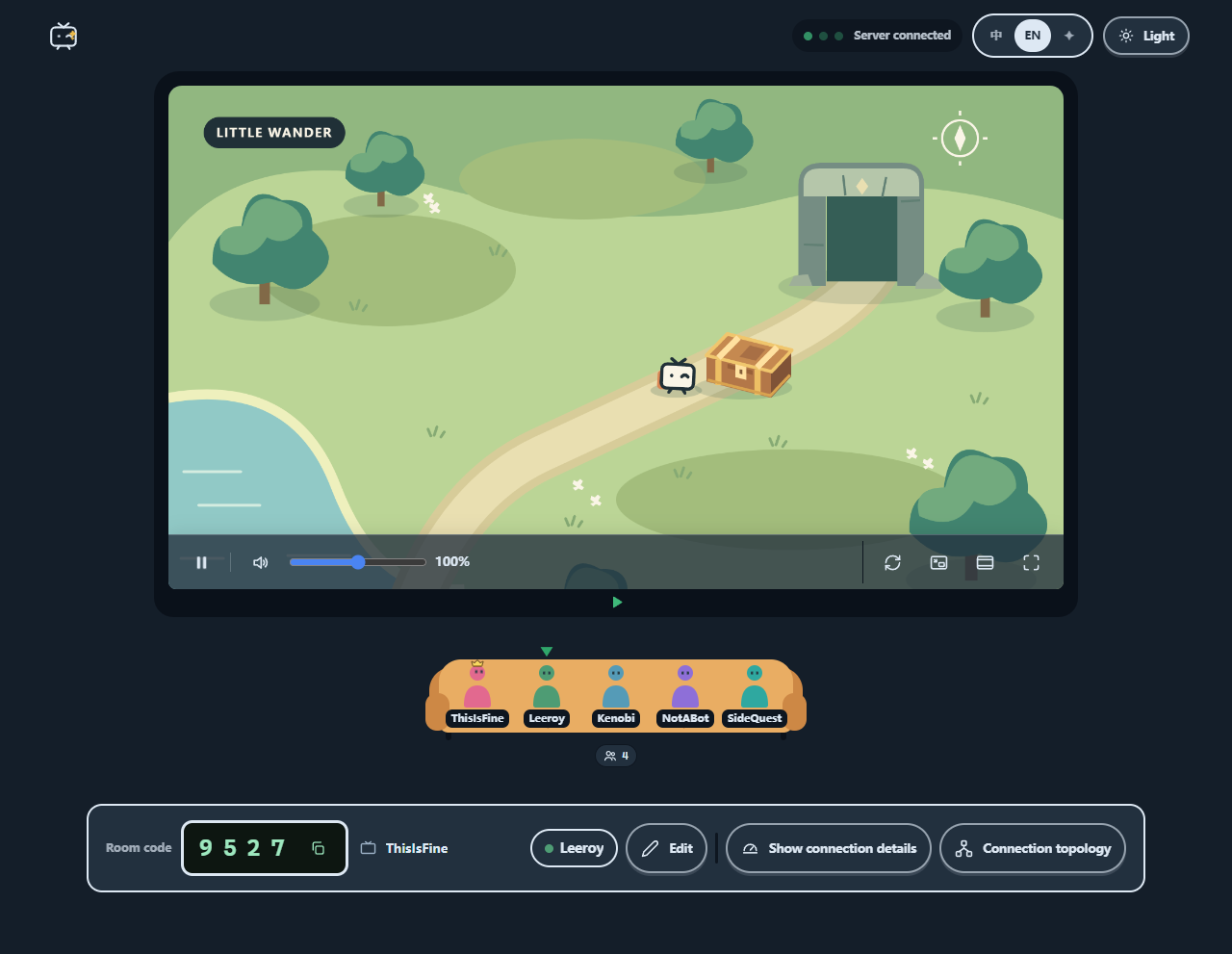

Interface preview · Sample room with a generated game scene

Get started

To watch: open the invitation your friend sends you. Select Play if the picture does not start automatically.

To share: download Piik App to get started. To share without installing, you can also create a room in the online version.

Start here What you need to do
Use Piik online Share from a desktop browser, or choose Camera on a phone with browser camera support.
Download Piik App Extract and open the App, choose Public invite, then Open Piik to create a temporary room.
Host your own site Advanced: deploy Piik Server on a Linux x64 server with your own domain, then connect through Piik App or a browser.

  1. Select Start sharing, then choose the picture and audio to share.
  2. Select Copy invite link and send it to your friends. Keep the sharing tab open.

Turn on the Microphone for commentary; its settings let you choose the input device and adjust your voice volume.

Piik follows your system language: Chinese or English, with English as the fallback. Use 中 / EN / ✦ in the header to switch language or try the visual mode. The App offers a local room, a temporary public link, or a connection to your own site. Keep the App running while sharing through it.

Download a ZIP beginning with piik-app. The filename also identifies the platform:

Filename contains Platform
windows-amd64 Windows x64
darwin-arm64 Apple silicon; native capture requires macOS 13+
linux-amd64 Linux x64

Full setup guide → · Open online →

Browser capture requires HTTPS or localhost. Windows App and desktop browser sharing are the primary tested paths. The macOS and Linux apps have not yet been tested on physical devices; test results and feedback are welcome. P2P-only modes, including the App's temporary public link and the online version, may not connect on restrictive networks.

Self-hosting

Piik Server is a standalone binary with the web interface built in. Download the Linux x64 Server package (piik--runtime.tar.gz), extract it, and run:

./piik-server

Open http://localhost:8787 to try it locally. For a public site, configure your domain, HTTPS reverse proxy and STUN address. Room data is stored in SQLite. For containers, use the Docker Compose setup.

Deploy your own site → · Configuration · Run from source

Contributing

Bug reports, translations, documentation improvements and pull requests are welcome. See ways to contribute or help translate Piik. Use the repository layout to find your way around.

License

Piik-owned code is MIT licensed. Dependencies retain their own licenses and notices.

Frequently asked questions

Is Piik free to use?

Piik is open source under the MIT licence. There is no licence fee and no seat count — you can self-host it or, where the project offers one, pay a vendor for a managed version instead.

What does Piik do?

Free, open-source screen sharing for friends. P2P-first, with browser viewing, a desktop app and optional self-hosting.

What is Piik written in?

Piik is primarily written in TypeScript. Its source is publicly available at https://github.com/TNTcraftHIM/Piik, and it has 533 GitHub stars.