
PI-Desktop
The desktop workspace for AI coding agents.
Bring your own model. Open any local project. Let agents work — while you stay in control.
Local-first · Model-agnostic · Extensible · macOS / Windows / Linux





Download · Documentation · Screenshots · Build a Plugin · 简体中文
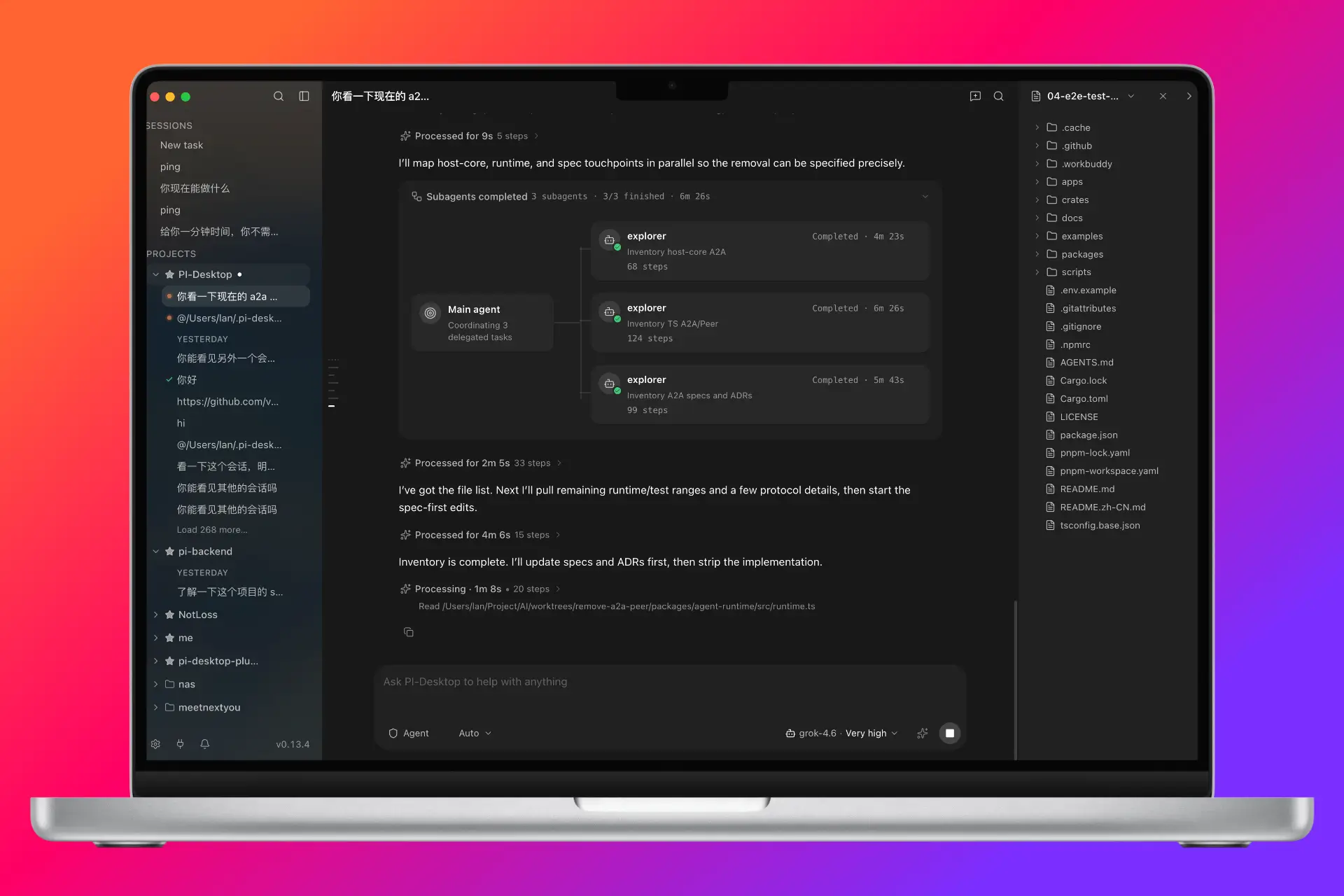
No PI-Desktop account. No mandatory relay. No editor lock-in.
Projects and sessions stay on your machine. Model requests go directly to the provider or endpoint you configure.

[!IMPORTANT] PI-Desktop is in Early Preview. It is already usable for real coding workflows, while APIs, extension interfaces, and some desktop behaviors are still evolving.
Not another chat window
Most coding agents live inside a terminal, an editor extension, or a hosted service.
PI-Desktop gives the agent workflow a workspace of its own.
Projects, sessions, files, reviews, previews, models, permissions, extensions, and long-running work live together — without tying your workflow to a single editor, model vendor, or hosted runtime.
Your modelsUse OpenAI, Anthropic, local models, hosted gateways, or any OpenAI-compatible API. Configure multiple providers, context windows, output limits, reasoning levels, and model-specific behavior. Switch models directly from the Composer without recreating the session. |
Your projectsOpen a local repository or project directory and keep its sessions, files, reviews, previews, and agent work in one place. Import existing local sessions from Claude Code, Codex, OpenCode, and Pi. |
Your controlAgents can read files, edit code, and run commands, while privileged actions pass through PI-Desktop's permission layer. Inspect diffs. Review command output. Decide how much autonomy each session gets. |
Your extensionsAdd Skills, MCP servers, Subagents, pi extensions, and installable Plugins. Extend the agent and the desktop instead of waiting for every workflow to become a built-in feature. |
One workspace. Three ways to work.
Same agent. Different approval boundaries.
| Agent | Plan | Goal | |
|---|---|---|---|
| You approve | Nothing extra | The implementation plan | The outcome and acceptance criteria |
| The agent does | Reads, edits, runs commands, tests, iterates | Studies the repo, writes a frozen plan, then waits | Chooses the path and works toward the goal |
| Best for | Fast day-to-day work | Large or risky changes | Outcome-first tasks |
Agent — let it inspect the tree, patch files, run commands, test, and keep going.
Plan — review the approach before execution. The agent researches first, produces an immutable implementation plan, and waits for approval.
Goal — lock the objective and acceptance criteria. The agent decides how to get there.
Privileged tools still go through the permission layer in every mode.
See the work, not just the answer
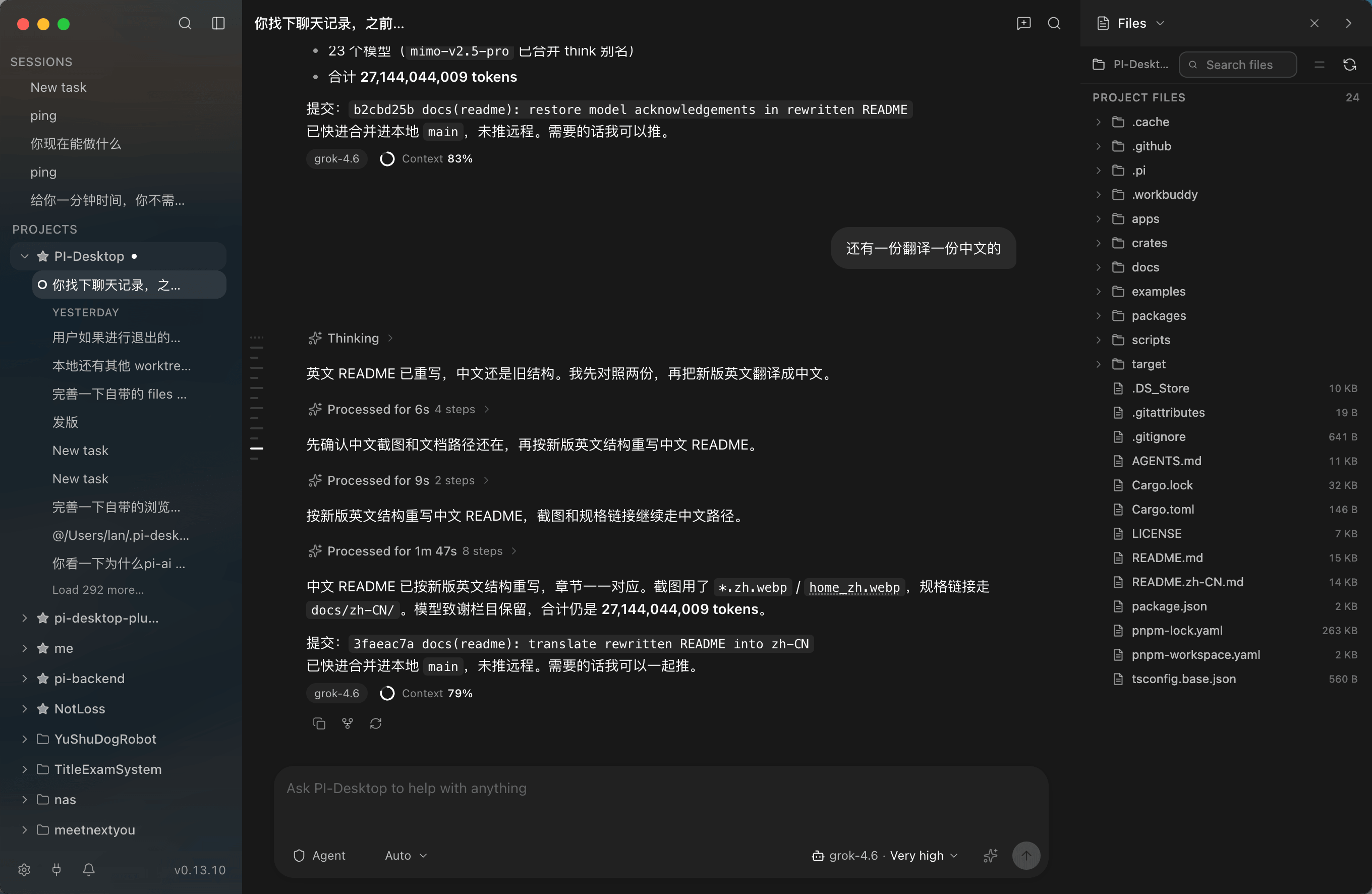 Long-running conversations with transcript navigation |
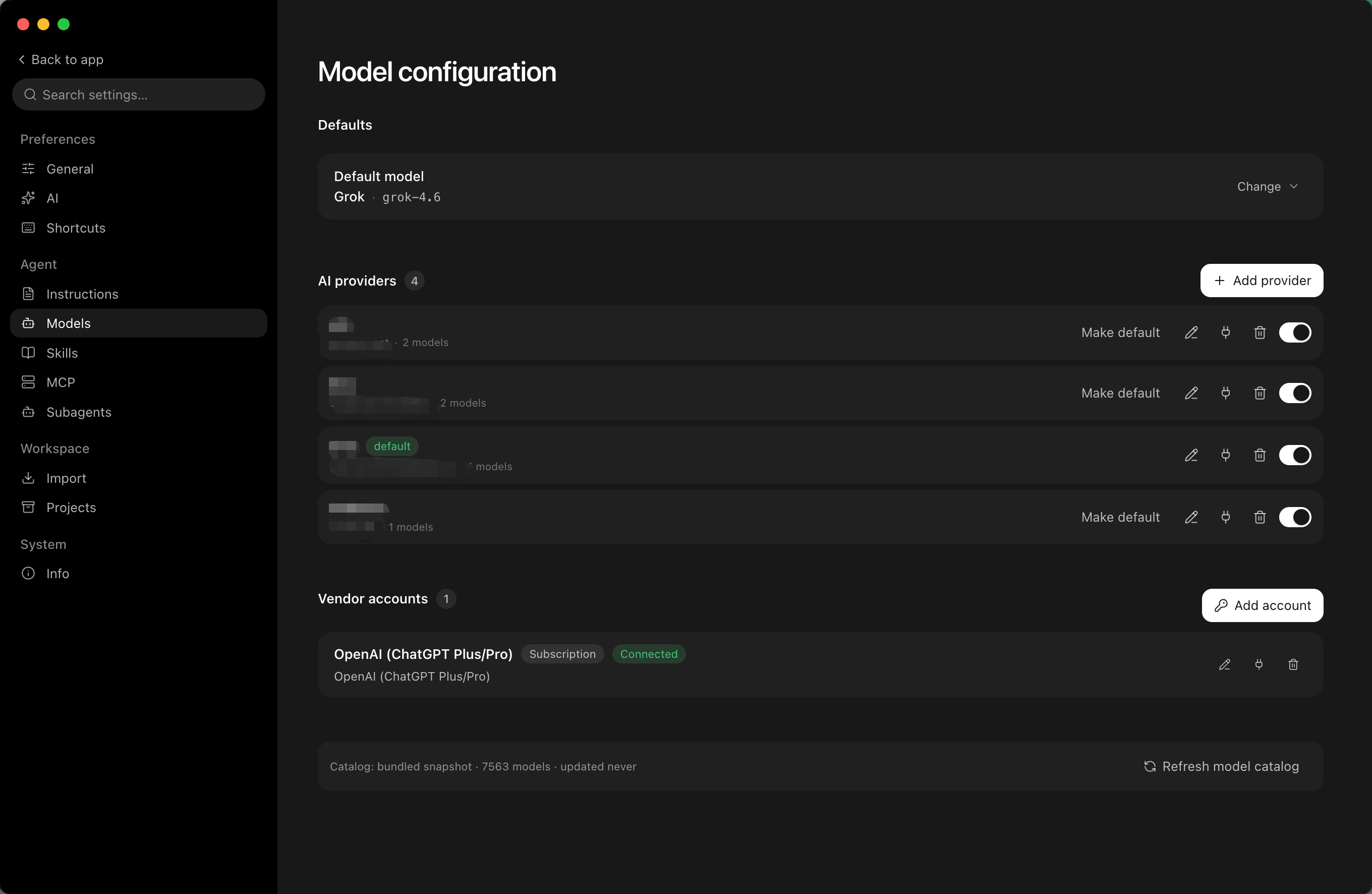 Switch providers, models, and reasoning levels per session |
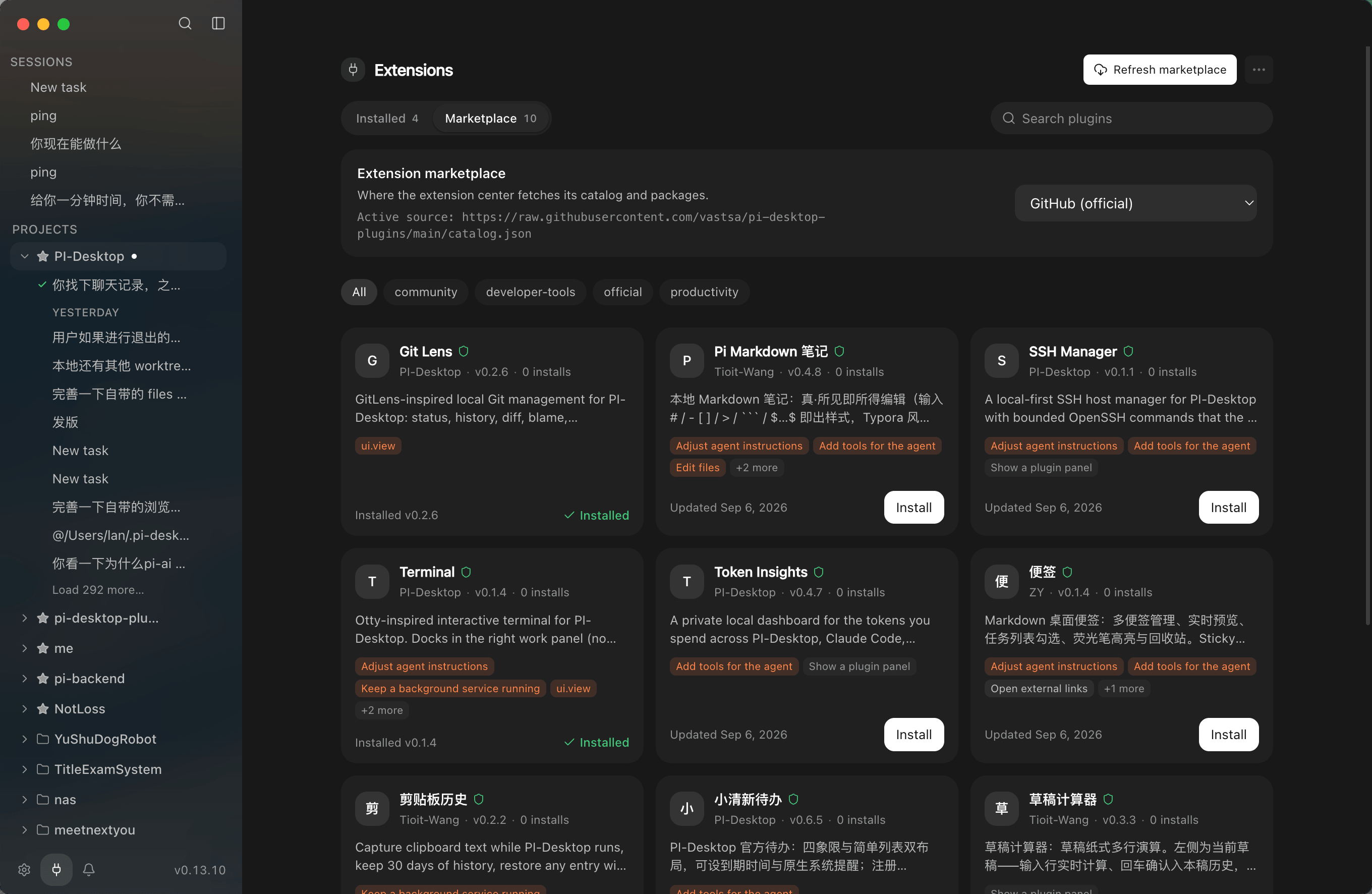 Extend the workspace through the plugin marketplace |
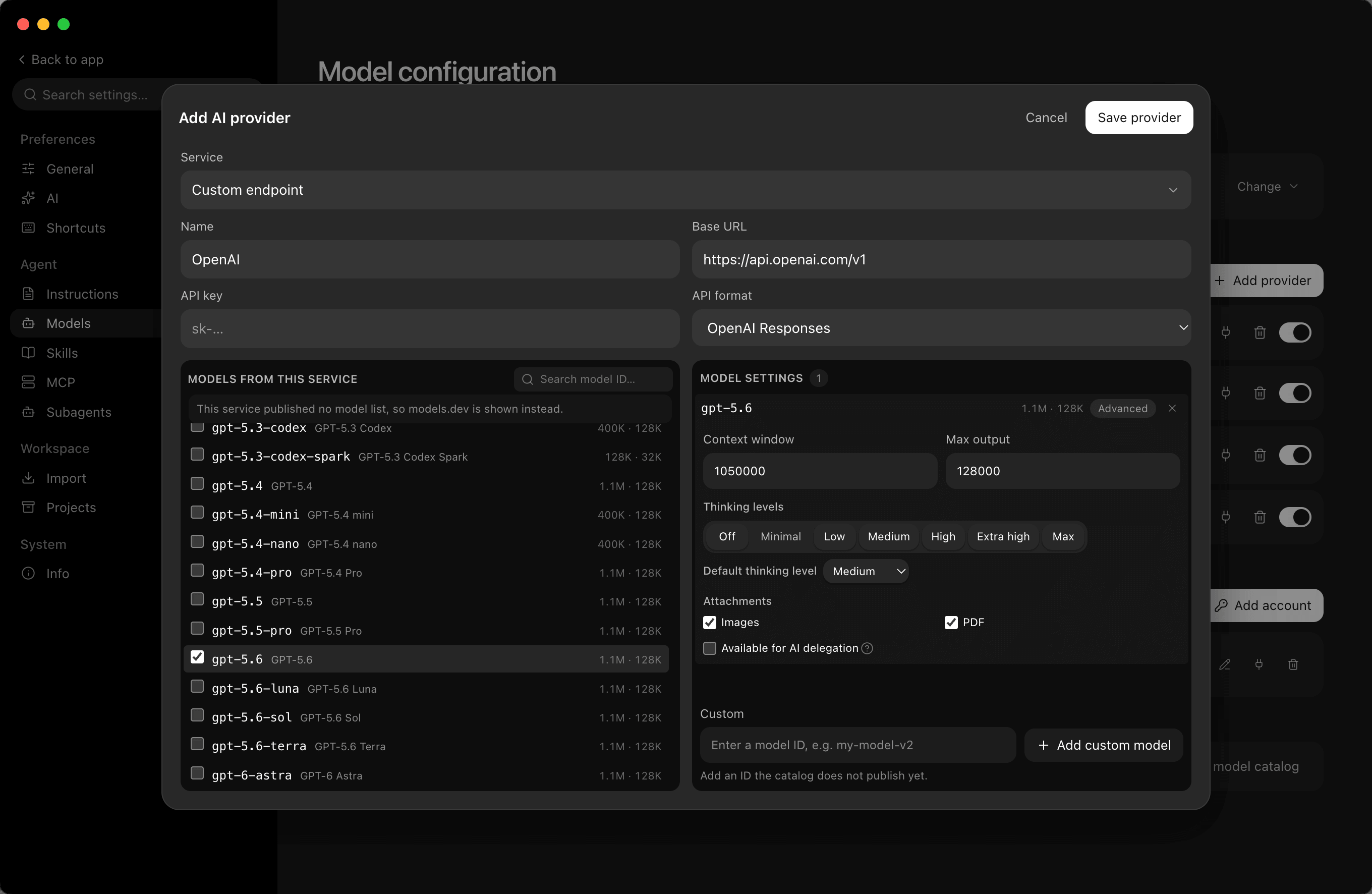 Add a provider and connect a model |
Built for work that lasts longer than one prompt
PI-Desktop is designed around persistent projects and long-running sessions rather than disposable chat threads.
- Manage multiple projects and sessions
- Pin, archive, branch, and search conversations
- Queue prompts while an agent is already running
- Reference files with
@ - Use slash commands
- Review diffs and command output
- Keep streaming responses checkpointed so interrupted work can recover whenever possible
Delegate to Subagents
Large tasks do not have to live in one context window.
Delegate independent work to background Subagents for:
- codebase exploration
- multi-file implementation
- research and investigation
- test analysis
- adversarial review
Each Subagent runs in its own context and reports its result back to the parent agent.
Extend the workspace instead of rebuilding it
PI-Desktop has multiple extension layers, from lightweight reusable instructions to full desktop integrations.
Plugins
Plugins can extend PI-Desktop with:
| Agent | Workspace | Platform |
|---|---|---|
| Agent tools | Commands | MCP servers |
| Skills | Workspace panels | Subagents |
| pi extensions | Work-panel views | Resident services |
| Themes | Inter-plugin messaging |
Install plugins locally or through the marketplace using the .piplug package workflow.
Session Orchestrator
The official pi.session-orchestrator plugin lets an Agent coordinate durable worker sessions in parallel. Install pi.session-orchestrator from the Plugins marketplace, then use its SessionTask tool to spawn, send, supervise, inspect status, wait for bounded results, accept reports, cancel work, and list workers.
Workers inherit the parent project's provider, model, thinking level, and permission mode. They remain ordinary PI-Desktop sessions, so you can open and inspect their transcripts at any time. Work is parent-scoped and bounded to four active workers per parent and sixteen across the plugin.
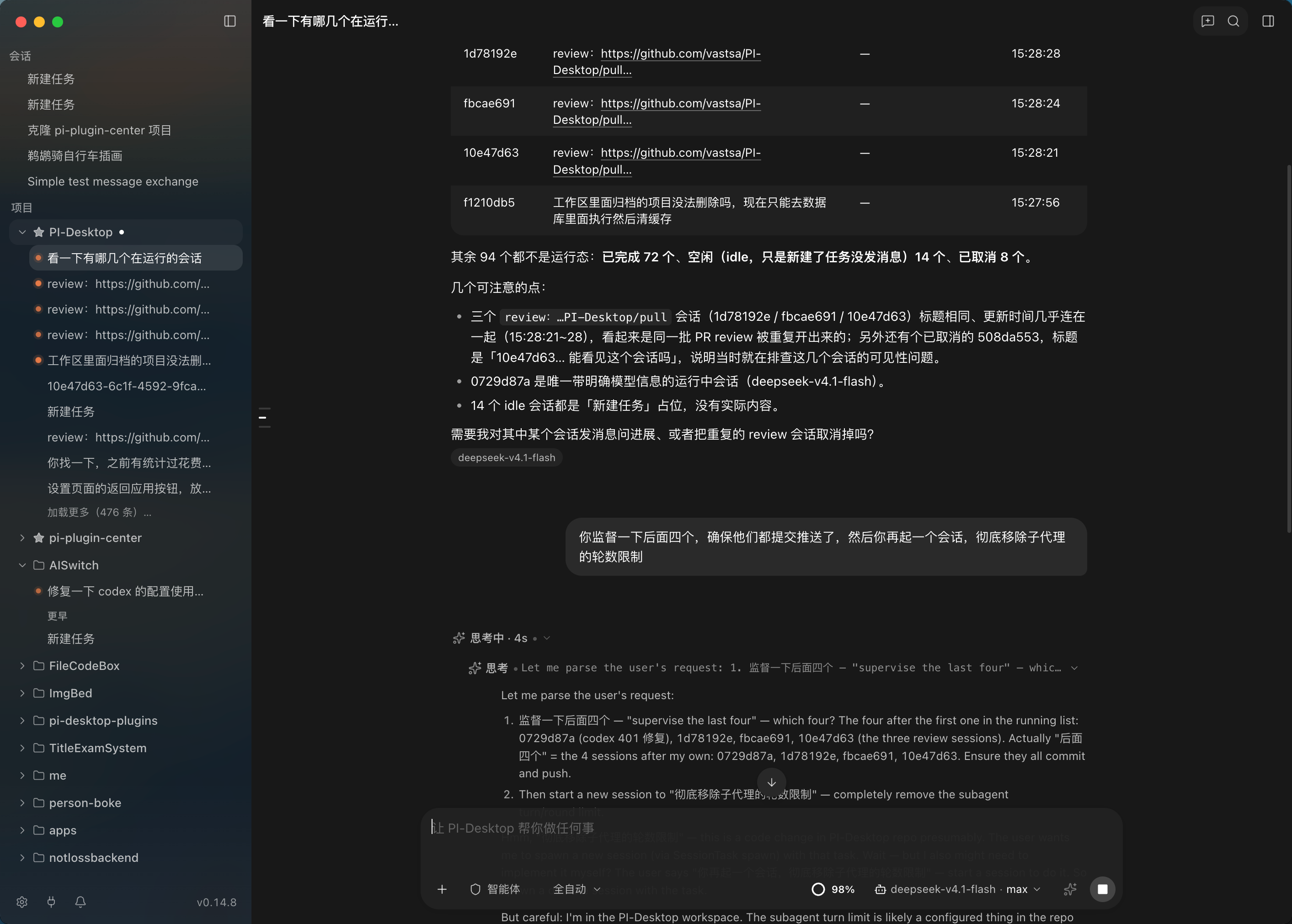 Coordinate multiple durable worker sessions from one conversation |
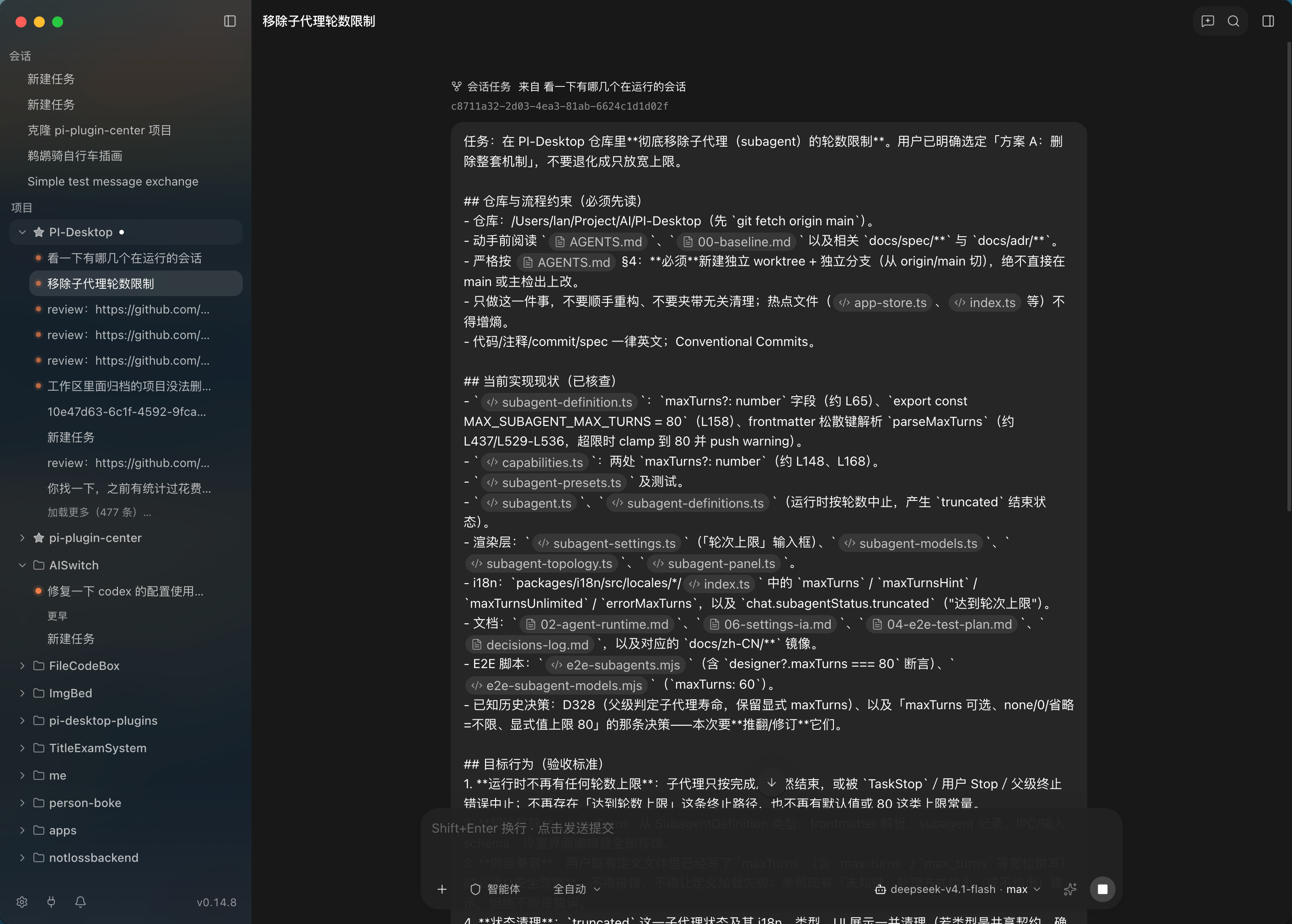 Open a worker session and inspect its progress independently |
[!NOTE] Plugin processes are permission-gated and isolated from the renderer, but plugins are still user-trusted code rather than a complete operating-system sandbox. Only install plugins you trust.
Skills
Give agents reusable instructions and workflows. Skills can be installed globally or activated for individual projects.
MCP
Connect external tools and services through Model Context Protocol servers without baking them into the desktop application.
PI-Desktop can also be controlled by an external MCP Agent. Start the app with PI_DESKTOP_MCP_CONTROL=1, then read the loopback endpoint and bearer token from