


Quickstart · Performance · Models · Architecture · API · Development
PegaInfer serves LLMs through an OpenAI-compatible API. Each model owns its scheduler, state, and kernels; serving and KV infrastructure are shared. No PyTorch or Python runtime.
Quickstart
Prebuilt binary · Qwen3 on Linux
The Qwen3-only release bundles CUDA 13 and cuBLAS. It requires Linux x86_64, an NVIDIA GPU with compute capability 8.x–12.x, driver 580+, glibc 2.35+, and OpenSSL 3. Model weights are downloaded separately.
curl -fsSL https://raw.githubusercontent.com/pegainfer-project/pegainfer/main/install.sh | bash
Download Qwen3-4B into models/Qwen3-4B, then start the server:
pegainfer --model-path models/Qwen3-4B
The server listens on port 8000. If the command is not on your shell's path:
export PATH="$HOME/.local/bin:$PATH"
The installer selects the latest release by default. PEGAINFER_VERSION selects an exact version; see releases.
Build from source
Use the Rust toolchain pinned in rust-toolchain.toml, a CUDA Toolkit with nvcc and cuBLAS, and a compatible NVIDIA driver. The default Qwen3 build needs no Python. Its driver floor is R545 / CUDA 12.3; newer toolkits and model-specific kernels can require a newer driver.
From the repository root, with the checkpoint downloaded:
export CUDA_HOME=/usr/local/cuda
cargo run --release -- --model-path models/Qwen3-4B
Always use --release for GPU builds. The server entrypoint is pegainfer-server; model crates contain the model implementation and diagnostics.
Feature builds and environment options
Qwen3.5 uses Triton AOT kernels, requiring Python and Triton at build time:
uv venv
uv pip install triton
export PEGAINFER_TRITON_PYTHON=.venv/bin/python
cargo run --release --features qwen35 -- --model-path models/Qwen3.5-4B
| Variable | Purpose |
|---|---|
CUDA_HOME |
CUDA Toolkit location; defaults to /usr/local/cuda |
PEGAINFER_CUDA_SM |
Target GPU architecture when it cannot be detected, e.g. 120 |
PEGAINFER_TRITON_PYTHON |
Python interpreter for Qwen3.5 Triton AOT compilation |
PEGAINFER_TILELANG_PYTHON |
Python interpreter for K3 TileLang kernel generation |
Other model lines have their own hardware and build requirements; follow the model guides below. Run cargo run --release -- --help for the compiled-in CLI.
Windows source builds
$env:CUDA_PATH = "C:\Program Files\NVIDIA GPU Computing Toolkit\CUDA\v12.x"
cargo run --release -p pegainfer-server -- --model-path models/Qwen3-4B

# Qwen3.5 additionally needs Triton at build time
uv venv .venv --python 3.12
uv pip install "triton-windows<3.7"
$env:PEGAINFER_TRITON_PYTHON = ".venv\Scripts\python.exe"
cargo run --release --features qwen35 -- --model-path models/Qwen3.5-4B
Performance
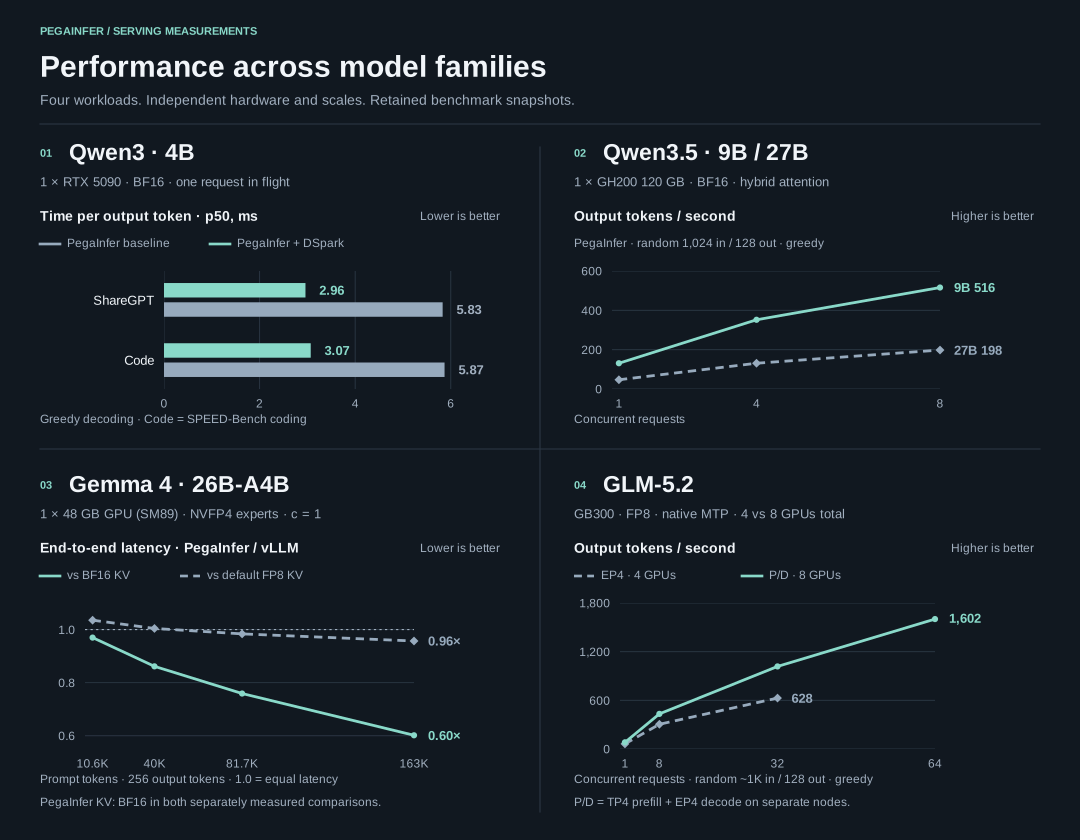
Selected serving measurements across dense, hybrid-attention, and MoE models. Each panel uses its own hardware, workload, and scale; the linked reports preserve the benchmark conditions.
| Panel | Measurement and source |
|---|---|
| Qwen3 · 4B | DSpark vs PegaInfer baseline, single-request greedy decoding on ShareGPT and SPEED-Bench coding. |
| Qwen3.5 · 9B / 27B | GH200 concurrency sweep, revision ffb959c4, random 1,024-token prompts and 128-token outputs. |
| Gemma 4 · 26B-A4B | Four-round long-context report. Ratios use reported median end-to-end latencies; PegaInfer uses BF16 KV in both comparisons. The BF16 and default-FP8 vLLM comparisons were measured separately using PegaInfer revisions e7a41975 and ea02a9f7, respectively. |
| GLM-5.2 | Native MTP serving sweep: co-located EP4 uses 4 GPUs; disaggregated TP4 prefill + EP4 decode uses 8 GPUs total. |
Qwen3 serving footprint and additional measurements
Qwen3-4B on one RTX 5090, BF16, TP1: PegaInfer 70888b2 vs vLLM 0.24.0, loaded and serving the same model. PegaInfer is one process; the vLLM figure sums its process tree. This is a separate snapshot from the DSpark panel above.
| Metric | PegaInfer | vLLM 0.24.0 |
|---|---|---|
| Resident memory, loaded and idle | 771 MB | 3814 MB |
| Startup to HTTP ready, cold | 2.99 s | 70.0 s |
| Startup, warm compile cache | ~3.0 s | 32.7 s |
The Qwen3 serving report also covers the 8B model, warm-prefix TTFT, host-tier restore, and the serving sweep against vLLM. Further reports cover DSpark vs matched DFlash, DFlash serving, and Gemma 4 12B long-context performance.
Supported Models
Only qwen3 is enabled by default, including in the prebuilt binary. Build other lines with --features . At launch, --model-path selects a checkpoint and its config.json identifies the model family.
| Model line | Attention / experts | Cargo feature | Serving scope and guide |
|---|---|---|---|
| Qwen3 · dense 0.6B to 32B | Full attention, GQA | qwen3 · default |
Greedy + sampling, tensor parallel, prefix cache, KV offload; DFlash / DSpark on 4B. Model page |
| Qwen3.5 · dense 0.8B to 27B | Gated DeltaNet + full attention | qwen35 |
Text-only BF16; build-time Triton. Model page |
| Gemma 4 · 12B and 26B-A4B | Sliding-window + global attention; NVFP4 routed experts on 26B | gemma4 |
Text-only, single GPU, batched decode and optional chunked prefill. Model page |
| DeepSeek-V2-Lite | MLA + MoE | deepseek-v2-lite |
2-GPU EP2 correctness path. Status and limits |
| Kimi-K2 / K2.5 | MLA + MoE, Marlin INT4 | kimi-k2 |
8-GPU expert parallelism. Model roadmap |
| GLM-5.2 | Sparse MLA + MoE, FP8 | glm52 |
Blackwell; EP decode, TP4 prefill, native MTP speculative decoding, P/D disaggregation. Bring-up. Model page |
| Kimi-K3 | KDA + MLA, latent MoE, MXFP4 | k3 |
Text-only, Blackwell, EP and DSpark. Bring-up. Model guide |
Capabilities and maturity differ by model. Quantized formats are model-specific; the Qwen paths listed here use BF16. DeepSeek-V2-Lite's retained correctness and benchmark gates are documented separately from production readiness.
Architecture
Share the infrastructure; let each model own its execution. The frontend submits requests through an