PaddleOCR is a free, open source ai development platforms project written in Python and released under Apache-2.0. It has 89,729 GitHub stars, 11,355 forks and 243 open issues, and was last pushed yesterday. On this registry it ranks #8 of 61 tracked projects in AI Development Platforms, with 5 head-to-head comparisons available. It gained 142 stars over the last 3 tracked days.

What is PaddleOCR?

PaddleOCR is an Apache-2.0 Python OCR and document AI toolkit that converts PDFs and images into structured, LLM-ready JSON or Markdown across more than 100 languages, and it is built for developers who need to feed documents into RAG pipelines, agents, and document-parsing services.

What it is

PaddleOCR is an open-source OCR toolkit and document AI engine distributed on PyPI as the paddleocr package. It runs on Python 3.8 through 3.12 across Linux, Windows, and macOS, and it targets CPU, GPU, XPU, and NPU hardware. The project ships the PP-OCR text detection and recognition family and PP-Structure for document structure parsing, alongside PaddleOCR-VL-1.6, a 0.9B lightweight document vision-language model. It lives in the Python AI ecosystem and exposes its own homepage at paddleocr.com, with documentation mirrored in English, Simplified Chinese, Traditional Chinese, Japanese, Korean, French, Russian, Spanish, and Arabic.

The concrete problem it solves is that PDFs and scanned images carry text and layout that large language models cannot consume directly. PaddleOCR turns those raw documents into structured JSON and Markdown, which is the format RAG ingestion, retrieval, and agent workflows actually need. It replaces the plain-text extraction step that returns unstructured strings, and the topics the project carries describe exactly that work: pdf2markdown, pdf-parser, pdf-extractor-rag, document-parsing, kie for key information extraction, and document-translation.

Key capabilities

  • Converts PDF and image documents into structured JSON or Markdown as LLM-ready output, matching the pdf2markdown and pdf-extractor-rag topics.
  • Supports more than 100 languages, including dedicated Chinese OCR coverage through the chineseocr topic.
  • Includes PaddleOCR-VL-1.6 (0.9B), a lightweight state-of-the-art document vision-language model.
  • Provides the PP-OCR detection and recognition models plus PP-Structure for layout and structure parsing.
  • Performs key information extraction (kie) to pull named fields out of documents rather than dumping raw text.
  • Handles document translation via the document-translation topic.
  • Runs on CPU, GPU, XPU, and NPU across Linux, Windows, and macOS on Python 3.8 to 3.12.

Who uses it and how

  • RAG and agent platforms including Dify, RAGFlow, and Cherry Studio build on PaddleOCR as their document ingestion layer.
  • More than 6,000 repositories depend on the project, so it functions as shared infrastructure rather than a single-application tool.
  • Teams working with Chinese-language and mixed-script documents use it where CJK accuracy decides whether retrieval works at all.
  • Scientific and research document workflows are covered by the ai4science topic.
  • Projects needing a self-hosted parser deploy the paddleocr package on their own CPU or accelerator hardware instead of calling an external service.

Getting started

Install the paddleocr package from PyPI onto Python 3.8 to 3.12, or use the hosted offering at https://www.paddleocr.com if running the models in-house is not required. Documentation is also indexed on DeepWiki for the PaddlePaddle/PaddleOCR repository.

How it compares

The facts provided do not name a list of paid products that PaddleOCR replaces, and they name no directly comparable OCR or document-parsing tool. On the evidence available here, it stands alone in this registry.

When to use it — and when not to

PaddleOCR is a strong fit when documents must stay in-house on self-managed hardware, and the Apache-2.0 licence removes most legal friction for commercial embedding. A self-hoster must operate a Python 3.8 to 3.12 environment and choose accelerator hardware, since the project spans CPU, GPU, XPU, and NPU targets rather than shipping as a single managed service. Teams that want zero operational surface, or that only need a hosted API, should look elsewhere; note also that the README excerpt provided is truncated and does not contain an explicit install command, and the repository carries 243 open issues.

project readme (upstream, from github) — read inline

Star-history

Global Leading OCR Toolkit & Document AI Engine

English | 简体中文 | 繁體中文 | 日本語 | 한국어 | Français | Русский | Español | العربية

PyPI Downloads Used by python os hardware

AI Studio Ask DeepWiki License

PaddleOCR converts PDF documents and images into structured, LLM-ready data (JSON/Markdown) with industry-leading accuracy. With 70k+ Stars and trusted by top-tier projects like Dify, RAGFlow, and Cherry Studio, PaddleOCR is the bedrock for building intelligent RAG and Agentic applications.

🚀 Key Features

📄 Intelligent Document Parsing (LLM-Ready)

Transforming messy visuals into structured data for the LLM era.

  • SOTA Document VLM: Featuring PaddleOCR-VL-1.6 (0.9B), the industry's leading lightweight vision-language model for document parsing. It achieves 96.3% accuracy on OmniDocBench v1.6, leads in text, formula, and table recognition, and shows significantly enhanced capabilities in ancient documents, rare characters, seals, and charts, with structured outputs in Markdown and JSON formats.
  • Structure-Aware Conversion: Powered by PP-StructureV3, seamlessly convert complex PDFs and images into Markdown or JSON. Unlike the PaddleOCR-VL series models, it provides more fine-grained coordinate information, including table cell coordinates, text coordinates, and more.
  • Production-Ready Efficiency: Achieve commercial-grade accuracy with an ultra-small footprint. Outperforms numerous closed-source solutions in public benchmarks while remaining resource-efficient for edge/cloud deployment.

🔍 Universal Text Recognition (Scene OCR)

The global gold standard for high-speed, multilingual text spotting.

  • 100+ Languages Supported: Native recognition for a vast global library. PP-OCRv6 supports 50 languages with a single unified model (Chinese, English, Japanese, and 46 Latin-script languages) — no model switching needed for multilingual documents.
  • Complex Element Mastery: Beyond standard text recognition, we support natural scene text spotting across a wide range of environments, including IDs, street views, books, and industrial components
  • Performance Leap: PP-OCRv6 achieves +4.6% detection and +5.1% recognition accuracy over PP-OCRv5, surpassing mainstream Vision-Language Models. 5.2× CPU inference speedup end-to-end.
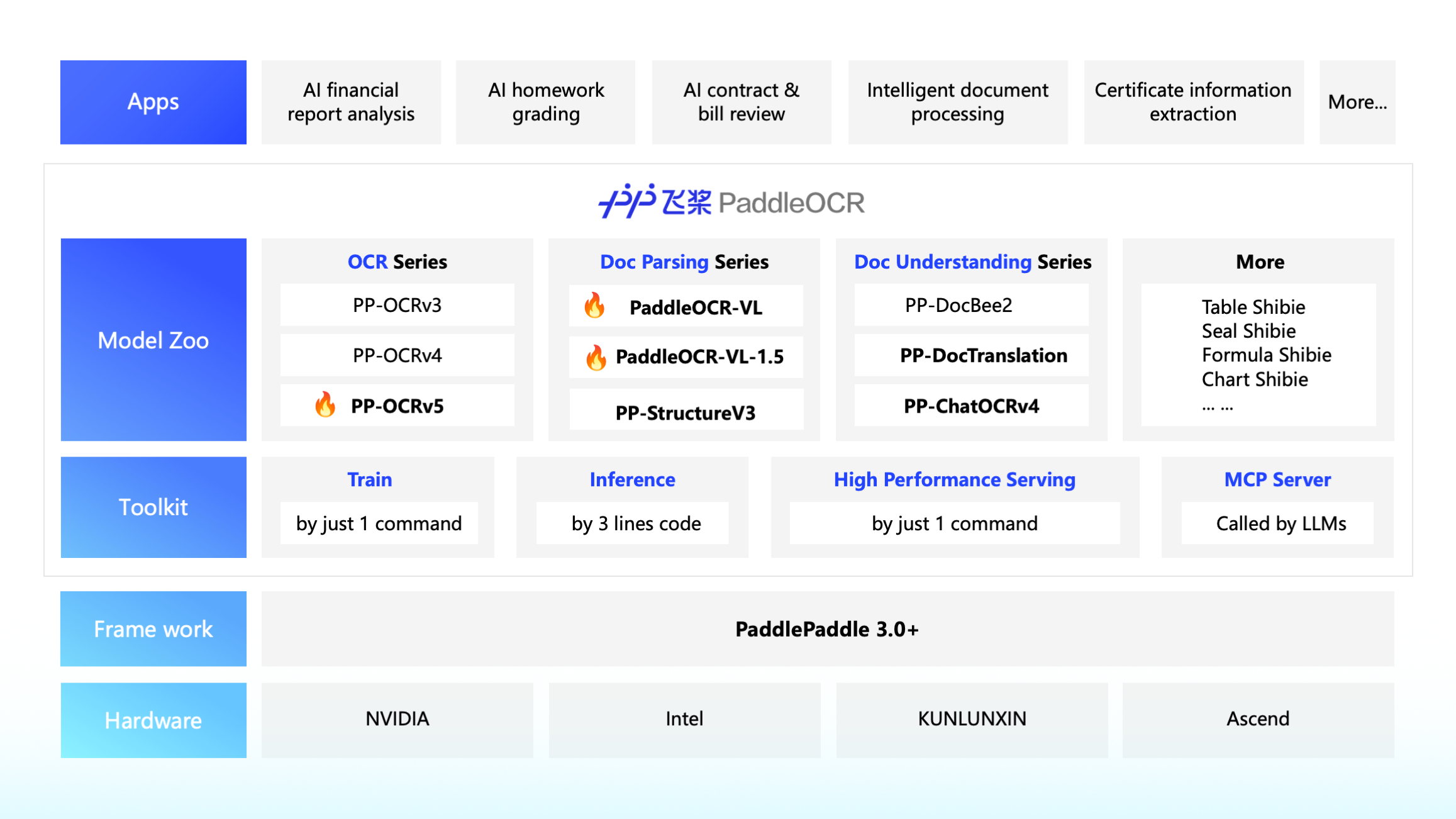
PaddleOCR Architecture

🛠️ Developer-Centric Ecosystem

  • Seamless Integration: The premier choice for the AI Agent ecosystem—deeply integrated with Dify, RAGFlow, Pathway, and Cherry Studio.
  • LLM Data Flywheel: A complete pipeline to build high-quality datasets, providing a sustainable "Data Engine" for fine-tuning Large Language Models.
  • One-Click Deployment: Supports various hardware backends (NVIDIA GPU, Intel CPU, Kunlunxin XPU, and diverse AI Accelerators).

📣 Recent updates

🔥 2026.07.22: HPD-Parsing is now available

  • HPD-Parsing is a lightweight vision-language model designed for high-throughput document parsing. It adopts a hierarchical parallel decoding paradigm and Progressive Multi-Token Prediction (P-MTP), achieving a peak throughput of 4,752 tokens/s on public benchmarks while maintaining competitive parsing accuracy.
  • HPD-Parsing supports both OpenAI-compatible serving and local inference through a customized vLLM runtime, making it suitable for document parsing scenarios with high demands on inference efficiency and deployment throughput.
  • See the HPD-Parsing usage tutorial for environment setup, serving, and local inference instructions.
2026.06.11: Release of PaddleOCR 3.7.0
  • PP-OCRv6 highlights:

    • Accuracy boost: Medium tier achieves +4.6% detection and +5.1% recognition over PP-OCRv5_server, surpassing mainstream VLMs (Qwen3-VL-235B, GPT-5.5) with only 34.5M parameters.
    • 50 languages unified: Single model covers Chinese, English, Japanese, and 46 Latin-script languages — no model switching needed.
    • Specialized scenarios: Major improvements in digital displays, dot-matrix characters, tire prints, and industrial text recognition.
    • Faster inference: 5.2× CPU speedup (OpenVINO), 6.1× on Apple M4 (tiny), 0.13s on A100 GPU.
    • Three tiers for all scenarios: tiny (1.5M) / small (7.7M) / medium (34.5M) for edge, mobile, and server deployment.
    • Model availability: All models are available on HuggingFace and ModelScope.
2026.05.28: Release of PaddleOCR 3.6.0
  • PaddleOCR-VL-1.6 highlights:

    • New SOTA Accuracy: Achieves over 96.3% on OmniDocBench v1.6, also sets new SOTA on OmniDocBench v1.5 and Real5-OmniDocBench, leading both open-source and proprietary solutions in text, formula, and table recognition.
    • Comprehensive Capability Upgrade: Significant improvements in table, ancient document, and rare c

readme truncated — read the full docs on github

Frequently asked questions

Is PaddleOCR free to use?

PaddleOCR is open source under the Apache-2.0 licence. There is no licence fee and no seat count — you can self-host it or, where the project offers one, pay a vendor for a managed version instead.

What does PaddleOCR do?

Turn any PDF or image document into structured data for your AI. A powerful, lightweight OCR toolkit that bridges the gap between images/PDFs and LLMs. Supports

What is PaddleOCR written in?

PaddleOCR is primarily written in Python. Its source is publicly available at https://github.com/PaddlePaddle/PaddleOCR, and it has 89,729 GitHub stars.




