

🗒️ Structured outputs for LLMs 🗒️
Made with ❤👷️ by the team at .txt
Trusted by NVIDIA, Cohere, HuggingFace, vLLM, etc.
[![PyPI Version][pypi-version-badge]][pypi] [![Downloads][downloads-badge]][pypistats] [![Stars][stars-badge]][stars]
[![Discord][discord-badge]][discord] [![Blog][dottxt-blog-badge]][dottxt-blog] [![Twitter][twitter-badge]][twitter]
The .txt API is currently in early access. Request access here →
🚀 Building the future of structured generation
We're working with select partners to develop new interfaces to structured generation.
Need XML, FHIR, custom schemas or grammars? Let's talk.
Audit your schema: share one schema, we show you what breaks under generation, the constraints that fix it, and compliance rates before and after. Sign up here.
Table of Contents
- Why Outlines?
- Quickstart
- Real-World Examples
- They Use Outlines
- Model Integrations
- Core Features
- Other Features
- About .txt
- Community

Why Outlines?
LLMs are powerful but their outputs are unpredictable. Most solutions attempt to fix bad outputs after generation using parsing, regex, or fragile code that breaks easily.
Outlines guarantees structured outputs during generation — directly from any LLM.
- Works with any model - Same code runs across OpenAI, Ollama, vLLM, and more
- Simple integration - Just pass your desired output type:
model(prompt, output_type) - Guaranteed valid structure - No more parsing headaches or broken JSON
- Provider independence - Switch models without changing code
The Outlines Philosophy
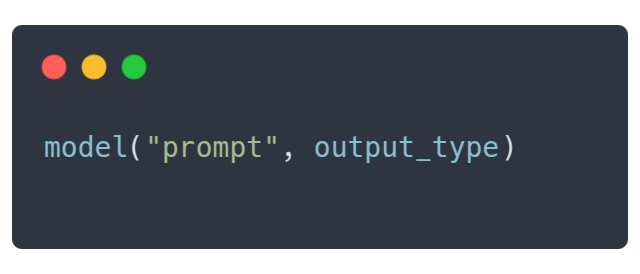
Outlines follows a simple pattern that mirrors Python's own type system. Simply specify the desired output type, and Outlines will ensure your data matches that structure exactly:
- For a yes/no response, use
Literal["Yes", "No"] - For numerical values, use
int - For complex objects, define a structure with a Pydantic model
Quickstart
Getting started with outlines is simple:
1. Install outlines
pip install outlines
2. Connect to your preferred model
import outlines
from transformers import AutoTokenizer, AutoModelForCausalLM


MODEL_NAME = "microsoft/Phi-3-mini-4k-instruct"
model = outlines.from_transformers(
    AutoModelForCausalLM.from_pretrained(MODEL_NAME, device_map="auto"),
    AutoTokenizer.from_pretrained(MODEL_NAME)
)
3. Start with simple structured outputs
from typing import Literal
from pydantic import BaseModel


# Simple classification
sentiment = model(
    "Analyze: 'This product completely changed my life!'",
    Literal["Positive", "Negative", "Neutral"]
)
print(sentiment)  # "Positive"

# Extract specific types
temperature = model("What's the boiling point of water in Celsius?", int)
print(temperature)  # 100
4. Create complex structures
from pydantic import BaseModel
from enum import Enum

class Rating(Enum):
    poor = 1
    fair = 2
    good = 3
    excellent = 4

class ProductReview(BaseModel):
    rating: Rating
    pros: list[str]
    cons: list[str]
    summary: str

review = model(
    "Review: The XPS 13 has great battery life and a stunning display, but it runs hot and the webcam is poor quality.",
    ProductReview,
    max_new_tokens=200,
)

review = ProductReview.model_validate_json(review)
print(f"Rating: {review.rating.name}")  # "Rating: good"
print(f"Pros: {review.pros}")           # "Pros: ['great battery life', 'stunning display']"
print(f"Summary: {review.summary}")     # "Summary: Good laptop with great display but thermal issues"
Real-world examples
Here are production-ready examples showing how Outlines solves common problems:
🙋♂️ Customer Support Triage
This example shows how to convert a free-form customer email into a structured service ticket. By parsing attributes like priority, category, and escalation flags, the code enables automated routing and handling of support issues.
import outlines
from enum import Enum
from pydantic import BaseModel
from transformers import AutoTokenizer, AutoModelForCausalLM
from typing import List


MODEL_NAME = "microsoft/Phi-3-mini-4k-instruct"
model = outlines.from_transformers(
    AutoModelForCausalLM.from_pretrained(MODEL_NAME, device_map="auto"),
    AutoTokenizer.from_pretrained(MODEL_NAME)
)


def alert_manager(ticket):
    print("Alert!", ticket)


class TicketPriority(str, Enum):
    low = "low"
    medium = "medium"
    high = "high"
    urgent = "urgent"

class ServiceTicket(BaseModel):
    priority: TicketPriority
    category: str
    requires_manager: bool
    summary: str
    action_items: List[str]


customer_email = """
Subject: URGENT - Cannot access my account after payment

I paid for the premium plan 3 hours ago and still can't access any features.
I've tried logging out and back in multiple times. This is unacceptable as I
have a client presentation in an hour and need the analytics dashboard.
Please fix this immediately or refund my payment.
"""

prompt = f"""
<|im_start|>user
Analyze this customer email:

{customer_email}
<|im_end|>
<|im_start|>assistant
"""

ticket = model(
    prompt,
    ServiceTicket,
    max_new_tokens=500
)

# Use structured data to route the ticket
ticket = ServiceTicket.model_validate_json(ticket)
if ticket.priority == "urgent" or ticket.requires_manager:
    alert_manager(ticket)
📦 E-commerce product categorization
This use case demonstrates how outlines can transform product descriptions into structured categorization data (e.g., main category, sub-category, and attributes) to streamline tasks such as inventory management. Each product description is processed automatically, reducing manual categorization overhead.
import outlines
from pydantic import BaseModel
from transformers import AutoTokenizer, AutoModelForCausalLM
from typing import List, Optional


MODEL_NAME = "microsoft/Phi-3-mini-4k-instruct"
model = outlines.from_transformers(
    AutoModelForCausalLM.from_pretrained(MODEL_NAME, device_map="auto"),
    AutoTokenizer.from_pretrained(MODEL_NAME)
)


def update_inventory(product, category, sub_category):
    print(f"Updated {product.split(',')[0]} in category {category}/{sub_category}")


class ProductCategory(BaseModel):
    main_category: str
    sub_category: str
    attributes: List[str]
    brand_match: Optional[str]

# Process product descriptions in batches
product_descriptions = [
    "Apple iPhone 15 Pro Max 256GB Titanium, 6.7-inch Super Retina XDR display with ProMotion",
    "Organic Cotton T-Shirt, Men's Medium, Navy Blue, 100% Sustainable Materials",
    "KitchenAid Stand Mixer, 5 Quart, Red, 10-Speed Settings with Dough Hook Attachment"
]

template = outlines.Template.from_string("""
<|im_start|>user
Categorize this product:

{{ description }}
<|im_end|>
<|im_start|>assistant
""")

# Get structured categorization for all products
categories = model(
    [template(description=desc) for desc in product_descriptions],
    ProductCategory,
    max_new_tokens=200
)

# Use categorization for inventory management
categories = [
    ProductCategory.model_validate_json(category) for category in categories
]
for product, category in zip(product_descriptions, categories):
    update_inventory(product, category.main_category, category.sub_category)