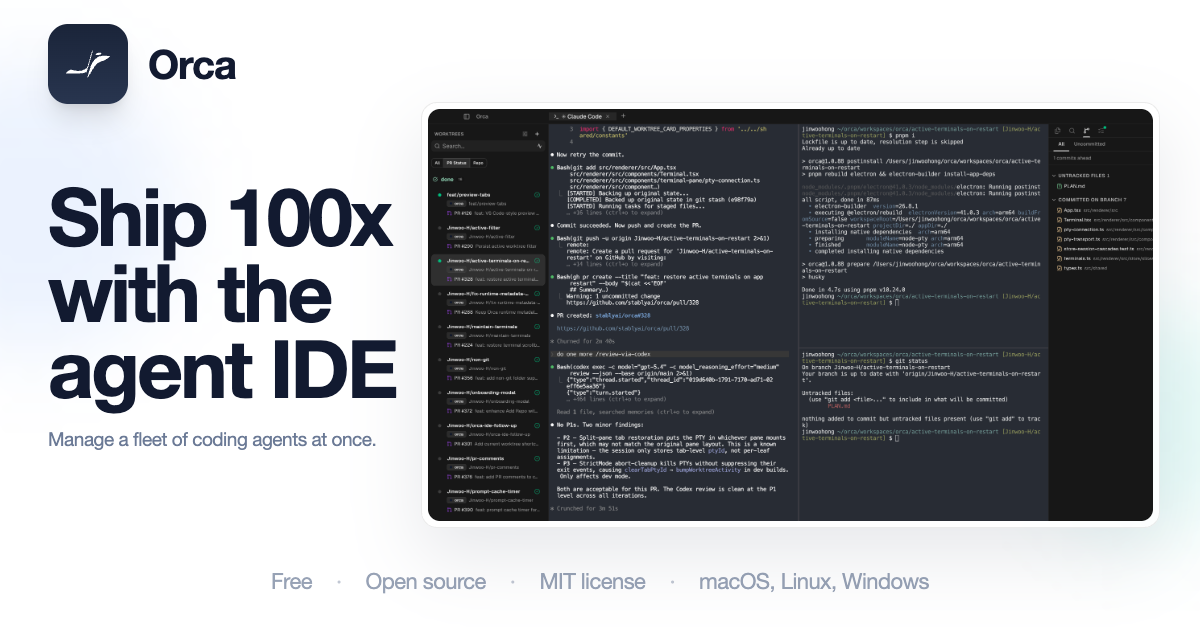



Orca is a free, open source ai assisted coding project written in TypeScript and released under MIT. It has 71,017 GitHub stars, 4,642 forks and 5,801 open issues, and was last pushed 3 hours ago. On this registry it ranks #5 of 24 tracked projects in AI Assisted Coding, with 5 head-to-head comparisons available. It gained 3,772 stars over the last 6 tracked days.

Orca — Run multiple AI coding agents in parallel, side by side

What is Orca?

What it is

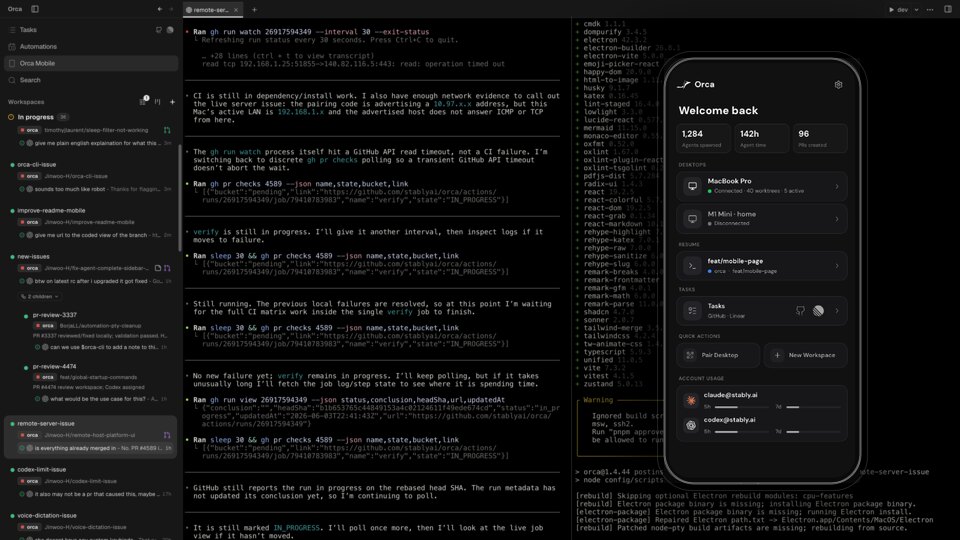
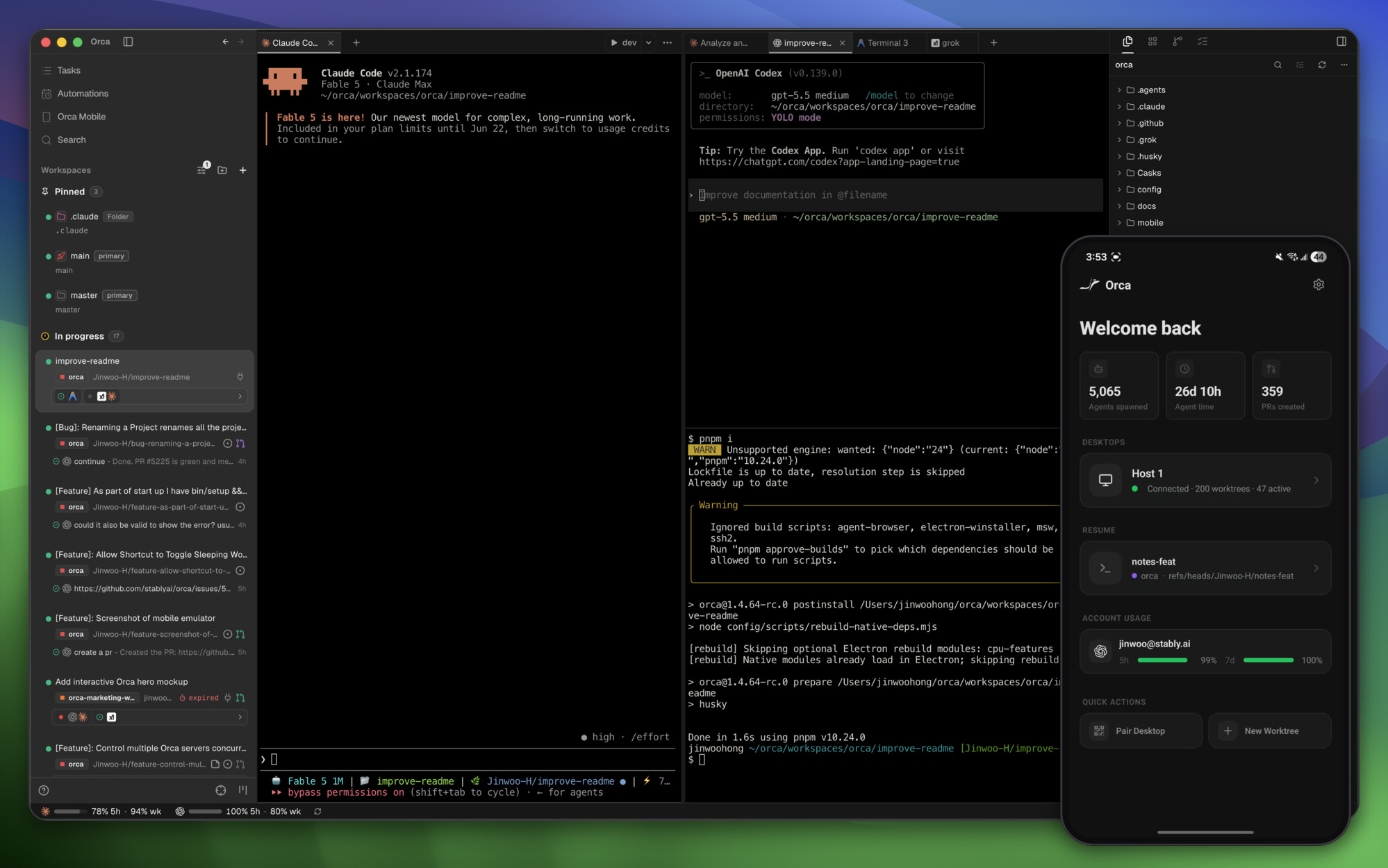
Orca is an agent desktop environment (ADE) that runs multiple AI coding agents in parallel, each in its own isolated git worktree. It unifies workflow, monitoring, and collaboration around AI-assisted coding across desktop, mobile, and remote runtimes. Built for developers who rely on several AI coding tools simultaneously, Orca eliminates context switching by tracking all agents and their outputs in one place.

The project solves the fragmentation problem inherent in using multiple AI coding agents—each requiring separate terminals, workspaces, and manual coordination. With Orca, users can fan a single prompt across five agents, compare outputs, annotate diffs, and merge results—all within a single interface. It replaces disjointed workflows involving terminal tabs, multiple IDEs, and external task management tools.

Key capabilities

  • Run any CLI-based AI agent (e.g., Claude Code, Codex, OpenCode, Pi) side-by-side in isolated git worktrees
  • Monitor and control agents from a mobile app with push notifications and follow-up prompts
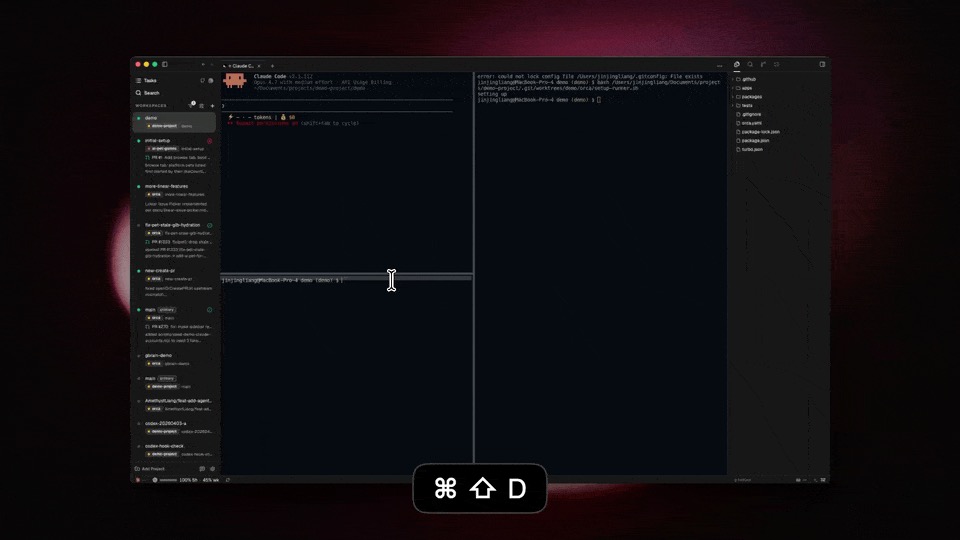
  • Use terminal splits with Ghostty-class rendering, infinite splits, and persistent scrollback
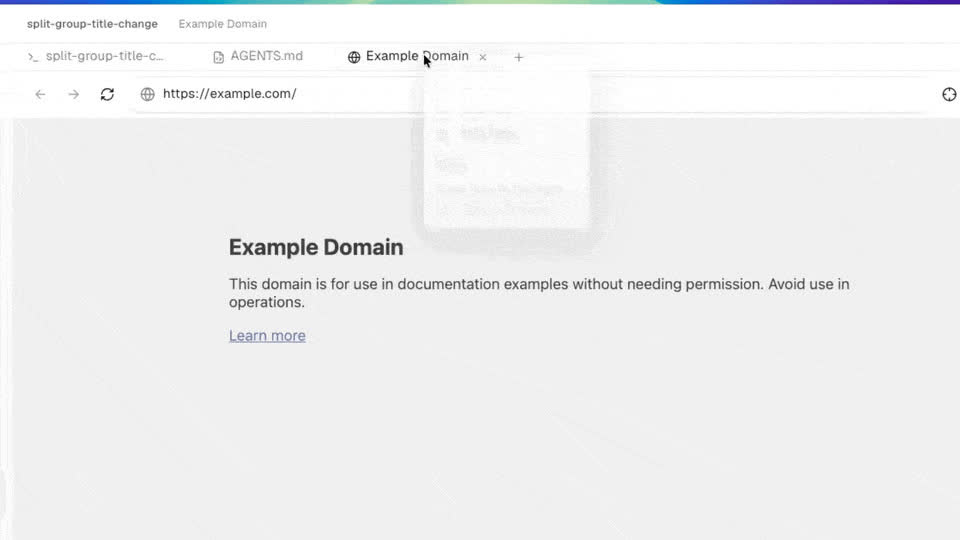
  • Click UI elements in a Chromium window to inject HTML, CSS, and screenshots into agent prompts via Design Mode
  • SSH into remote machines and run agents there with full file editing, git, and auto-reconnect
  • Annotate AI-generated diffs with inline comments and ship feedback back to agents without leaving Orca
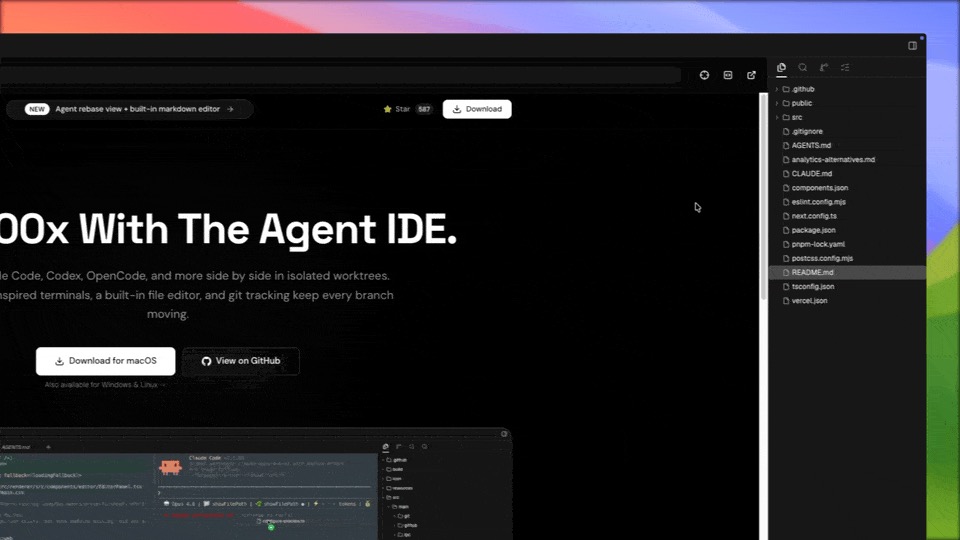
  • Drag files or images directly into agent prompts and preview Markdown, PDFs, and images natively

Who uses it and how

  • Developers running multiple AI agents in parallel to compare outputs and select the best solution for a task
  • Teams using Linear or GitHub to track tasks, opening worktrees directly from issues or PRs for context-aware coding
  • Remote engineers using SSH worktrees to offload heavy agent runs to powerful servers while editing locally
  • Mobile users managing long-running agent tasks and receiving finish notifications while away from desktop
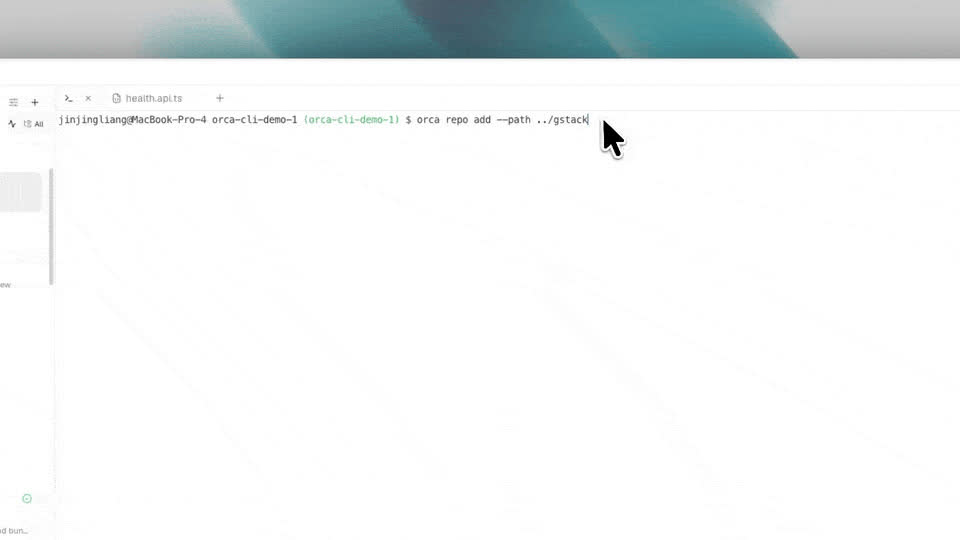
  • Automation engineers scripting agent workflows via the Orca CLI (orca worktree create, snapshot, click, fill)

Getting started

Download desktop builds from onOrca.dev or GitHub Releases for macOS, Windows, or Linux; install the mobile companion via iOS App Store, TestFlight, or Android APK. No build required—run out of the box. The CLI is bundled with the desktop app.

When to use it — and when not to

Orca shines when you need to orchestrate multiple agents concurrently with tight feedback loops and minimal context switching. It replaces manual terminal multiplexing and scattered tooling but does not replace the agents themselves—each still requires its own API key or subscription. Self-hosting is not supported; Orca is a client-side desktop/mobile app with optional remote agent execution via SSH. It does not manage infrastructure, authentication, or billing—those remain user responsibilities.

project readme (upstream, from github) — read inline

Orca

GitHub stars License: MIT Join the Orca Discord Follow Orca on X Supported platforms: macOS, Windows, and Linux

中文 · 日本語 · 한국어 · Español · Français · Português

The AI Orchestrator for 100x builders.
Run Codex, ClaudeCode, OpenCode or Pi side-by-side — each in its own worktree, tracked in one place.

Download Orca
Features

Mobile Companion

Monitor and steer your agents from your phone — get notified when an agent finishes and send follow-ups from anywhere.

iOS App Store · TestFlight · Android APK 0.0.48 · Docs →

Parallel Worktrees

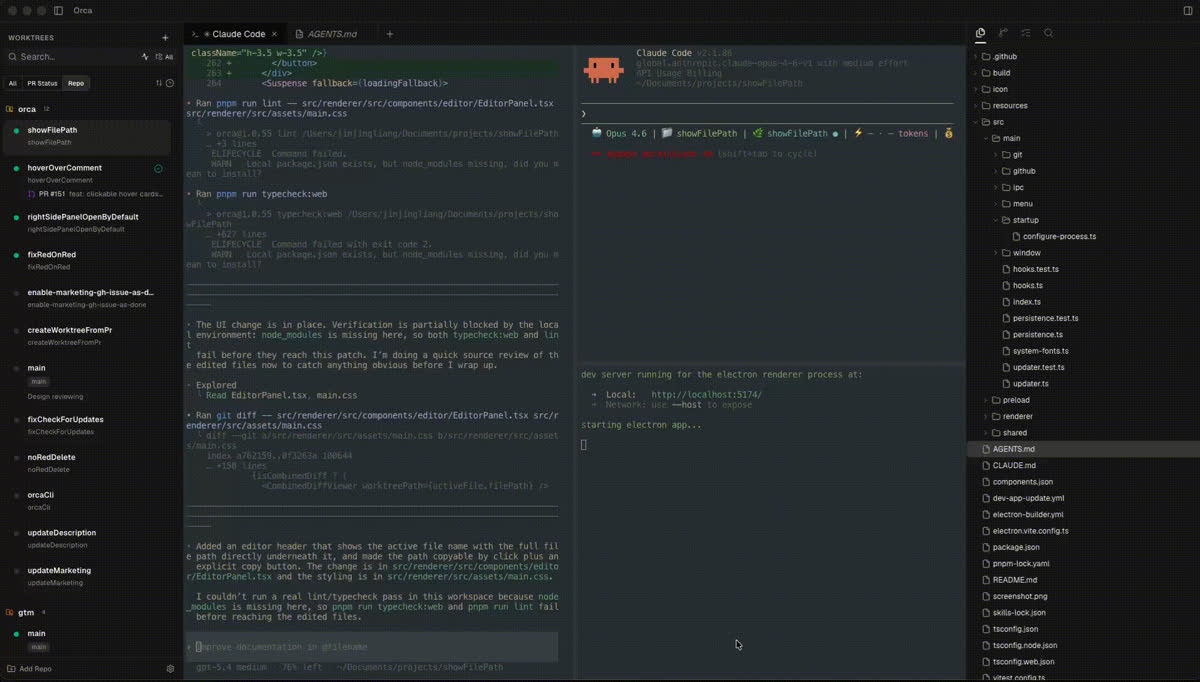
Fan one prompt across five agents, each in its own isolated git worktree — compare the results and merge the winner.

Docs →

Terminal Splits

Ghostty-class terminals with WebGL rendering, infinite splits, and scrollback that survives restarts.

Docs →

Design Mode

Click any UI element in a real Chromium window to send its HTML, CSS, and a cropped screenshot straight into your agent's prompt.

Docs →

GitHub & Linear, Native

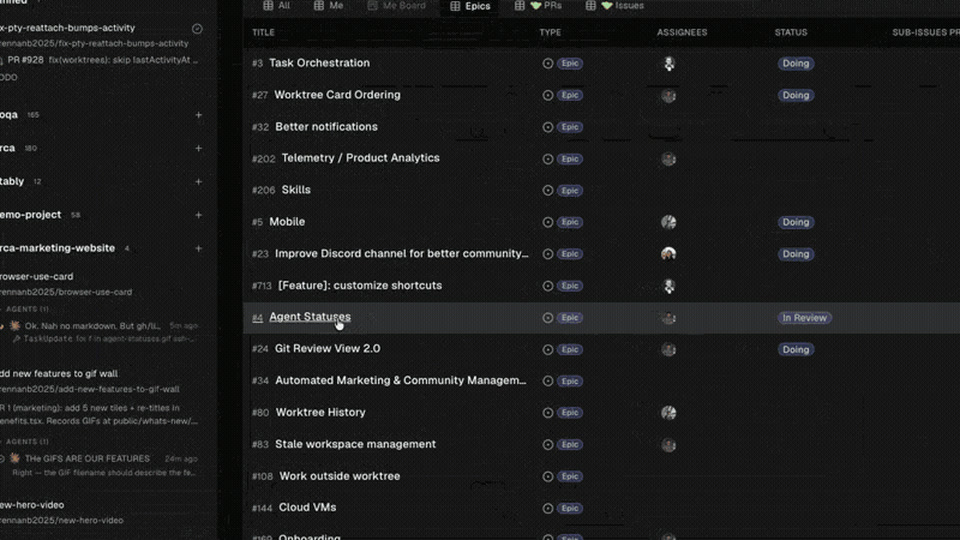
Browse PRs, issues, and project boards in-app — open a worktree from any task and review without a context switch.

Docs →

SSH Worktrees

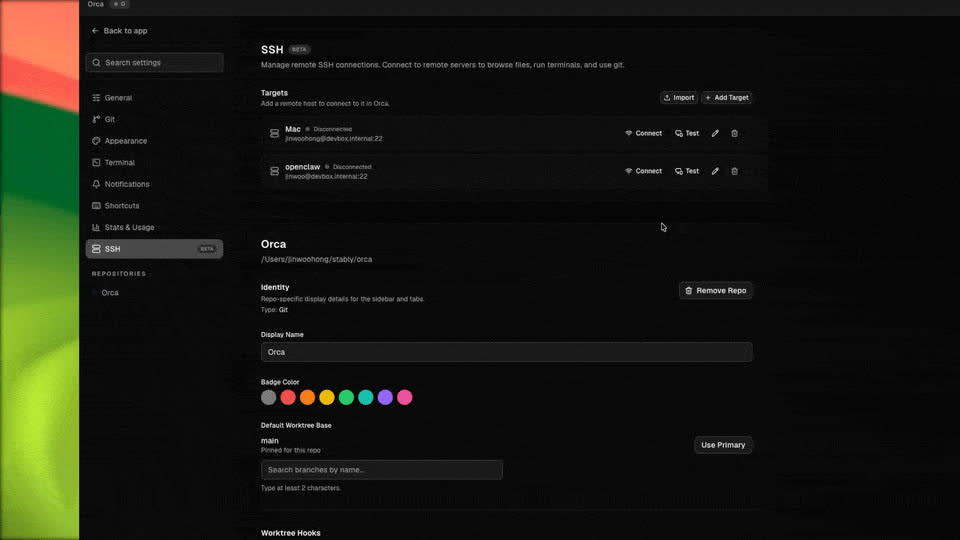
Run agents on a beefy remote box with full file editing, git, and terminals — auto-reconnect and port forwarding included.

Docs →

Annotate AI Diffs

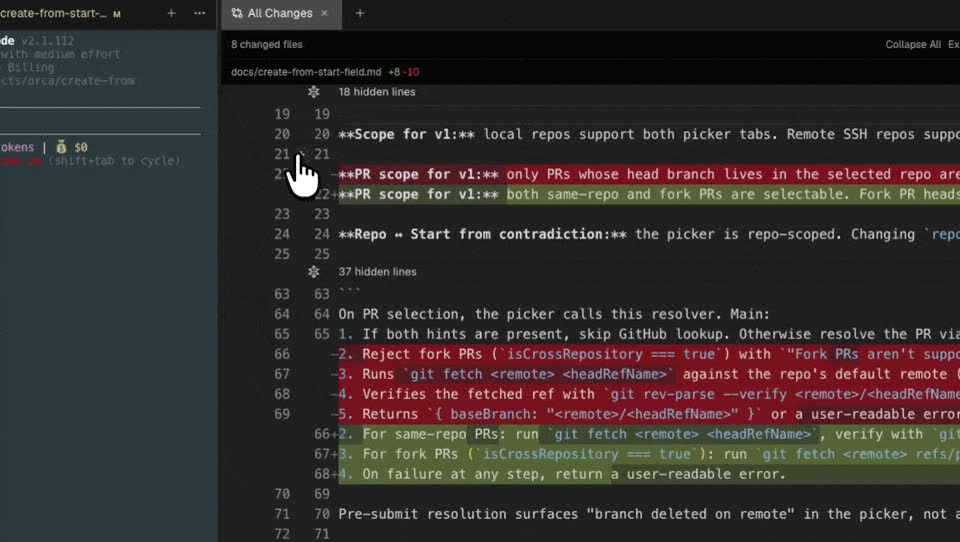
Drop comments on any diff line and ship them back to the agent — review, edit, and commit without leaving Orca.

Docs →

Drag Files to Agents

VS Code's editor with autosave everywhere — drag files or images straight into an agent prompt.

Docs →

Orca CLI

Agents drive Orca too — script every workflow with orca worktree create, snapshot, click, and fill.

Docs →

Also in the box:

  • Quick open — Search across worktrees, files, agents, commands, and repo context without leaving your flow.
  • Account switcher & usage tracking — See Claude and Codex usage and rate-limit resets, and hot-swap accounts without re-logging in.
  • Rich repo previews — Preview Markdown, images, PDFs, and repo docs in the workspace.
  • Computer Use — Let agents operate desktop apps and visible UI when a workflow needs real interaction.
  • Notifications and unread state — Know when an agent finishes or needs attention, then mark threads unread to come back later.
  • And many, many more — we ship daily, so this list is perpetually behind. The changelog is the real feature list.

Supported Agents

Works with any CLI agent — if it runs in a terminal, it runs in Orca.

Claude Code   Codex logo Codex   Grok logo Grok   Cursor logo Cursor   GitHub Copilot logo GitHub Copilot   readme truncated — read the full docs on github

Frequently asked questions

Is Orca free to use?

Orca is open source under the MIT licence. There is no licence fee and no seat count — you can self-host it or, where the project offers one, pay a vendor for a managed version instead.

What does Orca do?

Run multiple AI coding agents in parallel, side by side

What is Orca written in?

Orca is primarily written in TypeScript. Its source is publicly available at https://github.com/stablyai/orca, and it has 71,017 GitHub stars.