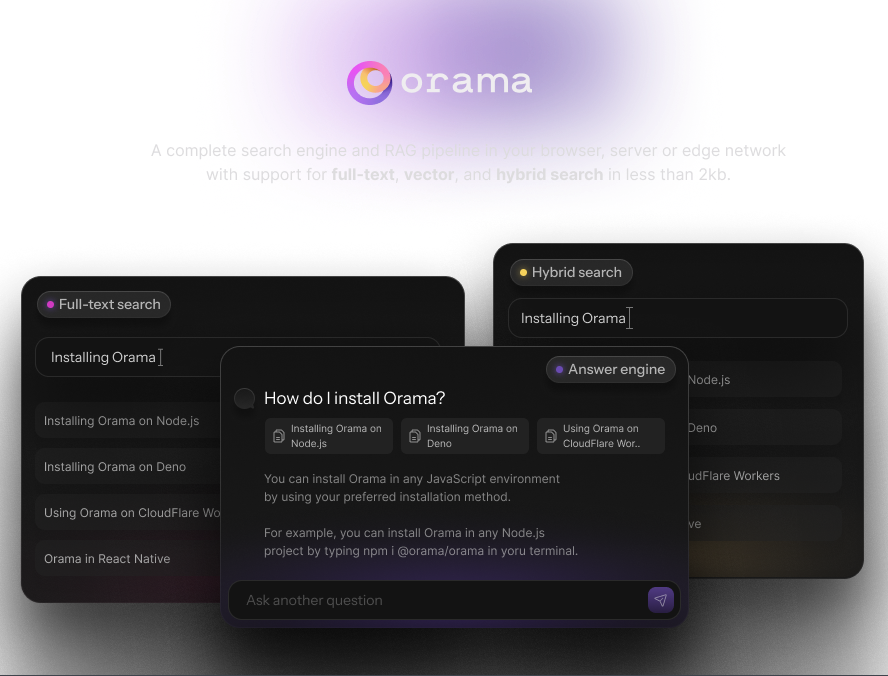
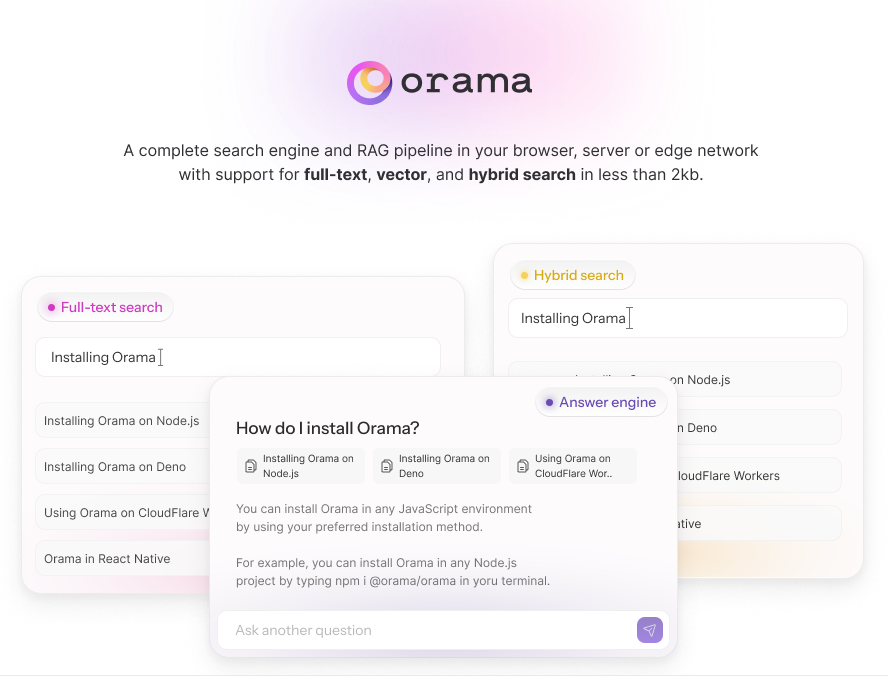



If you need more info, help, or want to provide general feedback on Orama, join the Orama Slack channel
Highlighted features
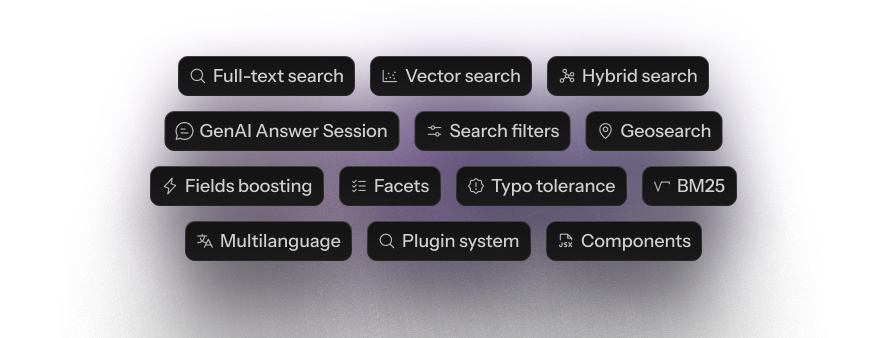
- Full-Text search
- Vector Search
- Hybrid Search
- GenAI Chat Sessions
- Search Filters
- Geosearch
- Pinning Rules (Merchandising)
- Facets
- Fields Boosting
- Typo Tolerance
- Exact Match
- BM25
- Stemming and tokenization in 30 languages
- Plugin System
Installation
You can install Orama using npm, yarn, pnpm, bun:
npm i @orama/orama
Or import it directly in a browser module:
<html>
  <body>
    <script type="module">
      import { create, insert, search } from 'https://cdn.jsdelivr.net/npm/@orama/orama@latest/+esm'
    </script>
  </body>
</html>
With Deno, you can just use the same CDN URL or use npm specifiers:
import { create, search, insert } from 'npm:@orama/orama'
Read the complete documentation at https://docs.orama.com.
Orama Features

Usage
Orama is quite simple to use. The first thing to do is to create a new database instance and set an indexing schema:
import { create, insert, remove, search, searchVector } from '@orama/orama'

const db = create({
  schema: {
    name: 'string',
    description: 'string',
    price: 'number',
    embedding: 'vector[1536]', // Vector size must be expressed during schema initialization
    meta: {
      rating: 'number',
    },
  },
})

insert(db, {
  name: 'Noise cancelling headphones',
  description: 'Best noise cancelling headphones on the market',
  price: 99.99,
  embedding: [0.2432, 0.9431, 0.5322, 0.4234, ...],
  meta: {
    rating: 4.5
  }
})

const results = search(db, {
  term: 'Best headphones'
})

// {
//   elapsed: {
//     raw: 21492,
//     formatted: '21μs',
//   },
//   hits: [
//     {
//       id: '41013877-56',
//       score: 0.925085832971998432,
//       document: {
//         name: 'Noise cancelling headphones',
//         description: 'Best noise cancelling headphones on the market',
//         price: 99.99,
//         embedding: [0.2432, 0.9431, 0.5322, 0.4234, ...],
//         meta: {
//           rating: 4.5
//         }
//       }
//     }
//   ],
//   count: 1
// }
Orama currently supports 10 different data types:
| Type | Description | Example |
|---|---|---|
string |
A string of characters. | 'Hello world' |
number |
A numeric value, either float or integer. | 42 |
boolean |
A boolean value. | true |
enum |
An enum value. | 'drama' |
geopoint |
A geopoint value. | { lat: 40.7128, lon: 74.0060 } |
string[] |
An array of strings. | ['red', 'green', 'blue'] |
number[] |
An array of numbers. | [42, 91, 28.5] |
boolean[] |
An array of booleans. | [true, false, false] |
enum[] |
An array of enums. | ['comedy', 'action', 'romance'] |
vector[] |
A vector of numbers to perform vector search on. | [0.403, 0.192, 0.830] |
Vector and Hybrid Search Support
Orama supports both vector and hybrid search by just setting mode: 'vector' when performing search.
To perform this kind of search, you'll need to provide text embeddings at search time:
import { create, insertMultiple, search } from '@orama/orama'

const db = create({
  schema: {
    title: 'string',
    embedding: 'vector[5]', // we are using a 5-dimensional vector.
  },
});

insertMultiple(db, [
  { title: 'The Prestige', embedding: [0.938293, 0.284951, 0.348264, 0.948276, 0.56472] },
  { title: 'Barbie', embedding: [0.192839, 0.028471, 0.284738, 0.937463, 0.092827] },
  { title: 'Oppenheimer', embedding: [0.827391, 0.927381, 0.001982, 0.983821, 0.294841] },
])

const results = search(db, {
  // Search mode. Can be 'vector', 'hybrid', or 'fulltext'
  mode: 'vector',
  vector: {
    // The vector (text embedding) to use for search
    value: [0.938292, 0.284961, 0.248264, 0.748276, 0.26472],
    // The schema property where Orama should compare embeddings
    property: 'embedding',
  },
  // Minimum similarity to determine a match. Defaults to `0.8`
  similarity: 0.85,
  // Defaults to `false`. Setting to 'true' will return the embeddings in the response (which can be very large).
  includeVectors: true,
})
Have trouble generating embeddings for vector and hybrid search? Try our @orama/plugin-embeddings plugin!
import { create } from '@orama/orama'
import { pluginEmbeddings } from '@orama/plugin-embeddings'
import '@tensorflow/tfjs-node' // Or any other appropriate TensorflowJS backend, like @tensorflow/tfjs-backend-webgl

const plugin = await pluginEmbeddings({
  embeddings: {
    // Schema property used to store generated embeddings
    defaultProperty: 'embeddings',
    onInsert: {
      // Generate embeddings at insert-time
      generate: true,
      // properties to use for generating embeddings at insert time.
      // Will be concatenated to generate a unique embedding.
      properties: ['description'],
      verbose: true,
    }
  }
})

const db = create({
  schema: {
    description: 'string',
    // Orama generates 512-dimensions vectors.
    // When using @orama/plugin-embeddings, set the property where you want to store embeddings as `vector[512]`.
    embeddings: 'vector[512]'
  },
  plugins: [plugin]
})

// Orama will generate and store embeddings at insert-time!
await insert(db, { description: 'Classroom Headphones Bulk 5 Pack, Student On Ear Color Varieties' })
await insert(db, { description: 'Kids Wired Headphones for School Students K-12' })
await insert(db, { description: 'Kids Headphones Bulk 5-Pack for K-12 School' })
await insert(db, { description: 'Bose QuietComfort Bluetooth Headphones' })

// Orama will also generate