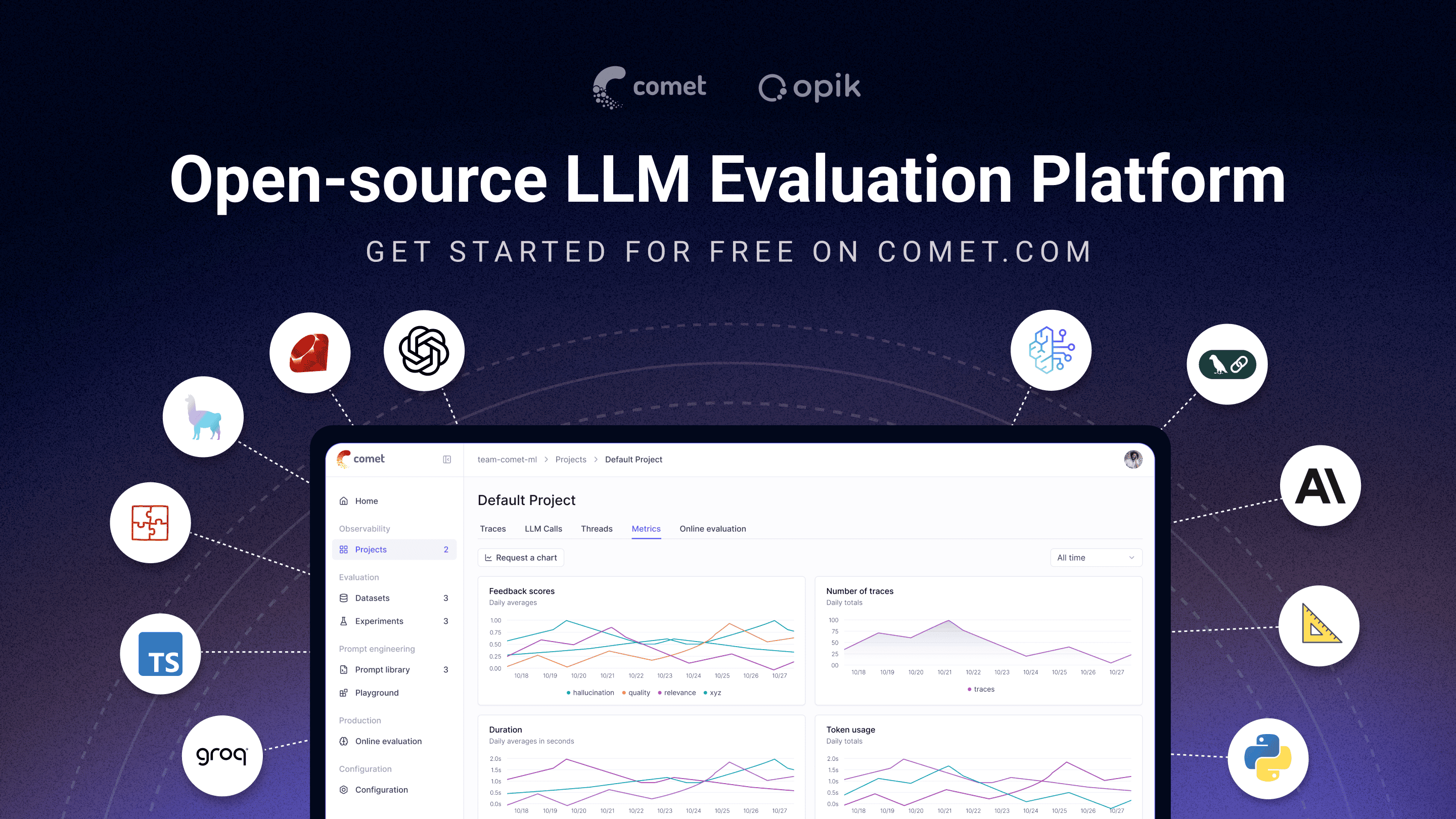
opik is a free, open source ai development platforms project written in Python and released under Apache-2.0. It has 22,098 GitHub stars, 1,801 forks and 258 open issues, and was last pushed 6 hours ago. On this registry it ranks #36 of 61 tracked projects in AI Development Platforms, with 5 head-to-head comparisons available. It gained 54 stars over the last 3 tracked days.

What is opik?

Opik is open-source LLM observability, evaluation, and AI agent tracing platform for teams building LLM apps, RAG systems, and agentic workflows, built by Comet, Apache-2.0 licensed, free to self-host full platform.

What it is

Opik covers full LLM application lifecycle, from first trace in development to production monitoring. Platform handles AI agent tracing and observability, LLM evaluation, prompt management, and prompt and agent optimization. Deep tracing covers LLM calls, conversation logging, and agent activity, with full trace trees for multi-step agents and tool calls. Package ships as Python SDK on PyPI under name opik, with separate server component for self-hosting.

Project lives in LLM observability and evaluation ecosystem, commonly shortened to LLMOps. It replaces ad-hoc print logging, scattered notebook experiments, and homegrown trace viewers that teams otherwise assemble to watch agent steps and judge output quality. Datasets, Experiments, and LLM-as-a-judge metrics give one place to store test cases, run evaluations, and score results, instead of stitching separate logging, dataset, and scoring tools together.

Key capabilities

  • AI agent tracing and observability: deep tracing of LLM calls, conversation logging, and full trace trees for multi-step agents and tool calls.
  • LLM evaluation with Datasets and Experiments, plus LLM-as-a-judge metrics for hallucination detection, moderation, and RAG assessment.
  • Opik Agent Optimizer SDK to improve prompts and agents.
  • Production monitoring with scalable dashboards and online evaluation rules.
  • Opik Guardrails for safe and responsible AI practices.
  • CI/CD evaluation through PyTest integration, so LLM pipelines get tested on every commit.
  • Prompt Playground for experimenting with prompts and models, plus third-party integrations including Google ADK, Autogen, Flowise AI, LangChain, and LlamaIndex.

Who uses it and how

  • Teams building multi-step agents and RAG systems use trace trees to follow tool calls and conversation flow across development and production.
  • Evaluation engineers run Datasets and Experiments with LLM-as-a-judge metrics to catch hallucination and moderation problems before release.
  • Platform teams wire the PyTest integration into CI so LLM pipeline tests run on every commit.
  • Developers annotate traces and spans with feedback scores through the Python SDK or the UI, then feed that signal back into optimization.
  • Operators deploy self-hosted Opik Server and apply online evaluation rules to score live traffic.

Getting started

Install the Python SDK package opik from PyPI for client-side tracing, then follow the quickstart to log first trace. Self-hosters instead run the Opik Server installation, and Comet offers a hosted option linked from the README.

How it compares

No paid products are listed as replacements in the supplied facts, and no directly comparable tools are named there either, so on the evidence given Opik stands alone in this registry. Its integrations with LangChain, LlamaIndex, and OpenAI describe interoperability, not competition.

When to use it — and when not to

Pick Opik if team wants Apache-2.0 tracing, evaluation, and monitoring in one stack, and can operate the Opik Server component when self-hosting rather than using the hosted Comet option. Avoid it if team wants a zero-infrastructure, SDK-only logging library, because full platform means running and maintaining a server alongside the opik client. Note the honest weaknesses: README excerpt supplied here is truncated mid-sentence, so public documentation summary is incomplete, and no database, storage, or SMTP requirements appear in the facts — confirm those operational details from the docs before committing to a self-hosted deployment.

project readme (upstream, from github) — read inline

English | 简体中文 | Español | Français | Deutsch | 日本語

Comet Opik logo
Opik: Open-Source LLM Observability, Evaluation & AI Agent Tracing

Opik is the open-source LLM observability and evaluation platform for AI agent tracing, LLM evaluation, prompt management, and production monitoring. Built by Comet. Apache-2.0 licensed, free to self-host the full platform, with 20,000+ GitHub stars.


Python SDK License Build

WebsiteSlack CommunityTwitterChangelogDocumentation

Last updated: 2026-07-17

🚀 What is Opik?⚡ Quick Start📊 How Does Opik Compare?❓ FAQ🛠️ Opik Server Installation💻 Opik Client SDK📝 Logging Traces
🧑‍⚖️ LLM as a Judge🔍 Evaluating your Application⭐ Star Us🤝 Contributing


Opik platform screenshot (thumbnail)

🚀 What is Opik?

Opik covers the full LLM application lifecycle, from the first trace in development to production monitoring, for teams building LLM apps and AI agents. Key offerings include:

  • AI Agent Tracing & Observability: Deep tracing of LLM calls, conversation logging, and agent activity, with full trace trees for multi-step agents and tool calls.
  • LLM Evaluation: Datasets, experiments, and LLM-as-a-judge metrics for hallucination detection, moderation, and RAG assessment.
  • Prompt & Agent Optimization: The Opik Agent Optimizer SDK to improve prompts and agents.
  • Production-Ready Monitoring: Scalable dashboards and online evaluation rules.
  • Opik Guardrails: Features to help you implement safe and responsible AI practices.
  • CI/CD Evaluation: A PyTest integration to test LLM pipelines on every commit.

Key capabilities include:

  • Development & Tracing:

    • Track all LLM calls and traces with detailed context during development and in production (Quickstart).
    • Extensive 3rd-party integrations for easy observability: Seamlessly integrate with a growing list of frameworks, supporting many of the largest and most popular ones natively (including recent additions like Google ADK, Autogen, and Flowise AI). (Integrations)
    • Annotate traces and spans with feedback scores via the Python SDK or the UI.
    • Experiment with prompts and models in the Prompt Playground.
  • Evaluation & Testing:

  • Production Monitoring & Optimization:

    • Log high volumes of production traces: Opik is designed for scale (40M+ traces/day).
    • Monitor feedback scores, trace counts, and token usage over time in the Opik Dashboard.
    • Utilize Online Evaluation Rules with LLM-as-a-Judge metrics to identify production issues.
    • Leverage Opik Agent Optimizer and Opik Guardrails to continuously improve and secure your LLM applications in production.

Who it's for: ML engineers building LLM-powered agents, AI teams moving from prototype to production, and engineering teams that need open-source, self-hostable observability they can run in their own environment.

Why open source matters here: Opik is Apache-2.0 licensed and free to self-host: the full platform, backend included, not just a client SDK. The repository includes the server backend, web application, tracing, datasets, experiments, evaluations, prompt management, online evaluation, and agent optimization components, all under Apache-2.0. You can run LLM observability inside your own infrastructure with no data leaving your environment and no Enterprise sales conversation required.

[!TIP] If you are looking for features that Opik doesn't have today, please raise a new Feature request 🚀

readme truncated — read the full docs on github

Frequently asked questions

Is opik free to use?

opik is open source under the Apache-2.0 licence. There is no licence fee and no seat count — you can self-host it or, where the project offers one, pay a vendor for a managed version instead.

What does opik do?

Debug, evaluate, and monitor your LLM applications, RAG systems, and agentic workflows with comprehensive tracing, automated evaluations, and production-ready d

What is opik written in?

opik is primarily written in Python. Its source is publicly available at https://github.com/comet-ml/opik, and it has 22,098 GitHub stars.