OpenSurge for Mac
把 Mac 变成可按设备分流的 Surge 风格全屋透明代理网关——既可让指定设备通过旁路由手动接入,也支持 DHCP/DNS 自动接管与实验性下游 IPv6 接管





简体中文 · English
官网 · 下载 · 使用文档 · App 指南 · 能力 · 每设备策略 · Web GUI · Agent 工作区
|
|
OpenSurge-for-Mac is a free, open source networking & connectivity project written in Go and released under GPL-3.0. It has 2,367 GitHub stars, 166 forks and 9 open issues, and was last pushed 37 hours ago. On this registry it ranks #13 of 14 tracked projects in Networking & Connectivity, with 5 head-to-head comparisons available.
OpenSurge for Mac is an open-source, GPL-3.0 macOS gateway and control plane that turns a Mac into a Surge-style whole-home transparent proxy gateway with IPv4 and IPv6 support, built for home-network operators and small labs that want per-device routing without swapping out their main router.
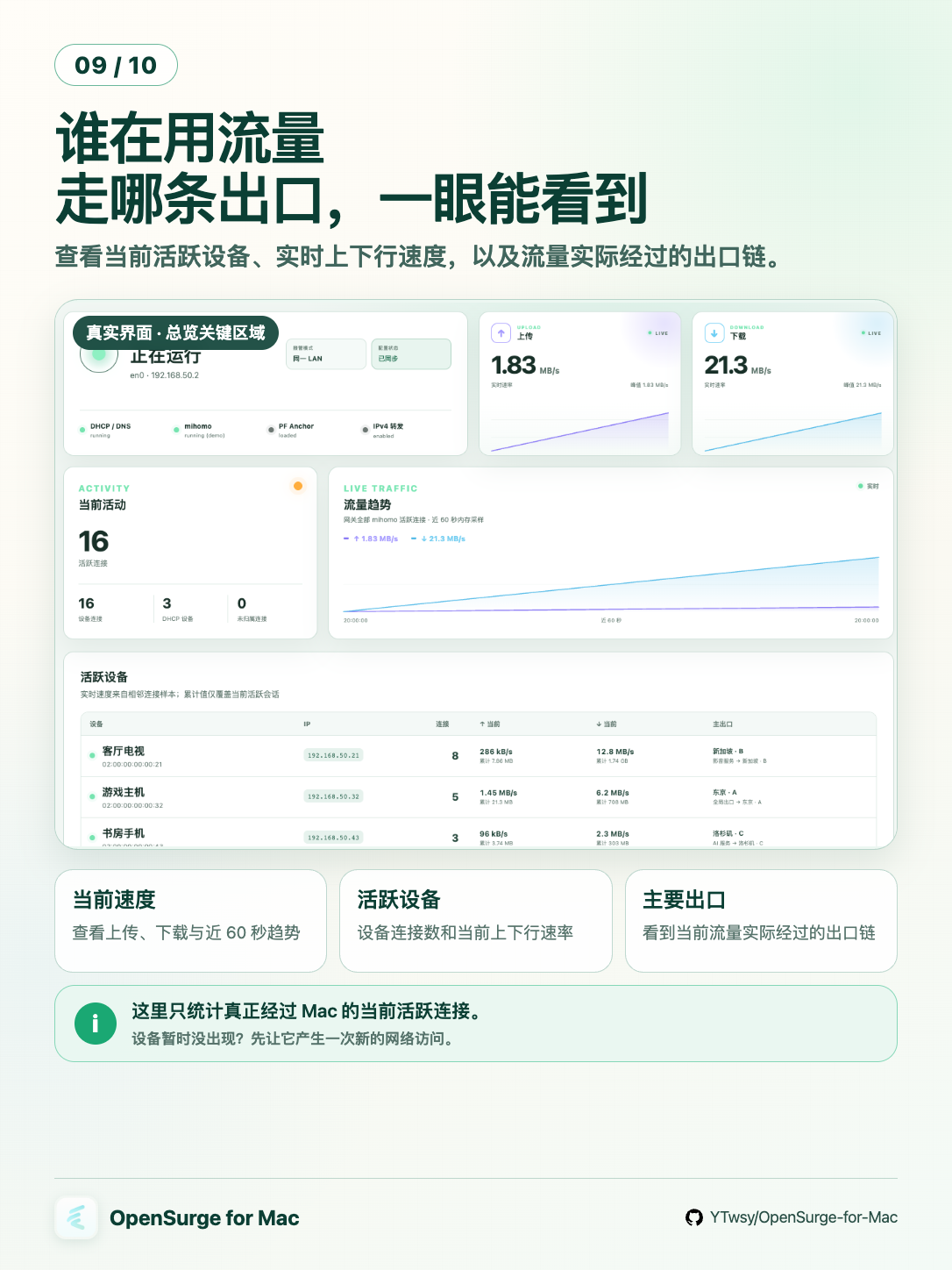
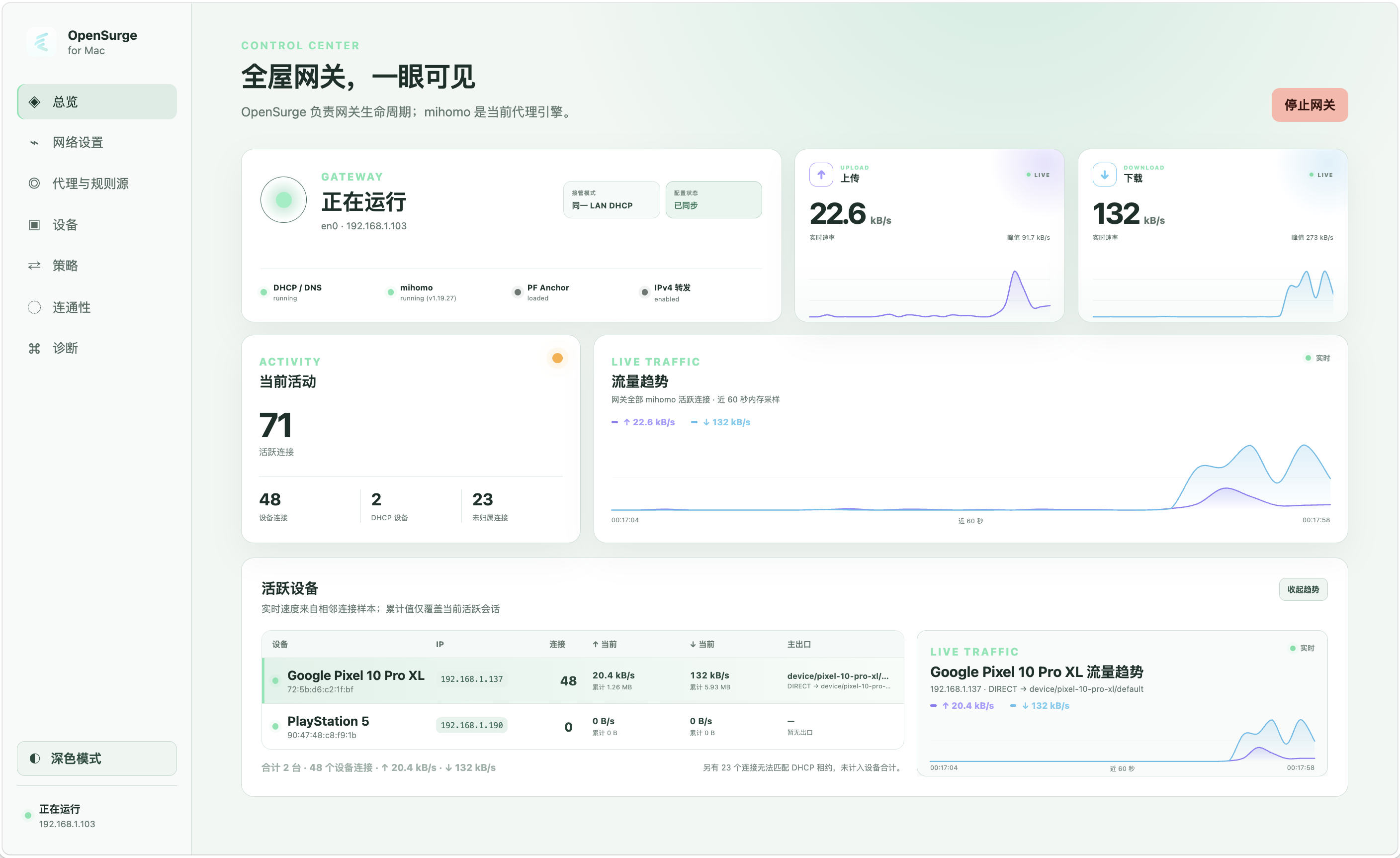
OpenSurge for Mac combines a macOS menu bar app, a local Web GUI and a set of system-level components into one control surface. Below the interface it drives mihomo as the proxy engine and dnsmasq for DHCP and DNS, while IPv4 traffic takes a native gateway path through macOS pf and forwarding. Experimental IPv6 takeover works differently: dnsmasq RA/SLAAC/RDNSS, a macOS BPF packet broker and a mihomo user-space data plane built from patched sources cover TCP, UDP and QUIC over UDP/443, preserving MAC identity for per-device policy. The project is written in Go, licensed under GPL-3.0, and documented at opensurge.pages.dev.
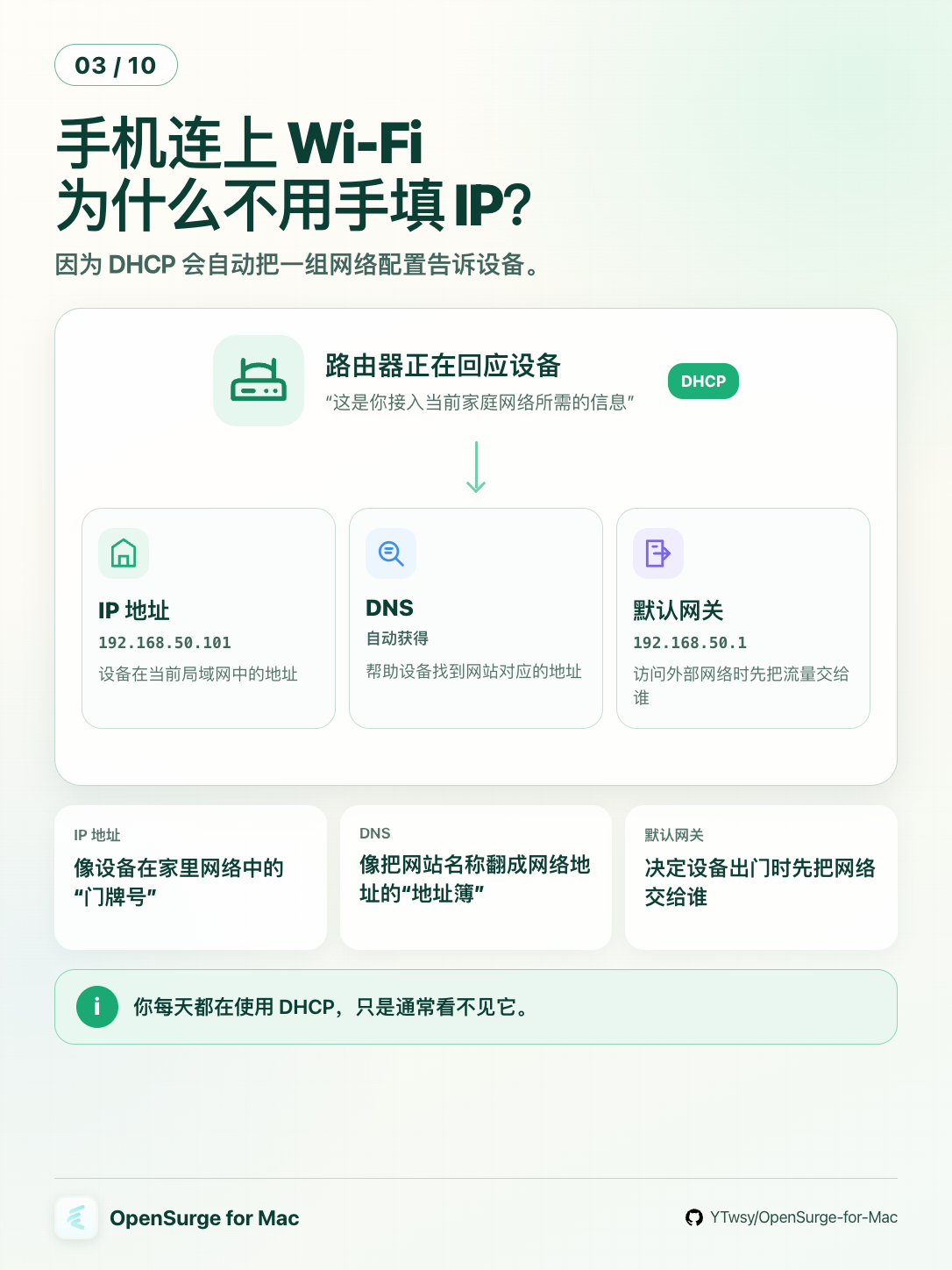
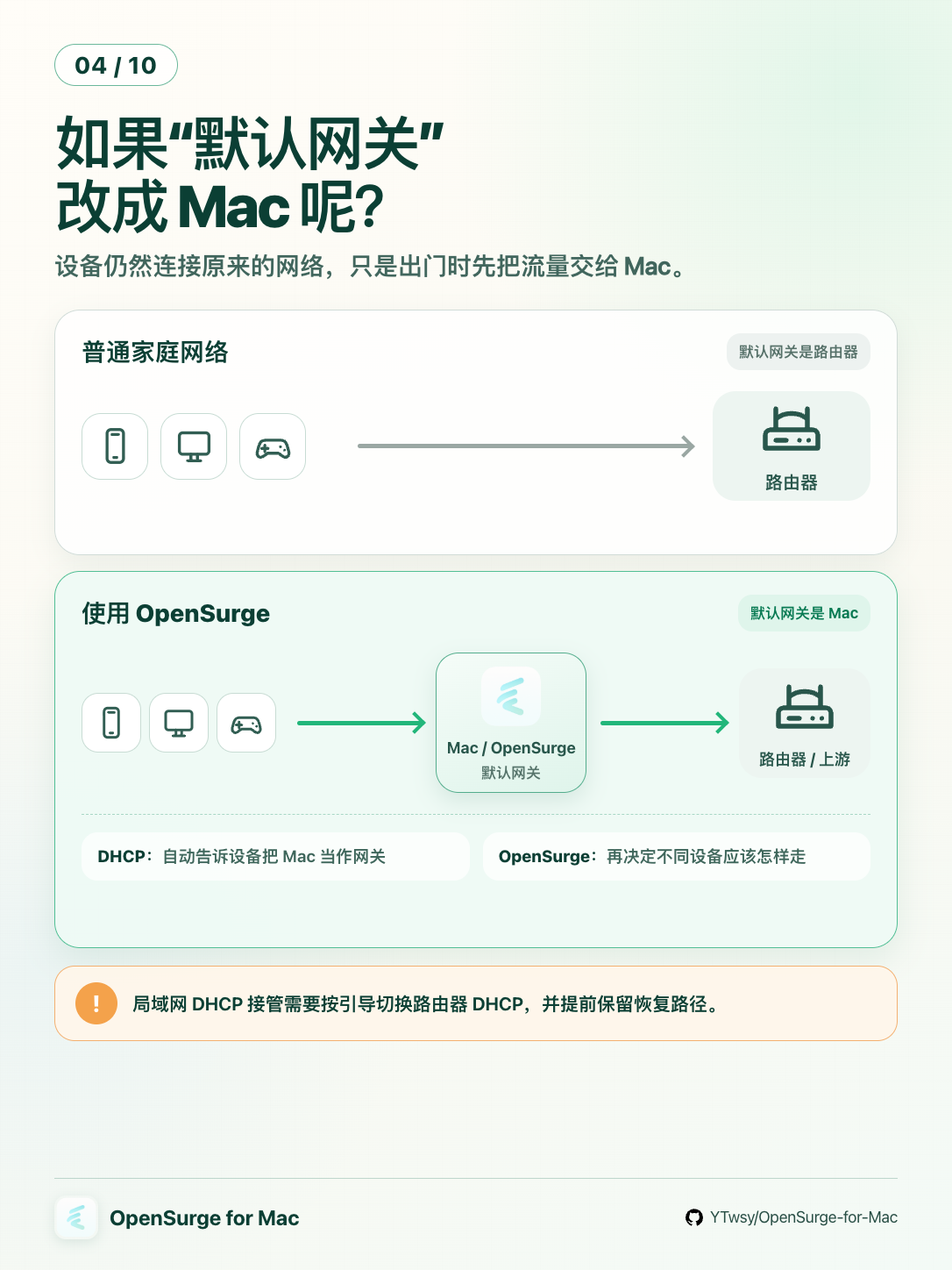
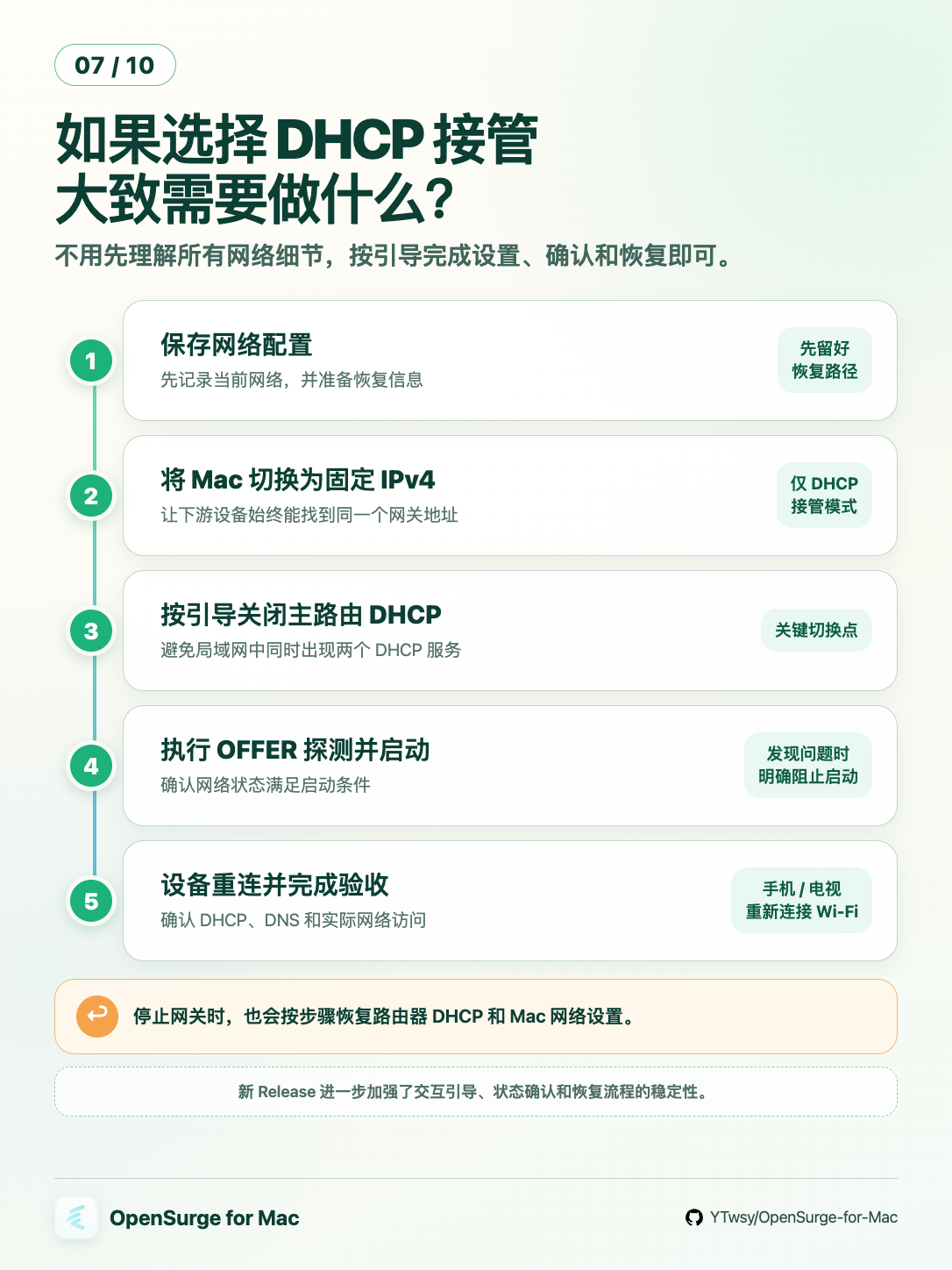
The concrete problem it solves is the friction of routing individual devices. Rather than editing gateway and DNS settings on every phone, television, console or headset, an operator registers devices once and lets OpenSurge hand out DHCP and DNS automatically in LAN DHCP takeover mode or from an independent downstream LAN, or keeps the main router in charge and points only chosen devices at the Mac in bypass-router mode. In DHCP takeover it takes over the DHCP/DNS role the main router would otherwise fill.
mixed-port.SRC-IP-CIDR rules, with device-specific REJECT actions and overrides by domain, IP, protocol, port or rule provider.status, doctor, logs and snapshot output.The README points to the macOS app distributed from the project site at opensurge.pages.dev, where it installs as /Applications/OpenSurge.app and reopening it expands the same status panel as the menu bar icon. First-time setup and the three network modes are covered in the project guides, including docs/app-user-guide.zh-CN.md.
No list of paid products is provided in the facts, so the honest framing is that OpenSurge sits on top of tools it does not replace: mihomo remains the proxy engine, dnsmasq provides DHCP and DNS, and Tailscale or Headscale supply remote outbound connectivity. Its role is the orchestration layer those tools lack on macOS — mode selection, per-device policy, rollback and observability around them.
A self-hoster must run a Mac as an always-on gateway and operate dnsmasq, mihomo, pf NAT and IPv4 forwarding together; in DHCP takeover mode, anything that stops serving DHCP and DNS can cut the LAN off from both. Anyone unwilling to accept that risk, or not running macOS, should look elsewhere, and the keep-awake toggle that prevents sleep is off by default and lasts only for the current run, so a laptop that closes its lid can drop the gateway. IPv6 takeover is explicitly experimental, and much of the documentation, including docs/device-policy.zh-CN.md and docs/faq.zh-CN.md, is written in Simplified Chinese first.
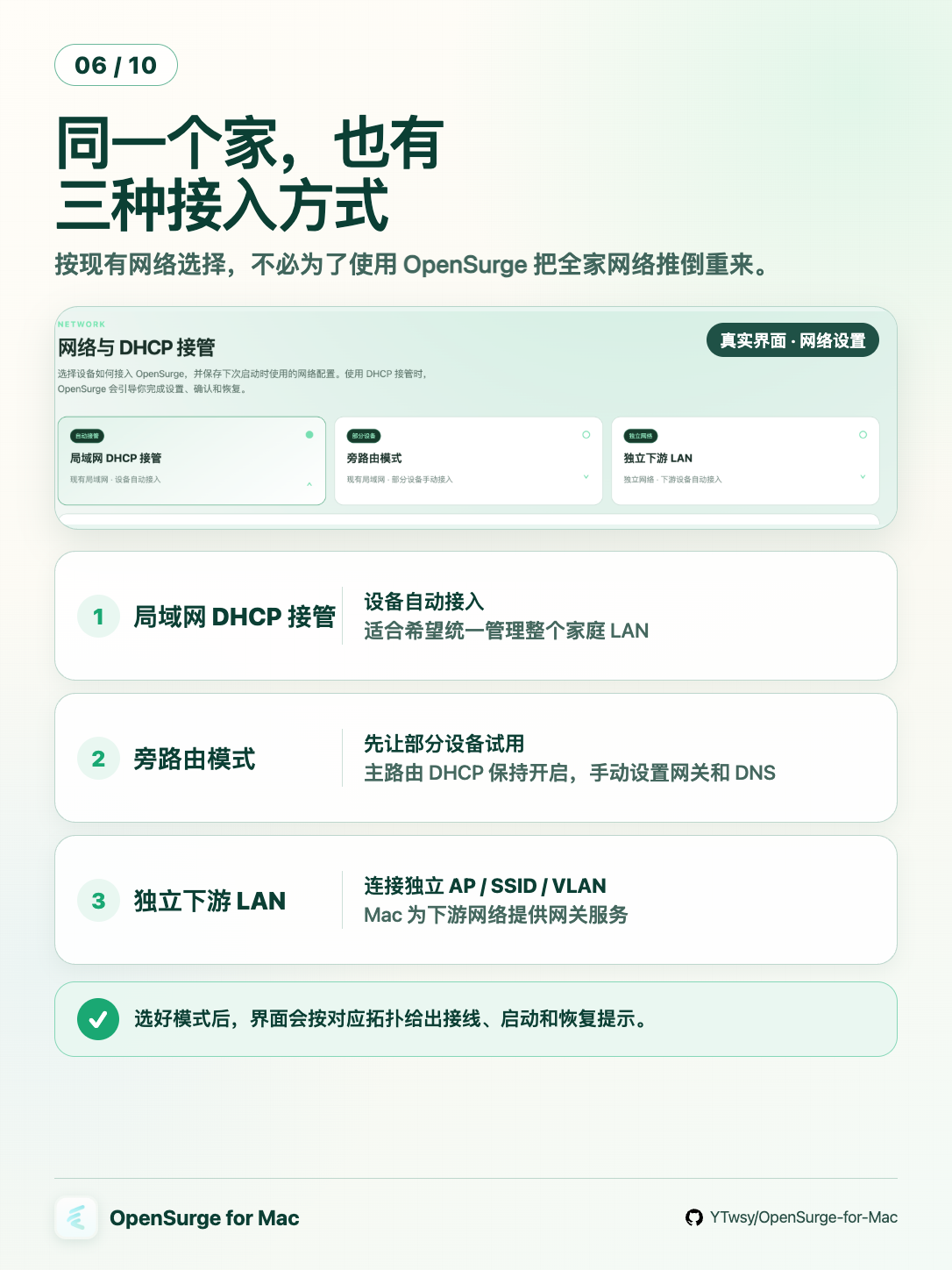
OpenSurge for Mac 是一个开源的 Surge 风格 macOS 网关与控制面。多数用户可以先从 旁路由模式开始:主路由 DHCP 保持开启,只让需要接入的设备使用稳定 IPv4,并把网关和 DNS 指向 Mac。需要让同一局域网的设备自动接入时,也可以选择局域网 DHCP 接管;有独立 AP、SSID 或 VLAN 时,则可以使用独立下游 LAN。三种模式均可按需启用实验性的 IPv6 接管。
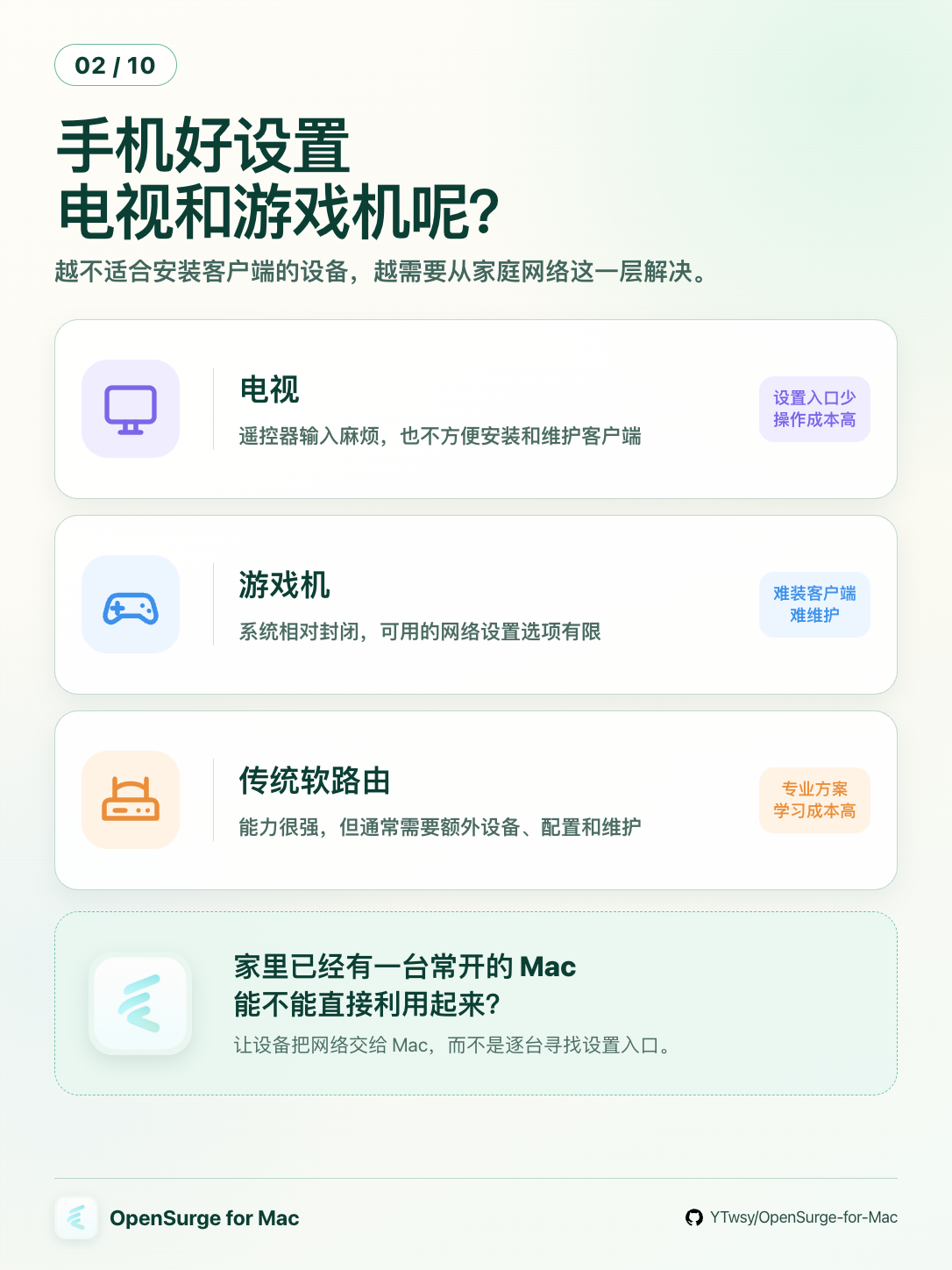
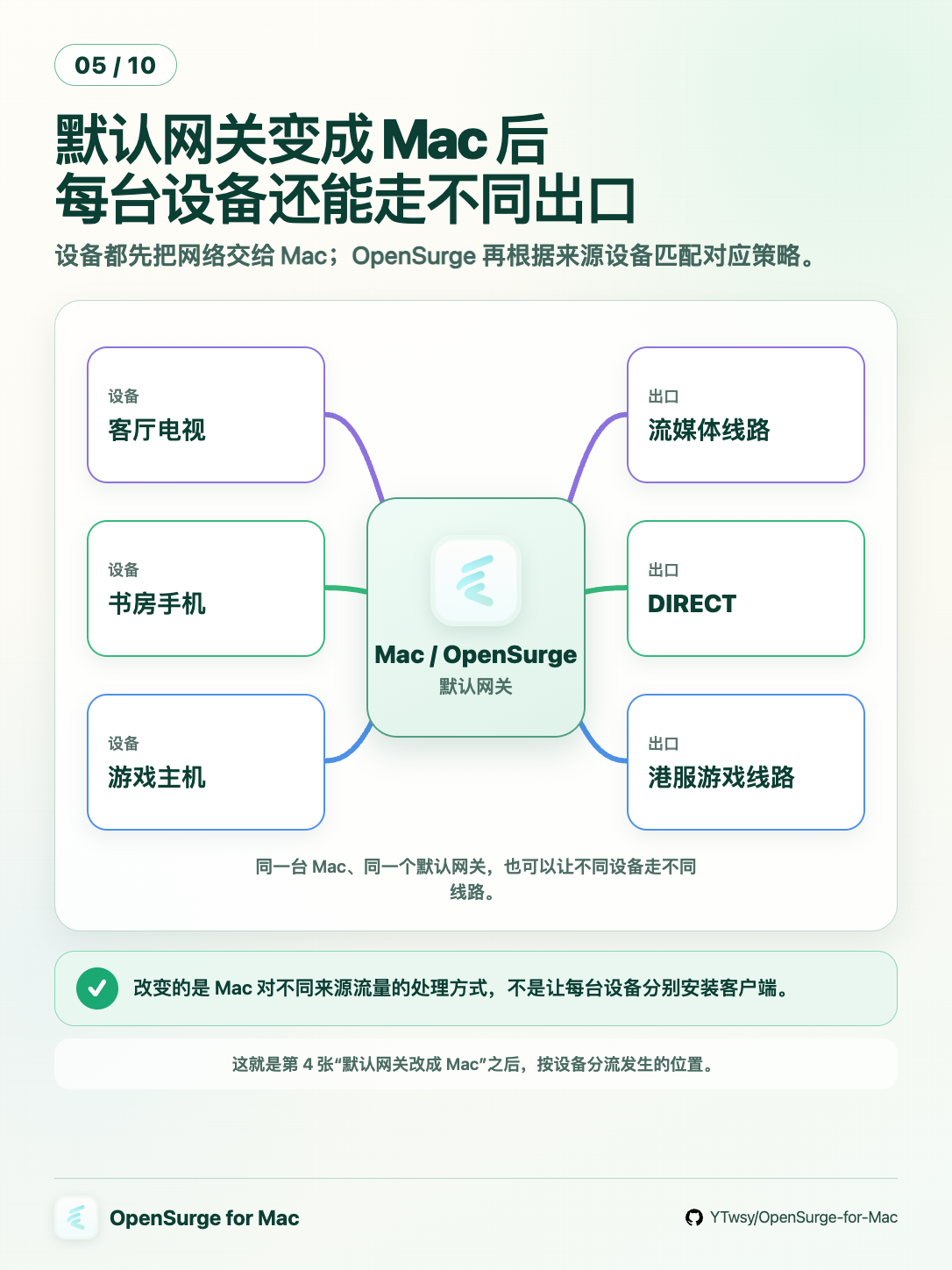
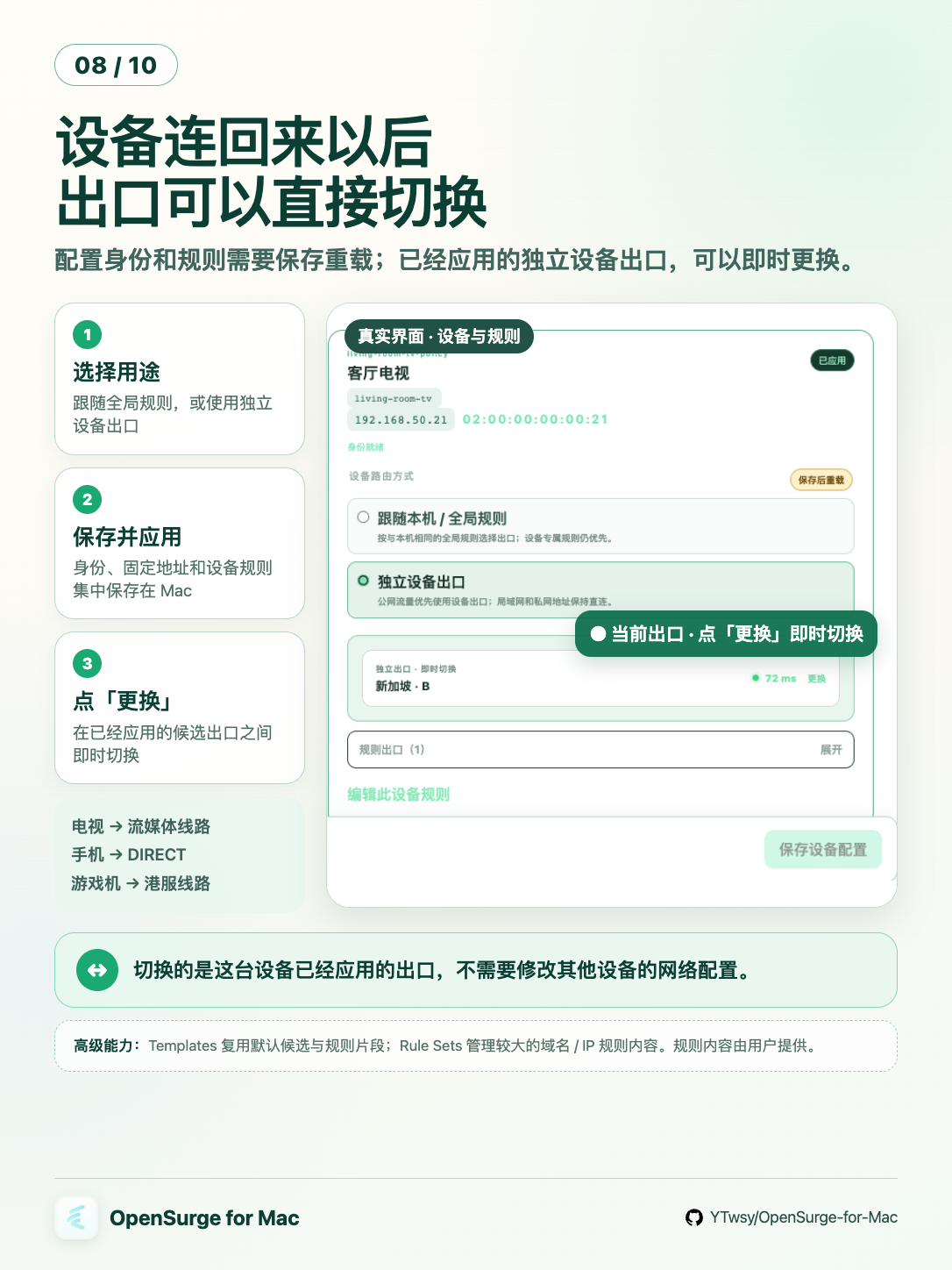
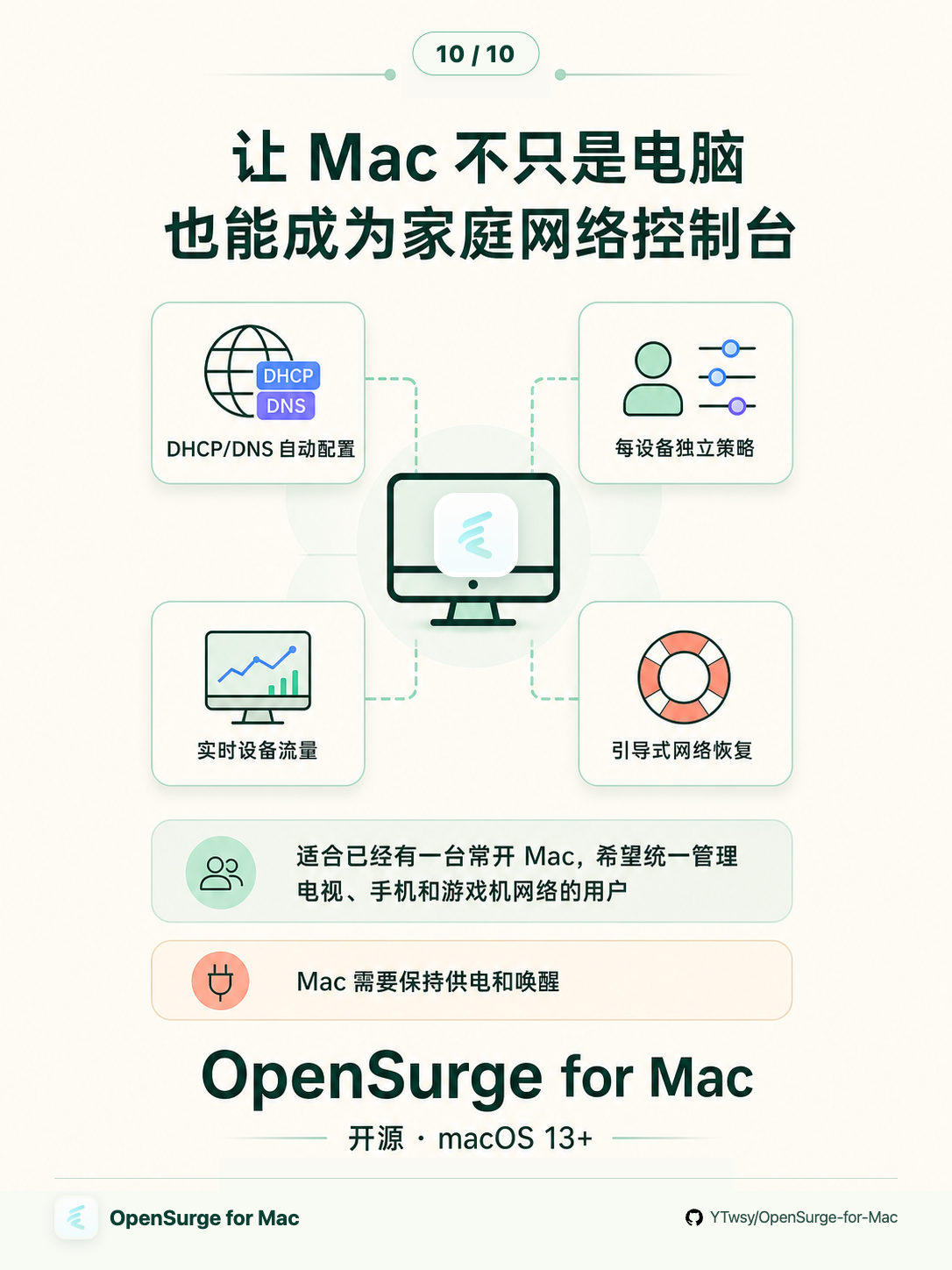
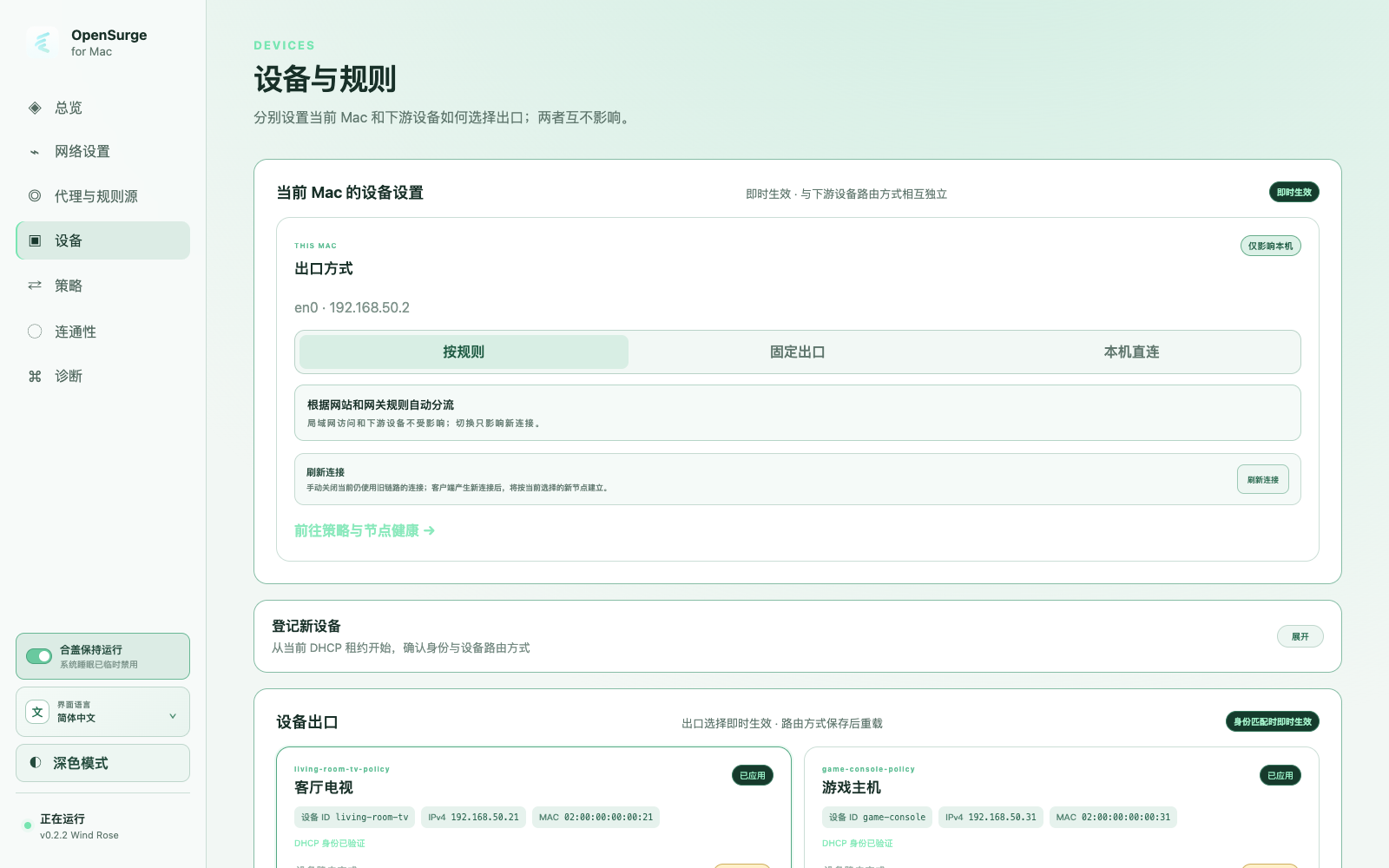
无论采用哪种模式,你都可以为已登记设备配置不同的出口策略:手机和 Mac 一起走规则 分流、游戏机连美服、电视走流媒体节点。在局域网 DHCP 接管和独立下游 LAN 模式下, 接入相应网络的手机、电视、PS5 和 VR 设备,都可以自动从 Mac 获取 DHCP/DNS,无需逐台 修改网关和 DNS。
想了解 OpenSurge 的具体功能、安装配置和常见使用场景,请访问 OpenSurge 官网。
左右滚动查看完整图文。
| 模式 | 适合场景 | 对现有网络的影响 |
|---|---|---|
| 旁路由模式(常用,推荐首次体验) | 先接入手机、电视、游戏机等指定设备 | 主路由 DHCP 保持开启;指定设备使用稳定 IPv4,并手工设置网关和 DNS |
| 局域网 DHCP 接管(进阶 · 自动接入) | 希望同一 LAN 的设备自动使用 OpenSurge | 需要按引导关闭主路由 DHCP,停止时按恢复流程重新开启 |
| 独立下游 LAN | 独立 AP、SSID 或 VLAN | 不改变现有 LAN 的 DHCP;Mac 为独立下游网络提供 DHCP/DNS 和网关 |
底层由 dnsmasq 提供 DHCP/DNS,mihomo 作为代理引擎。IPv4 使用 macOS pf 与 forwarding 提供原生网关路径;实验性的下游 IPv6 则由 dnsmasq RA/SLAAC/RDNSS、 macOS BPF packet broker 和本项目补丁构建的 mihomo 用户态数据面共同接管。
这个仓库也被有意设计成一个 AI Agent 友好工作区:项目知识与代码一起版本化,高风险 网络行为有可执行的证据门槛,Virtual Lab 与真实设备产生的证据会回流到下一轮工程 循环。
友好的 App 体验
/Applications/OpenSurge.app 会直接展开与菜单栏图标相同的状态面板;第一次使用请参阅 OpenSurge for Mac App 使用指南。遇到常见 网络、TUN 或设备配置问题时,请参阅 常见问题。
网关与代理
mixed-port 提供显式代理;select 组,同时保留 Mac 全局出口和设备
出口候选;可观测性
安全与验证
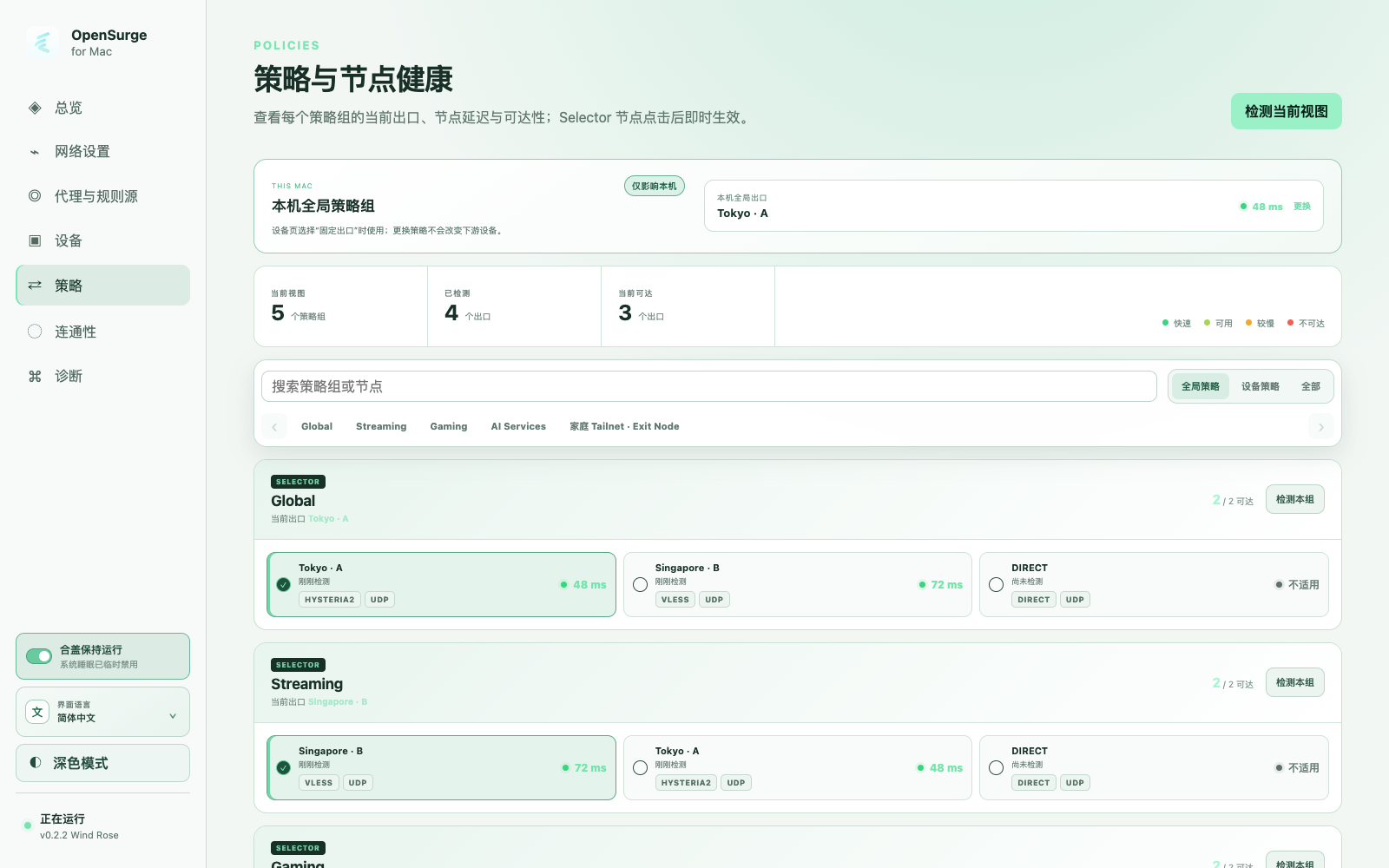
一个 mihomo 进程可以对已登记的 LAN 设备应用独立策略。DHCP 接管模式会为带 MAC 的设备
配置固定 IPv4 租约;旁路由模式只需主路由侧保持稳定的静态 IPv4,MAC 可留空,并可从
当前经过 Mac 的流量与 ARP 邻居观察辅助登记。切换到 DHCP 模式时,GUI 会要求确认当前
可观察到的 MAC;仍无 MAC 的登记会保留,但设备专属策略暂停,补全 MAC 后恢复。当前拓扑中
身份信息充分的设备会生成各自的 mihomo selector group 和 SRC-IP-CIDR 规则。安装版默认
启用每设备策略,Web GUI 始终保留该能力;JSON 策略文件让每台设备要么跟随网关规则,要么在
全局规则之前走设备专属 selector;它也支持 REJECT 这类设备专属动作,以及按
域名/IP/协议/端口/rule-provider 叠加的规则覆盖。dedicated 模式下,本地/私有目标
保持直连。Mac 本机的规则 / 全局 / 直连开关不改变这些下游规则;详见
Mac 本机流量模式。
Web GUI 的规则库把规则集、不带出口的分流模版和每台设备的命中出口分开管理。 其中提供一份可查看的 Claude Code 社区规则示例,但不会默认应用到任何设备;其他策略内容由操作者提供,空 starter 文件也是合法配置。JSON 模型、优先级、CLI 命令和验证边界见 每设备策略覆盖。
Web GUI 的“代理与规则源”页面可以管理一个 OpenSurge 托管的 Tailscale
outbound。Auth Key 只写入权限受限的独立文件,配置和 API 响应不会回显;
本地 state-dir 保留节点身份,所以停用后再启用不需创建新设备。“忘记本地
身份”是单独动作,只能在 Tailscale 已停用且网关已停止时执行;它不会从
Tailscale / Headscale 管理后台删除节点。
卡片内的折叠设置会只读检测本机 Tailscale App,把当前 Tailnet 的 MagicDNS 后缀、peer
精确地址、在线状态、已接受的私网路由和可用 Exit Node 显示为待确认建议;不会
自动保存或扩大访问范围。成功发现会保存不含密钥的受限缓存;本机 App 断开后仍可
继续配置,界面会标明信息来源和检测/缓存时间,不把快照描述成实时状态。若本机
Tailscale App 已通过自己的 utun 接管同一条
子网路由,界面会在运行中网关重载前指出具体路由和接口,并要求先关闭 App 的
“接受子网路由”或断开连接;OpenSurge 不会自动修改另一个 App。首次注册仍需要
单独的 Auth Key,界面可直接打开官方 Keys 页面,并提示使用一次性、非 Ephemeral
的 key。本机 App 与 OpenSurge 托管
节点不共享登录身份或 state;检测失败时仍可使用折叠的高级手动配置。
Tailnet 访问和 Exit Node 是两种不同角色:
DIRECT;open-surge/tailscale-exit 独立策略组;
它会成为 Mac 全局出口、每设备 Selector,以及所有用户定义手动 type: select 组的
可选成员,但不会加入自动测速/故障转移/负载均衡组;generate_204 误判 Tailnet-only 节点。当前边界是 outbound-only:OpenSurge 不向 Tailnet 发布本地 LAN,也不用这个节点 提供入站服务。
通过安装包使用 OpenSurge 时,请从 OpenSurge for Mac App 使用指南开始。
本地 Control API、React Web GUI 和以状态展示为主的 SwiftUI 菜单栏 launcher 已进入仓库。开发构建:
make web-install
make control-build
./bin/opensurge-control --config examples/config.example.yaml
make menubar-build
控制服务只监听 127.0.0.1,启动时会输出一次性 Web GUI 链接。菜单栏 App 显示
状态、恢复警报并打开 Web GUI;除独立的临时合盖运行开关外,不提供网关 start/stop 或
策略切换。它区分“只退出菜单栏
App”和“退出 OpenSurge”:后者只在网关数据面已经停止时退出菜单栏 App 与用户级
Control Service;系统 launchd 托管的 root Helper 保持空闲加载,下次打开无需再次授权。
菜单栏还提供独立的“卸载 OpenSurge”入口:只要网关已经停止即可通过 macOS 管理员授权
移除 App、Control Service 与 root Helper,并可选择保留配置数据供以后重新安装或彻底删除。
架构、安全边界与构建说明见 Web GUI 与菜单栏 App。
Web GUI 内置 applied 配置 + 当前 Mac 本机模式的连通性页面,并提供 Net.Coffee 的
独立浏览器本机检测入口;两者都不会被描述成下游设备网关规则或 DHCP/DNS/TUN 路径
已经验收。
make gui-installer 会在取得真实 mihomo、dnsmasq 二进制后构建 macOS 安装包。
Developer ID 签名和 notarization 必须显式提供发布凭据。
readme truncated — read the full docs on github
OpenSurge-for-Mac is open source under the GPL-3.0 licence. There is no licence fee and no seat count — you can self-host it or, where the project offers one, pay a vendor for a managed version instead.
Surge-style whole-home gateway and control plane for macOS with IPv4/IPv6 support— mihomo TUN, dnsmasq-powered DHCP/DNS, per-device routing, and an agent-friend
OpenSurge-for-Mac is primarily written in Go. Its source is publicly available at https://github.com/YTwsy/OpenSurge-for-Mac, and it has 2,367 GitHub stars.