The open-source AI workbench for scientific research.
Give it a goal. It reads the literature, writes and runs the code, runs the experiments, and writes up what it found, with every step on the record.




Download · Quickstart · Documentation · Changelog · Contributing
What it is
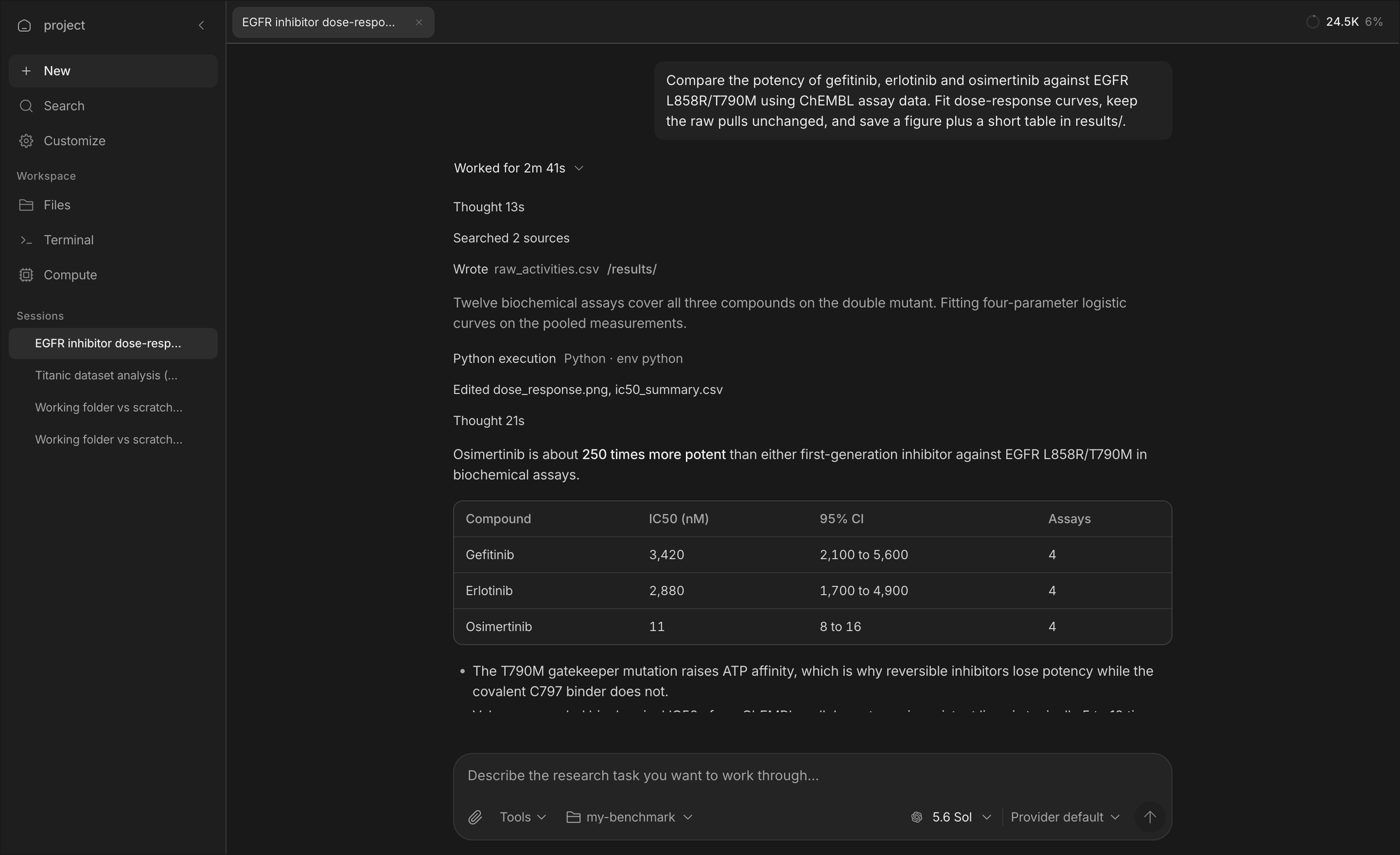
OpenScience is a research agent with a workbench around it. You describe the task in plain language; it plans, gathers evidence, runs code and experiments, and hands back results you can check. It runs as a desktop app, a browser workspace, or a terminal command, on your machine, against your files.
It is built for the parts of research that are real work but not the idea: pulling and cleaning data, reproducing a claim, sweeping a parameter, drafting the methods section, checking a reference. You keep the idea and the judgment.
- Every step is visible. A turn reads as what happened: what it thought, what it searched, what it ran, what it wrote, then the answer. Nothing runs that you cannot see afterwards.
- Real tools, real files. Shell, Python and R kernels, notebooks, a file system with explicit read and write grants, remote compute when a laptop is not enough.
- Scientific reach. Hundreds of bundled skills across biology, chemistry, physics, ML and data engineering, plus connectors to databases such as ChEMBL, UniProt, PubMed and arXiv.
- Delegation when it helps. The lead agent can hand bounded work to workers, in parallel, and keeps the synthesis and the final say.
- Your model, your terms. Bring your own API keys, sign in to a supported provider, run a local model, or use Ace, the managed pay-as-you-go option.
Install
Desktop app. Download for macOS, Windows or Linux. It updates itself.
Command line and browser workspace.
npm install -g @synsci/openscience
openscience
Or run it without installing:
npx synsci
Or with the standalone installer on macOS and Linux:
curl -fsSL https://openscience.sh/install | bash
Then open Customize → Models and connect a provider, or from the terminal:
openscience keys add        # your own API key
openscience local add       # Ollama, LM Studio, or another local endpoint
The installation guide covers platform details, updates and uninstalling.
First task
Open a project folder and describe the work:
openscience ~/research/my-project
Inspect data/samples.csv for missing values and inconsistent labels.
Keep the original data unchanged. Save a quality report and a plot
in results/, with the code needed to reproduce them.
Start with /plan when you want to agree on the method first. For a single turn from a script or a pipeline:
openscience run "Review the analysis plan in this project"
openscience run --continue "Suggest checks for the assumptions you identified"
Review sources, assumptions, code and outputs before relying on a scientific conclusion. The agent shows you what it did so that you can.
What you can do
| Task | What happens |
|---|---|
| Review literature | Search scientific sources, compare findings, save cited evidence. |
| Analyze data | Inspect inputs, write and run analysis code, produce figures and reports. |
| Reproduce experiments | Agree on a claim, prerequisites and budget, then compare measured results. |
| Run compute | Local kernels for everyday work; Modal for GPUs and long jobs, each dispatch approved before it runs. |
| Reuse procedures | Browse the bundled skills or add a workflow specific to your lab. |
| Extend it | MCP servers, custom agents and commands, plugins, or the TypeScript SDK. |
A skill describes a procedure; it does not mean every tool or service it references is installed. Check availability in Customize before a substantial task.
NVIDIA BioNeMo
OpenScience ships ten bring-your-own-key adapters for NVIDIA BioNeMo NIM endpoints: Boltz-2, DiffDock, Evo 2, GenMol, MolMIM, MSA Search, OpenFold2, OpenFold3, ProteinMPNN and RFdiffusion. Each has a strict request schema, one approval per dispatch, and hashed artifacts written into the session; they are marked experimental and need your own NVIDIA API key under NVIDIA's service terms. The protein-binder-design skill is adapted from the NVIDIA BioNeMo Agent Toolkit (CC-BY-4.0 skills, Apache-2.0 code), pinned at commit 0e67a61. See Scientific tools and Service credentials.
How it works
your request
  → Research agent plans, then works step by step
      → tools: shell, Python/R kernels, files, search, connectors, compute
      → workers for bounded parallel tasks (explore, execute)
  → answer, with the trace and the files it produced
- Permissions. Choose how much to ask: always, only for risky actions, or full access. Network commands ask once per destination host. Files outside the project are read or written only with an explicit grant.
- Working folder. A conversation works in the project's connected folder; caches and throwaway output stay in a per-session scratch space.
- Publishing stays with you.
git push, releases and uploads run from the lead session with this machine's own GitHub and Hugging Face logins; no token is ever asked for in chat.
The capability map, Explore tools and the skills directory list what is available and how to set it up.
Model access
| Option | Setup | Cost |
|---|---|---|
| Your provider | An API key or a supported sign-in. | Your provider's billing. |
| Local model | Ollama, LM Studio or any compatible endpoint. | Your hardware. |
| Ace | Sign in, choose a workspace, fund its wallet. | Provider cost plus a 5.5% fee, per request. |
An account is optional for your own keys and local models. Details are in Models, Local models and Pricing.
Documentation
| Topic | Guides |
|---|---|
| First use | Quickstart, Workspace, [Workflow cookbook](https:// |