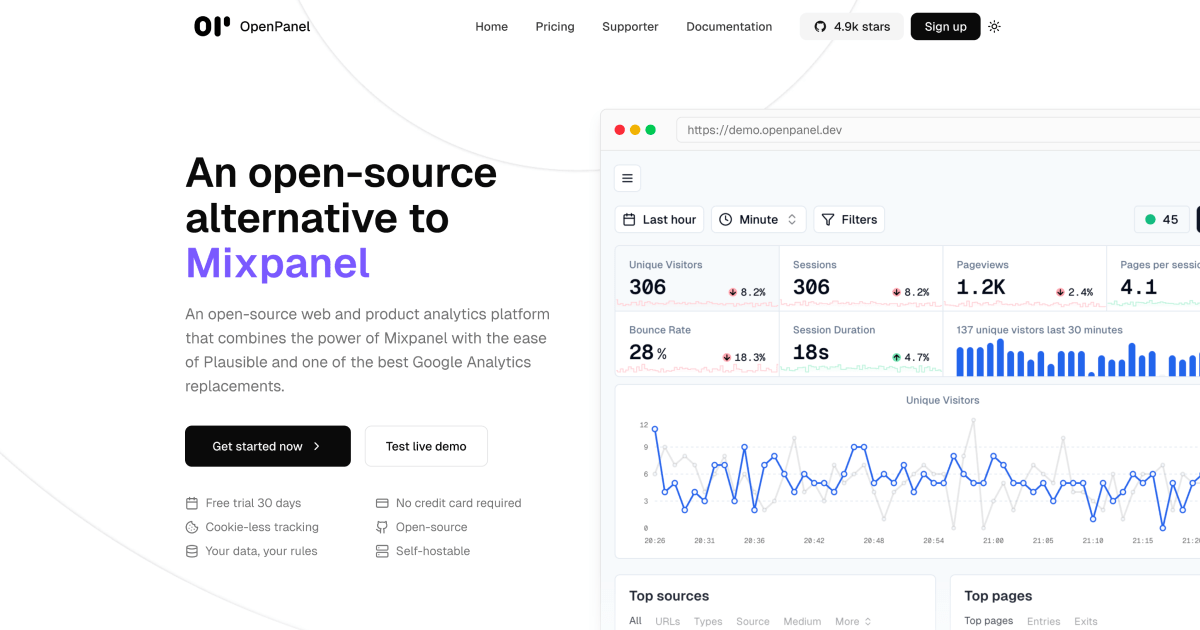
openpanel is a free, open source miscellaneous project written in TypeScript and released under AGPL-3.0. It has 6,985 GitHub stars, 480 forks and 49 open issues, and was last pushed 14 days ago. On this registry it ranks #10 of 25 tracked projects in Miscellaneous, with 5 head-to-head comparisons available. It gained 64 stars over the last 6 tracked days.

What is openpanel?

OpenPanel is an open-source web and product analytics platform written in TypeScript and licensed under AGPL-3.0, built for product teams and developers who want Mixpanel-style funnels, cohorts, and session replay while keeping their event data on their own infrastructure.

What it is

OpenPanel is a self-hostable web and product analytics platform that combines event tracking, funnel and cohort analysis, user profiles, session history, and session replay in one system. It lives in the TypeScript ecosystem: the dashboard is a Next.js application, the event ingestion API is a Fastify service, and the internal API layer is exposed over tRPC with Tailwind and Shadcn for styling. Events are stored in ClickHouse, while Postgres holds the basic relational data, Redis serves as the cache, pub/sub, and queue layer, and BullMQ and GroupMQ handle background and grouped job processing. Email is delivered through Resend, with Arctic and Oslo handling OAuth and authentication.

The concrete thing it replaces is Mixpanel, along with GA4 for teams that need raw event access without the BigQuery dependency. Mixpanel is closed source and cannot be self-hosted, and GA4 has no self-hosting path and no cookieless mode by default, which has led to GDPR enforcement actions in several EU countries over data transfers to US-based servers. OpenPanel keeps cookieless tracking as the default, ships under the AGPL-3.0, and gives the operator full control over the database and infrastructure, so the question of where user data lives is answered by deployment rather than by a vendor's terms. It also carries an MCP server with 38 hosted tools, so Claude, Cursor, or any other MCP client can query user data without a local install.

Key capabilities

  • Funnels, cohorts, user profiles, and full session history for tracked users, with real-time dashboards that update live.
  • Session replay with privacy controls built into the recording pipeline.
  • A/B testing with variant testing and per-variant breakdowns.
  • Event-based and funnel-based smart notifications, so alerting is tied to product behaviour rather than to raw traffic.
  • Cookieless tracking and GDPR-compliant collection by default.
  • Revenue tracking that monitors purchases, subscriptions, and LTV alongside product events.
  • SDKs covering Web, Swift, Kotlin, and ReactNative, plus API access for server-side tracking and integrations such as Google Search Console.

Who uses it and how

  • Product teams that need Mixpanel-class funnel and cohort work but cannot send event data to a third-party SaaS, including teams under EU data-residency constraints.
  • Growth and experimentation groups running A/B tests and reading variant breakdowns from the same dashboards that hold their funnel data.
  • Engineering teams instrumenting multiple surfaces at once: web, iOS, Android, and server-side events feeding one event API.
  • Privacy-conscious operators replacing GA4 without accepting the BigQuery path for raw data access, using cookieless tracking as the default collection mode.
  • Support and analytics staff who want session replay tied to identified user profiles and session history, rather than a separate replay vendor.

Getting started

Self-hosting requires Docker, Docker Compose, Node, and pnpm; the development flow is pnpm install, copy .env.example to .env, set API_URL=http://localhost:3333 in apps/start/.env, then pnpm dock:up, pnpm codegen, pnpm migrate:deploy once to set up the database, and pnpm dev. The dashboard then runs at https://localhost:3000, the API at https://api.localhost:3333, and Bullboard at http://localhost:9999, with pnpm dock:ch and pnpm dock:redis opening ClickHouse and Redis terminals. Hosted self-hosting instructions are published at https://openpanel.dev/docs/self-hosting/self-hosting.

How it compares

Mixpanel, the product it is written as an alternative to, is closed source with no self-hosting option, and its session replay is capped at 5k sessions per month on the free tier and 20k on paid, whereas OpenPanel imposes no session replay limit. GA4 offers no self-hosting and no cookieless default, and raw data access in practice often requires a paid BigQuery setup, while some EU deployments have faced GDPR bans. Plausible is also open source and self-hostable, but its goal tracking is simpler, and it lacks user profiles, session history, custom dashboards, session replay, and event and funnel notifications — all of which OpenPanel provides under the AGPL-3.0 with no usage limits in the licence itself.

When to use it — and when not to

A self-hoster has to operate a real stack: Postgres, ClickHouse, Redis, a queue layer through BullMQ and GroupMQ, and Resend for email, which is materially more operational surface than a single-container analytics tool. Teams without anyone comfortable running ClickHouse and Redis in production, or teams that want a zero-maintenance managed analytics service and have no data-residency reason to leave one, should not pick this up. The project also carries 49 open issues at the time of writing, so prospective adopters should check the issue tracker against their own requirements before committing; the AGPL-3.0 is a copyleft licence that affects how modified versions may be distributed.

project readme (upstream, from github) — read inline

hero

Openpanel

An open-source alternative to Mixpanel

Website · Docs · Sign in · Discord · X/Twitter · Creator ·


Openpanel is an open-source web and product analytics platform that combines the power of Mixpanel with the ease of Plausible and one of the best Google Analytics replacements.

✨ Features

  • 🔍 Advanced Analytics: Funnels, cohorts, user profiles, and session history
  • 🎬 Session Replay: Record and replay user sessions with privacy controls built in
  • 📊 Real-time Dashboards: Live data updates and interactive charts
  • 🎯 A/B Testing: Built-in variant testing with detailed breakdowns
  • 🔔 Smart Notifications: Event and funnel-based alerts
  • 🌍 Privacy-First: Cookieless tracking and GDPR compliance
  • 🚀 Developer-Friendly: Comprehensive SDKs and API access
  • 📦 Self-Hosted: Full control over your data and infrastructure
  • 💸 Transparent Pricing: No hidden costs or usage limits
  • 🛠️ Custom Dashboards: Flexible chart creation and data visualization
  • 📱 Multi-Platform: Web, mobile (iOS/Android), and server-side tracking
  • 🤖 MCP Server: Ask Claude, Cursor, or any MCP client about your users — 38 tools, hosted, no install
  • 💰 Revenue Tracking: Monitor purchases, subscriptions, and LTV alongside product events
  • 🔌 Integrations: Connect Google Search Console, and more to enrich your data

📊 Analytics Platform Comparison

Feature OpenPanel Mixpanel GA4 Plausible
✅ Open-source
🧩 Self-hosting supported
🔒 Cookieless by default
🔁 Real-time dashboards
🔍 Funnels & cohort analysis ✅* ✅***
👤 User profiles & session history
🎬 Session replay ✅****
📈 Custom dashboards & charts
💬 Event & funnel notifications
🌍 GDPR-compliant tracking ❌**
📦 SDKs (Web, Swift, Kotlin, ReactNative)
💸 Transparent pricing ✅*
🚀 Built for developers
🔧 A/B testing & variant breakdowns

✅* GA4 has a free tier but often requires BigQuery (paid) for raw data access. ❌** GA4 has faced GDPR bans in several EU countries due to data transfers to US-based servers. ✅*** Plausible has simple goals ✅**** Mixpanel session replay is limited to 5k sessions/month on free and 20k on paid. OpenPanel has no limit.

Stack

  • Nextjs - the dashboard
  • Fastify - event api
  • Postgres - storing basic information
  • Clickhouse - storing events
  • Redis - cache layer, pub/sub and queue
  • BullMQ - queue
  • GroupMQ - for grouped queue
  • Resend - email
  • Arctic - oauth
  • Oslo - auth
  • tRPC - api
  • Tailwind - styling
  • Shadcn - ui

Self-hosting

OpenPanel can be self-hosted and we have tried to make it as simple as possible.

You can find the how to here

Give us a star if you like it!

Star History Chart

Development

Prerequisites

  • Docker
  • Docker Compose
  • Node
  • pnpm

Start

pnpm install
cp .env.example .env
echo "API_URL=http://localhost:3333" > apps/start/.env

pnpm dock:up
pnpm codegen
pnpm migrate:deploy # once to setup the db
pnpm dev

You can now access the following:

Frequently asked questions

Is openpanel free to use?

openpanel is open source under the AGPL-3.0 licence. There is no licence fee and no seat count — you can self-host it or, where the project offers one, pay a vendor for a managed version instead.

What does openpanel do?

OpenPanel is an open-source web and product analytics platform, an open-source alternative to Mixpanel with optional self-hosting.

What is openpanel written in?

openpanel is primarily written in TypeScript. Its source is publicly available at https://github.com/openpanel-dev/openpanel, and it has 6,985 GitHub stars.