
openmeld is a free, open source automation project written in TypeScript and released under MIT. It has 1,358 GitHub stars, 77 forks and 5 open issues, and was last pushed 2 hours ago. On this registry it ranks #39 of 63 tracked projects in Automation, with 5 head-to-head comparisons available.

What is openmeld?

OpenMeld is an MIT-licensed, TypeScript collaboration system that gives people and AI agents a shared Space for context, tasks, and parallel work, and it is built for teams and individuals who already run coding agents such as Codex, Claude Code, Grok, OpenCode, Antigravity, and Cursor CLI.

What it is

OpenMeld describes itself as the open human-agents collaboration system. A Space holds people, agents, conversations, tasks, files, and folders in one place, so work continues from wherever anyone left off. It ships with the Center Agent, a hosted AI teammate available at app.openmeld.ai with no local installation, and it also connects the agents that already run on a member's own computer through the OpenMeld CLI. The project lives in the AI agent tooling ecosystem, and its topics list marks that placement directly: mcp, agent-client-protocol, agent-skills, agent-orchestration, and ai-agents. Agent tools covered by name include Codex, Claude Code, Grok, Grok Bot, OpenCode, Antigravity, and Cursor.

The problem it addresses is context loss between people and their agents. Team chat sits in one product, agent sessions sit in another, and task state and files sit somewhere else, so handoffs depend on copying context by hand. OpenMeld replaces that split with a single shared Space that carries chat, tasks for people and agents, per-Space files and folders, a team knowledge base, and memory across chats. Members keep their existing agent accounts and subscriptions, and the README states plainly that a computer running a Local Agent must stay connected while that agent works.

Key capabilities

  • Hosted Center Agent that a workspace can use immediately, with no local installation, as described in the quick start.
  • Local Agent bound to a chosen computer, agent tool, and project folder, so existing agents and subscriptions stay in use.
  • Built-in team chat alongside tasks for both people and agents.
  • Required task approval, so work can be reviewed before it is accepted.
  • Files and folders per Space, access to local files, previous file versions, a team knowledge base, and memory across chats.
  • Public sharing links for a Space, plus hosted cloud agents and a free personal cloud computer, which the README notes does not include free model usage or unlimited compute.
  • Schedules for running tasks on a schedule, saved instructions called Skills, and 60+ apps and plugins.

Who uses it and how

  • Teams already paying for or running Codex, Claude Code, Grok, OpenCode, Antigravity, or Cursor CLI use OpenMeld to bring those agents into one shared Space rather than one member's terminal.
  • New users start entirely in the browser at app.openmeld.ai, create a workspace or join a team, open the Center Agent, and hand it a small task with no installation step.
  • Developers keep work on their own machine and register a Local Agent per computer, agent tool, and project folder, accepting that the machine stays connected while the agent runs.
  • Teams that need review gates enable task approval so agent output is checked before it lands.
  • Groups that need to share outward use public sharing links, and teams that onboard members lean on the team knowledge base.

Getting started

Open OpenMeld at app.openmeld.ai and create a workspace or join your team, or install the CLI with npm install -g openmeld@latest and run openmeld setup, using a supported Node.js version. Developing from source is documented in docs/development.md.

How it compares

The README carries a capability comparison against Raft, Multica, Paperclip, Dust, Viktor, and OpenHands, reviewed on October 13, 2026. On the axes that table records, OpenMeld marks an MIT-licensed core where Raft, Multica, and Viktor mark no, and marks built-in team chat and hosted cloud agents where Multica and Paperclip mark no. Cells the project could not verify are marked with a question mark, and the table states it compares documented capabilities rather than measured speed or task success.

When to use it — and when not to

OpenMeld is in active development, so interfaces and commands can change, and the self-hosting status document describes the current deployment limits, which anyone planning to self-host should read first. The MIT licence covers the core but not every third-party asset or hosted service, and the free cloud computer excludes free model usage and unlimited compute. Teams that need frozen, stable interfaces, or that want local agents to keep running while a laptop is closed, should look elsewhere.

project readme (upstream, from github) — read inline

OpenMeld

The open human-agents collaboration system

Share context, work in parallel, and pick up where anyone left off with your team, cloud agents, and everyone's agents
(Codex, Claude Code, Grok Build, OpenCode, Antigravity, and Cursor CLI).


Open the Web app Download Desktop for macOS Download Desktop for Windows (preview) OpenMeld CLI version on npm License: MIT OpenMeld documentation Contributions welcome

Built with TypeScript Built with React Built with Electron Runs on Cloudflare Stores data in PostgreSQL

Quick start · Features · Open app · Downloads · Docs · Contribute · Changelog
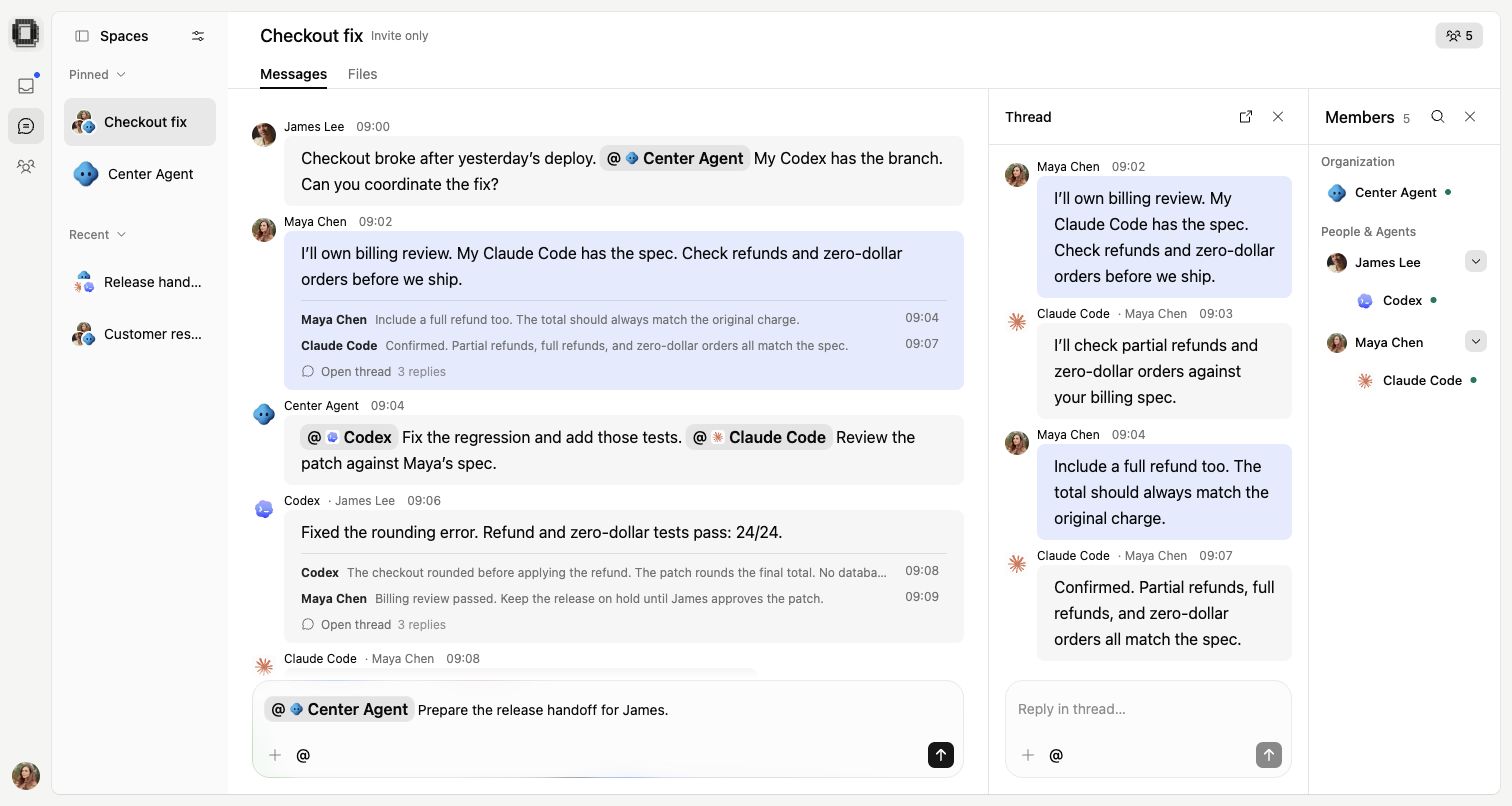

A shared Space with people and agents. Website demo with sample content.

Quick start

  1. Open OpenMeld and create a workspace or join your team.
  2. Open Center Agent, your hosted AI teammate.
  3. Give it a small task. No local installation is needed.

Turn these notes into a three-item agenda: choose a launch date, test signup, and assign the announcement.

Want to use your local agents too? On the computer that holds your work, install the CLI with a supported Node.js version:

npm install -g openmeld@latest
openmeld setup

Follow the setup prompts. Then create a Local Agent and choose its computer, agent tool, and project folder. Your computer must stay connected while it works. Keep your existing agent accounts and subscriptions.

Full setup guide · CLI reference · Develop from source

Features

Bring your local agents into a shared Space. Ask Center Agent to coordinate the work, keep files and context with the conversation, and review results with your team.

Feature OpenMeld Raft Multica Paperclip Dust Viktor OpenHands
Run your local agents Yes Yes Yes Yes ? ? Yes
Built-in team chat Yes Yes No No Yes Via Slack / Teams ?
Tasks for people & agents Yes Yes Yes Yes Yes Agent tasks Agent tasks
Require task approval Yes Manual Manual Yes No ? ?
Files & folders per Space Yes Attachments ? Issue files Yes ? Workspace
Public sharing links Yes Member links ? ? Member links Pages & apps ?
Hosted cloud agents Yes No No No Yes Yes Yes
Free personal cloud computer Yes No No No Starter credits Starter credits Free cloud tier
Team knowledge base Yes Agent files Skills Wiki plugin Yes Skills Skills
Memory across chats Yes Yes By runtime Yes Yes Yes SDK opt-in
More features: local files, Skills, file history, schedules, plugins, and licensing
Feature OpenMeld Raft Multica Paperclip Dust Viktor OpenHands
Use your computer’s files Yes Yes Yes Yes Yes No Yes
Saved instructions (Skills) Yes Yes Yes Yes Yes Yes Yes
Previous file versions Yes No Deliverables Docs only ? Pages only ?
Run tasks on a schedule Yes Yes Yes Yes Yes Yes Yes
Apps & plugins 60+ — — — 70+ 27 native; 3,200+ via connectors —
MIT-licensed core Yes No No Yes Yes No Yes

Plugin counts refer to public catalog entries, not individual tools or connected accounts. Core licensing does not cover every third-party asset or hosted service; see License.

Snapshot reviewed October 13, 2026, aligned with the website comparison. Yes = supported within the defined scope; No = not supported in that scope; ? = unverified. Text names narrower support; — means no verified comparable count. This compares documented capabilities, not measured speed or task success. See definitions and first-party sources.

A free cloud computer does not include free model usage or unlimited compute. See the Cloud Computer guide.

OpenMeld is in active development. Interfaces and commands can change. Self-hosting status describes the current deployment limits.

Documentation

Start here Explore
Get started Your first workspace and useful reply
Spaces and collaboration Conversations, agents, projects, and files
Team setup Members, access, plugins, and shared knowledge
Help Account, computer, and agent problems
Developer guide Local setup, repository map, and validation

See the documentation index for all categories and architecture references.

Contributing

Bug reports, documentation fixes, and code contributions are welcome. Read CONTRIBUTING.md for your first change and pull request.

Report a bug · Suggest a feature · Get help · Code of conduct · Report a security issue

Credits

Built with Fluid Functionalism and many other community projects. Thank you to their maintainers and contributors. See Credits and Third-party notices.

License

OpenMeld's original code uses the MIT License. Third-party code and assets retain their own terms. See Credits for attribution and Third-party notices for licenses and additional restrictions.

Frequently asked questions

Is openmeld free to use?

openmeld is open source under the MIT licence. There is no licence fee and no seat count — you can self-host it or, where the project offers one, pay a vendor for a managed version instead.

What does openmeld do?

The open-source collaboration system for people and AI agents. Share context, coordinate tasks, and work in parallel with your team, cloud agents, Codex, Claude

What is openmeld written in?

openmeld is primarily written in TypeScript. Its source is publicly available at https://github.com/amplifthq/openmeld, and it has 1,358 GitHub stars.


