
Give your AI assistant a persistent memory.
Stop repeating yourself. Start building smarter.
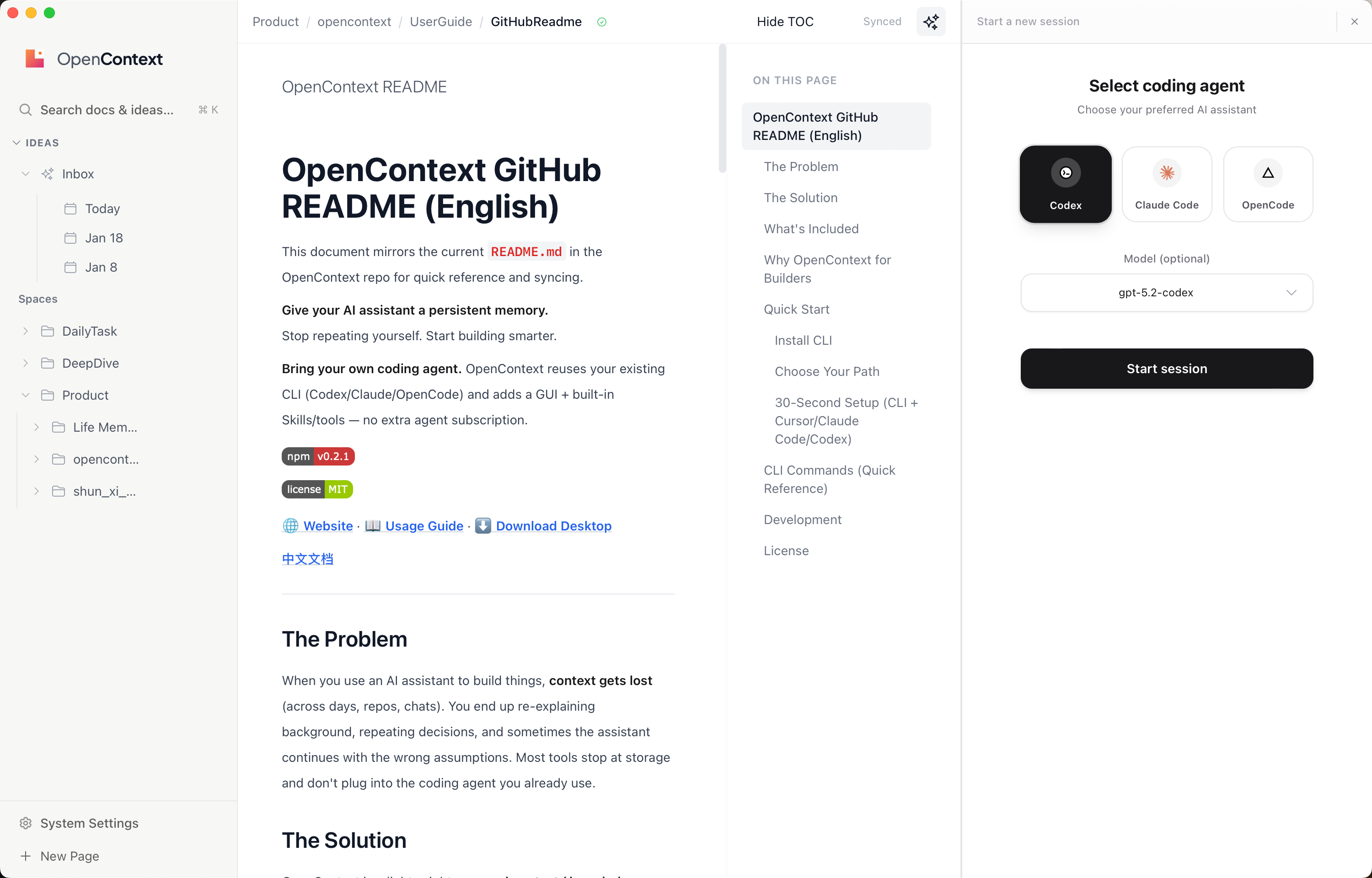
Bring your own coding agent. OpenContext reuses your existing CLI (Codex/Claude/OpenCode) and adds a GUI + built-in Skills/tools — no extra agent subscription.
|
|


🌐 Website · 📖 Usage Guide · ⬇️ Download Desktop
The Problem
When you use an AI assistant to build things, context gets lost (across days, repos, chats). You end up re-explaining background, repeating decisions, and sometimes the assistant continues with the wrong assumptions. Most tools stop at storage and don't plug into the coding agent you already use.
The Solution
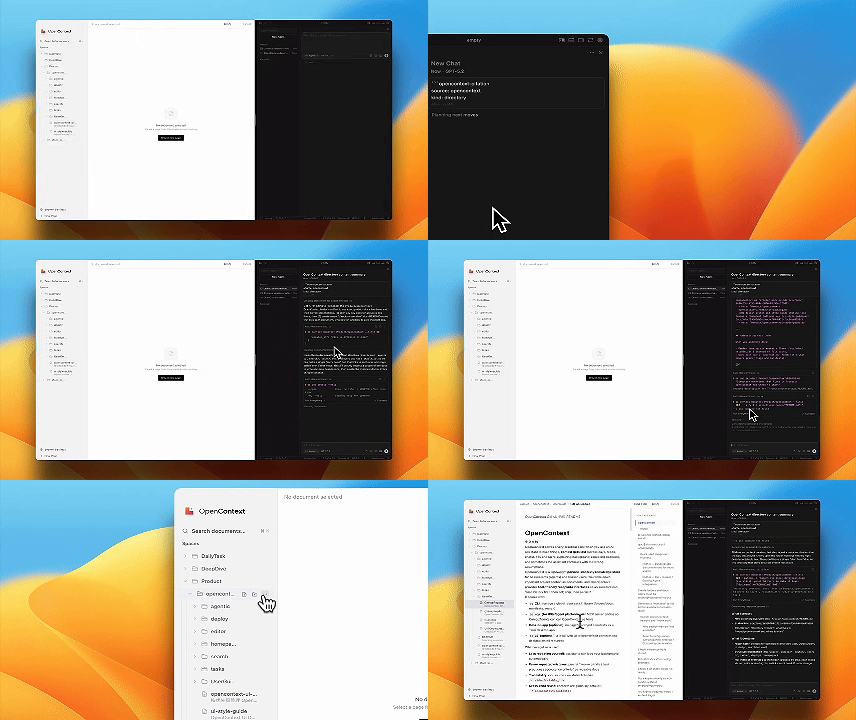
OpenContext is a lightweight personal context / knowledge store for AI assistants (Agents) and coding tools like Cursor / Claude Code / Codex. It reuses your existing coding agent CLI (Codex/Claude/OpenCode) while adding a GUI plus built-in Skills/tools, so your agent can "load history first, then act; ship, then persist".
Skills-first support: oc init generates user-level skills (Cursor/Claude Code/Codex) plus slash commands (Cursor/Claude Code), so agents can load, search, create, and iterate your context with one command.
| Before OpenContext | After OpenContext |
|---|---|
| 📂 Hard to share context across repos/sessions | ✅ Global context library works across all projects |
| 🤷 Your ideas can't be quickly perceived by Agent | ✅ Agent loads your background & decisions automatically |
| 🔒 Existing knowledge can't be operated by Coding Agent | ✅ Agent can directly read/write your knowledge base |
What's Included
ocCLI — manage a globalcontexts/library (folders/docs, manifests, search)- MCP Server — so Cursor/Claude Code/Codex/Agents can call OpenContext as tools
- Skills + Slash Commands — user-level skills for Cursor/Claude Code/Codex and slash commands for Cursor/Claude Code (generated by
oc init) - Agent-ready Knowledge Layer — reuse your existing coding agent CLI (Codex/Claude/OpenCode) with built-in skills/tools and GUI
- Desktop App — manage/search/edit contexts with a native UI
- Web UI — browse/edit contexts locally (no install required)
Why OpenContext for Builders
OpenContext's knowledge management Agent can be the coding agent you already use (Codex/Claude/OpenCode). You don't pay for a separate agent — you bring your own CLI and get a ready-to-use experience: a GUI for context management plus built-in Skills and tools that let the agent read, search, create, and iterate on your knowledge.
Quick Start
Install CLI
npm install -g @aicontextlab/cli
Choose Your Path
| Path | Best For | Get Started |
|---|---|---|
| 🖥️ Desktop App | Visual users who want a native UI | Download from Releases |
| ⌨️ CLI + Tools | Developers using Cursor/Claude Code/Codex/AI agents | npm install -g @aicontextlab/cli && oc init |
| 🔧 CLI Only | Power users, automation | npm install -g @aicontextlab/cli |
OpenContext works with the coding agent CLI you already have — it adds a GUI plus built-in Skills/tools instead of replacing your agent.
30-Second Setup (CLI + Cursor/Claude Code/Codex)
# 1. Install
npm install -g @aicontextlab/cli

# 2. Initialize (prompts for tool setup; defaults to all)
cd your-project
oc init

# 3. Use slash commands (Cursor + Claude Code)
#    /opencontext-context  — load background before working
#    /opencontext-search   — find relevant docs
#    /opencontext-create   — create a new doc
#    /opencontext-iterate  — persist what you learned
#    Tip: non-interactive installs can use --tools cursor,claude,codex or --no-claude/--no-cursor/--no-codex
#
#    Installed by oc init:
#    - Cursor: ~/.cursor/commands
#    - Claude Code: ~/.claude/commands (or $CLAUDE_CONFIG_DIR/commands)
#    Skills (wrapped from slash commands):
#    - Cursor: ~/.cursor/skills/opencontext-*/SKILL.md
#    - Claude Code: ~/.claude/skills/opencontext-*/SKILL.md (or $CLAUDE_CONFIG_DIR/skills)
#    - Codex: ~/.codex/skills/opencontext-*/SKILL.md (or $CODEX_HOME/skills)
#
# 4. MCP config is user-level (Cursor/Claude Code/Codex)
#    - Cursor: ~/.cursor/mcp.json
#    - Claude Code: ~/.claude/mcp.json (or $CLAUDE_CONFIG_DIR/mcp.json)
#    - Codex: ~/.codex/mcp.json (or $CODEX_HOME/mcp.json)
📖 For detailed usage guide, search configuration, and FAQ, visit the Website.
FAQ (Frequently Asked Questions)
What is OpenContext?
OpenContext is a lightweight personal context / knowledge store for AI assistants and coding tools like Cursor / Claude Code / Codex. It gives your AI agent a persistent memory so you can stop repeating yourself and start building smarter.
How does OpenContext work with my existing coding agent?
OpenContext reuses your existing coding agent CLI (Codex/Claude/OpenCode) while adding a GUI plus built-in Skills/tools. You don't pay for a separate agent subscription — you bring your own CLI and get a ready-to-use experience.
What are the core components?
| Component | Function |
|---|---|
oc CLI |
Manage global contexts/ library (folders/docs, manifests, search) |
| MCP Server | Cursor/Claude Code/Codex/Agents call OpenContext as tools |
| Skills + Slash Commands | User-level skills for Cursor/Claude Code/Codex + slash commands for Cursor/Claude Code |
| Desktop App | Manage/search/edit contexts with a native UI |
| Web UI | Browse/edit contexts locally (no install required) |
What coding agents are supported?
| Agent | Config Location |
|---|---|
| Cursor | ~/.cursor/mcp.json |
| Claude Code | ~/.claude/mcp.json |
| Codex | ~/.codex/mcp.json |
| OpenCode | ~/.config/opencode/ |
What are the key benefits?
| Before OpenContext | After OpenContext |
|---|---|
| 📂 Hard to share context across repos/sessions | ✅ Global context library works across all projects |
| 🤷 Your ideas can't be quickly perceived by Agent | ✅ Agent loads your background & decisions automatically |
| 🔒 Existing knowledge can't be operated by Coding Agent | ✅ Agent can directly read/write your knowledge base |
Is OpenContext free and open source?
Yes! OpenContext is free and open source. Check the repository for license details.
How do I get started?
npm install -g @aicontextlab/cli
oc init
This generates user-level skills and slash commands for your coding agent.
Where can I get help?
- 📖 Usage Guide
- 🌐 Website
- 💬 GitHub Issues
CLI Commands (Quick Reference)
Run oc --help for details.
| Command | What it does |
|---|---|
oc init |
Initialize OpenContext + user-level tool integrations |
oc folder ls |
List folders |
oc folder create -d "desc" |
Create a folder |
oc doc create .md -d "desc" |
Create a document |
oc doc ls |
List documents |
oc context manifest |
Generate file list for AI to read |
oc search "query" |
Search documents |
oc mcp |
Start MCP server for MCP clients |
oc ui |
Start local Web UI |
📖 Full command reference available on the Website.
Development
# Clone & install
git clone https://github.com/0xranx/OpenContext.git
cd OpenContext && npm install

# Desktop app
npm run tauri:dev    # development
npm run tauri:build  # production build

# Web UI
npm run ui:dev       # development
npm run ui:build     # production build
License
MIT © OpenContext