A complete, open-source developer platform for Kubernetes
OpenChoreo is a developer platform for Kubernetes that lets developers and AI agents build, deploy, and operate apps, resources, and agentic workloads. It provides development and platform abstractions, a Backstage-powered developer portal, CI/CD, GitOps, and observability.












Why OpenChoreo?
Kubernetes gives you powerful primitives like Namespaces, Deployments, CronJobs, Services, and NetworkPolicies, but they're too low-level for most developers. Platform engineers end up building the actual platform from scratch: defining higher-level abstractions, wiring together tools for delivery, security and observability, and maintaining all of it as an in-house product.
That means stitching together a developer portal, CI pipelines, GitOps workflows, an observability stack, and access controls and then owning the glue between them indefinitely. The result is a fragile, bespoke system that's expensive to maintain and hard to evolve.
Developers and platform engineers need different things from the same platform. Developers want a simple, self-service experience. Platform engineers want control over what's running underneath. Most DIY platforms end up optimizing for one side at the expense of the other.
What is OpenChoreo?
OpenChoreo, now a CNCF Sandbox project, takes a different approach. Instead of giving you a toolkit to assemble your own platform, it provides a complete, open-source developer platform for Kubernetes with abstractions that translate developer intent into platform reality. So platform engineers don't have to reinvent the wheel, and developers get a self-service experience that stays out of their way.
Under the hood, OpenChoreo brings together a Backstage-powered developer portal, built-in CI and GitOps, observability, RBAC, and analytics and all of them are organized across dedicated control, CI, data, and observability planes. Platform engineers get a production-ready foundation they can operate and extend, not scaffolding they'll eventually replace.
OpenChoreo was originally developed by WSO2, based on its experience building the SaaS internal developer platform formerly known as WSO2 Choreo (now WSO2 Developer Platform), bringing its core ideas to the open-source community. It's not a fork or an open-source dump; it's a complete rewrite based on what we learned from Choreo’s users over the years.
How does OpenChoreo work?
OpenChoreo is built around a multi-plane architecture, where each plane handles a distinct concern and operates independently.
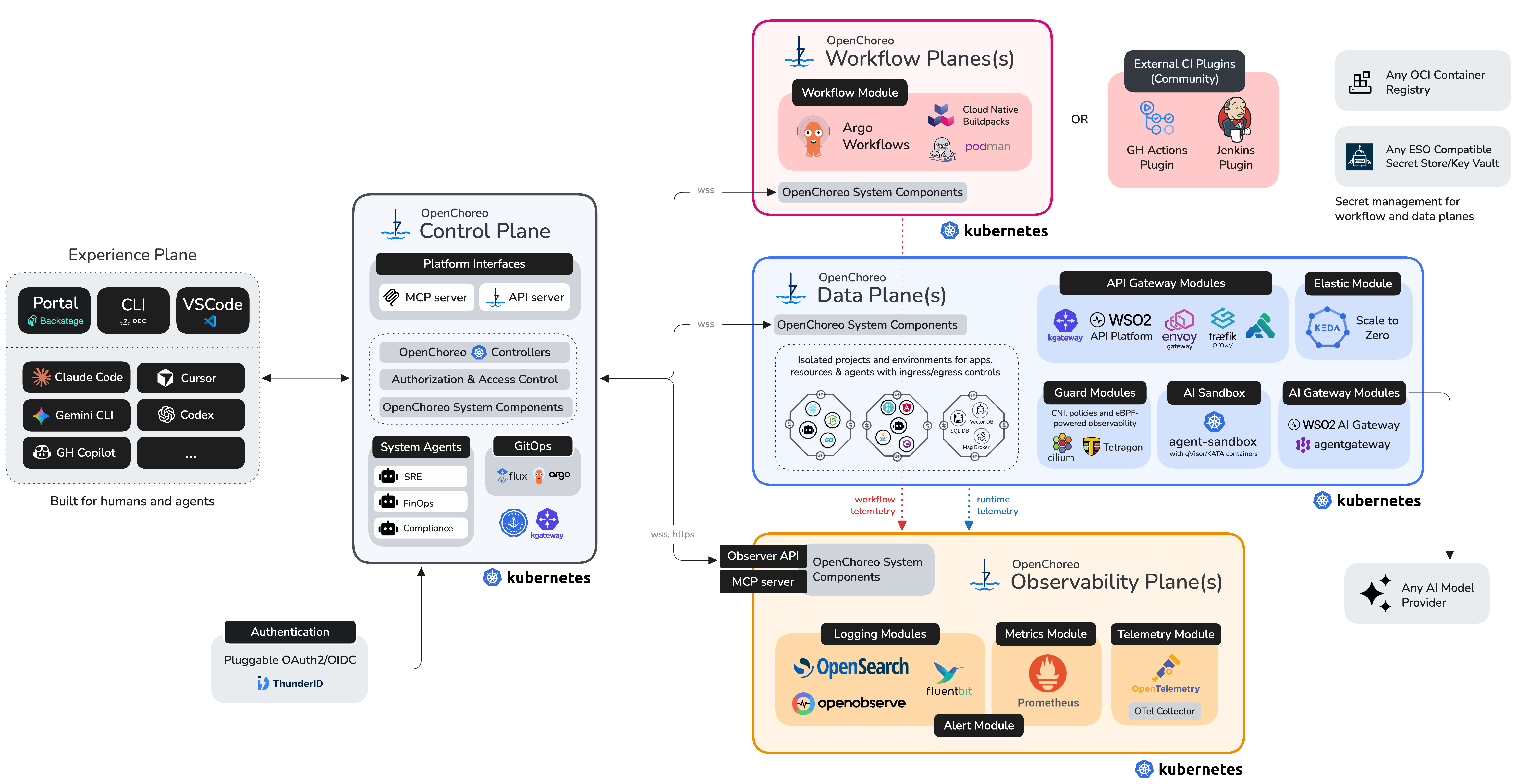
The Experience Plane is where developers, platform engineers, and SREs interact with the platform via a Backstage-powered OpenChoreo Portal, CLI, GitOps, or AI agents.
The Control Plane sits at the center of OpenChoreo. It takes developer intent and platform intent expressed through high-level abstractions like components, endpoints, dependencies, environments, pipelines, and namespaces and translates them into the underlying Kubernetes resources. It also reflects runtime reality back up, so what developers see always matches what's actually running.
The Data Plane is where your workloads run. It is where OpenChoreo enforces and guarantees the semantics of those high-level abstractions, such as isolation between projects, traffic policies, and security boundaries. These aren't just configurations; they're guaranteed by the platform.
The Observability Plane feeds the loop with metrics, logs, and tracing, all surfaced through the abstractions your developers already understand.
The optional CI Plane handles builds using cloud native Buildpacks and Argo Workflows by default.
At the center of this is a set of opinionated abstractions. Developers work with components (services, workers, cron jobs, and other types defined as component types), expose functionality through endpoints, and declare dependencies on other endpoints or resources. Platform engineers control what component types are available, what traits can be applied, and how workloads behave, through configuration, not custom code.
The result is a clear separation of concerns: developers express what they want to run, the control plane figures out how to run it, and platform engineers govern the boundaries.
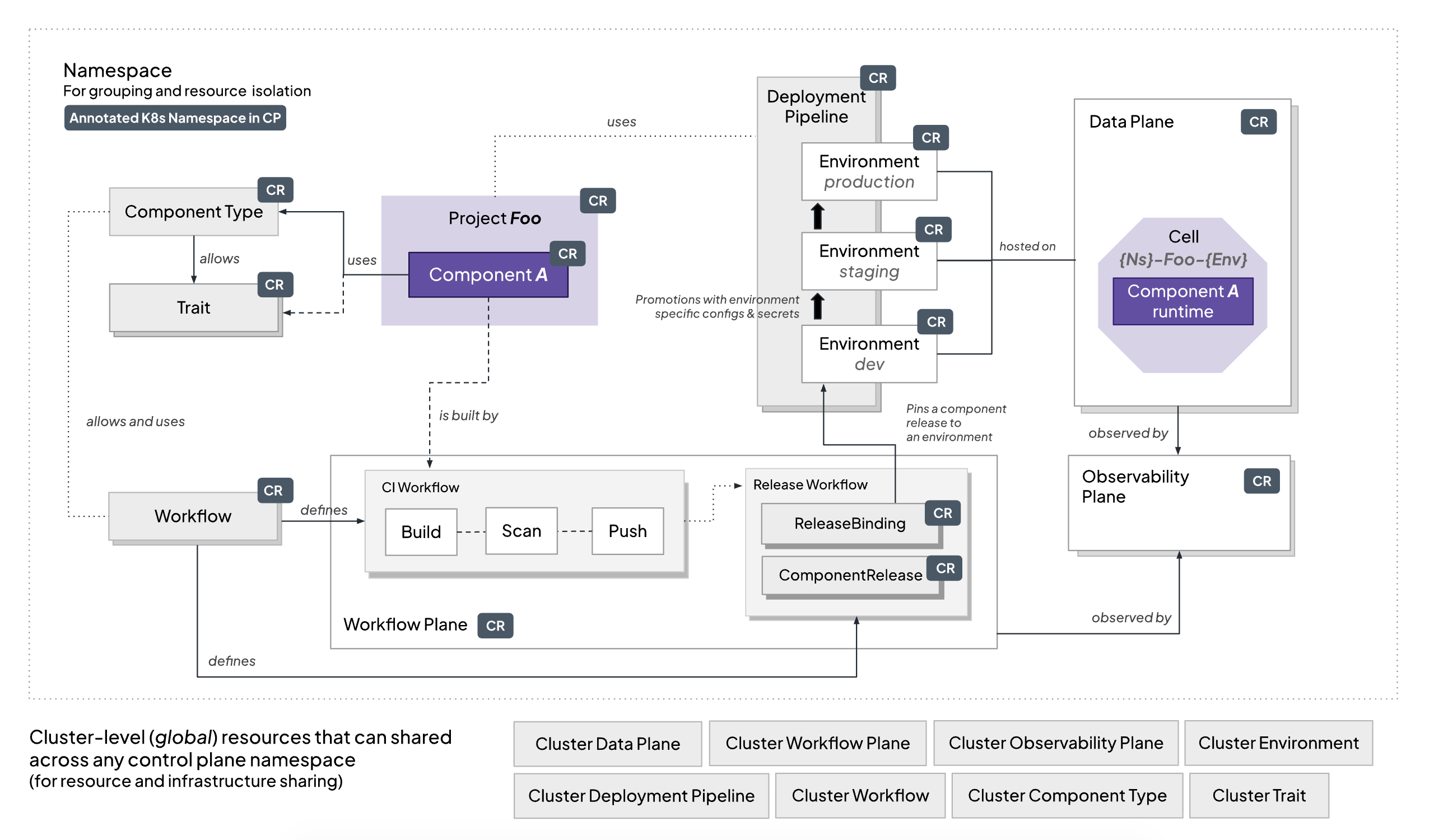
Underpinning all of this is the Platform API. It is a set of Kubernetes CRDs that let platform engineers declaratively define the structure and behavior of the entire platform. Instead of writing custom controllers or glue scripts, you configure organizational boundaries, environments, data planes, deployment pipelines, and observability through familiar Kubernetes-native resources. The Platform API also includes programmable abstractions like ComponentTypes, Traits, and Workflows that let platform teams define golden paths for their developers, encapsulate best practices, and enforce organizational standards. Together, they enable OpenChoreo's approach to policy, security, and governance by design.
The diagram below illustrates some of the core concepts of the Platform API and how they relate to each other. It represents one possible platform topology, not a prescribed structure.
Getting Started
The easiest way to try OpenChoreo is by following the Quick Start Guide. It walks you through setting up Choreo using a Dev Container, so you can start experimenting without affecting your local environment.
For a deeper understanding of OpenChoreo's architecture, see OpenChoreo Concepts.
Visit Installation Guide to learn more about installation methods.
Samples
Explore hands-on examples to help you configure and deploy your applications using OpenChoreo.
- Platform Configuration – Set up deployment pipelines and environments.
- Deploy from Source – Deploy services and web apps