OpenAgentsControl is a free, open source ai development platforms project written in TypeScript and released under MIT. It has 4,861 GitHub stars, 398 forks and 67 open issues, and was last pushed 4 days ago. On this registry it ranks #87 of 116 tracked projects in AI Development Platforms, with 5 head-to-head comparisons available.

What is OpenAgentsControl?

OpenAgentsControl (OAC) is an MIT-licensed AI agent framework built on the OpenCode CLI that teaches coding agents a team's own patterns upfront, then runs plan-first workflows where every execution waits for human approval — aimed at developers and teams who want repeatable AI-generated code instead of generic output they must rewrite.

What it is

OpenAgentsControl is a framework of specialized agents, context management, and team workflows layered on top of OpenCode, an open-source AI coding framework. It is written in TypeScript and distributed under the MIT licence. Rather than shipping agents as baked-in plugins, OAC keeps agent behavior in editable markdown files that control how an agent plans, what it loads, and when it stops to ask for approval. It is model agnostic, so the same agent definitions can drive Claude, GPT, Gemini, MiniMax, or local models, and its pattern system targets TypeScript, Python, Go, Rust, and C#, with the README claiming applicability to any language.

The concrete problem it solves is context blindness in code generation. A generic agent does not know the project's validation library, ORM, response conventions, or security rules, so it emits plausible code that does not match the codebase and must be rewritten by hand. The README illustrates this with a route handler that returns an unchecked JSON success, against the version a team actually needs: request body parsed, validated through the project's Zod schema, written through its Drizzle ORM, and returned with a 201 status in the team's response format. OpenAgentsControl replaces that guess-and-refactor loop by loading the project's own patterns before generation, so output matches from the first pass.

Key capabilities

  • Pattern control: define coding patterns once in context files, and agents reuse them for every subsequent generation.
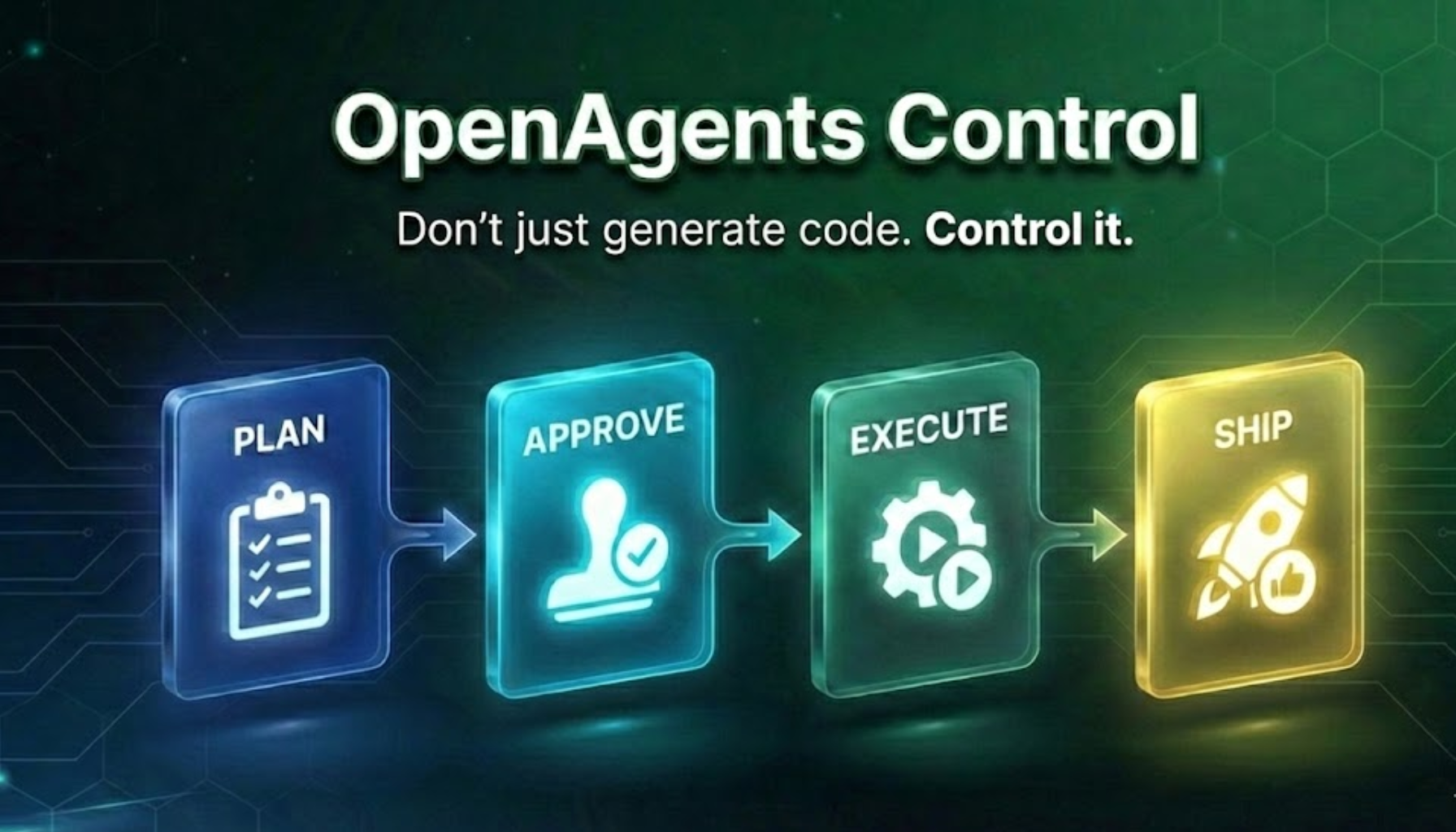
  • Approval gates: agents follow a propose, approve, execute sequence and always request approval before execution.
  • Editable agents: agent behavior lives in markdown files edited directly, with no compilation step and no vendor lock-in.
  • Minimal Viable Information design: only the needed context is loaded when it is needed, to limit token consumption.
  • Multi-language coverage: TypeScript, Python, Go, Rust, and C#, with the README extending the claim to any language.
  • Model agnosticism: Claude, GPT, Gemini, MiniMax, and local models are all supported.
  • One-command install: curl -fsSL https://raw.githubusercontent.com/darrenhinde/OpenAgentsControl/main/install.sh | bash -s developer, or the interactive variant that downloads install.sh and runs it.

Who uses it and how

  • Teams that want every member generating code against the same shared patterns, since agent definitions are shared markdown and team-ready by design.
  • Projects with strict architecture or security conventions, where the approval gate keeps a human between the plan and the diff.
  • Polyglot codebases spanning TypeScript, Python, Go, Rust, or C#, where a single agent definition set covers several services.
  • Shops bound to a specific model vendor or running local models, since the framework does not tie agents to one provider.
  • Developers already on the OpenCode CLI who want context management and approval workflows without leaving that tooling.

Getting started

Install with the single command curl -fsSL https://raw.githubusercontent.com/darrenhinde/OpenAgentsControl/main/install.sh | bash -s developer, or download install.sh and run it interactively with bash install.sh. Prerequisites are the OpenCode CLI, Bash 3.2 or newer, and Git; the installer sets up the OpenCode CLI if it is absent.

How it compares

The facts name no paid products this project replaces. The one comparable tool named is OpenCode itself, which OAC extends rather than competes with: OpenCode is the open-source AI coding framework, and OpenAgentsControl adds specialized agents, context management, and team workflows on top of it. There is no hosted or paid tier described here, so the framework stands on its own within this registry alongside its OpenCode base.

When to use it — and when not to

A self-hoster must operate the OpenCode CLI, Bash 3.2 or newer, and Git, and must author and maintain the markdown context files and agent definitions that make pattern control work; the installer does not supply a database, storage layer, or SMTP service because the framework describes none. Teams wanting a managed GUI product should not pick it, since installation is a piped remote shell script and configuration is file-based. The README excerpt is promotional rather than operational, and 67 open issues against a repository last pushed on 2026-09-13 suggest the project is active but still settling, so evaluate the workflow before standardizing a large team on it.

project readme (upstream, from github) — read inline

OpenAgents Control Hero

OpenAgents Control (OAC)

Control your AI patterns. Get repeatable results.

AI agents that learn YOUR coding patterns and generate matching code every time.

🎯 Pattern Control - Define your patterns once, AI uses them forever
Approval Gates - Review and approve before execution
🔁 Repeatable Results - Same patterns = Same quality code
📝 Editable Agents - Full control over AI behavior
👥 Team-Ready - Everyone uses the same patterns

Multi-language: TypeScript • Python • Go • Rust • C# • Any language*
Model Agnostic: Claude • GPT • Gemini • MiniMax • Local models


GitHub stars X Follow License: MIT Last Commit

🚀 Quick Start💻 Show Me Code🗺️ Roadmap💬 Community


Built on OpenCode - An open-source AI coding framework. OAC extends OpenCode with specialized agents, context management, and team workflows.


The Problem

Most AI agents are like hiring a developer who doesn't know your codebase. They write generic code. You spend hours rewriting, refactoring, and fixing inconsistencies. Tokens burned. Time wasted. No actual work done.

Example:

// What AI gives you (generic)
export async function POST(request: Request) {
  const data = await request.json();
  return Response.json({ success: true });
}

// What you actually need (your patterns)
export async function POST(request: Request) {
  const body = await request.json();
  const validated = UserSchema.parse(body);  // Your Zod validation
  const result = await db.users.create(validated);  // Your Drizzle ORM
  return Response.json(result, { status: 201 });  // Your response format
}

The Solution

OpenAgentsControl teaches agents your patterns upfront. They understand your coding standards, your architecture, your security requirements. They propose plans before implementing. They execute incrementally with validation.

The result: Production-ready code that ships without heavy rework.

What Makes OAC Different

🎯 Context-Aware (Your Secret Weapon)
Agents load YOUR patterns before generating code. Code matches your project from the start. No refactoring needed.

📝 Editable Agents (Not Baked-In Plugins)
Full control over agent behavior. Edit markdown files directly—no compilation, no vendor lock-in. Change workflows, add constraints, customize for your team.

✋ Approval Gates (Human-Guided AI)
Agents ALWAYS request approval before execution. Propose → Approve → Execute. You stay in control. No "oh no, what did the AI just do?" moments.

⚡ Token Efficient (MVI Principle)
Minimal Viable Information design. Only load what's needed, when it's needed. Context files Full comparison: Read detailed analysis →


🚀 Quick Start

Prerequisites: OpenCode CLI (free, open-source) • Bash 3.2+ • Git

Step 1: Install

One command:

curl -fsSL https://raw.githubusercontent.com/darrenhinde/OpenAgentsControl/main/install.sh | bash -s developer

The installer will set up OpenCode CLI if you don't have it yet.

Or interactive:

curl -fsSL https://raw.githubusercontent.com/darrenhinde/OpenAgentsControl/main/install.sh -o install.sh
bash install.sh

Keep Updated

curl -fsSL https://raw.githubusercontent.com/darrenhinde/OpenAgentsControl/main/update.sh | bash

Use --install-dir PATH if you installed to a custom location (e.g. ~/.config/opencode).

Step 2: Start Building

opencode --agent OpenAgent
> "Create a user authentication system"

Step 3: Approve & Ship

What happens:

  1. Agent analyzes your request
  2. Proposes a plan (you approve)
  3. Executes step-by-step with validation
  4. Delegates to specialists when needed
  5. Ships production-ready code

That's it. Works immediately with your default model. No configuration required.


Alternative: Claude Code Plugin (BETA)

Prefer Claude Code? OpenAgents Control is also available as a Claude Code plugin!

Installation:

  1. Register the marketplace:
/plugin marketplace add darrenhinde/OpenAgentsControl
  1. Install the plugin:
/plugin install oac
  1. Download context files:
/oac:setup --core
  1. Start building:
Add a login endpoint

Features:

  • ✅ 6-stage workflow with approval gates
  • ✅ Context-aware code generation
  • ✅ 7 specialized subagents (task-manager, context-scout, context-manager, coder-agent, test-engineer, code-reviewer, external-scout)
  • ✅ 9 workflow skills + 6 user commands
  • ✅ Flexible context discovery (.oac config, .claude/context, context, .opencode/context)
  • ✅ Add context from GitHub, worktrees, local files, or URLs
  • ✅ Easy feature planning with /oac:plan

Documentation:

Status: BETA - Actively tested and ready for early adopters


💡 The Context System: Your Secret Weapon

The problem with AI code: It doesn't match your patterns. You spend hours refactoring.

The OAC solution: Teach your patterns once. Agents load them automatically. Code matches from the start.

How It Works

Your Request
    ↓
ContextScout discovers relevant patterns
    ↓
Agent loads YOUR standards
    ↓
Code generated using YOUR patterns
    ↓
Ships without refactoring ✅

Add Your Patterns (10-15 Minutes)

/add-context

Answer 6 simple questions:

  1. What's your tech stack? (Next.js + TypeScript + PostgreSQL + Tailwind)
  2. Show an API endpoint example (paste your code)
  3. Show a component example (paste your code)
  4. What naming conventions? (kebab-case, PascalCase, camelCase)
  5. Any code standards? (TypeScript strict, Zod validation, etc.)

readme truncated — read the full docs on github

Frequently asked questions

Is OpenAgentsControl free to use?

OpenAgentsControl is open source under the MIT licence. There is no licence fee and no seat count — you can self-host it or, where the project offers one, pay a vendor for a managed version instead.

What does OpenAgentsControl do?

AI agent framework for plan-first development workflows with approval-based execution. Multi-language support (TypeScript, Python, Go, Rust) with automatic test

What is OpenAgentsControl written in?

OpenAgentsControl is primarily written in TypeScript. Its source is publicly available at https://github.com/darrenhinde/OpenAgentsControl, and it has 4,861 GitHub stars.
