openagent is a free, open source documentation & knowledge base project written in Go and released under Apache-2.0. It has 5,628 GitHub stars, 656 forks and 45 open issues, and was last pushed 11 hours ago. On this registry it ranks #23 of 40 tracked projects in Documentation & Knowledge Base, with 5 head-to-head comparisons available. It gained 7 stars over the last 3 tracked days.

What is openagent?

OpenAgent is an open-source, self-hostable personal AI assistant written in Go under the Apache-2.0 licence, combining large language models, a retrieval-augmented knowledge base, and autonomous agent loops for individuals and teams who want their own assistant running on their own machine.

What it is

OpenAgent is a next-generation personal AI assistant powered by LLMs, RAG, and agent loops, and it ships as a single binary. The project describes itself as an open-source personal AI assistant that brings together model providers, your own knowledge base, and autonomous agent loops in one self-hostable platform. It is written in Go, licensed under Apache-2.0, and catalogued in the Content & Publishing / Documentation & Knowledge Base category. You can connect any model provider, build a RAG knowledge base from your own documents, and let agents browse the web, run code, and call any MCP-compatible tool on your behalf.

The concrete problem it solves is fragmentation. Assembling a personal assistant normally means subscribing to a hosted chatbot, bolting on a separate retrieval stack for your documents, and wiring up yet another framework for autonomous tool use, each with its own account and data handling. OpenAgent consolidates those layers into one self-hostable platform: it connects 30+ model providers and lets you switch between them per conversation without code changes, keeps your documents in a knowledge base you host, and runs the agent loop locally. It lives in the Go and LLM and agent tooling ecosystem, and it takes the place of a hosted assistant plus a separate RAG pipeline and agent harness.

Key capabilities

  • Connects 30+ model providers, including OpenAI, and switches between them per conversation with no code changes required.
  • Builds a RAG knowledge base from your own documents.
  • Runs agent loops with computer-use, browser-use, and coding agent support, letting agents browse the web and run code.
  • Calls any MCP-compatible tool on the user's behalf.
  • Ships as a single binary with pre-built releases for Linux, macOS, and Windows on x86_64 and arm64, and Windows runs natively without WSL or Docker.
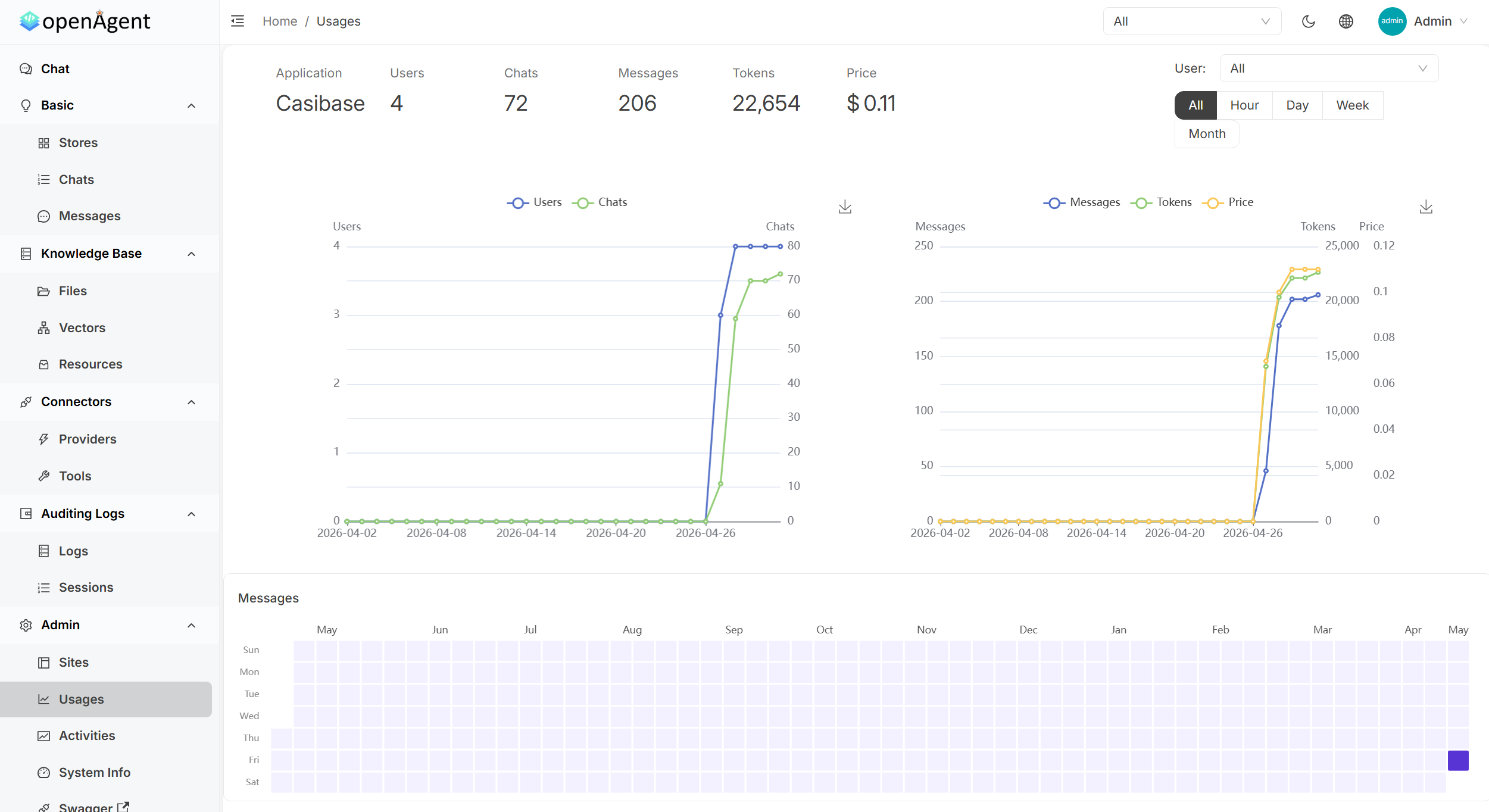
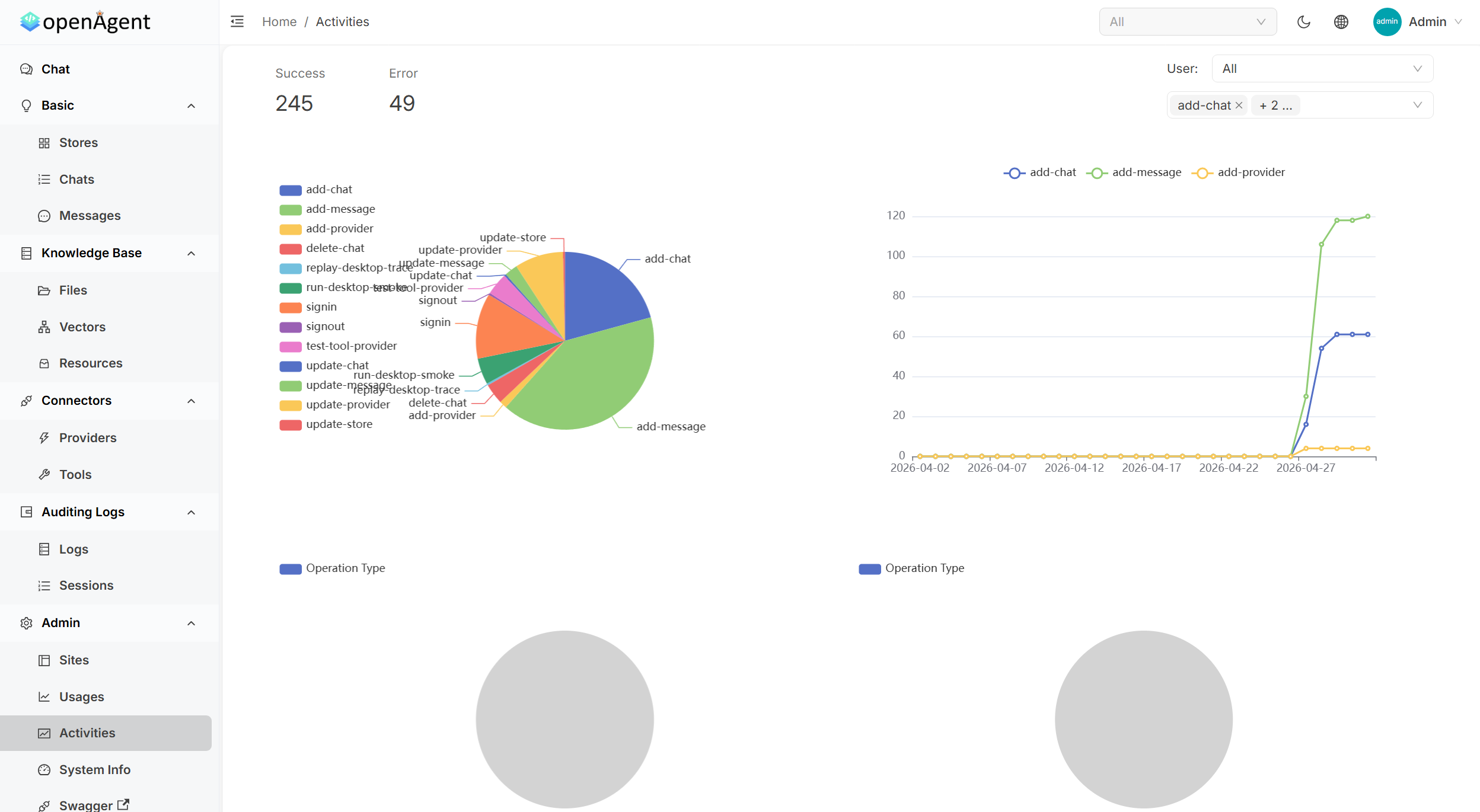
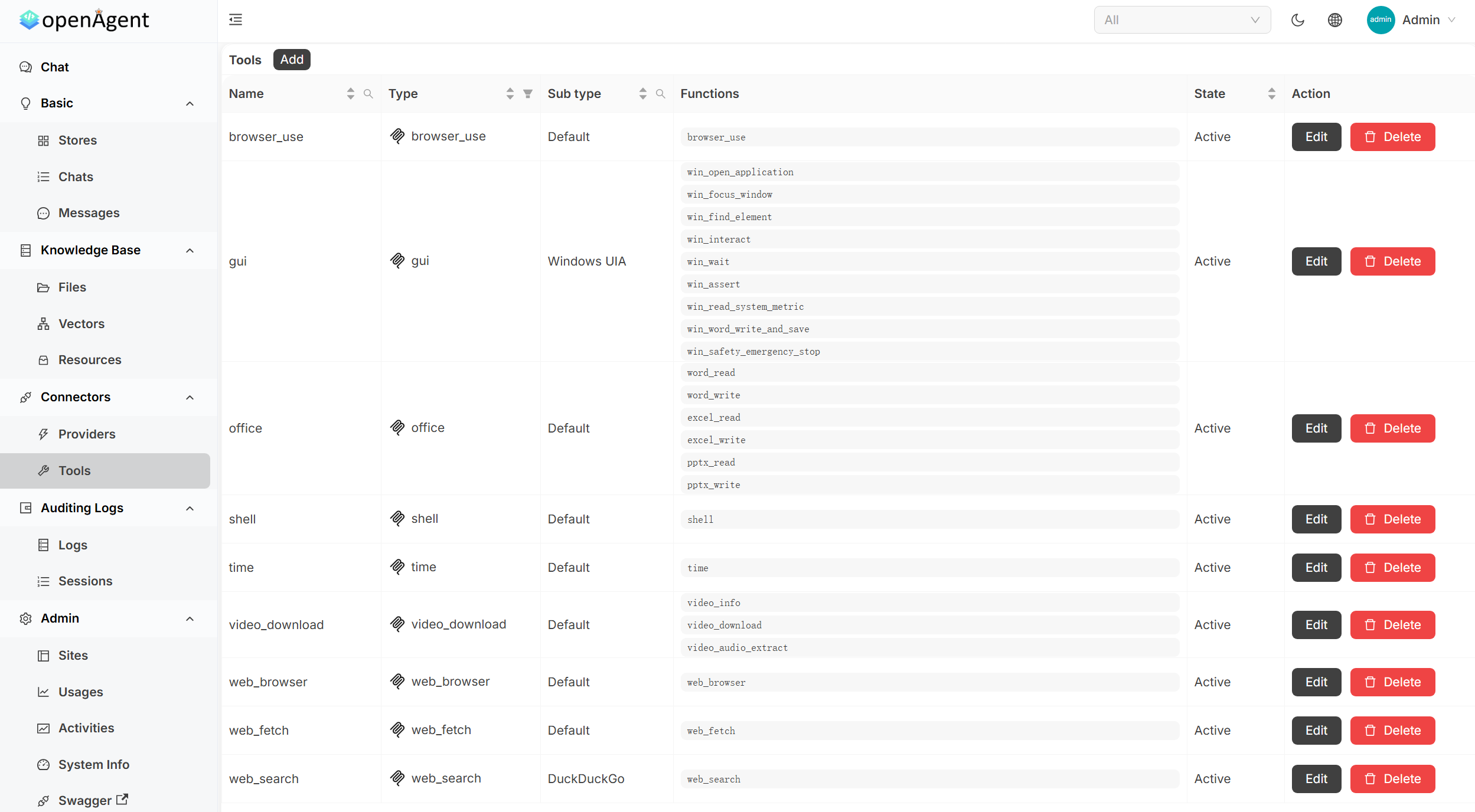
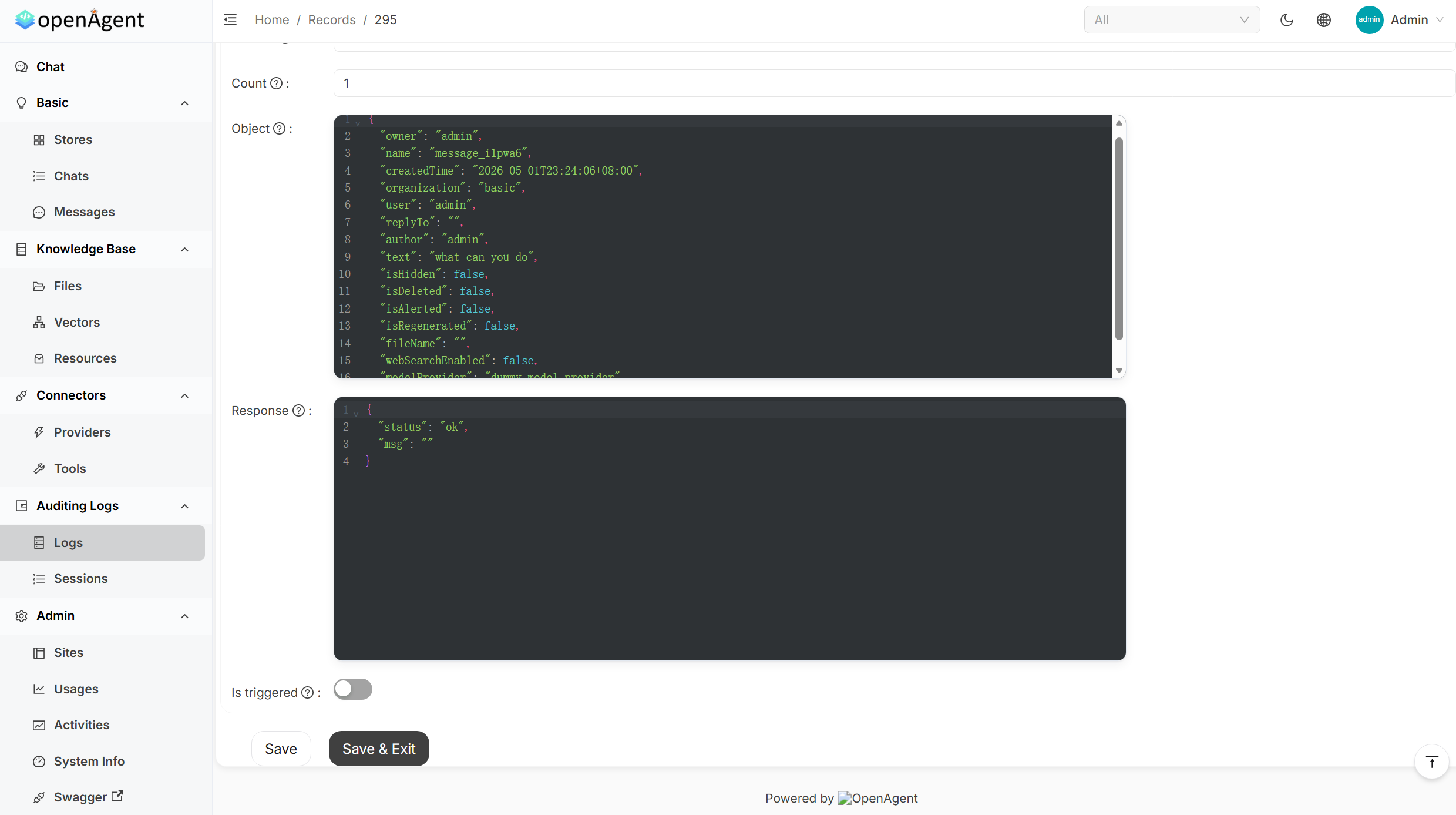
  • Provides Tool Management, Usage Analytics, Activity Monitoring, and Detailed Logs surfaces.
  • Offers a Docker image, casbin/openagent, run through docker-compose up.

Who uses it and how

  • Individuals who want a personal assistant on their own hardware, started by the installer and reached at http://localhost:14000.
  • Teams that self-host a shared knowledge base assistant on internal infrastructure through docker-compose up.
  • Developers running coding agent and browser-use tasks against their own repositories and documents.
  • Windows users who want a native assistant without setting up WSL or Docker.
  • Operators who monitor usage through the Usage Analytics and Activity Monitoring views and audit actions through Detailed Logs.

Getting started

The README's quick start runs an installer that downloads the latest release and starts OpenAgent on port 14000; on macOS, Linux, or WSL that is curl -fsSL https://raw.githubusercontent.com/the-open-agent/openagent/master/scripts/install.sh | bash, on Windows PowerShell it is irm https://raw.githubusercontent.com/the-open-agent/openagent/master/scripts/install.ps1 | iex, and a docker-compose up path is also documented. Building from source needs Go 1.25.0+ for the backend and Node.js 20+ with Yarn 1.x for the frontend.

How it compares

In this registry OpenAgent is catalogued alongside other agent and LLM tooling, sharing topic tags such as langchain, chatgpt, and hermes-agent. The facts provided do not name a set of paid products it directly replaces, so no licence, hosting, or cost comparison is drawn here; its distinguishing facts are the Apache-2.0 licence, the self-hostable single binary, and the per-conversation switching across 30+ model providers.

When to use it — and when not to

OpenAgent fits when you want to run the assistant yourself and keep your knowledge base and agent activity on your own infrastructure, and the single binary makes that a low-effort start. A self-hoster still operates a service on port 14000, and anyone building from source must manage a Go 1.25.0+ toolchain and a Node.js 20+ with Yarn 1.x toolchain. It is a poor fit for someone who wants a fully managed hosted assistant and will not run software on their own machine or server; note also that the README excerpt provided is truncated at the model provider list, so the full feature set is not visible from the facts given.

project readme (upstream, from github) — read inline
OpenAgent

Next-generation personal AI assistant powered by LLM, RAG and agent loops — ships as a single binary, no installation needed

Supporting computer-use, browser-use and coding agent


Build Release Docker Pulls Go Report License Discord


Live Demo · Playground · Docs · Discord


English | 中文


What is OpenAgent?

OpenAgent is an open-source personal AI assistant that brings together powerful LLMs, your own knowledge base, and autonomous agent loops — all in one self-hostable platform. Connect any model provider, build a RAG knowledge base from your documents, and let agents browse the web, run code, and call any MCP-compatible tool on your behalf.


Usage Analytics Activity Monitoring
Tool Management Detailed Logs


Sponsors

APIMart Thanks to APIMart for sponsoring this project! APIMart is a low-cost API platform for AI image & video generation — GPT-Image-2 from $0.006/image, 160+ images per dollar. One async API covers both image and video: submit a task, get an ID, fetch results via polling or callback. Batch tens of thousands of images without timeouts, switch models without changing code. Pay-as-you-go with no monthly fee — sign up here to get started.

Quick Start

Pre-built binaries for Linux, macOS, and Windows (x86_64 / arm64). The installer downloads the latest release and starts OpenAgent on port 14000.

macOS / Linux / WSL

curl -fsSL https://raw.githubusercontent.com/the-open-agent/openagent/master/scripts/install.sh | bash

Windows (PowerShell)

irm https://raw.githubusercontent.com/the-open-agent/openagent/master/scripts/install.ps1 | iex

Windows runs natively — no WSL, no Docker required.

Open http://localhost:14000 and you're in.

Optional env vars: OPENAGENT_VERSION, INSTALL_DIR, BIN_DIR

Build from source

Prerequisites:

# Backend
go build

# Frontend
cd web && yarn install && yarn start

Docker

docker-compose up

Open http://localhost:14000 once the containers are running.


Features

🤖 30+ Model Providers

Connect every major LLM provider and switch between them per conversation — no code changes required.

OpenAI · Azure OpenAI · Anthropic Claude · Google Gemini · DeepSeek · Mistral · Grok · Qwen · Doubao · Moonshot · ChatGLM · Baichuan · Ernie · iFlytek · HuggingFace · Cohere · Amazon Bedrock · OpenRouter · Ollama · APIMart · and more


🔄 Autonomous Agent Loops

Capability Description
Browser-Use Drive a real browser — navigate, click, fill forms, scrape, and screenshot pages
Web Search & Fetch Search the web and pull live page content into the agent's context
Shell Execution Run shell commands and scripts directly from the agent loop
Office Automation Read and write Word, Excel, and PowerPoint files
MCP Integration Plug in any MCP-compatible server (SSE / Stdio / StreamableHTTP) and expose its tools to the agent
Transparent Tool Calls See every tool invocation, its arguments, and its return value — step by step

📚 RAG & Knowledge Base

Capability Description
Document Ingestion Upload PDFs, Word docs, Excel sheets, and more — chunked, embedded, and indexed automatically
Semantic Search Retrieves the most relevant passages from your knowledge base before each LLM response
Pluggable Embeddings OpenAI, Azure, Gemini, Qwen, Cohere, Jina, HuggingFace, local models, and more
Isolated Stores Organise knowledge into separate stores; assign them per chat or per application

⚡ Workflow Automation

Capability Description
Visual Workflow Builder Compose multi-step pipelines with a BPMN-style drag-and-drop editor
Conditional & Parallel Execution Branch on gateway conditions; run independent tasks concurrently
Task Scheduling Trigger workflows or agent jobs on a recurring schedule
Usage Analytics Track token consumption and cost per provider, model, and user

🏗️ Platform Features

Capability Description
Single Binary One executable file — no installer, no runtime dependencies. Download and run instantly on any supported platform
Native Windows Support Runs directly on Windows — no WSL, no Docker, no Linux subsystem required
Single Sign-On OIDC / OAuth2 / LDAP / SAML via the built-in auth layer
Multi-tenancy Isolated workspaces per user or organisation
REST API + Swagger UI Every feature is accessible

readme truncated — read the full docs on github

Frequently asked questions

Is openagent free to use?

openagent is open source under the Apache-2.0 licence. There is no licence fee and no seat count — you can self-host it or, where the project offers one, pay a vendor for a managed version instead.

What does openagent do?

⚡️next-generation personal AI assistant powered by LLM, RAG and agent loops, supporting computer-use, browser-use and coding agent, demo: https://demo.openagent

What is openagent written in?

openagent is primarily written in Go. Its source is publicly available at https://github.com/the-open-agent/openagent, and it has 5,628 GitHub stars.