[![Forks][forks-shield]][forks-url] [![Stargazers][stars-shield]][stars-url] [![Issues][issues-shield]][issues-url] [![MIT License][license-shield]][license-url]

Open Notebook
An open source, privacy-focused alternative to Google's Notebook LM!
Join our Discord server for help, to share workflow ideas, and suggest features!
Checkout our website »
Follow @lfnovo on X for updates
📚 Get Started
·
📖 User Guide
·
✨ Features
·
🚀 Deploy
Deutsch | Español | français | 日本語 | 한국어 | Português | Русский | 中文
A private, multi-model, 100% local, full-featured alternative to Notebook LM
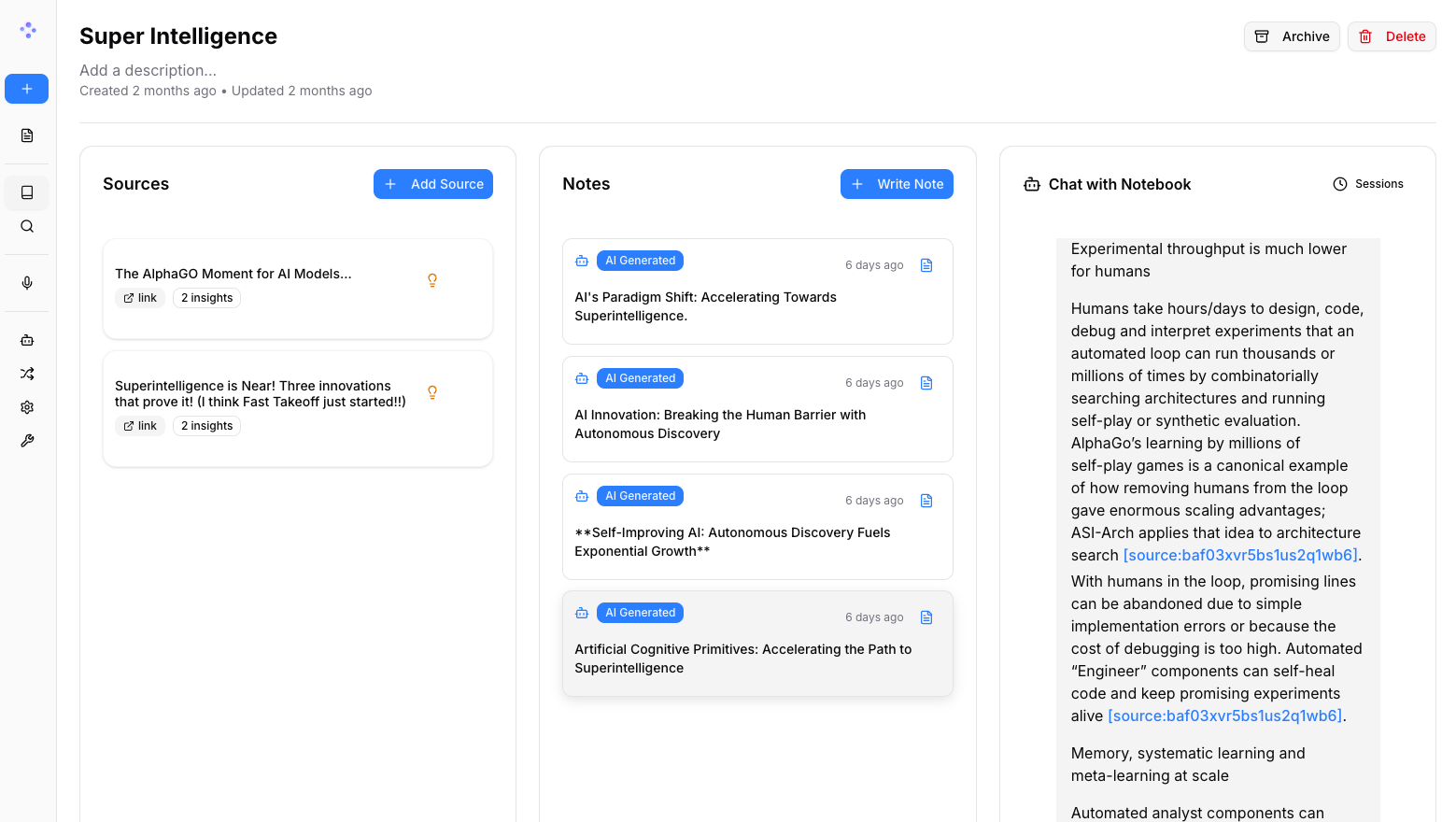
In a world dominated by Artificial Intelligence, having the ability to think 🧠 and acquire new knowledge 💡, is a skill that should not be a privilege for a few, nor restricted to a single provider.
Open Notebook empowers you to:
- 🔒 Control your data - Keep your research private and secure
- 🤖 Choose your AI models - Support for 18+ providers including OpenAI, Anthropic, Ollama, LM Studio, and more
- 📚 Organize multi-modal content - PDFs, videos, audio, web pages, and more
- 🎙️ Generate professional podcasts - Advanced multi-speaker podcast generation
- 🔍 Search intelligently - Full-text and vector search across all your content
- 💬 Chat with context - AI conversations powered by your research
- 🌐 Multi-language UI - English, Portuguese, Chinese (Simplified & Traditional), Japanese, Russian, and Bengali support
Learn more about our project at https://www.open-notebook.ai
🆚 Open Notebook vs Google Notebook LM
| Feature | Open Notebook | Google Notebook LM | Advantage |
|---|---|---|---|
| Privacy & Control | Self-hosted, your data | Google cloud only | Complete data sovereignty |
| AI Provider Choice | 18+ providers (OpenAI, Anthropic, Ollama, LM Studio, etc.) | Google models only | Flexibility and cost optimization |
| Podcast Speakers | 1-4 speakers with custom profiles | 2 speakers only | Extreme flexibility |
| Content Transformations | Custom and built-in | Limited options | Unlimited processing power |
| API Access | Full REST API | No API | Complete automation |
| Deployment | Docker, cloud, or local | Google hosted only | Deploy anywhere |
| Citations | Basic references (will improve) | Comprehensive with sources | Research integrity |
| Customization | Open source, fully customizable | Closed system | Unlimited extensibility |
| Cost | Pay only for AI usage | Free tier + Monthly subscription | Transparent and controllable |
Why Choose Open Notebook?
- 🔒 Privacy First: Your sensitive research stays completely private
- 💰 Cost Control: Choose cheaper AI providers or run locally with Ollama
- 🎙️ Better Podcasts: Full script control and multi-speaker flexibility vs limited 2-speaker deep-dive format
- 🔧 Unlimited Customization: Modify, extend, and integrate as needed
- 🌐 No Vendor Lock-in: Switch providers, deploy anywhere, own your data
Built With
[![Python][Python]][Python-url] [![Next.js][Next.js]][Next-url] [![React][React]][React-url] [![SurrealDB][SurrealDB]][SurrealDB-url] [![LangChain][LangChain]][LangChain-url]
🚀 Quick Start (2 Minutes)
Prerequisites
- Docker Desktop installed
- That's it! (API keys configured later in the UI)
Step 1: Get docker-compose.yml
Option A: Download directly
curl -o docker-compose.yml https://raw.githubusercontent.com/lfnovo/open-notebook/main/docker-compose.yml
Option B: Create the file manually
Copy this into a new file called docker-compose.yml:
services:
  surrealdb:
    image: surrealdb/surrealdb:v2
    # Credentials default to root:root for a zero-config local setup. Before
    # exposing this instance to a network, set SURREAL_USER / SURREAL_PASSWORD
    # in a .env file (see .env.example) — they are applied here and to the
    # open_notebook service below, so the two always stay in sync.
    # List (exec) form so each interpolated value stays a single argument —
    # a password containing spaces would otherwise be split into several.
    command: ["start", "--log", "info", "--user", "${SURREAL_USER:-root}", "--pass", "${SURREAL_PASSWORD:-root}", "rocksdb:/mydata/mydatabase.db"]
    user: root  # Required for bind mounts on Linux
    ports:
      # Bound to localhost only: the open_notebook service reaches this over
      # the internal compose network regardless, so the host port is purely
      # for local debugging (e.g. Surrealist, `surreal sql`). Exposing this
      # on 0.0.0.0 would let anyone who can reach the host connect with the
      # default root:root credentials.
      - "127.0.0.1:8000:8000"
    volumes:
      - ./surreal_data:/mydata
    environment:
      - SURREAL_EXPERIMENTAL_GRAPHQL=true
    restart: always
    pull_policy: always

  open_notebook:
    image: lfnovo/open_notebook:v1-latest
    ports:
      - "8502:8502"  # Web UI
      - "5055:5055"  # REST API
    environment:
      # REQUIRED: Change this to your own secret string
      # This encrypts your API keys in the database
      - OPEN_NOTEBOOK_ENCRYPTION_KEY=change-me-to-a-secret-string

      # Database connection. SURREAL_USER / SURREAL_PASSWORD default to root:root
      # for local use; override them in a .env file before exposing the instance
      # (the same values configure the surrealdb service above).
      - SURREAL_URL=ws://surrealdb:8000/rpc
      - SURREAL_USER=${SURREAL_USER:-root}
      - SURREAL_PASSWORD=${SURREAL_PASSWORD:-root}
      - SURREAL_NAMESPACE=open_notebook
      - SURREAL_DATABASE=open_notebook
    volumes:
      - ./notebook_data:/app/data
    depends_on:
      - surrealdb
    restart: always
    pull_policy: always
Step 2: Set Your Encryption Key
Edit docker-compose.yml and change this line:
- OPEN_NOTEBOOK_ENCRYPTION_KEY=change-me-to-a-secret-string
to any secret value (e.g., my-super-secret-key-123)
Step 3: Start Services
docker compose up -d
Wait 15-20 seconds, then open: http://localhost:8502
Step 4: Configure AI Provider
- Go to Models and choose your provider (OpenAI, Anthropic, Google, etc.)
- Click + Add Configuration
- Paste your API key and other info as needed and click Add Configuration
- Click Test to test connection
- Click Sync Models and check models to include
- Under Default Model Assignments, click Auto-Assign Defaults or manually specify which models to use for what
Done! You're ready to create your first notebook.
Need an API key? Get one from: OpenAI · Anthropic · Google · Groq (free tier)
Want free local AI? See examples/docker-compose-ollama.yml for Ollama setup
📚 More Installation Options
- With Ollama (Free Local AI) - Run models locally without API costs
- From Source (Developers) - For development and contributions
- Complete Installation Guide - All depl