ongrid is a free, open source monitoring & observability project written in Go and released under AGPL-3.0. It has 1,246 GitHub stars, 279 forks and 74 open issues, and was last pushed 15 hours ago. On this registry it ranks #208 of 270 tracked projects in Monitoring & Observability, with 5 head-to-head comparisons available. It gained 142 stars over the last 30 tracked days.

What is ongrid?

Ongrid is an open-source, self-hosted ops AI agent that reads metrics, logs, traces and topology to find the root cause of an incident and act on it from Slack, Telegram, Lark or DingTalk.

What it is

Ongrid is a Go-based AI agent for infrastructure operations, published under the AGPL-3.0 licence by ongridio and distributed as source on GitHub. It sits in the AIOps and ChatOps corner of the observability ecosystem: it wires Prometheus, Loki, Tempo and Grafana into one stack, connects to Kubernetes clusters and network devices, and places an LLM-driven reasoning layer on top, so an operator can ask a question in a chat channel and receive an evidence-backed answer. The project ships as a coordinator agent that dispatches work to specialist SRE, network and database sub-agents, backed by a RAG store over operational knowledge and source code.

The concrete problem it solves is the gap between an alert firing and someone understanding why. In a conventional setup, an alert fires, a human opens a dashboard, jumps onto a host through an SSH jumpbox with a key on disk, correlates metrics, logs and traces by hand, and then guesses at a cause. Ongrid replaces that manual jumpbox-and-key path with a reverse-tunnelled browser shell, and replaces ad-hoc chat triage with an investigator that spawns a root-cause worker when an alert fires and writes the cause back into the channel. Edge components dial out, so no inbound ports 22, 80 or 443 need to be open on managed hosts.

Key capabilities

  • Coordinator plus specialist agents: the coordinator dispatches work to SRE, network and database sub-agents.
  • Alert-driven auto-investigation: an investigator spawns an RCA worker and writes the cause back to chat.
  • Root-cause analysis that walks topology, correlates metrics, logs and traces, and pins the cause to a source-code line, supported by RAG knowledge and code search.
  • Zero inbound ports on managed hosts: edge dials out, and browser SSH runs over a reverse tunnel with no keys, no jumpbox and full auditing.
  • Read-only host tools: a bash sandbox plus 26 or more inspection tools, with every call audited.
  • Built-in observability: Prometheus, Loki, Tempo and Grafana are wired together, and the agent writes the queries.
  • Bring your own model: Anthropic, OpenAI, GLM, DeepSeek, Gemini and Kimi with hot routing, plus two-way Slack, Telegram, Larksuite, DingTalk and WeCom channels with per-channel locale.

Who uses it and how

  • On-call SRE teams that already live in Slack, Telegram, Larksuite, DingTalk or WeCom and want incident investigation to happen in the channel rather than in a separate dashboard.
  • Kubernetes platform teams that enroll clusters through Edge, inspect workloads and events, manage upgrades, and mirror Kubernetes resources into topology.
  • Network operations teams that discover neighbors from Edge hosts, verify them with SNMP, poll interfaces, and map host-to-network-device links.
  • Environments where hosts must not expose inbound ports, since the edge component dials out and browser SSH uses a reverse tunnel with auditing.
  • Self-hosters who want the full observability stack and their own model credentials in one deployment; operators in mainland China can pull from the ongrid.cloud CDN mirror when GitHub is slow.

Getting started

Download the release tarball for the server architecture, ongrid-v0.16.0-linux-amd64.tar.xz or ongrid-v0.16.0-linux-arm64.tar.xz, extract it, and run sudo ./install.sh, which brings up the full stack in one command. It targets Ubuntu 22.04+, Debian 12+ and RHEL/Rocky 9.

How it compares

These facts do not name a set of paid products that Ongrid replaces, and they name no directly comparable tools either. It therefore stands alone in this registry, and any comparison would have to be drawn from sources outside the material provided.

When to use it — and when not to

A self-hoster must operate the bundled Prometheus, Loki, Tempo and Grafana stack, run edge agents on managed hosts, and supply model credentials for one of the supported providers, which brings its own cost and data-flow questions. The AGPL-3.0 licence is a real constraint for anyone embedding the code in a closed product, and the project carries 74 open issues, so teams expecting a polished, fully managed service should look elsewhere. Installation is also Linux-only through a tarball and install.sh; the facts mention no container image or compose file.

project readme (upstream, from github) — read inline

Ongrid

An ops AI Agent that understands your infrastructure, finds the root cause, and fixes it — right from Slack or Telegram.

Metrics · logs · traces · topology blast-radius · root-cause correlation · remote execution · alert-driven auto-investigation · RAG knowledge & code search · specialist agents & skills.

Go Report Card Release Go License Stack PRs Welcome Telegram Slack

Ongrid on Trendshift

English | 简体中文 | 日本語 | 한국어 | Español | Français | Deutsch | Português | Русский
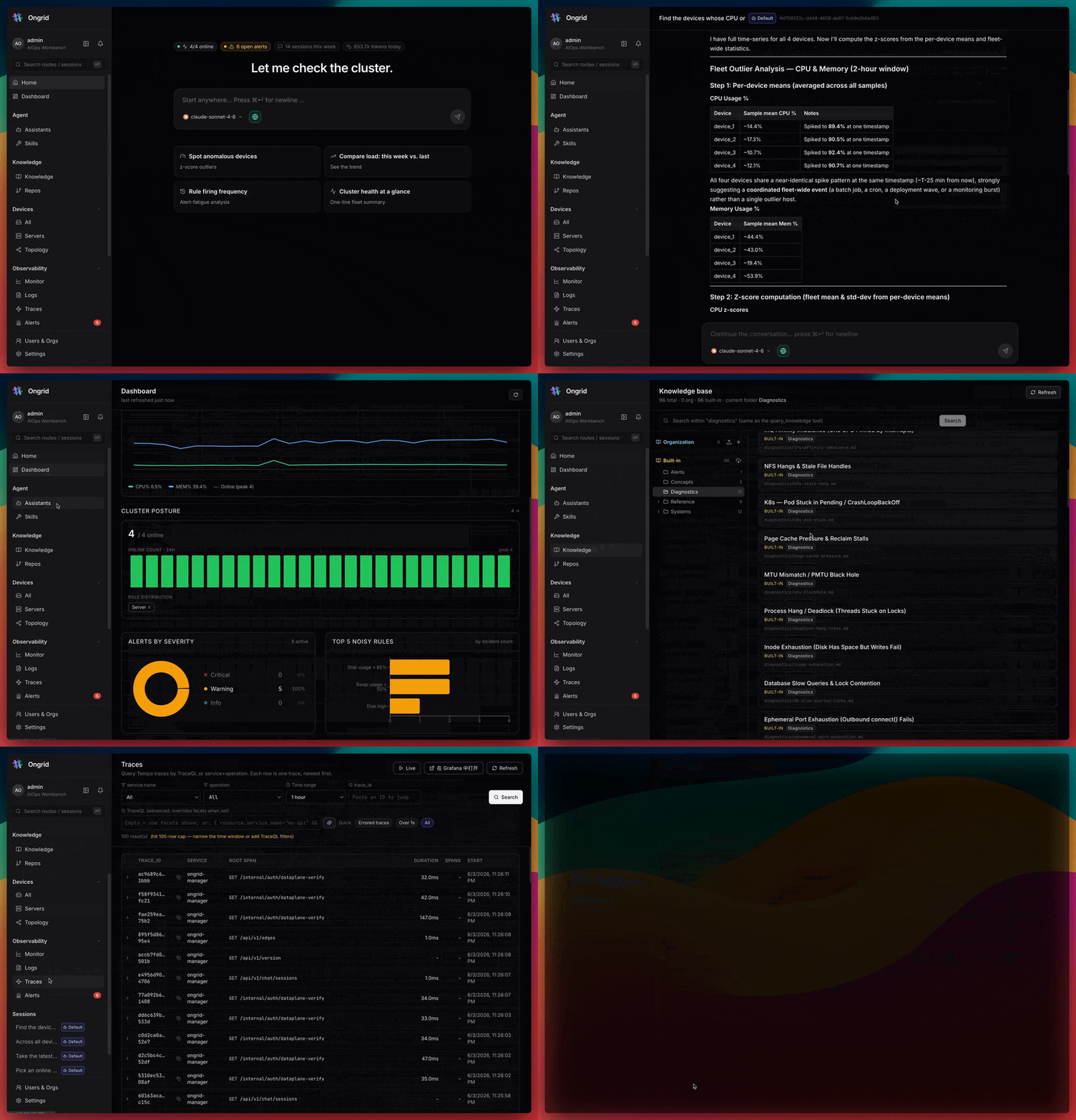


☸️ Kubernetes lifecycle management is now available
Enroll clusters through Edge, inspect workloads and events, manage upgrades, and connect Kubernetes resources to topology.

Features • Install • Integrations • License

Features

  • 🤖 Coordinator + Specialist agents — coordinator dispatches to SRE / network / DB sub-agents
  • 🚨 Auto-investigate on alert — investigator spawns an RCA worker, writes the cause back to chat
  • 🔍 Root-cause RCA — walks topology, correlates m/l/t, pins the "why" to a source-code line
  • 🔒 Zero inbound ports — edge dials out; no port 22 / 80 / 443 on hosts
  • 💻 Browser SSH — reverse-tunnel shell into any host; no keys, no jumpbox, all audited
  • 🐳 Self-host in one command — install.sh brings up the full stack
  • 📊 Built-in observability — Prometheus + Loki + Tempo + Grafana wired; the agent writes the queries
  • 🧠 Bring your own model — Anthropic / OpenAI / GLM / DeepSeek / Gemini / Kimi, hot routing
  • 💬 Two-way IM channels — Slack / Telegram / Larksuite / DingTalk / WeCom, per-channel locale
  • 🛠️ Read-only host tools — bash sandbox + 26+ inspection tools; every call audited
  • ☸️ Kubernetes lifecycle — enroll clusters, inspect workloads and events, manage upgrades, and mirror Kubernetes resources into topology
  • 🌐 Network device management — discover neighbors from Edge hosts, verify with SNMP, poll interfaces, and map host-to-network-device links

Install

Download the latest release for your server architecture (linux-amd64 or linux-arm64), extract it, and run the installer (Ubuntu 22.04+, Debian 12+, RHEL/Rocky 9):

Choose the command for your server architecture:

AMD64

wget https://github.com/ongridio/ongrid/releases/download/v0.16.0/ongrid-v0.16.0-linux-amd64.tar.xz
tar -xf ongrid-v0.16.0-linux-amd64.tar.xz && cd ongrid-v0.16.0-linux-amd64
sudo ./install.sh

ARM64

wget https://github.com/ongridio/ongrid/releases/download/v0.16.0/ongrid-v0.16.0-linux-arm64.tar.xz
tar -xf ongrid-v0.16.0-linux-arm64.tar.xz && cd ongrid-v0.16.0-linux-arm64
sudo ./install.sh

🇨🇳 Mainland China — if GitHub is slow, use the matching CDN mirror URL instead:

# AMD64
wget https://ongrid.cloud/dl/ongrid-v0.16.0-linux-amd64.tar.xz

# ARM64
wget https://ongrid.cloud/dl/ongrid-v0.16.0-linux-arm64.tar.xz

Product Tour

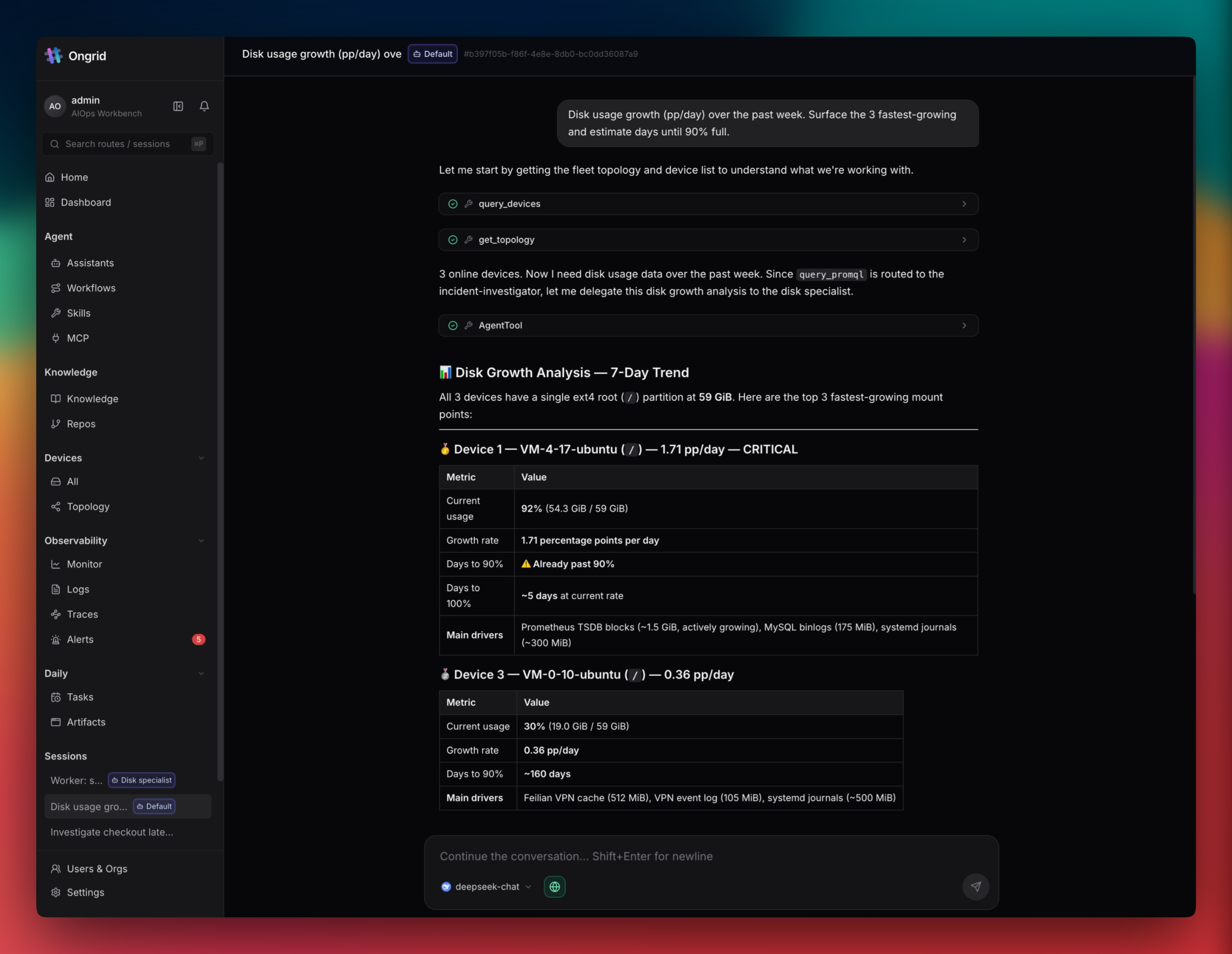
Root Cause Analysis
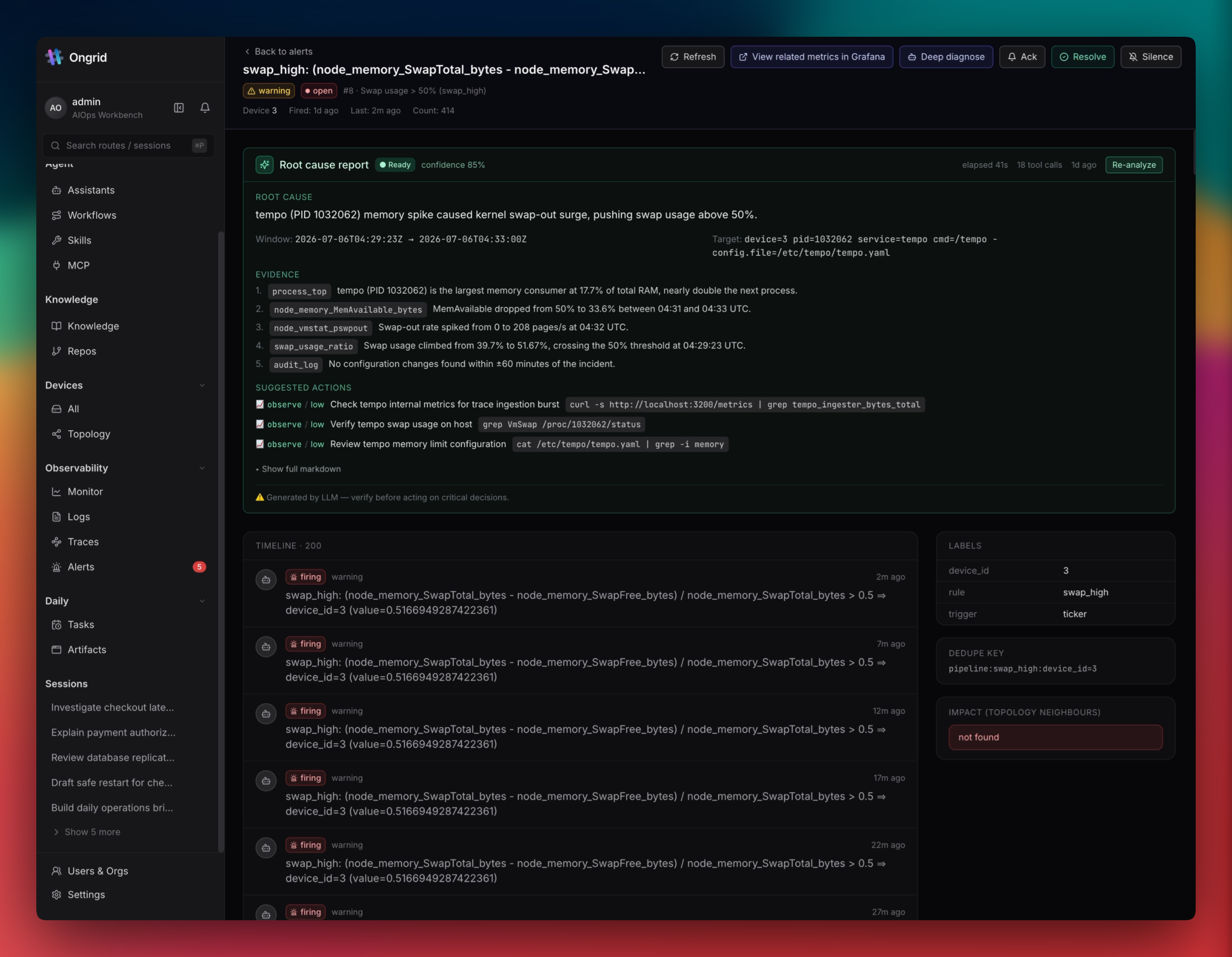
Start from an operator question or alert, collect topology and device context, and produce an evidence-backed analysis with concrete next steps.

Workflow Builder
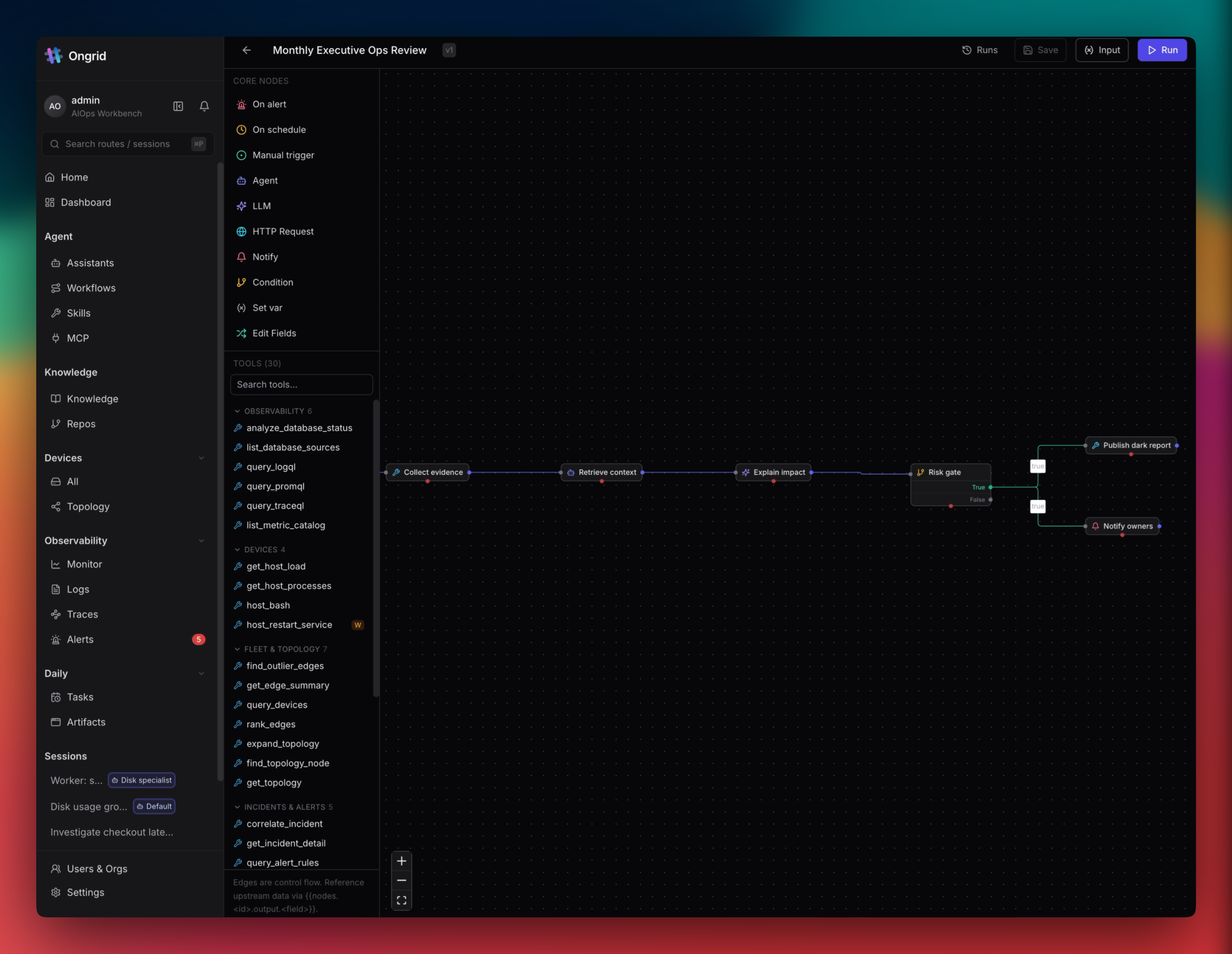
Wire triggers, agents, tools, conditions, and notifications into repeatable automations that stay editable and reviewable.

Skills Catalog
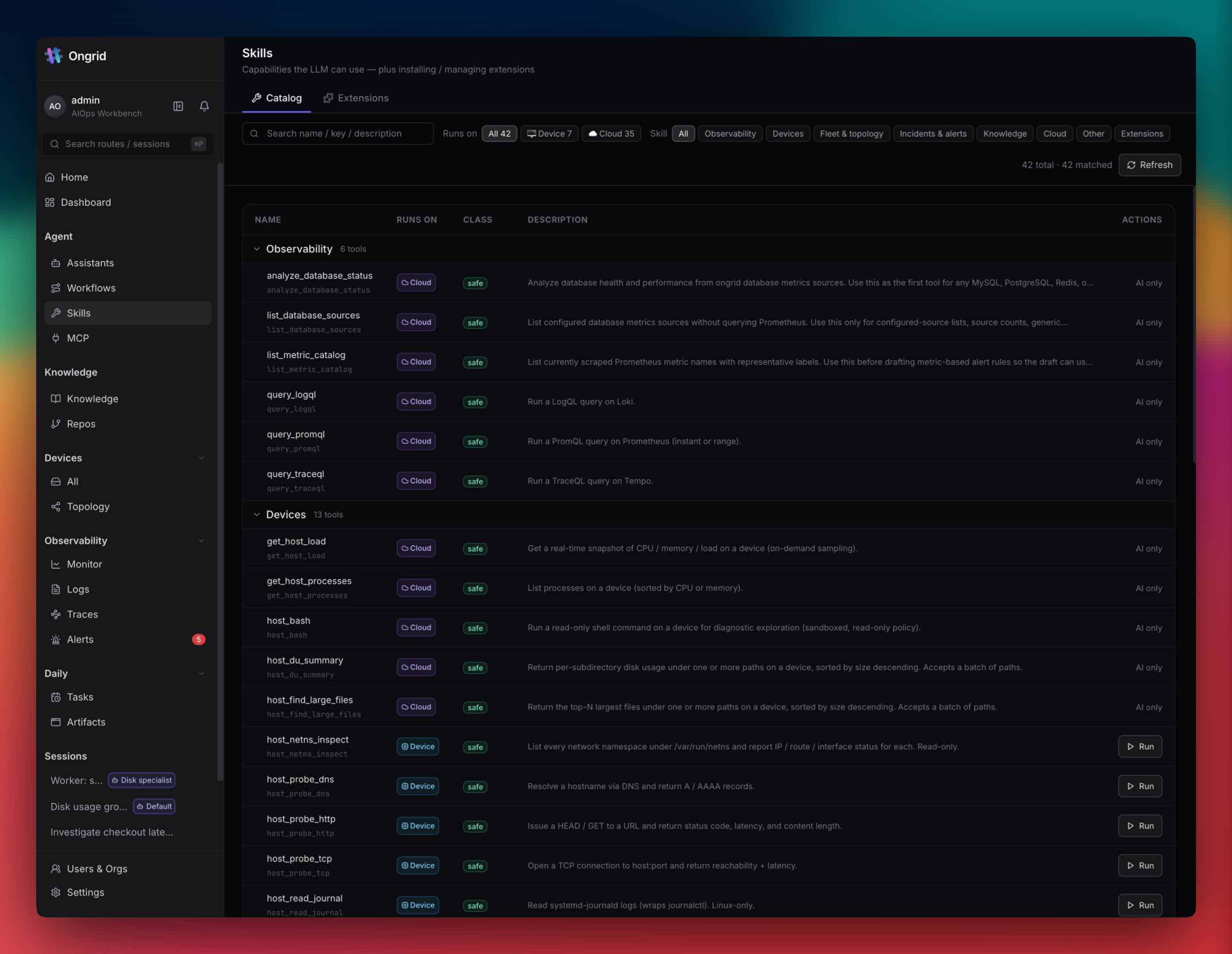
Show the tools agents can call, with clear descriptions and a visible inventory for operators.

MCP Servers
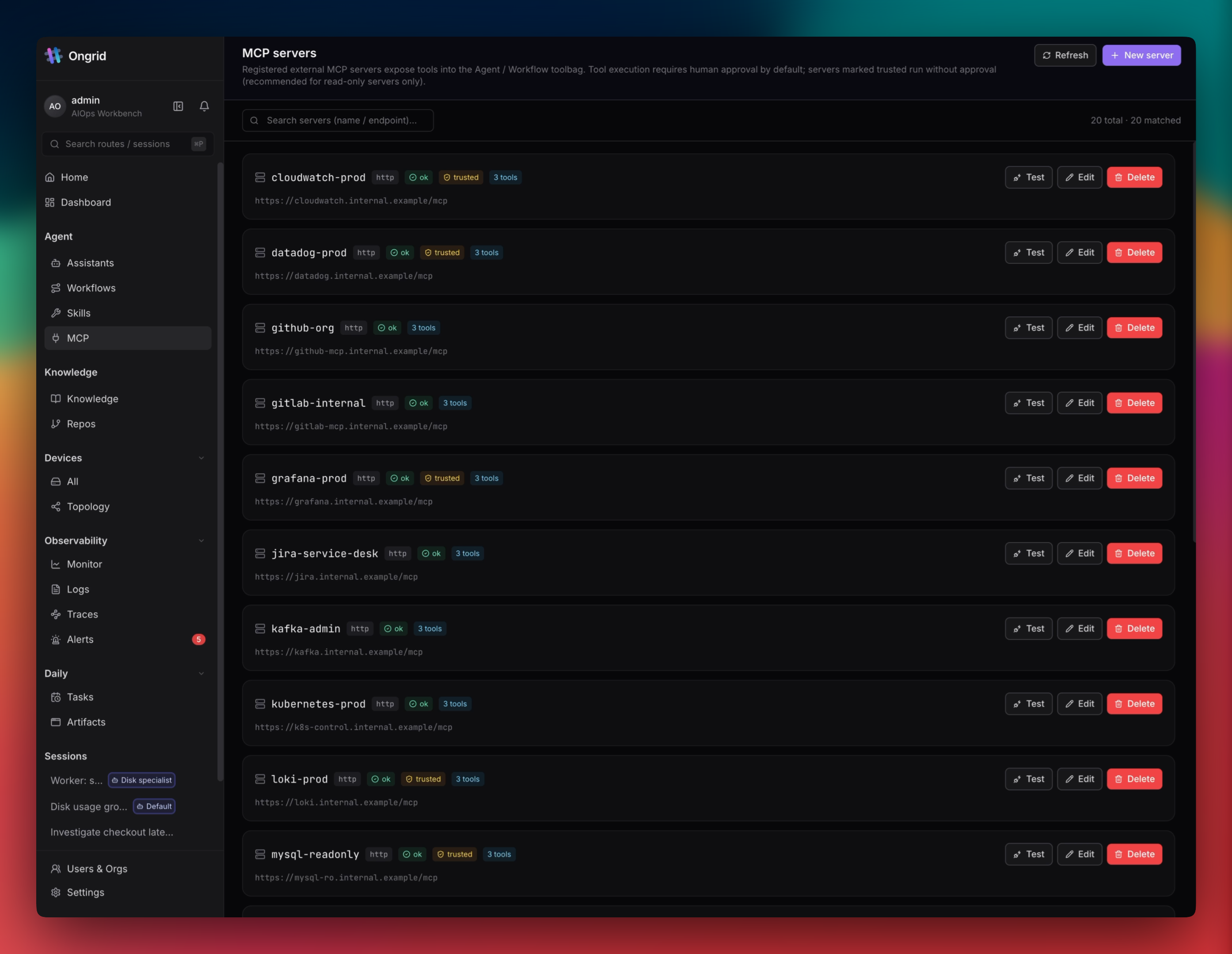
Register external MCP servers and expose their tools to chat agents and workflows with clear runtime and trust boundaries.

Knowledge Vault
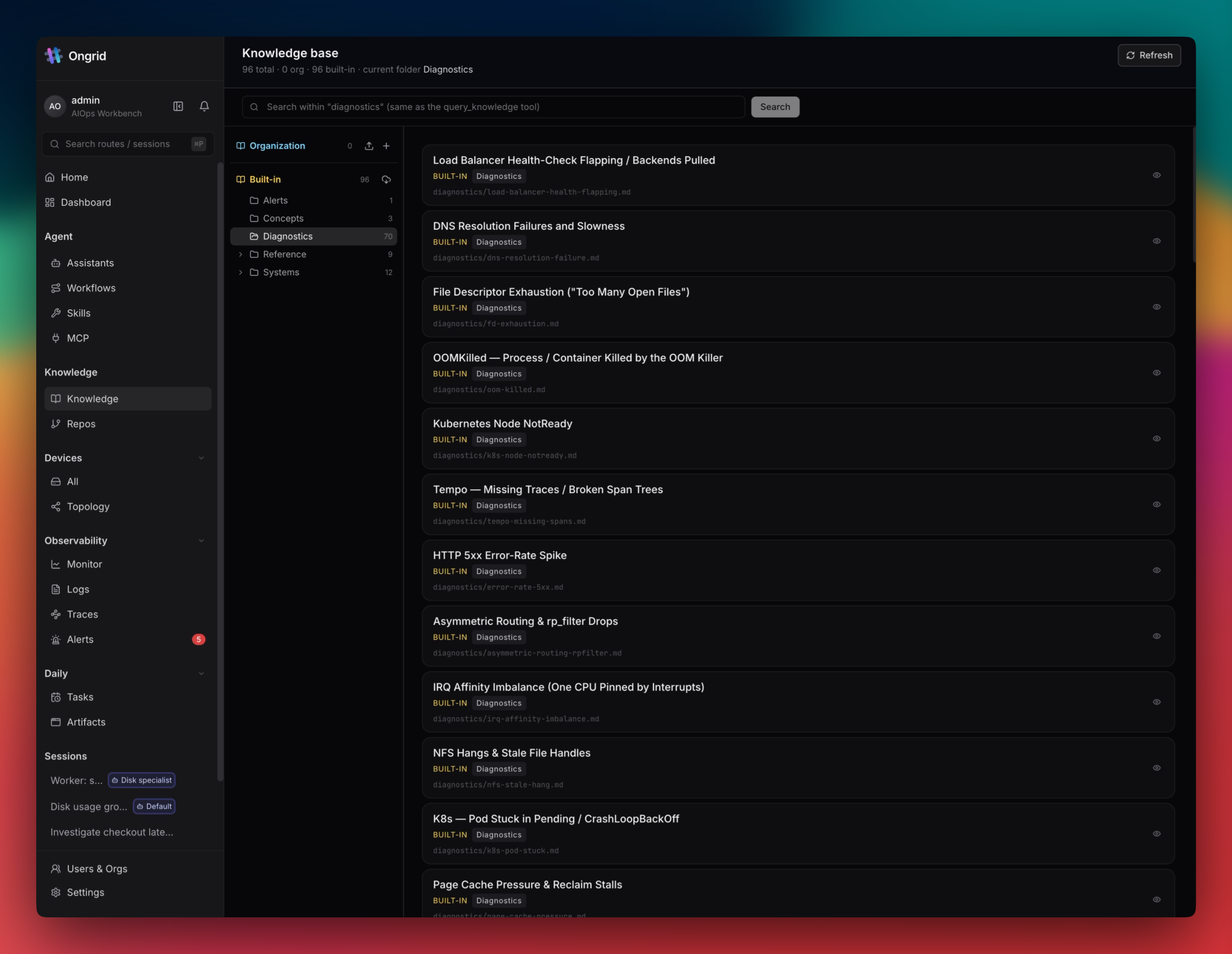
Index runbooks, notes, incident history, and repositories so both humans and agents can search the same operational context.

Artifacts Center
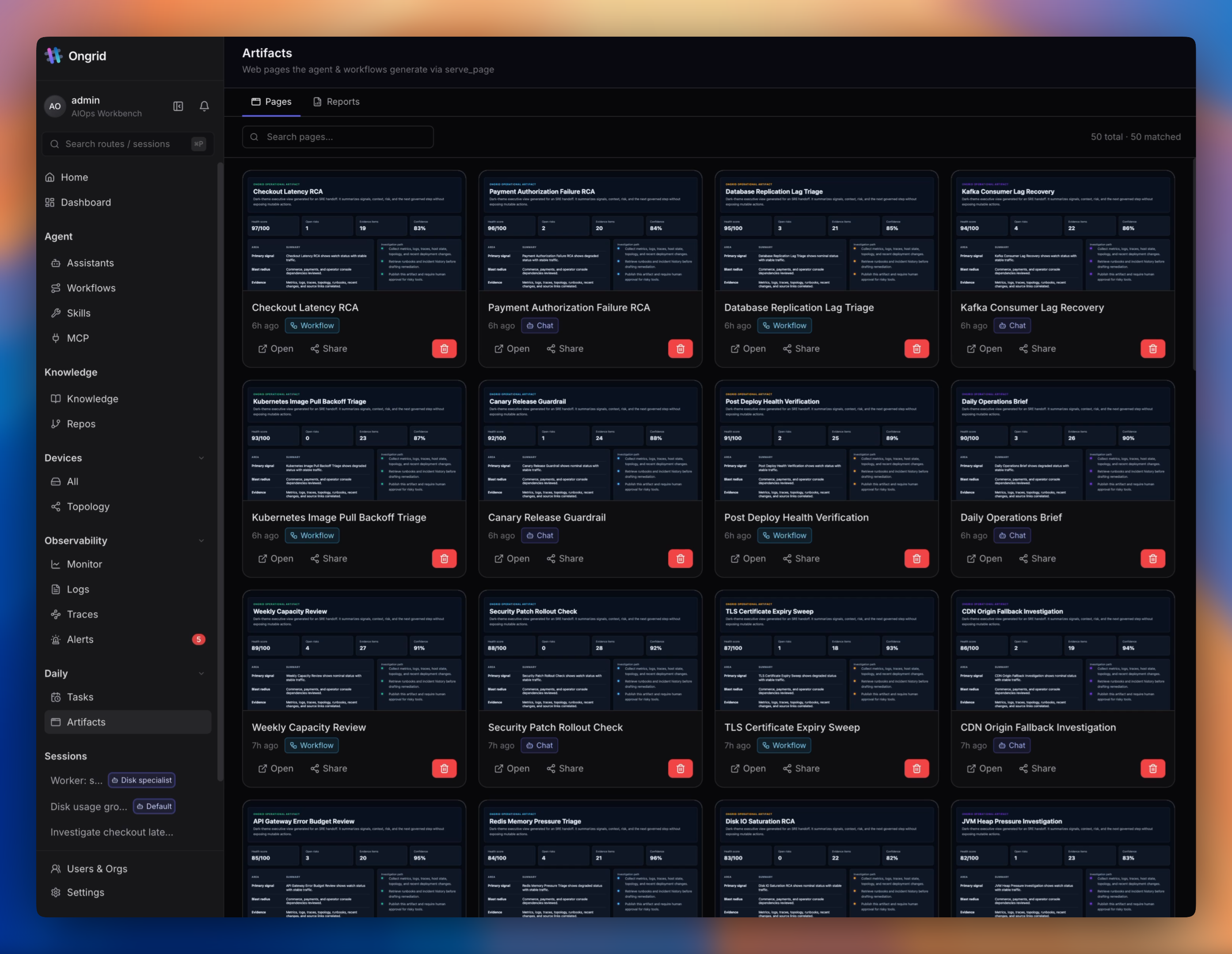
Keep generated pages and reports in one place, with private-by-default sharing and a clean handoff for review.

Monitoring
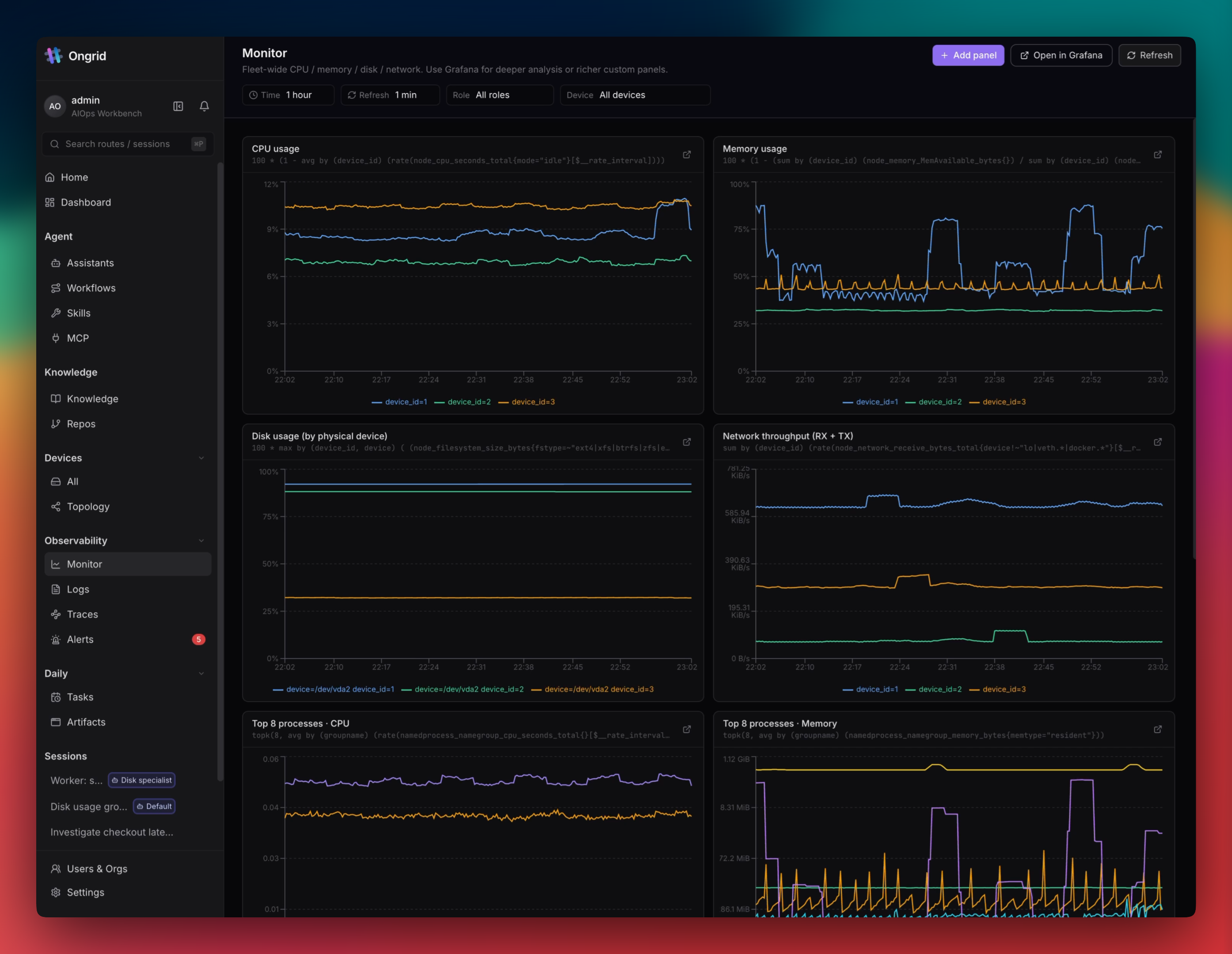
Inspect fleet health, logs, traces, and alert state from the same workspace where the agent gathers evidence.

Topology Map
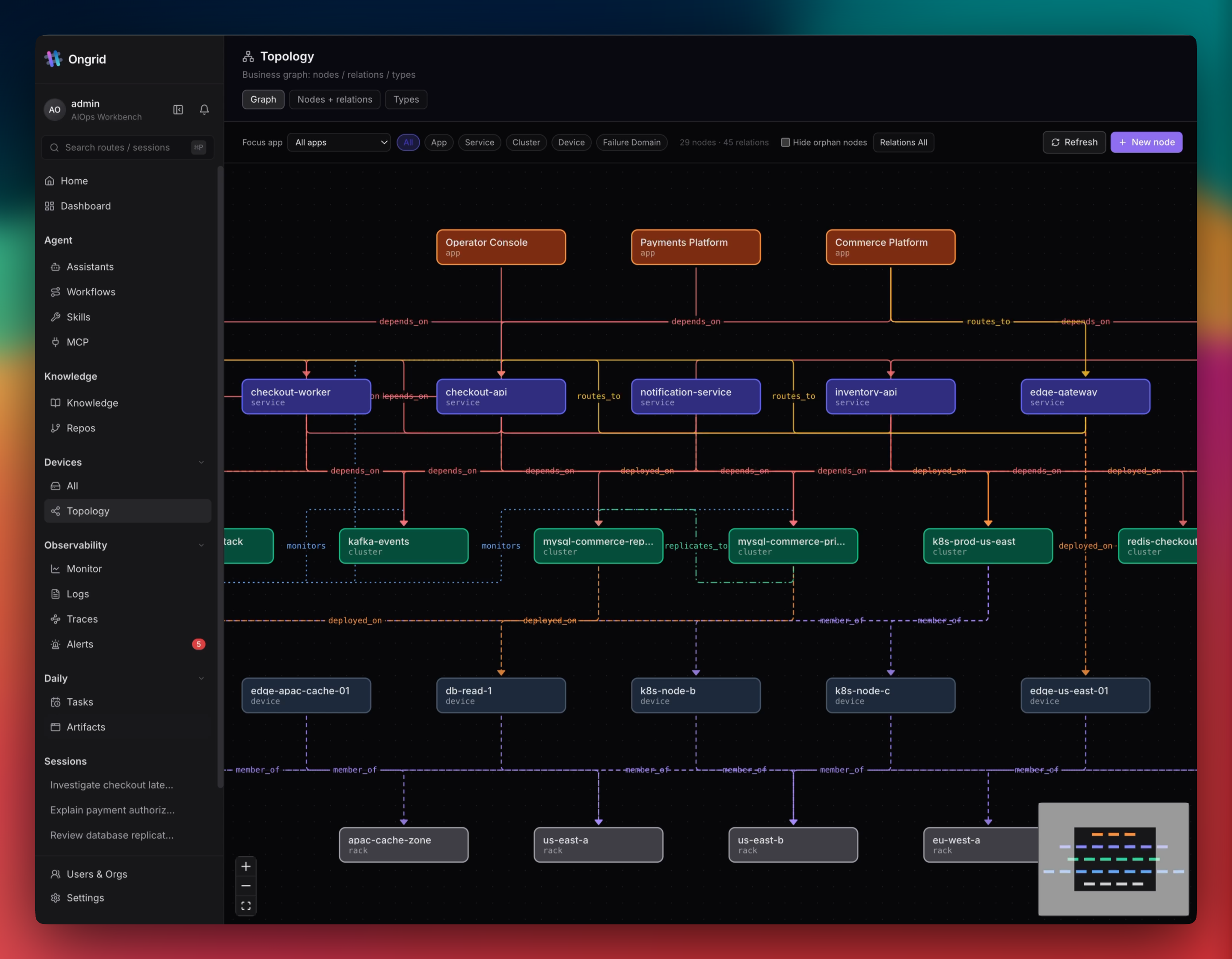
Visualize dependencies and blast radius so incidents can be traced through the affected service graph.

Approval and Write Gate
Keep risky actions behind approvals, with a visible policy boundary before anything changes production systems.

Documentation

The full product documentation is available at ongrid.cloud.

Area Start here
Get started Introduction · Quickstart · Architecture · Concepts
Install & operate Server install · Edge install · First boot · Upgrade
Capabilities Alerts · RCA · Monitoring · Logs · Traces · Knowledge · Skills
Agents Overview · Coordinator · Incident investigator · Specialists · Reviewer
Reference API · CLI · Alert rules · Skill manifest · Data plane

Integrations

Drop-in for the observability, channel, and model stacks your team already uses.

Observability Prometheus   Grafana            Qdrant
Channels Slack   Telegram         WeCom   Webhook
Models Anthropic      Gemini   DeepSeek      Kimi

License

AGPLv3 — see LICENSE.

Ongrid brand assets are not licensed under AGPLv3. See TRADEMARK.md.

Frequently asked questions

Is ongrid free to use?

ongrid is open source under the AGPL-3.0 licence. There is no licence fee and no seat count — you can self-host it or, where the project offers one, pay a vendor for a managed version instead.

What does ongrid do?

An ops AI Agent that understands your infrastructure, finds the root cause, and fixes it — right from Slack, Telegram, Lark or DingTalk.

What is ongrid written in?

ongrid is primarily written in Go. Its source is publicly available at https://github.com/ongridio/ongrid, and it has 1,246 GitHub stars.