
✨ oh-my-opencode-slim ✨
Seven divine beings emerged from the dawn of code, each an immortal master of their craft,
awaiting your command to forge order from chaos and build what was once thought impossible.
Opencode Multi Agent Suite · Mix any models · Auto delegate tasks
by Boring Dystopia Development



✦ ✦ ✦
What's This Plugin
oh-my-opencode-slim is an agent orchestration plugin for OpenCode. It includes a built-in team of specialized agents that can scout a codebase, look up fresh documentation, review architecture, handle UI work, and execute well-scoped implementation tasks under one orchestrator.
The main idea is simple: instead of forcing one model to do everything, the plugin routes each part of the job to the agent best suited for it, balancing quality, speed and cost. The Orchestrator plans the work graph, dispatches specialists as background tasks, and reconciles their results before continuing.
✨ Highlights
- Seven specialized agents - Orchestrator, Explorer, Oracle, Council, Librarian, Designer, and Fixer. Each part of the job goes to the agent best suited for it - mix any models across any providers.
- Background orchestration - the Orchestrator dispatches specialists as background tasks, tracks them, and reconciles results before continuing - parallel work by default.
- Bundled skills - prompt-based workflows like
deepwork,codemap,verification-planning, andreflect, assigned per agent. - Council - run multiple models in parallel on the same
question and synthesize a single answer with
@council. - Companion - an optional floating desktop window showing which agents are active, including parallel background specialists.
- Multiplexer integration - watch agents work live in Tmux, Zellij, Herdr, cmux, or kitty panes.
- Preset switching - swap the whole team's
models at runtime with
/preset. - Code intelligence tools - LSP tools, AST-aware search across 25 languages, and built-in MCPs for docs and GitHub code search.
- Fully customizable - custom agents, prompt overrides, per-agent skill/MCP permissions, and project-local customization.
What Users Say
“Task management went from 5/10 to 8-9/10 easily. The Orchestrator sends Fixers and Explorers, and I can still talk and plan with the Orchestrator in the same session. The experience feels way smoother now.”
-
vipor_idk
“I ditched all my harnesses for this beta version of omo-slim and don't look back or miss anything. Great work and IMHO all in the right direction.”
-
stephanschielke
“I love omo-slim, and can't imagine running opencode without it. I love that I can create a Frankenstein of models... Makes the setup such a beast.”
-
Capital-One3039
“It has significantly improved my workflow... Now, it is working very smoothly, and I love it.”
-
xenstar1
Quick Start
Copy and paste this prompt to your LLM agent (Claude Code, AmpCode, Cursor, etc.):
Install and configure oh-my-opencode-slim: https://raw.githubusercontent.com/alvinunreal/oh-my-opencode-slim/refs/heads/master/README.md
Manual Installation
bunx oh-my-opencode-slim@latest install
The published CLI is a Node-compatible bundle, so npx works too if you don't
have Bun installed:
npx oh-my-opencode-slim@latest install
Run from Master
Use this if you want the latest code, easier bug fixes, or a local setup for development and contributions:
git clone https://github.com/alvinunreal/oh-my-opencode-slim.git ~/repos/oh-my-opencode-slim
cd ~/repos/oh-my-opencode-slim
bun install
bun run build
bun dist/cli/index.js install
The installer adds the local repo path to the plugin array in
~/.config/opencode/opencode.json, so OpenCode loads the plugin from that
folder. To update later:
cd ~/repos/oh-my-opencode-slim
git pull
bun install
bun run build
Getting Started
The installer generates both OpenAI and OpenCode Go presets, with OpenAI active by default.
[!TIP] Tune the models and agents for your own workflow. The defaults are only a starting point; the plugin is designed for deep flexibility and customization.
To make OpenCode Go active during install, run bunx oh-my-opencode-slim@latest install --preset=opencode-go or change the default preset name in ~/.config/opencode/oh-my-opencode-slim.json after installation.
Then:
Log in to the providers you want to use if you haven't already:
opencode auth loginRefresh and list the models OpenCode can see:
opencode models --refreshOpen your plugin config at
~/.config/opencode/oh-my-opencode-slim.jsonUpdate the models you want for each agent
[!TIP] It's recommended to understand how background orchestration works. The Orchestrator prompt contains the scheduler rules, specialist routing logic, and thresholds for when work should be assigned to background agents. You can always delegate manually by calling a subagent via:
@agentName
[!TIP] Because background agents are now the default workflow, it is highly recommended to enable and configure Multiplexer Integration. It automatically opens each agent in a dedicated Tmux, Zellij, Herdr, cmux, or kitty pane, so you can watch specialists work live while the Orchestrator continues coordinating the session.
The default generated configuration includes both openai and opencode-go presets.
{
  "$schema": "https://unpkg.com/oh-my-opencode-slim@latest/oh-my-opencode-slim.schema.json",
  "preset": "openai",
  "presets": {
    "openai": {
      "orchestrator": { "model": "openai/gpt-5.6-terra", "variant": "high", "skills": ["*"], "mcps": ["*", "!context7"] },
      "oracle": { "model": "openai/gpt-5.6-sol", "variant": "high", "skills": ["simplify"], "mcps": [] },
      "librarian": { "model": "openai/gpt-5.6-luna", "variant": "low", "skills": [], "mcps": ["context7", "gh_grep"] },
      "explorer": { "model": "openai/gpt-5.6-luna", "variant": "low", "skills": [], "mcps": [] },
      "designer": { "model": "openai/gpt-5.6-luna", "variant": "medium", "skills": [], "mcps": [] },
      "fixer": { "model": "openai/gpt-5.6-luna", "variant": "high", "skills": [], "mcps": [] }
    }
  }
}
Preset Docs
Consider presets as guidelines as they are often outdated.
- OpenAI Preset — the default generated preset; runs all agents on OpenAI models.
- OpenCode Go Preset — runs the agents on OpenCode Go models; enables the Observer agent for visual analysis since its orchestrator model isn't multimodal.
- Author's Preset — the exact config the author runs day to day, with third-party skills.
- $30 Preset — a mixed-provider setup built around Codex Plus and GitHub Copilot Pro for about $30/month.
- OpenCode Zen Free Preset — every agent runs on an opencode free model; no usage cost.
For Alternative Providers
To use custom providers or a mixed-provider setup, use Configuration for the full reference.
✅ Verify Your Setup
After installation and authentication, verify all agents are configured and responding:
opencode
Then run:
ping all agents
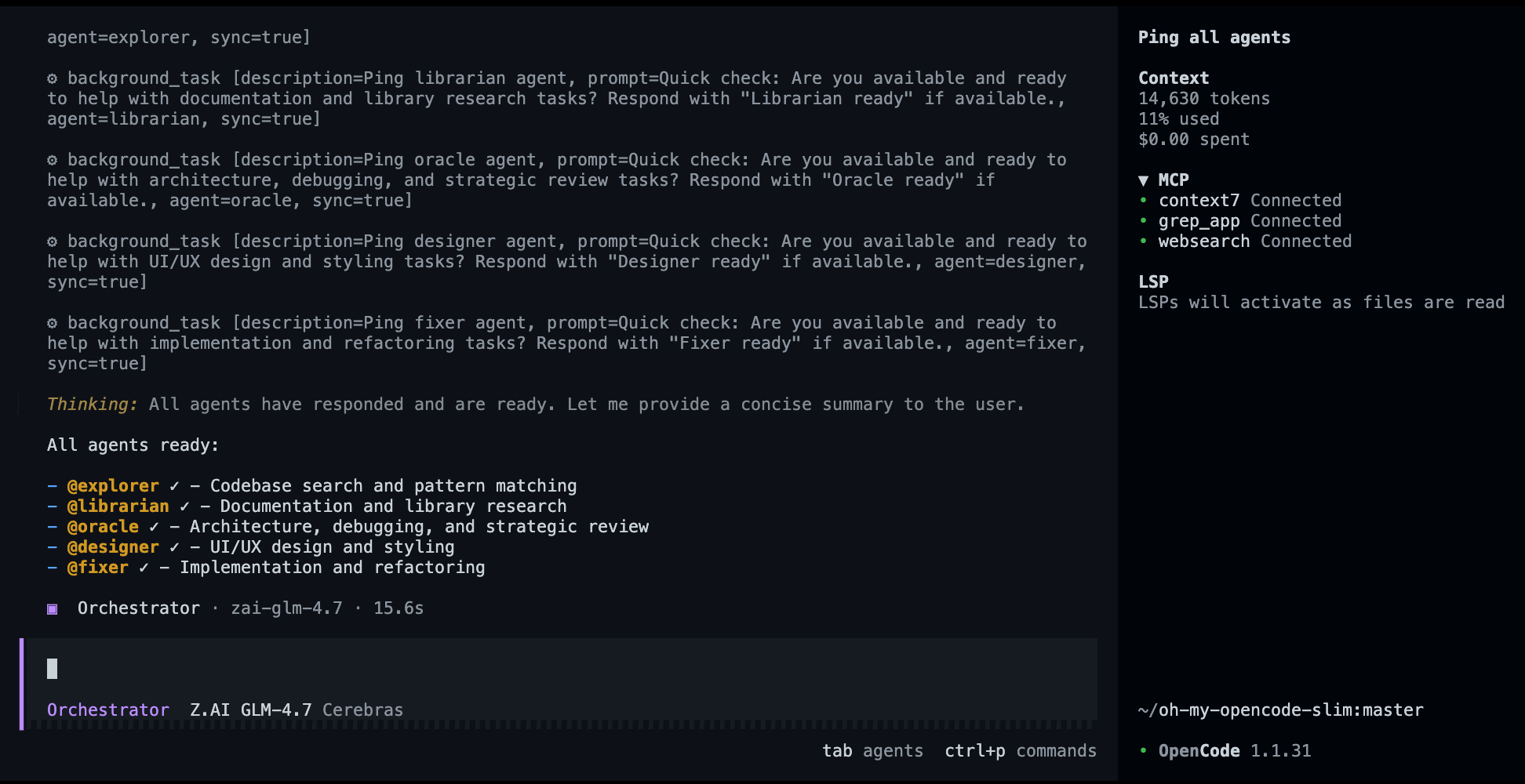
Confirmation that all conf