Odysseus is a self-hosted AI workspace written in Python and released under the AGPL-3.0-or-later licence, built for people who want chat, agents, research, documents, email, notes, tasks, and calendar in one deployment on infrastructure they control.
What it is
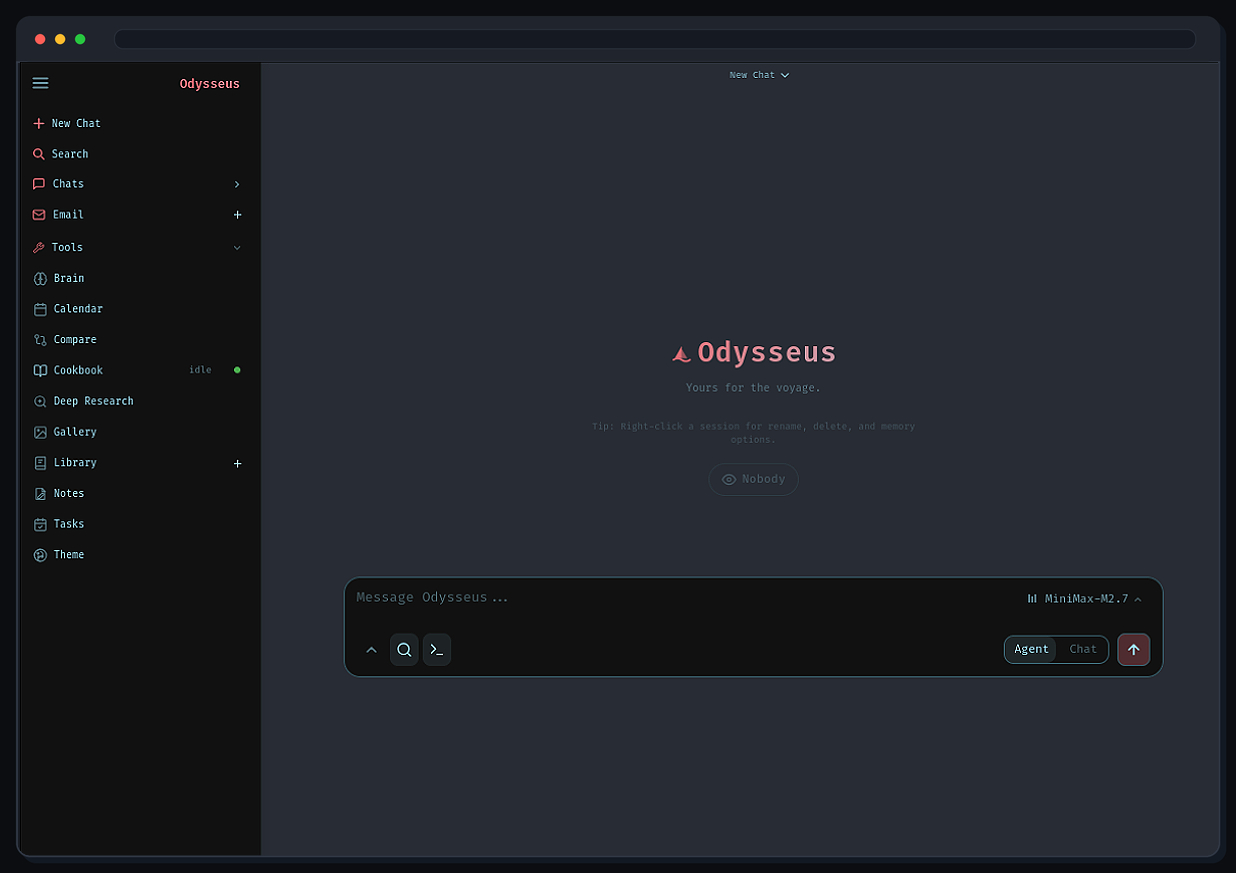
Odysseus is a self-hosted AI workspace distributed as a GitHub project. It is a Python application brought up as a Docker Compose stack that serves a single web interface on port 7000. Rather than being a single-purpose chat client, it groups chat and agent orchestration, hardware-aware model recommendations, multi-step web research, side-by-side model comparison, a writing-first document editor, an IMAP/SMTP mail client, notes, tasks, calendar, and an image gallery into one workspace behind one login. It lives in the self-hosting and local-model ecosystem: it talks to local or API-hosted models, uses MCP for tool integration, and reaches outward to standard protocols such as IMAP, SMTP, and CalDAV.
The concrete problem it solves is fragmentation. Anyone running local models usually assembles a separate chat front end, a download-and-serving script, a note application, a mail client, and a calendar, then wires credentials between them by hand. Odysseus internalises those functions so that agents can reach files, a shell, skills, memory, mail, and calendar entries inside one authenticated application. Instead of replacing one named product, it collapses a stack of separately deployed self-hosted services into a single Compose project with a shared configuration file.
Key capabilities
- Chat and Agents with local or API models, tool use, MCP connections, file access, shell access, skills, and memory.
- Cookbook for hardware-aware model recommendations, downloads, and serving.
- Deep Research for multi-step web research with source reading and report generation.
- Compare for blind, side-by-side model testing and synthesis.
- Documents, a writing-first editor with AI edits, suggestions, Markdown, HTML, CSV, and syntax highlighting.
- Email over IMAP and SMTP with triage, tags, summaries, reminders, and reply drafts.
- Notes, Tasks and Calendar with reminders, todos, scheduled agent tasks, and CalDAV sync.
Who uses it and how
- Self-hosters running local models on their own hardware, using Cookbook recommendations to match model size to available GPU capacity.
- Privacy-conscious teams that need chat, documents, and mail to stay on their own network, enabling the 2FA option and keeping
AUTH_ENABLED=true.
- Operators who already have a mail and calendar provider and want AI triage and reply drafts layered on top through IMAP, SMTP, and CalDAV.
- Contributors working on fresh-install testing, provider setup bugs, mobile and editor polish, documentation, and small focused refactors, as described in
CONTRIBUTING.md and ROADMAP.md.
- Small deployments that follow the HTTPS and security guidance in
website/setup.md before exposing the workspace beyond localhost.
Getting started
The README's quick start is to clone the repository, copy .env.example to .env, and run docker compose up -d --build, then open http://localhost:7000; the first admin password is printed in docker compose logs odysseus. Native installs, GPU notes, Windows and macOS instructions, HTTPS, and configuration details live in website/setup.md.
How it compares
This registry entry supplies no list of paid products that Odysseus replaces, and it names no directly comparable project, so it stands alone here rather than being contrasted against named alternatives. One fact worth recording on its own: the licence is AGPL-3.0-or-later, a copyleft licence, which differs in kind from a permissive licence for anyone planning closed redistribution.
When to use it — and when not to
A self-hoster must operate the full Docker Compose stack, maintain a .env configuration, supply IMAP and SMTP credentials, connect CalDAV if calendar sync is wanted, provide local GPU capacity for self-served models, and terminate HTTPS according to the setup guide; the README also warns against exposing raw model or service ports publicly and against running with LOCALHOST_BYPASS=true outside local development. Anyone unwilling to run and patch a server, or who needs a permissive licence for closed redistribution, should not pick it. The honest weakness visible in the metadata is scale of maintenance: 1,233 open issues, no declared repository topics, and a rapidly moving default dev branch that ships newest changes before the curated main branch does.
project readme (upstream, from github) — read inline

A self-hosted AI workspace for chat, agents, research, documents, email, notes, calendar, and local model workflows.
Quick Start ·
Setup Guide ·
Contributing ·
Roadmap

Quick Start
dev is the default branch and gets the newest changes first. Use main if you want the more curated branch.
git clone https://github.com/odysseus-dev/odysseus.git
cd odysseus
cp .env.example .env
docker compose up -d --build
Open http://localhost:7000 when the containers are healthy. The first admin password is printed in docker compose logs odysseus.
Native installs, GPU notes, Windows/macOS instructions, HTTPS, and configuration live in the setup guide.
Features
- Chat + Agents — local/API models, tools, MCP, files, shell, skills, and memory.
- Cookbook — hardware-aware model recommendations, downloads, and serving.
- Deep Research — multi-step web research with source reading and report generation.
- Compare — blind side-by-side model testing and synthesis.
- Documents — writing-first editor with AI edits, suggestions, Markdown, HTML, CSV, and syntax highlighting.
- Email — IMAP/SMTP inbox with triage, tags, summaries, reminders, and reply drafts.
- Notes, Tasks + Calendar — reminders, todos, scheduled agent tasks, and CalDAV sync.
- Extras — gallery/image editor, themes, uploads, web search, presets, sessions, and 2FA.
Demo
A full hover-to-play tour lives on the Odysseus landing page. Its source lives under website/.
Contributing
Help is welcome. The best entry points are fresh-install testing, provider setup bugs, mobile/editor polish, docs, and small focused refactors. See CONTRIBUTING.md and ROADMAP.md.
Security
Odysseus is a self-hosted workspace with powerful local tools. Keep auth enabled, keep private data out of Git, and do not expose raw model/service ports publicly.
- Keep
AUTH_ENABLED=true for any network-accessible deployment.
- Keep
LOCALHOST_BYPASS=false outside local development.
Deployment details are in the setup guide.
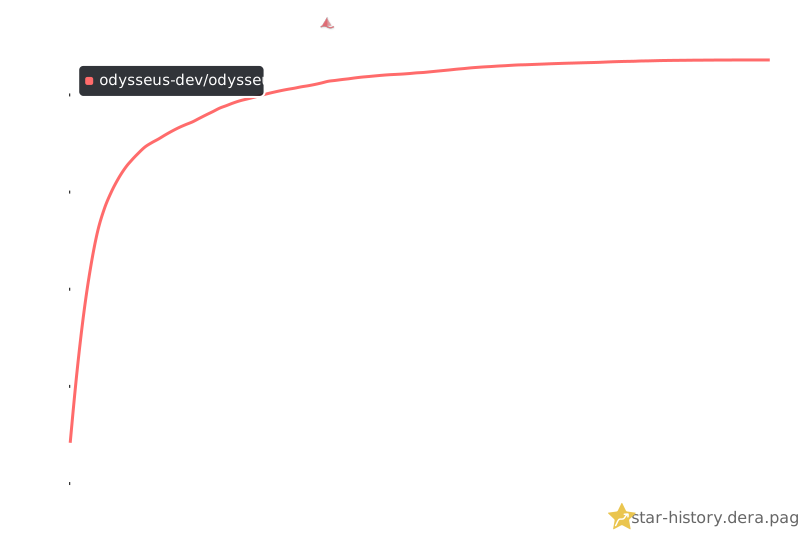
Star History
License
AGPL-3.0-or-later -- see LICENSE and ACKNOWLEDGMENTS.md.