 Obelisk
A deterministic workflow engine built on the WASM Component Model.
[!WARNING] Pre-release: Expect changes in CLI, gRPC, WIT, and database schema.
Obelisk in Action
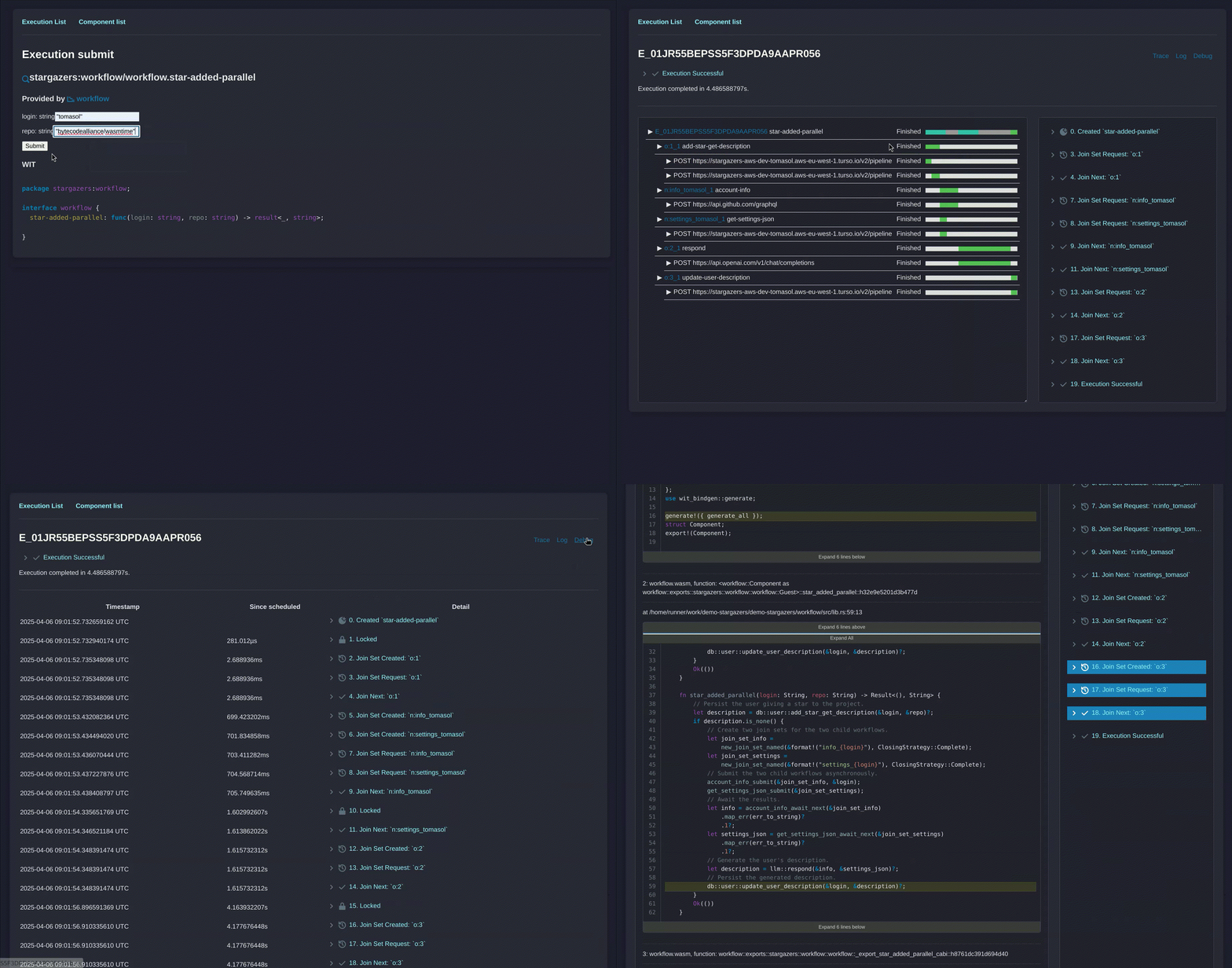
The Stargazers app features:
- A webhook listening to GitHub star events.
- Activities for interacting with Turso DB, OpenAI, and GitHub.
- A workflow orchestrating the activities.
Obelisk fly.io deployment tool features:
- A complete workflow for deploying Obelisk apps on fly.io
- Cleanup / compensating actions on failure
What's Included
- Obelisk Runtime: A single binary executing deterministic workflows, activities, and webhook endpoints, persisting steps in execution log using SQLite or PostgreSQL.
- Control Interfaces:
- CLI: Manage executions via the
obeliskcommand. - gRPC API: Programmatic interaction.
- Web UI: View and submit function executions, execution logs, WIT definitions, and a time-traveling debugger showing backtraces and sources of recorded events.
- CLI: Manage executions via the
Core Principles
- Replayable Workflows: Deterministic execution ensures reliable recovery, debugging, and auditing.
- Resilient Activities: Automatic retries on errors and timeouts, with persistent input and results.
- Schema-first design with end-to-end type safety: Uses WASM Component Model and WIT IDL for generating API bindings.
Use Cases
- Sandboxing and auditing of AI-Assisted Code
- Periodic Tasks: Automate periodic checks with complex logic using regular code.
- Background Jobs: Offload tasks with built-in error handling and retries.
- Batch jobs: Manage large-scale tasks like faas deployments.
- End-to-End Testing: Automate tests with detailed logs of each step.
Key Features
WASI Activities
- Activities must be idempotent (retriable). This contract must be fulfilled by the activity itself.
- Support for HTTP requests via WASI 0.2 HTTP client.
- Automatic retries on errors, timeouts, and panics (WASM traps).
- Persistent execution results.
Deterministic Workflows
- Runtime guaranteed determinism, fully replayable with persistent execution log and thus crash resilient.
- Automatic retries on timeouts.
- Support for spawning child executions with structured concurrency.
WASI Webhook Endpoints
- Mounted as a URL path, serving HTTP traffic.
- Support for spawning child executions.
Work Stealing Executor
- Concurrency limits and customizable retry handling.
Installation
Supported Platforms
- Linux x64, arm64 (musl, glibc v2.35+, NixOS)
- MacOS x64, arm64
Pre-built Binary
curl -L --tlsv1.2 -sSf https://raw.githubusercontent.com/obeli-sk/obelisk/main/download.sh | bash
Or use cargo-binstall:
cargo binstall obelisk
Docker
# Use host's network. Ports 8080 (web) and 5005 (grpc) will be bound to 127.0.0.1
mkdir config
docker run getobelisk/obelisk generate config > config/obelisk.toml
docker run \
  --net=host
  -v $(pwd)/config:/config \
  getobelisk/obelisk \
  server run --config /config/obelisk.toml

# Forward ports explicitly
docker run \
  -p 8080:8080 -e 'OBELISK__webui__listening_addr=0.0.0.0:8080' \
  -p 5005:5005 -e 'OBELISK__api__listening_addr=0.0.0.0:5005' \
  -v $(pwd)/config:/config \
  getobelisk/obelisk \
  server run --config /config/obelisk.toml

# Share the cache directory from host
docker run --net=host \
  -u $(id -u):$(id -g) \
  -v $(pwd)/config:/config \
  -e 'OBELISK__WASM__CACHE_DIRECTORY=/cache/obelisk/wasm' \
  -v ~/.cache/obelisk/wasm:/cache/obelisk/wasm \
  getobelisk/obelisk \
  server run --config /config/obelisk.toml
From Source
Requires protoc.
cargo install --locked obelisk
Using Nix:
nix run github:obeli-sk/obelisk/latest
For more options see Installation.
Persisted value limit
The server defaults to a 1 MiB compact JSON-encoded limit for each newly
persisted execution parameter array, result, stub result, persisted history
value, or failure diagnostic. Self-hosted operators can set a positive value in
server.toml:
[limits]
max_persisted_value_size_bytes = 1048576
Each top-level execution snapshots the effective limit. Child and scheduled
executions inherit it, so a configuration change applies only to new execution
trees and cannot change replay behavior. Existing databases require no schema
migration: executions created by older releases retain their legacy unlimited
contract. max_transport_message_size_bytes (also under [limits], defaulting to
512 MiB) is a separate, larger transport safeguard bounding a single gRPC message
or REST request body, and does not relax the persisted-value limit.
Getting Started
Check out the Getting Started Guide for details.
Start the Server
obelisk server run --deployment deployment-testing-wasm-oci.toml
Linux VM activity MVP
See deployment-testing-vm.toml for the runnable
example, setup commands, and architecture notes.
Running with Postgres
docker run -it --rm \
  --name obelisk-postgres \
  -e POSTGRES_PASSWORD=postgres \
  -p 5432:5432 \
  postgres:18

# export env vars if .envrc is not used
export POSTGRES_HOST="localhost"
export POSTGRES_USER="postgres"
export POSTGRES_PASSWORD="postgres"
export POSTGRES_DATABASE="obelisk"

obelisk server run --server-config server-postgres.toml --deployment deployment-testing-wasm-oci.toml
CLI Usage
obelisk component list
# Call fibonacci(10) activity from the workflow 500 times in series.
obelisk execution submit testing:fibo-workflow/workflow.fiboa '[10, 500]' --follow
Web UI
Visit localhost:8080 to manage components, functions and execution history.
Contributing
This project has a roadmap and features are added in a certain order. Discuss features via GitHub Discussions before contributing. A Contributor License Agreement is required.
Development
Set up dependencies via Nix:
cp .envrc-example .envrc
$EDITOR .envrc
direnv allow
# If direnv is not available use `nix develop`
Or manually install dependencies (see dev-deps.txt).
Run the program:
cargo run --release
See DEVELOPMENT.md for repository structure, build instructions, testing, code patterns, and contribution conventions.
Running Tests
Postgres must be running. See .envrc-example for how to set up the environment variables.
Quick start:
cp .envrc-example .envrc && $EDITOR .envrc && direnv allow
cargo run --release
./scripts/test.sh
Project Licensing Information
This project (all files and folders except as noted below) is licensed under the GNU Affero General Public License version 3.
Subfolder Exceptions
The following subfolders are licensed under the MIT License:
wit/– see LICENSE-MITproto/– see LICENSE-MIT
Generated WIT Files
The runtime includes functionality that may generate new "extension" WIT files. These generated files are typically based on a combination of user-provided WIT files and the base WIT definitions found in the MIT-licensed wit/ directory.
Users are free to use, modify, and distribute these generated WIT files under the terms of the MIT License, for example, to allow other WASM components to interact via these extended interfaces.