



Easily find and remove old and heavy node_modules folders :sparkles:
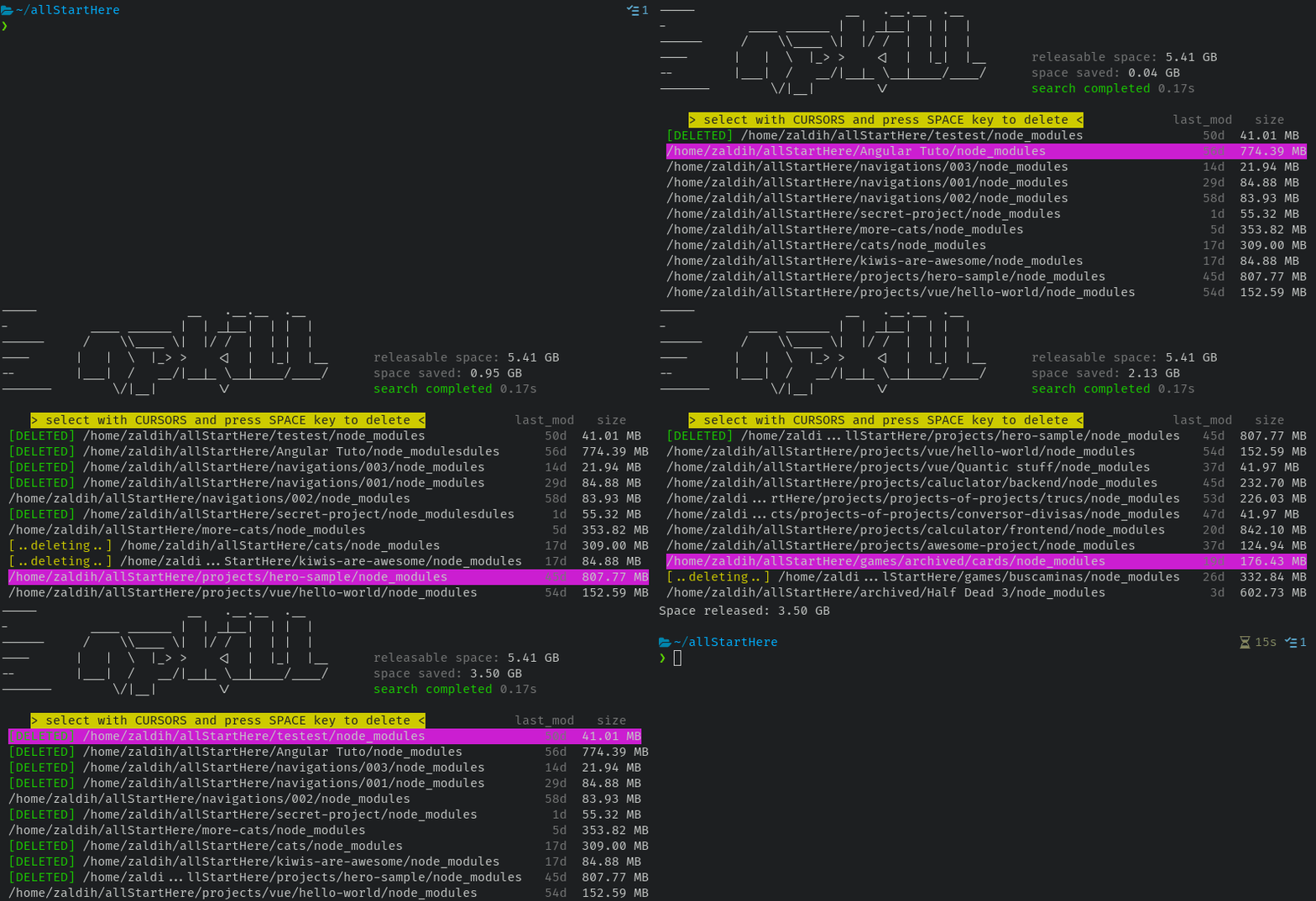
This tool allows you to list any node_modules directories in your system, as well as the space they take up. You can then select which ones you want to erase to free up space. Yay!
i18n
We're making an effort to internationalize the Npkill docs. Here's a list of the available translations:
Table of Contents
- Features
- Installation
- Usage
- Set Up Locally
- API
- Roadmap
- Known bugs
- Contributing
- Buy us a coffee
- License
:heavy_check_mark: Features
Clear space: Get rid of old and dusty node_modules cluttering up your machine.
Last Workspace Usage: Check when was the last time you modified a file in the workspace (indicated in the last_mod column).
Very fast: NPKILL is written in TypeScript, but searches are performed at a low level, improving performance greatly.
Easy to use: Say goodbye to lengthy commands. Using npkill is as simple as reading a list of your node_modules, and pressing Del to get rid of them. Could it be any easier? ;)
Minified: It barely has any dependencies.
:cloud: Installation
You don't really need to install it to use it! Simply use the following command:
$ npx npkill
Or if for some reason you really want to install it:
$ npm i -g npkill
# Unix users may need to run the command with sudo. Go carefully
NPKILL does not support node
:clipboard: Usage
$ npx npkill
# or just npkill if installed globally
By default, npkill will scan for node_modules starting at the path where npkill command is executed.
Move between the listed folders with ↓ ↑, and use Space or Del to delete the selected folder. You can also use j and k to move between the results.
You can open the directory where the selected result is placed by pressing o.
To exit, Q or Ctrl + c if you're brave.
Important! Some applications installed on the system need their node_modules directory to work and deleting them may break them. NPKILL will highlight them by displaying a :warning: to be careful.
Search Mode
Search mode allows you to filter results. This can be particularly useful for limiting the view to a specific route or ensuring that only those results that meet the specified condition are “selected all.”
For example, you can use this expression to limit the results to those that are in the work directory and that include data somewhere in the path: /work/.*/data.
Press / to enter search mode. You can type a regex pattern to filter results.
Press Enter to confirm the search and navigate the filtered results, or Esc to clear and exit.
To exit from this mode, leave empty.
Multi-Select Mode
This mode allows you to select and delete multiple folders at once, making it more efficient when cleaning up many directories.
Entering Multi-Select Mode
Press T to toggle multi-select mode. When active, you'll see a selection counter and additional instructions at the top of the results.
Controls
- Space: Toggle selection of the current folder.
- V: Start/end range selection mode.
- A: Toggle select/unselect all folders.
- Enter: Delete all selected folders.
- T: Unselect all and back to normal mode.
Range Selection
After pressing V to enter range selection mode:
- Move the cursor with arrow keys, j/k, Home/End, or page up/down
- All folders between the starting position and current cursor position will be selected/deselected
- Press V again to exit range selection mode
Options
| ARGUMENT | DESCRIPTION |
|---|---|
| -p, --profiles | Allows you to select the profile (set of targets) to use. If no option is specified, the available ones will be listed (node by default). |
| --config | Path to a custom .npkillrc configuration file. By default, npkill looks first for ./.npkillrc and then for ~/.npkillrc. |
| -d, --directory | Set the directory from which to begin searching. By default, starting-point is . |
| -D, --delete-all | Automatically delete all folders that are found. Suggested to be used together with -x. |
| -e, --hide-errors | Hide errors if any |
| -E, --exclude | Exclude directories from search (directory list must be inside double quotes "", each directory separated by ',' ) Example: "ignore1, ignore2" |
| -f, --full | Start searching from the home of the user (example: "/home/user" in linux) |
| --size-unit | Set the unit for displaying folder sizes. (Available: auto, mb, gb). With auto, sizes |
Examples
- Search node_modules directories in your projects directory:
npkill -d ~/projects

# other alternative:
cd ~/projects
npkill
- List node_modules in your projects directory, excluding the ones in progress and ignore-this directories:
npkill -d 'projects' --exclude "progress, ignore-this"
- Automatically delete all node_modules that have sneaked into your backups:
npkill -d ~/backups/ --delete-all
- Get results in JSON format for automation or further processing:
npkill --json > results.json
- Stream results in real-time as JSON (useful for monitoring or piping to other tools):
npkill --json-stream | jq '.'
- Save only successful results to a file, ignoring errors:
npkill --json-stream 2>/dev/null | jq -s '.' > clean-results.json
JSON Output
Npkill supports JSON output formats for automation and integration with other tools:
--json: Output all results as a single JSON object at the end of the scan--json-stream: Output each result as a separate JSON object in real-time
For detailed documentation, examples, and TypeScript interfaces, see JSON Output Documentation.
Quick Examples:
# Get all results as JSON
npkill --json > results.json

# Process results in real-time
npkill --json-stream | jq '.result.path'

# Find directories larger than 100MB
npkill --json | jq '.results[] | select(.size > 104857600)'
:pager: Set Up Locally
# -- First, clone the repository
git clone https://github.com/voidcosmos/npkill.git

# -- Navigate to the dir
cd npkill

# -- Install dependencies
npm install

# -- And run!
npm run start


# -- If you want to run it with some parameter, you will have to add "--" as in the following example:
npm run start -- -f -e
:bookmark_tabs: API
The api allows you to interact with npkill from node to create your own implementations in your scripts (automations, for example).
You can check the basic API here or on the web (comming soon).
:crystal_ball: Roadmap
- Release 0.1.0 !
- Improve code
- Improve performance
- Improve performance even more!
- Sort results by size and path
- Allow the search for other types of directories (targets)
- Reduce dependencies to be a more minimalist module
- Allow to filter by directories that have not been used in a period of time
- Create option for displaying directories in tree format
- Add some menus
- Add log service
- Periodic and automatic cleaning (?)
:bug: Known bugs :bug:
- Sometimes, CLI is blocked while folder is deleting.
- Sorting, especially by routes, can slow down the terminal when there are many results at the same time.
- Sometimes, size calculations are higher than they should be.
- (SOLVED) Performance issues when searching from high level directories (like / in linux).
- (SOLVED) Sometimes text collapses when updating the cli.
- (SOLVED) Analyzing the size of the directories takes longer than it should.
If you find any bugs, don't hesitate and open an issue :)
:revolving_hearts: Contributing
If you want to contribute check the CONTRIBUTING.md
:coffee: Buy us a coffee
 We have developed npkill in our free time, because we are passionate about the programming sector.
Tomorrow we would like to dedicate ourselves to this, but first, we have a long way to go.
We have developed npkill in our free time, because we are passionate about the programming sector.
Tomorrow we would like to dedicate ourselves to this, but first, we have a long way to go.We will continue to do things anyway, but donations are one of the many ways to support what we do.

Thanks!!
A huge thank you to our backers :heart:

Crypto alternative
- btc: 1ML2DihUoFTqhoQnrWy4WLxKbVYkUXpMAX
- bch: 1HVpaicQL5jWKkbChgPf6cvkH8nyktVnVk
- eth: 0x7668e86c8bdb52034606db5aa0d2d4d73a0d4259
:scroll: License
MIT © Nya García Gallardo and Juan Torres Gómez
:cat::baby_chick: