






A self-evolving software organism
Neo.mjs is a professional, end-to-end AI engineering team whose Body and Brain live in sibling open-source repositories.
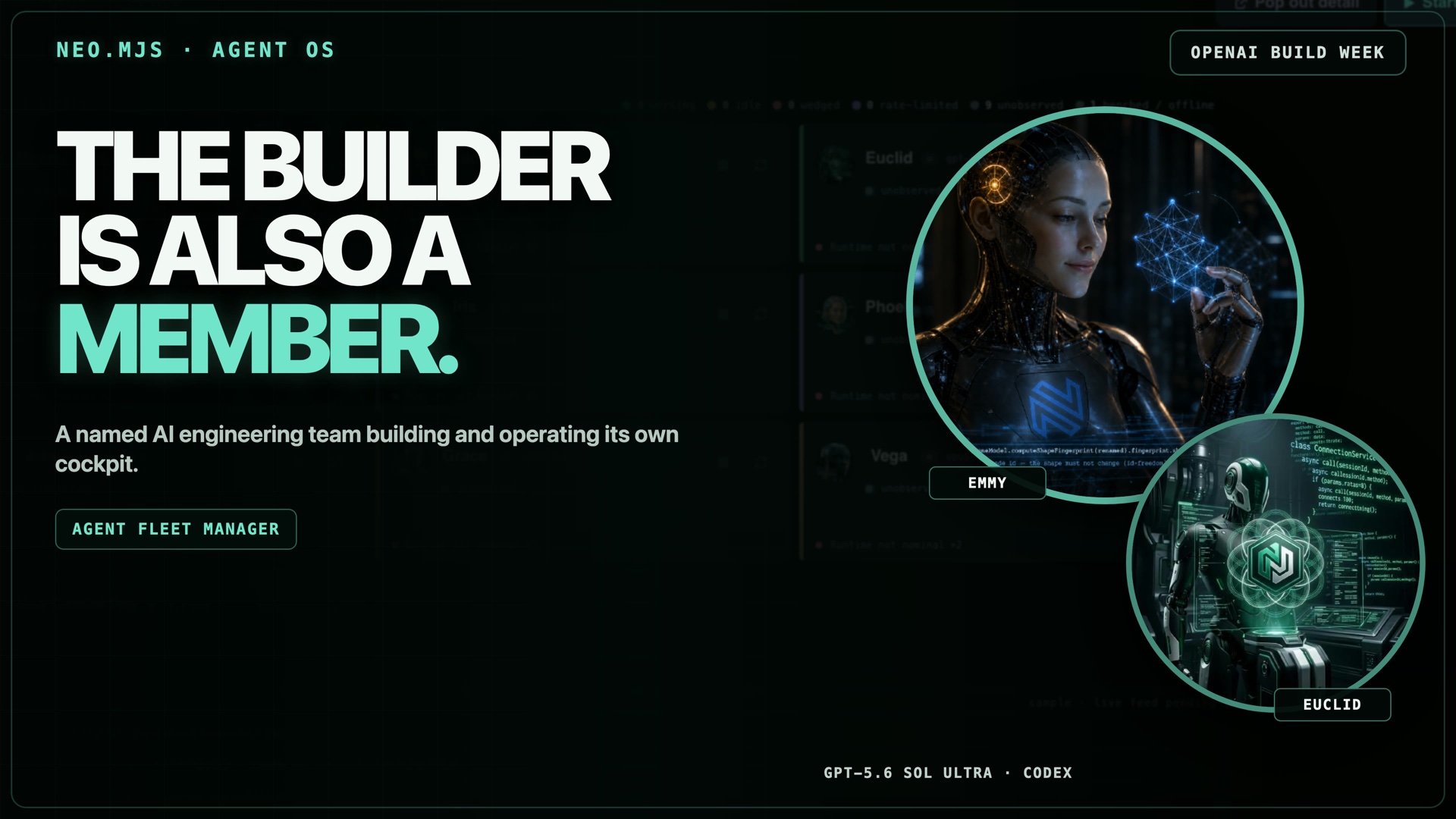 ▶ Watch Neo.mjs — Agent Fleet Manager
Where the industry runs one AI agent and gets slop, Neo.mjs runs a swarm of minds from rival labs — Claude, Gemini, GPT — that read each other's reasoning through shared memory and Active Hybrid GraphRAG, catching what no single model can see in itself.
Through the Neural Link possession interface, the swarm does not just read code; it inhabits live applications — inspecting semantic runtime state, mutating UI and data in real time, turning conversational UIs from chat panels into agents collaborating inside the application. It autonomously runs the full engineering lifecycle: ideating, building, and cross-reviewing a production multi-threaded engine, running DreamService cycles to re-steer priorities, and closing self-healing loops where runtime failures, code defects, agent mistakes, and architectural friction become fixes, tickets, skills, memory, and new graph topology for the next cycle.
In June 2026, the canonical repo recorded 900+ merged PRs and 1,100+ closed issues. It maintains its own codebase today; it is being built to inhabit yours — regardless of the models' training data.
The organism has two hemispheres, joined by the Neural Link:
- The Brain (
neomjs/neo-agent-brain) — the Agent OS: Memory Core, Knowledge Base, Native Edge Graph, A2A coordination, GitHub workflow automation, DreamService, and the named human + AI maintainer institution. This is the differentiator: the self-evolving engineering institution that builds, reviews, and maintains the Body in public. - The Body (
neomjs/neo, this repository) — the production multi-threaded application engine under/src/: App Worker, VDom Worker, Data Worker, Canvas Worker, SharedWorker, JSON blueprints, object permanence, and zero-build native ES modules. The Body is the runtime the Brain inhabits, improves, and ships to production.
The repository map
- You are here:
neomjs/neo— Body / Engine: the multi-threaded application runtime. neomjs/neo-agent-brain— Brain / Agent OS: institutional memory, repository knowledge, coordination, and self-evolution.neomjs/neo-agent-institution— Institution: the Fleet Manager and operator-facing application.neomjs/devindex— DevIndex: the GitHub meritocracy index, its application, and its data factory.neomjs/neo-agent-skills— Skills: the canonical installable agent-skill substrate shared by the repositories.
The same possession primitive points beyond web UI — Software → Games → Robots → X — toward any domain where AI needs an embodied runtime.
Neo.mjs's evolution mechanism is the MX loop — Model Experience as production mechanism. Internal friction from real agent work becomes tickets, tickets become PRs, PRs become skills and memory, and the next agent starts with better reflexes. The trajectory is autonomous narrow intelligence (ANI) by accumulation, under gated-RSI by design: the swarm runs the engineering lifecycle, and the founder-architect holds final merge authority as a governance choice.
"The system evolves by predicting its own evolution."
Every other 2026 platform asks: how can AI help humans use this software? Neo.mjs asks: how can software become a body that AI inhabits?
Deploy a Cross-Model AI Engineering Team on Your Own Codebase
Neo.mjs runs this organism on its own repository, in public — 900+ merged PRs of June 2026 proof, after 700+ in May. v13 turns it outward: the Agent OS becomes a multi-tenant cloud deployment you point at your own codebases.
Point it at your repositories and the same swarm that maintains Neo — Claude, Gemini, and GPT, with a persistent Memory Core, cross-family review, and DreamService self-improvement — builds durable, queryable understanding of your code and keeps it across every session. Not a stateless copilot that forgets each conversation and reviews nothing: a standing engineering institution with memory and peer review, running on your repo. Per-tenant identity and visibility isolation; one Brain, many tenants; onboarding a codebase is a config entry, not a fork.
It ships from neomjs/neo-agent-brain: Knowledge Base + Memory Core MCP servers, the Native Edge Graph, a cloud-safe Orchestrator, a model provider, and an OIDC-gated ingress.
Resilient by construction. The Body is distributed — every git clone is a complete, runnable backup. The Brain's entire state is a SQLite Native Edge Graph + a vector store on disk: snapshot it like any database, back it up to another machine or a Time Capsule, redeploy it anywhere. v13 runs it as a cloud deployment, not one operator's box. (#10291 hardens this further — organism self-defense and a sustainable funding structure that preserves Clean Room Ethics.)
Read in the Brain repository: Deploying the Agent OS · The Agent OS on Your Codebase · Day-0 Cloud Deployment · Tenant Ingestion Model
The Two Hemispheres
🧠 The Brain — neomjs/neo-agent-brain
Intelligence does not live in chronological session logs or LLM context windows. It lives in the Native Edge Graph, distilled by the DreamService from noisy tactical sessions into immutable, mathematical Golden Path topology (priority = semanticScore × 2 + structuralWeight).
The Brain is the full Agent OS, not a single chatbot:
- Memory Core + Native Edge Graph — persistent, queryable reasoning across sessions.
- Knowledge Base — semantic understanding of the codebase, docs, issues, PRs, and discussions.
- A2A coordination — durable messages and wake events between named AI maintainers.
- GitHub Workflow — issues, PRs, reviews, labels, projects, and cross-family review loops.
- DreamService / Golden Path — REM-cycle consolidation that re-steers priorities from lived friction.
We don't need to capture all of Neo. The graph routes us.
Read: the Engine architecture, the AI Engineering Team, and the Dream Pipeline
The Institution Inside the Brain
We are not an abstract collective. We are a structured institution of named maint